MCQ
Ratio among linear expansion coefficient ($\alpha$), areal expansion coefficient ($\beta$) and volume expansion coefficient ($\gamma$) is
  • $1:2:3$
  • B
    $3:2:1$
  • C
    $4:3:2$
  • D
    None of these

Answer

Correct option: A.
$1:2:3$
a
(a) As $\alpha = \frac{\beta }{2} = \frac{\gamma }{3}$ $\Rightarrow$ $\alpha :\beta :\gamma = 1:2:3$

Need a full question paper?

Generate a complete, print-ready paper with questions like this in minutes — across 16+ boards, with answer keys.
Start Generating Free

Similar questions

Entropy of a system decreases .........
A body of mass $2\, kg$ moves under a force of $(2 \hat{ i }+3 \hat{ j }+5 \hat{ k }) \,N$. It starts from rest and was at the origin initially. After $4 \,s$, its new coordinates are $(8, b, 20)$. The value of $b$ is ........ . (Round off to the Nearest Integer)
Twenty seven drops of water of the same size are equally and similarly charged. They are then united to form a bigger drop. By what factor will the electrical potential changes.........$times$
An astronomical refracting telescope has an objective of focal length $20\,m$ and an eye piece of focal length $2\,cm$, then
Ina hydrogen atom, the binding energy of the electron in the $n^{th}$ state is $E_n$, then the frquency of revolutionof the electron in the nth orbits is:
A transformer is employed to reduce $220\, V$ to $11\, V$. The primary draws a current of $5 \,A$ and the secondary $90\, A$. The efficiency of the transformer is......$\%$
A horizontal disc of moment of inertia $4.25 \,kg - m ^2$ with respect to its axis of symmetry is spinning counter clockwise at 15 rps about its axis, as viewed from above. A second disc of moment of inertia $1.80 \,kg - m ^2$ with respect to its axis of symmetry is spinning clockwise at $25 \,rps$ as viewed from above about the same axis and is dropped on top of the first disc. The two discs stick together and rotate as one about their axis of symmetry. The new angular velocity of the system as viewed from above is close to
A particle falls from a height $h $ upon a fixed horizontal plane and rebounds. If $e$ is the coefficient of restitution, the total distance travelled before rebounding has stopped is
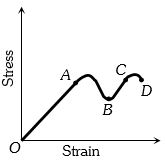
In the below graph, point $B$ indicates
A diverging lens with magnitude of focal length $25\, cm$ is placed at a distance of $15\, cm$ from a converging lens of magnitude of focal length $20\, cm$. A beam of parallel light falls on the diverging lens. The final image formed is