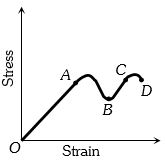
In the below graph, point $B$ indicates
Easy


Download our appand get started for free
Experience the future of education. Simply download our apps or reach out to us for more information. Let's shape the future of learning together!No signup needed.*
Similar Questions
- 1View SolutionWhen shearing force is applied on a body, then the elastic potential energy is stored in it. On removing the force, this energy
- 2The work per unit volume to stretch the length by $1\%$ of a wire with cross sectional area of $1\,m{m^2}$ will be. $[Y = 9 \times {10^{11}}\,N/{m^2}]$View Solution
- 3A stone of mass $20\, {g}$ is projected from a rubber catapult of length $0.1\, {m}$ and area of cross section $10^{-6} \,{m}^{2}$ stretched by an amount $0.04\, {m}$. The velocity of the projected stone is $....\,m\,/s.$ (Young's modulus of rubber $=0.5 \times 10^{9}\, {N} / {m}^{2}$ )View Solution
- 4When a weight of $10\, kg$ is suspended from a copper wire of length $3$ metres and diameter $0.4\, mm,$ its length increases by $2.4\, cm$. If the diameter of the wire is doubled, then the extension in its length will be ........ $cm$View Solution
- 5A square aluminium (shear modulus is $25 \times 10^{9}\,Nm ^{-2}$ ) slab of side $60\,cm$ and thickness $15\,cm$ is subjected to a shearing force (on its narrow face) of $18.0 \times 10^{4}\,N$. The lower edge is riveted to the floor. The displacement of the upper edge is $.......\mu\,m$.View Solution
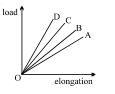
- 6View SolutionThe load versus strain graph for four wires of the same material is shown in the figure. The thickest wire is represented by the line
- 7The bulk moduli of ethanol, mercury and water are given as $0.9, 25$ and $2 .2$ respectively in units of $10^9\, Nm^{-2}$ . For a given value of pressure, the fractional compression in volume is $\frac{{\Delta V}}{V}$. Which of the following statements about $\frac{{\Delta V}}{V}$ for these three liquids is correct ?View Solution
- 8A meter scale of mass $m$ , Young modulus $Y$ and cross section area $A$ is hanged vertically from ceiling at zero mark. Then separation between $30\ cm$ and $70\ cm$ mark will be :-( $\frac{{mg}}{{AY}}$ is dimensionless)View Solution
- 9A cube of aluminium of sides $0.1\, m$ is subjected to a shearing force of $100\, N$. The top face of the cube is displaced through $0.02 \,cm$ with respect to the bottom face. The shearing strain would beView Solution
- 10When a certain weight is suspended from a long uniform wire, its length increases by one $cm$. If the same weight is suspended from another wire of the same material and length but having a diameter half of the first one, the increase in length will be ......... $cm$View Solution