MCQ
Ratio of the amount of heat radiation, transmitted through the body to the amount of heat radiation incident on it, is known as
  • A
    absortance
  • B
    inductance
  • C
    transmittance
  • D
    conductance

Need a full question paper?

Generate a complete, print-ready paper with questions like this in minutes — across 16+ boards, with answer keys.
Start Generating Free

Similar questions

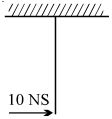
$A$ thin uniform straight rod of mass $2\, kg$ and length $1\, m$ is free to rotate about its upper end when at rest. It receives an impulsive blow of $10\, Ns$ at its lowest point, normal to its length as shown in figure. The kinetic energy of rod just after impact is ........ $J$
The bulk modulus of rubber is $9.1 \times 10^8\,N/m^2$. To what depth a rubber ball be taken in a lake so that its volume is decreased by $0.1\%$ ? ....... $m$
Choose the correct length $( L )$ versus square of time period $\left( T ^2\right)$ graph for a simple pendulum executing simple harmonic motion.
If $g$ is the acceleration due to gravity on the earth's surface, the gain in the potential energy of an object of mass $m$ raised from the surface of earth to a height equal to the radius $R$ of the earth is:
Two vectors $\overrightarrow a $ and $\overrightarrow b $ are at an angle of $60^o$ with  each other. Their resultant makes an angle of $45^o$ with $\overrightarrow a $ . If $|\overrightarrow b | = 2\,units$ then $|\overrightarrow a |$ is:-
An electromagnetic wave going through vacuum is described by $\text{E}=\text{E}_0\sin(\text{kx}-\omega\text{t}),\text{ B}=\text{B}_0\sin(\text{kx}-\omega\text{t})$ Then:
The ratio of the radii of gyration of a circular disc to that of a circular ring, each of same mass and radius, around their respective axes is
If the resultant of the two forces has a magnitude smaller than the magnitude of larger force, the two forces must be
If the kinetic energy of a body is directly proportional to time $t,$ the magnitude of force acting on the body is

$(i)$ directly proportional to $\sqrt t$
$(ii)$  inversely proportional to  $\sqrt t$
$(iii)$ directly proportional to the speed of the body
$(iv)$ inversely proportional to the speed of body

A perfect gas of a given mass is heated first in a small vessel and then in a large vessel, such that their volumes remain unchanged. The $P-T$ curves are