Question
Read each statement below carefully and state. with reasons, if it is true or false :
(a) The net acceleration of a particle in circular motion is always along the radius of the circle towards the centre.
(b) The velocity vector of a particle at a point is always along the tangent to the path of the particle at that point.
(c) The acceleration vector of a particle in uniform circular motion averaged over one cycle is a null vector.
Answer

(a) False, because only in uniform circular motion (constant speed) the acceleration occurs along the radius and towards the center (centripetal acceleration).
(b) True, the velocity vector is always tangent to the path of motion.
(c) True, because in this case displacement is zero.

Need a full question paper?

Generate a complete, print-ready paper with questions like this in minutes — across 16+ boards, with answer keys.

Start Generating Free

Similar questions

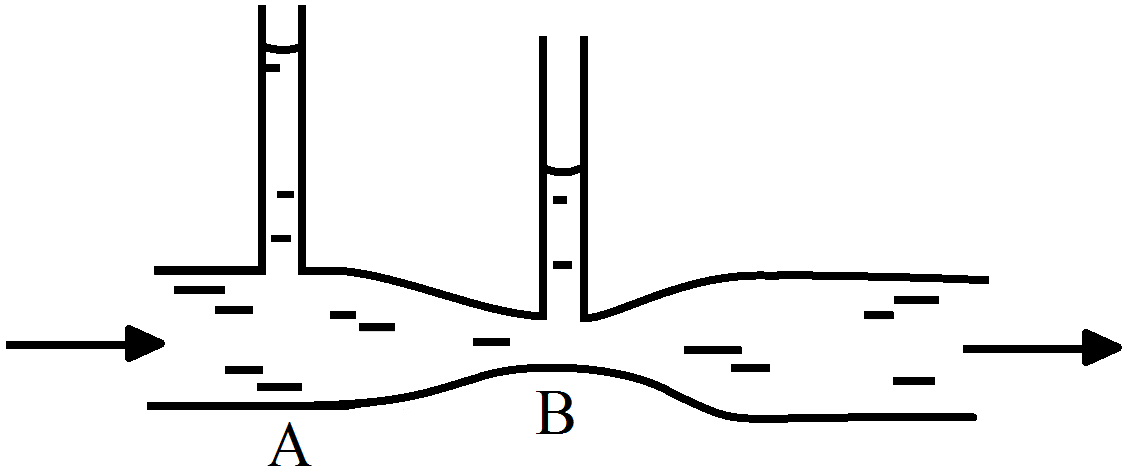
Water flows through a horizontal tube as shown in  If the difference of heights of water column in the vertical tubes is 2cm, and the areas of cross-section at A and B are 4cm2 and 2cm2 respectively, find the rate of flow of water across any section.

What is the principle behind the launch of rockets?
The mass of a bicycle rider along with the bicycle is 100 kg . He wants to cross over a circular turn of radius 100 m with a speed of $10 ms^{-1}$. If the coefficient of friction between the tyres and the road is 0.6 , will the rider be able to cross the turn? Take $g =10 ms^{-2}$.
A voltmeter consists of a $25\Omega$ coil connected in series with a $575\Omega$ resistor. The coil takes 10mA for full scale deflection. What maximum potential difference can be measured by this voltmeter?
The earth is acted upon by the gravitational attraction of the sun. Why don't the earth fall into the sun?
A point source is placed at a depth h below the surface of water (refractive index = μ).
  1. Show that light escapes through a circular area on the water surface with its centre directly above the point source.
  2. Find the angle subtended by a radius of the area on the source.
In which of the following examples of motion, can the body be considered approximately a point object:
A monkey sitting on top of a man cycling smoothly on a circular track.
A, B and C are three non-collinear, non co-planar vectors. What can you say about direction of A × (B × C)?
It is said that the separation between the two charges forming an electric dipole should be small. Small compared to what?
A body of mass m is placed on a table. The earth is pulling the body with a force mg. Taking this force to be the action what is the reaction?