Question
Read the extract given below and answer the questions that follow:
''Here are many activities that are undertaken by directly using natural resources. Since most of the natural products we get are from agriculture, dairy, fishing, forestry, this sector is also called agriculture and related sectors. The secondary sector covers activities in which natural products are changed into other forms through ways of manufacturing. This could be in a factory, a workshop, or at home. For example, using cotton fibre from the plant, we spin yarn and weave cloth. Since this sector gradually became associated with the different kinds of industries that came up, it is also called the industrial sector. After primary and secondary, there is a third category of activities that falls under the tertiary sector and are different from the above two. These are activities that help in the development of the primary and secondary sectors. These activities, by themselves, do not produce a good but they are an aid or support for the production process. For example, goods that are produced in the primary or secondary sector would need to be transported by trucks or trains and then sold in wholesale and retail shops. At times, it may be necessary to store these in godowns. Transport, storage, communication, banking, trade are some examples of tertiary activities. Since these activities generate services rather than goods, the tertiary sector is also called the service sector. The service sector also includes some essential services that may not directly help in the production of goods. For example, we require teachers, doctors, and those who provide personal services such as washermen, barbers, cobblers, lawyers, and people to do administrative and accounting work''
  1. Secondary sector: Workers in a match factory, Tertiary sector: _______.
  1. Beekeeper.
  2. Milk vendor.
  3. Handloom worker.
  4. Tailor.
  1. Which is the correct option for classification based on nature of activities?
  1. Organised and unorganised sector.
  2. Public sector and private sector.
  3. Primary, secondary and tertiary sector.
  4. None of these.
  1. "After primary and secondary, there is a third category of activities that falls under the tertiary sector and is different from the above two." Which of the following is incorrect regarding the given statement?
  1. These activities do not produce a good by themselves.
  2. These activities help in the development of the primary and secondary sectors.
  3. These activities are an aid or support for the production process.
  4. These activities generate goods rather than services.
  1. Choose the incorrect pair:
  1. Call centre employee-Secondary sector.
  2. IT specialists-Quaternary sector.
  3. Potter-Primary Sector.
  4. Money Lender-Tertiary sector.

Answer

  1. (b) Milk vendor.
  1. (c) Primary, secondary and tertiary sector.
  1. (d) These activities generate goods rather than services.
  1. (a) Call centre employee-Secondary sector.

Need a full question paper?

Generate a complete, print-ready paper with questions like this in minutes — across 16+ boards, with answer keys.

Start Generating Free

Similar questions

Read the extract given below and answer the questions that follow:
The availability of resources is a necessary condition for the development of any region, but mere availability of resources in the absence of corresponding changes in technology and institutions may hinder development. There are many regions in our country that are rich in resources but these are included in economically backward regions. On the contrary there are some regions which have a poor resource base but they are economically developed.
The history of colonisation reveals that rich resources in colonies were the main attractions for the foreign invaders. It was primarily the higher level of technological development of the colonising countries that helped them to exploit resources of other regions and establish their supremacy over the colonies. Therefore, resources can contribute to development only when they are accompanied by appropriate technological development and institutional changes. India has experienced all this in different phases of colonisation. Therefore, in India, development, in general, and resource development in particular does not only involve the availability of resources, but also the technology, quality of human resources and the historical experiences of the people.
Q.1. What is a necessary condition for the development of any region?
Q.2. What helped the colonial countries to exploit resources of their colonies?
Q.3. Why are some resource rich regions included in economically backward regions?
Source - 1: Religious Reform and Public DebatesThere were intense controversies between social and religious reformers and the Hindu orthodoxy over matters like widow immolation, monotheism, Brahmanical priesthood and idolatry. In Bengal, as the debate developed, tracts and newspapers proliferated, circulating a variety of arguments.
i. Evaluate how did the print shapes the nature of the debate in the early nineteenth century in India.

Source - 2: New Forms of Publication
New literary forms also entered the world of reading lyrics, short stories, essays about social and political matters. In different ways, they reinforced the new emphasis on human lives and intimate feelings, about the political and social rules that shaped such things.
ii. To what extent do you agree that print opened up new worlds of experience and gave a vivid sense of diversity of human lives?

Source - 3: Women and Print
Since social reforms and novels had already created a great interest in women's lives and emotions, there was also an interest in what women would have to say about their own lives.
iii. To what extent did the print culture reflect a great interest in women's lives and emotions? Explain.
Given the abundance and renewability of water, it is difficult to imagine that we may suffer from water scarcity. The moment we speak of water shortages; we immediately associate it with regions having low rainfall or those that are drought prone. We instantaneously visualise the deserts of Rajasthan and women balancing many 'matkas' (earthen pots) used for collecting and storing water and travelling long distances to get water. True, the availability of water resources varies over space and time, mainly due to the variations in seasonal and annual precipitation, but water scarcity in most cases is caused by over-exploitation, excessive use and unequal access to water among different social groups.
1. Give any one reason that could contribute to water scarcity in the future?
2.Why a resident of Rajasthan would choose to install a submersible water pump?
3. Why is water conservation crucial? Discuss any one key for effective water management and conservation.
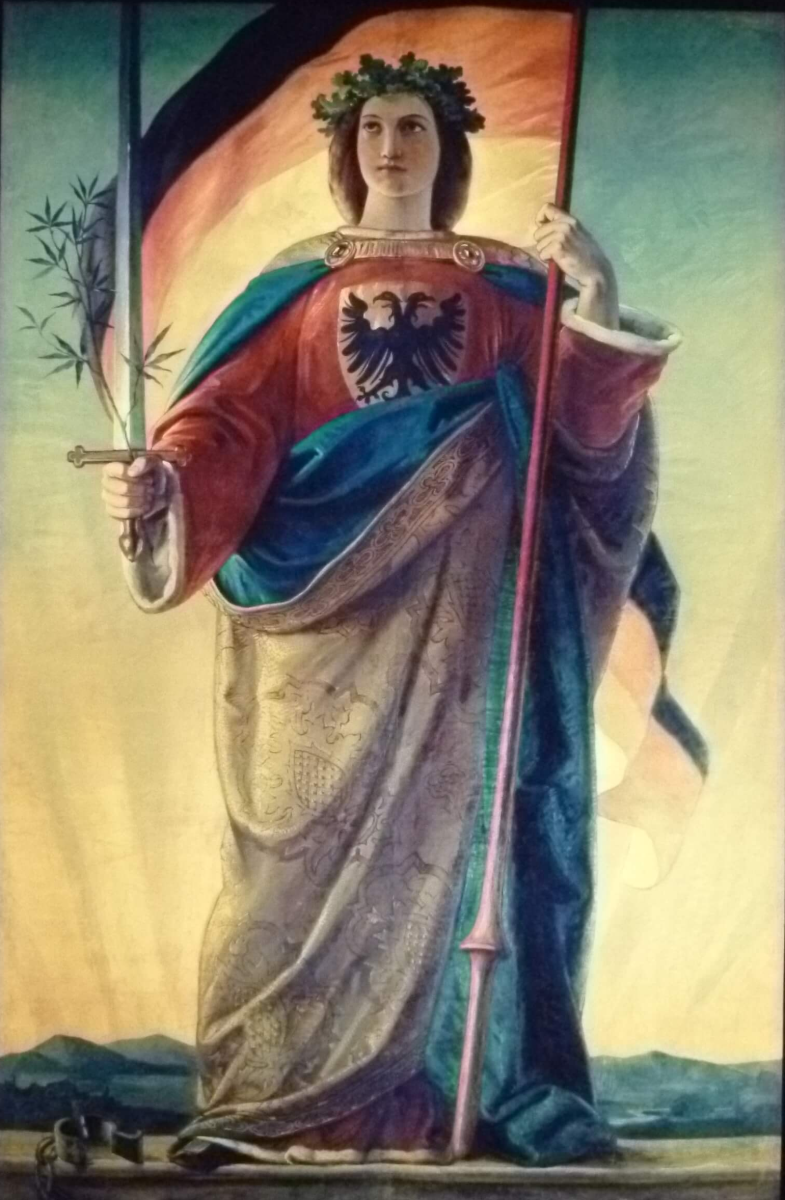
Recognise the picture below and answer the following questions:
  1. Whose painting is it? Who painted it and when?
  2. What does it signify
Read the source given below and answer the questions that follows:
ln 1848, Frederic Sorrieu, a French artist, prepared a series of four prints visualising his dream of a world made up of 'democratic and social Republics; as he called them. As you would recall, artists of the time of the French Revolution personified Liberty as a female figure- here you can recognise the torch of Enlightenment she bears in one hand and the Charter of the Rights of Man in the other. On the earth in the foreground of the image lie the shattered remains of the symbols of absolutist institutions. ln Sorrieu's utopian vision, the peoples of the world are grouped as distinct nations, identified through their flags and national costume. Leading the procession, way past the statue of Liberty, are the United States and Switzerland, which by this time were already nation-states. France, identifiable by the revolutionary tricolour, has just reached the statue. The concept and practices of a modern state, in which a centralised power exercised sovereign control over a clearly defined territory, had been developing over a long period of time in Europe. But a nation-state was one in which the majority of its citizens, and not only its rulers, came to develop a sense of common identity and shared history or descent.
Answer the following MCQs by choosing the most appropriate option:
  1. What was the theme of painting made by French artist?
  1. Constitutional Monarchy.
  2. Absolute Monarchy.
  3. True democracy.
  4. Democratic and Social Republic.
  1. The utopian vision of French artist Frederic Soreau was:
  1. The peoples of the world are grouped as distinct nations, identified through their Bags and national costume.
  2. Leading the procession, way past the statue of Liberty, are the United States and Switzerland, which by this time were already nation-states.
  3. France, identifiable by the revolutionary tricolour, has just reached the statue.
  4. The concept and practices of a modern state, in which a centralised power exercised sovereign control over a clearly defined territory.
  1. French Revolution personified Liberty as a female figure, she bears the torch of Enlightenment in one hand and ______ in the other.
  1. Charter of Rights of Man.
  2. Constitution.
  3. Charter of Rights of woman.
  4. Bible.
  1. Which of the following pairs represent two nation states?
  1. United States and Switzerland.
  2. Britain and Italy.
  3. Spain and Portugal.
  4. Japan and Turkey.
Study the given extract carefully and answer the questions that follow:Mahatma Gandhi on Satyagraha
'It is said of "passive resistance" that it is the weapon of the weak, but the power which is the subject of this article can be used only by the strong. This power is not passive resistance; indeed it call for intense activity. The movement in South Africa was not passive but active.
'Satyagraha is not physical force. A satyagrahi does not inflict pain on the adversary he does not seek his destruction . In the use of satyagraha, there is no ill will whatever.
Satyagraha is pure soul-force. Truth is the very substance of the soul. That is why this force is called satyagraha. The soul is informed with knowledge. In it burns the flame of love... Non-violence is the supreme dharma.
It is certain that India cannot rival Britain or Europe in force of arms. The British worship the war god and they can all of them become, as they are becoming, bearers of arms. The hundreds of millions in India can never carry arms. They have made the religion of nonviolence their own.
  1. What is the main difference between physical force and soul force?
  2. Why can't Indians carry arms? Explain.
Read the extract given below and answer the questions that follow:
For comparing countries, their income is considered to be one of the most important attributes. Countries with higher income are more developed than others with less income. This is based on the understanding that more incomemeans more of all things that human beings need. Whatever people like, and should have, they will be able to get with greater income. So, greater income itself is considered to be one important goal. The rich countries, excluding countries of the Middle East and certain other small countries, are generally called developed countries.
  1. Which country can be considered as a developed country in the modern world? Select your answer from the following statements.
  1. Countries which have accumulated huge amounts of wealth and always secures the future of their citizens. These countries are considered to be developed.
  2. Countries which are among the highest in the 'Human Development Index' are considered to be the developed countries.
  3. Only rich countries are considered to be developed because people have money to buy everything needed for human beings both material and non-material.
  4. Iran is a rich country and therefore it is a developed country.
  1. What is considered to be one of the most important attributes when we compare countries at the level of development?
  1. Industrial development.
  2. Resources of the country.
  3. Income.
  4. Import-export.
  1. The Middle East countries even though are rich countries; but they are not considered as a developed country because.
  1. Its high income is because of Oil exports and not because of development.
  2. It has all the facilities of a developed country because of its high income.
  3. Even after sufficient development they are still not considered as developed countries.
  4. It does not have many facilities so they are not treated as developed countries.
  1. ______ is the total income of the country divided by its total population.
  1. Gross income.
  2. Per capita income.
  3. Total income.
  4. Net income.
Read the source given below and answer the following questions.
Democracy is based on political equality and all individuals have equal right to choose their representative. But along with this (political equality) we can see growing economic inequality among the individuals. A small number of ultra-rich enjoys a highly disproportionate share of wealth and income. Due to these reasons, their share in total income of the country is increasing. On the other hand, the income of poor is declining. Sometimes they (poor) find it difficult to meet their basic needs of life, such as food, clothing. house, education and health. Though poor constitutes a large proportion of voters, yet the democratic governments are not keen to take up the question of poverty. The situation is much worse in some other countries. Like Bangladesh where more than half of its population lives in poverty, even people of poor countries are now dependent on the rich countries for food supplies.
Q.1. Democracy is based on which factor?
Q.2. Does democracy hold its purposes?
Q.3. What is the present scenario of the society?
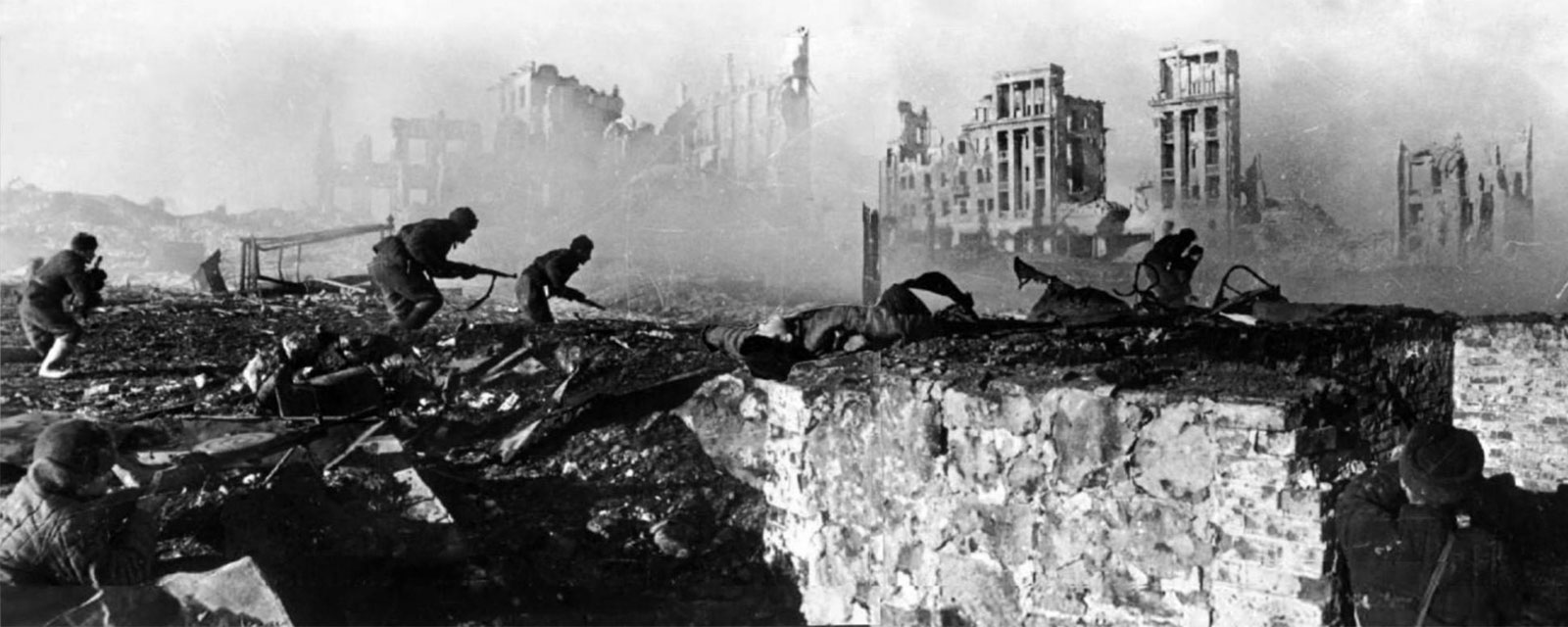
Observe the picture below and answer the questions that follow:
  1. Name the building in Soviet Russia which was devastated in the Second World War.
  2. When did this war break out? Between which two powers was this war fought?
Read the passage given below and answer the following questions:

A House Loan
Megha has taken a loan of 5 lakhs from the bank to purchase a house. The annual interest rate on the loan is 12 per cent and the loan is to be repaid in 10 years in monthly installments. Megha had to submit to the bank, documents showing her employment records and salary before the bank agreed to give her the loan.
The bank retained as collateral the papers of the new house, which will be returned to Megha only when she repays the entire loan with interest.
Q.1. From which source of credit Megha has taken loan?
Q.2. Explain the terms of credit given in the source.