Question
Read the source given below and answer the questions that follows:
ln 1848, Frederic Sorrieu, a French artist, prepared a series of four prints visualising his dream of a world made up of 'democratic and social Republics; as he called them. As you would recall, artists of the time of the French Revolution personified Liberty as a female figure- here you can recognise the torch of Enlightenment she bears in one hand and the Charter of the Rights of Man in the other. On the earth in the foreground of the image lie the shattered remains of the symbols of absolutist institutions. ln Sorrieu's utopian vision, the peoples of the world are grouped as distinct nations, identified through their flags and national costume. Leading the procession, way past the statue of Liberty, are the United States and Switzerland, which by this time were already nation-states. France, identifiable by the revolutionary tricolour, has just reached the statue. The concept and practices of a modern state, in which a centralised power exercised sovereign control over a clearly defined territory, had been developing over a long period of time in Europe. But a nation-state was one in which the majority of its citizens, and not only its rulers, came to develop a sense of common identity and shared history or descent.
Answer the following MCQs by choosing the most appropriate option:
  1. What was the theme of painting made by French artist?
  1. Constitutional Monarchy.
  2. Absolute Monarchy.
  3. True democracy.
  4. Democratic and Social Republic.
  1. The utopian vision of French artist Frederic Soreau was:
  1. The peoples of the world are grouped as distinct nations, identified through their Bags and national costume.
  2. Leading the procession, way past the statue of Liberty, are the United States and Switzerland, which by this time were already nation-states.
  3. France, identifiable by the revolutionary tricolour, has just reached the statue.
  4. The concept and practices of a modern state, in which a centralised power exercised sovereign control over a clearly defined territory.
  1. French Revolution personified Liberty as a female figure, she bears the torch of Enlightenment in one hand and ______ in the other.
  1. Charter of Rights of Man.
  2. Constitution.
  3. Charter of Rights of woman.
  4. Bible.
  1. Which of the following pairs represent two nation states?
  1. United States and Switzerland.
  2. Britain and Italy.
  3. Spain and Portugal.
  4. Japan and Turkey.

Answer

(i)
(d)
Democratic and Social Republic.
(ii)
(d)
The concept and practices of a modern state, in which a centralised power exercised sovereign control over a clearly defined territory.
(iii)
(a)
Charter of Rights of Man.
(iv)
(a)
United States and Switzerland.

Need a full question paper?

Generate a complete, print-ready paper with questions like this in minutes — across 16+ boards, with answer keys.

Start Generating Free

Similar questions

Read the extract given below and answer the questions that follow:
CRUDE OIL RESERVES
Regions/ Countries
Reserves (2017) (Thousand Million Barrels)
Number of Years Reserves will last
Middle East
808
70
United States of America
50
10.5
World
1697
50.2
The table gives an estimate of reserves of crude oil (column1). More importantly, it also tells us for how many years the stock of crude oil will last if people continue to extract it at the present rate. The reserves would last only 50 years more. This is for the world as a whole. However, different countries face different situations. Countries like India depend on importing oil from abroad because they do not have enough stocks of their own. If prices of oil increase this becomes a burden for everyone. There are countries like the USA which have low reserves and hence want to secure oil through military or economic power. The question of sustainability of development raises many fundamentally new issues about the nature and process of development.
  1. The stock of Crude Oil for the world will last for how many more years?
  1. 70 years
  2. 60 years
  3. 40 years
  4. 50 years
  1. The reserve of Crude Oil available in the Middle is how many times more than the reserves in the USA?
  1. 15 times
  2. 16 times
  3. 14 times
  4. 17 times
  1. Which among the following is a Judicious use of Crude Oil Reserves.
  1. Importing from other countries for domestic use.
  2. Overuse of non renewable resources.
  3. Use of alternative sources of resources.
  4. None of these.
  1. How do powerful countries secure oil for their use?
  1. Through military or economic power.
  2. By buying from the Middle East at higher prices.
  3. By using alternative sources of energy.
  4. Putting a restriction on usage of Crude oil in their territories.
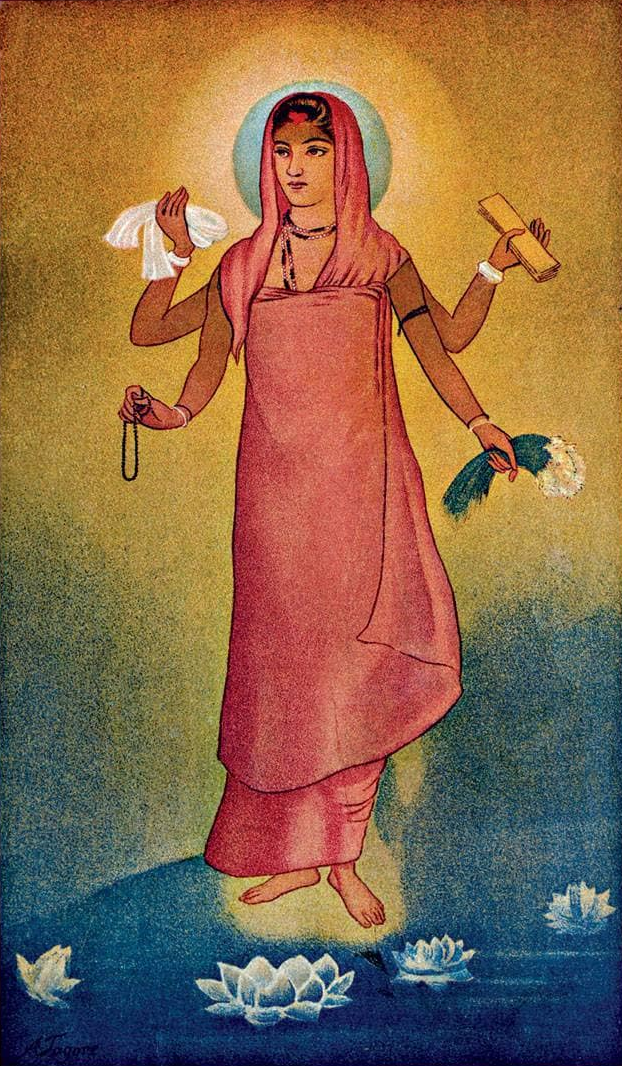
Observe the picture below and answer the questions that follow:
  1. How is Bharat Mata portrayed in the above picture?
  2. Who has painted this image?
  3. What does the mala in one hand emphasise?
Read the extract and answer the questions that follow:
The testimony of an indentured labourer
Extract from the testimony of Ram Narain Tewary, an indentured labourer who spent ten years on Demerara in the early twentieth century:
New emigrants find the tasks allotted to them extremely heavy and cannot complete them in a day. Deductions are also made from wages if the work is considered to have been done unsatisfactorily. Many people cannot therefore earn their full wages and are punished in various ways. In fact, the labourers have to spend their period of indenture in great trouble .
Source: Department of Commerce and Industry, Emigration Branch, 1916.
  1. What is meant by indentured labour? What were the main destinations of Indian indentured migrants?
  2. What do you know about their living and working conditions?
Read the source given below and answer lite questions that follows:
Economists began to think in terms of the national economy. They talked of how the nation could develop and what economic measures could help forge this nation together. Friedrich List, Professor of Economics at the University of Tu bingen in Germany, wrote in 1834: 'The aim of the zollverein is to bind the Germans economically into a nation. It will strengthen the nation materially as much by protecting its interests externally as by stimulating its internal productivity. It ought to awaken and raise national sentiment through a fusion of individual and provincial interests. The German people have realised that a free economic system is the only means to enhance national feeling'.
Answer the following MCQs by choosing the most appropriate option:
  1. State the aim of the Zollverein in Gennany.
  1. To divide German regions.
  2. To bind the Germans economically into a nation.
  3. To create confusion in trade.
  4. To support time consuming calculations.
  1. What German people have realized about new economic system?
  1. German people have realised that a free economic system is the only means to engender national feeling.
  2. German people wanted to conquer more regions.
  3. German people realised the importance of closed economy.
  4. German people realised that a free economic system is obstacle to develop nationalism.
  1. How does a country become stronger?
  1. By conquest.
  2. By making alliances.
  3. Both (a) and (b).
  4. It will strengthen the nation materially, as much by protecting its interests externally as by stimulating its internal productivity.
  1. Who was Friedrich List?
  1. Professor of Economics at the University of Tubingen in Germany.
  2. French Artist.
  3. Philosopher.
  4. Painter.
On 13th April the infamous Jallianwalla Bagh incident took place. On that day a large crowd gathered in the enclosed ground of Jallianwalla Bagh. Some came to protest against the government’s new repressive measures. Others had come to attend the annual Baisakhi fair. Dyer entered the area, blocked the exit points, and opened fire on the crowd, killing hundreds. As the news of Jallianwalla Bagh spread, crowds took to the streets in many north Indian towns. There were strikes, clashes with the police and attacks on government buildings. Seeing violence spread, Mahatma Gandhi called off the movement. While the Rowlatt satyagraha had been a widespread movement, it was still limited mostly to cities and towns. Mahatma Gandhi now felt the need to launch a more broad-based movement in India.
i. How did Mahatma Gandhi react to the Rowlatt Act?
ii. What made Mahatma Gandhi call off Rowlatt Satyagraha?
iii. Why did Rowlatt Act enrage people?
Read the passage given below and answer the following questions:
Agriculture has been the backbone of the Indian economy though its share in the Gross Domestic Product (GDP) has registered a declining trend from 1951 onwards; According to Census of India 2011 about 54.6 per cent of the total work force was employed by the farm sector which makes more than half of the Indian Population dependent on agriculture for sustenance. The declining share of agriculture in the GDP is a matter of serious concern because any decline and stagnation in agriculture will lead to a decline in other spheres of the economy having wider implications for society. Considering the importance of agriculture in India, the Government of India made concerted efforts to modernise agriculture. Establishment of Indian Council of Agricultural Research (ICAR), agricultural universities, veterinary services and animal breeding centres, horticulture development, research and development in the field of meteorology and weather forecast, etc. were given priority for improving Indian agriculture.
Q.1. What steps are taken by the government to modernise agriculture?
Q.2. What is the purpose of establishment of ICAR?
Q.3. Why is the declining share of agriculture a matter of concern?
Study the given extract carefully and answer the questions that follow:Mahatma Gandhi on Satyagraha
'It is said of "passive resistance" that it is the weapon of the weak, but the power which is the subject of this article can be used only by the strong. This power is not passive resistance; indeed it call for intense activity. The movement in South Africa was not passive but active.
'Satyagraha is not physical force. A satyagrahi does not inflict pain on the adversary he does not seek his destruction . In the use of satyagraha, there is no ill will whatever.
Satyagraha is pure soul-force. Truth is the very substance of the soul. That is why this force is called satyagraha. The soul is informed with knowledge. In it burns the flame of love... Non-violence is the supreme dharma.
It is certain that India cannot rival Britain or Europe in force of arms. The British worship the war god and they can all of them become, as they are becoming, bearers of arms. The hundreds of millions in India can never carry arms. They have made the religion of nonviolence their own.
  1. What is the main difference between physical force and soul force?
  2. Why can't Indians carry arms? Explain.
Read the source given below and answer the questions that follow:
Following the defeat of Napoleon in 1815, European governments were driven by a spirit of conservatism. Conservatives believed that established, traditional institutions of state and society-like the monarchy, the Church, social hierarchies, property and the family-should be preserved. Most conservatives, however, did not propose a return to the society of pre-revolutionary days. Rather, they realised, from the changes initiated by Napoleon, that modernisation could in fact strengthen traditional institutions like the monarchy. It could make state power more effective and strong. A modern army, an efficient bureaucracy, a dynamic economy, the abolition of feudalism and serfdom could strengthen the autocratic monarchies of Europe.
In 1815, representatives of the European powers-Britain, Russia, Prussia and Austria-who had collectively defeated Napoleon, met at Vienna to draw up a settlement for Europe. The Congress was hosted by the Austrian Chancellor Duke Metternich. The delegates drew up the Treaty of Vienna of 1815 with the object of undoing most of the changes that had come about in Europe during the Napoleonic wars. The Bourbon dynasty, which had been deposed during the French Revolution, was restored to power, and France lost the territories it had annexed under Napoleon. A series of states were set up on the boundaries of France to prevent French expansion in future.
Answer the following MCQs by choosing the most appropriate options:
  1. Which of the following statements correctly describes about European conservative ideology?
  1. Preservation of beliefs introduced by Napoleon.
  2. Preservation of two sects of Christianity.
  3. Preservation of traditionalist beliefs in state and society.
  4. Preservation of socialists’ ideology in economic sphere.
  1. Identify the purpose to convene Vienna of Congress of Vienna in 1815 from the following options.
  1. To declare completion of German unification.
  2. To declare war against France.
  3. To start the process of Italian unification
  4. To restore conservative regime in Europe.
  1. What did conservatives focus on at the Congress of Vienna? Select the appropriate option.
  1. To establish socialism in Europe.
  2. To re-establish peace and stability in Europe.
  3. To introduce democracy in France.
  4. To set up a new Parliament in Austria.
  1. How did the Congress of Vienna ensure peace in Europe? Select the appropriate option.
  1. Laying out a balance of power between all the great powers in Europe.
  2. With the restoration of Bourbon Dynasty.
  3. Austria was not given the control of Northern Italy.
  4. By giving power to the German confederation.
Read the passage below and answer the questions that follow:
Power may also be shared among different social groups, such as the religious and linguistic groups. ‘Community government’ in Belgium is a good example of this arrangement. In some countries there are constitutional and legal arrangements whereby socially weaker sections and women are represented in the legislatures and administration. This type of arrangement is meant to give space in the government and administration to diverse social groups who otherwise would feel alienated from the government. This method is used to give minority communities a fair share in power.
  1. Power sharing means:
  1. System of political arrangement in which power is shared between ministers of the government.
  2. System of political arrangement in which power is shared between different organs of the government.
  3. System of political arrangement in which power is shared between different levels of the government.
  4. All of the above.
  1. Which one is not a benefit of Power sharing?
  1. Reduces the possibilities of conflicts between social groups.
  2. Ensures political stability in the long run.
  3. All the political parties get their expected share.
  4. It upholds the spirit of democracy.
  1. Apart from the Central and State Government, there is a third type of government in Belgium called the:
  1. Regional Government.
  2. State Government.
  3. Union Government.
  4. Community Government.
  1. Which is not a feature of Community government?
  1. Apart from the Central and the State Government, this is a third type of government.
  2. It is elected by the people belonging to one community that is Dutch, French, German speaking.
  3. It is mainly based on cooperation and tolerance.
  4. It does not have the power regarding cultural, educational and language related issues.
Read the passage below and answer the questions that follow:
Power is shared among different organs of government, such as the legislature, executive and judiciary. Let us call this horizontal distribution of power because it allows different organs of government placed at the same level to exercise different powers. Such a separation ensures that none of the organs can exercise unlimited power. Each organ checks the others. This results in a balance of power among various institutions. Last year we studied that in a democracy, even though ministers and government officials exercise power, they are responsible to the Parliament or State Assemblies. Similarly, although judges are appointed by the executive, they can check the functioning of executive or laws made by the legislatures. This arrangement is called a system of checks and balances.
  1. Power sharing between different organs of the government is being referred as:
  1. Horizontal distribution of power.
  2. Vertical division of power.
  3. Union Government.
  4. Community Government.
  1. Power Sharing is between:
  1. Legislature, executive and parliament.
  2. Legislature, executive and judiciary.
  3. Legislature, high court and judiciary.
  4. None of the above.
  1. It allows different organs of government placed at the same level to exercise different powers is known as:
  1. Circular distribution of power.
  2. Vertical distribution of power.
  3. Horizontal distribution of power.
  4. All of the above.
  1. Judges are appointed by the executive, they can check the functioning of executive or laws made by the legislature known as:
  1. Horizontal distribution of power.
  2. Vertical distribution of power.
  3. Checks and balances.
  4. All of the above.