Question
Read the following and answer any four questions from (i) to (v) given below:

Embryo develops at the micropylar end of the embryo sac, where the zygote is situated. Most zygotes divided only after certain amount of endosperm is formed. The early stages of embryo development are similar in both monocotyledons and dicotyledons. The zygote gives rise to the proembryo and subsequently to the globular heart-shaped and mature embryo. A typical dicotyledonous embryo consists of an embryonal axis and two cotyledons. Embryo of monocotyledons possess only one cotyledon.

  1. True embryo develops as a result of fusion of:
  1. Two polar nuclei of embryo sac.
  2. An egg cell and a male gamete.
  3. Synergid and male gamete.
  4. A male gamete and antipodals.
  1. Refer to the given diagram of the embryo of an angiospermous plant with parts labelled P, Q and R. Select the correct statement(s) regarding this.
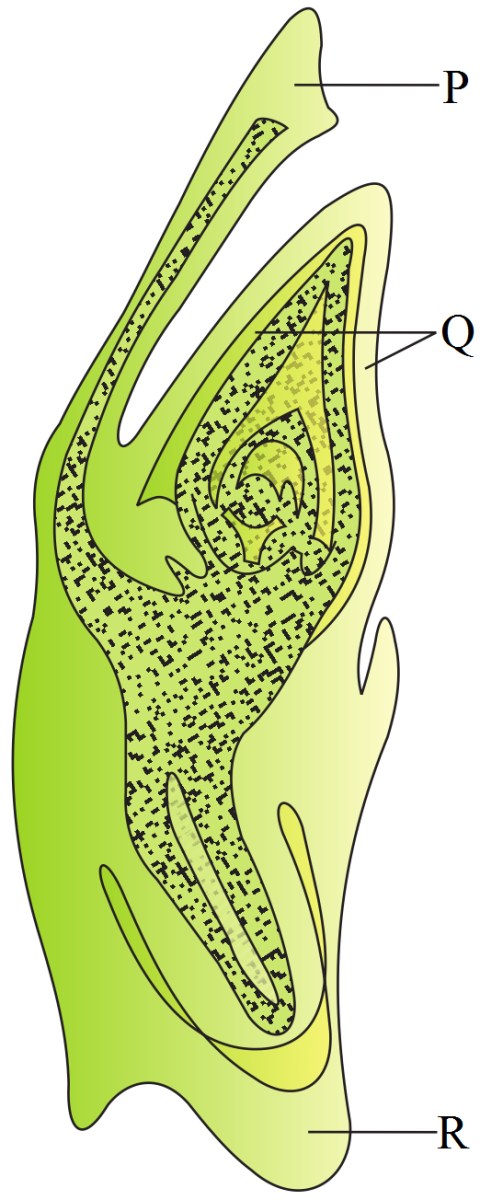
  1. Part 'P' supplies nutrition to the developing embryo.
  2. Part 'Q' is the protective sheath of radicle and root cap.
  3. Part 'R' is the protective sheath of shoot apex and leaf primordia.
  4. The embryo shown in the diagram is present in members of Family Poaceae.
  1. (IV) only.
  2. (II) and (III) only.
  3. (I) and (IV) only.
  4. (I), (II), (III) and (IV).
  1. Which of the given statements are true?
  1. During the development of a dicot embryo, heart-shaped embryo is followed by globular embryo.
  2. The part of embryonal axis above the level of cotyledons is epicotyl, while the part below the level of cotyledons is hypocotyl.
  3. Monocot seeds possess a single cotyledon, represented by scutellum.
  1. (I) and (II).
  2. (II) and (III).
  3. (I) and (III).
  4. (I), (II) and (III).
  1. Consider the following parts of an embryonal axis of a dicot seed.
  1. Hypocotyl.
  2. Epicotyl.
  3. Radicle.
  4. Plumule.

In which of the following the above parts are correctly arranged from top to base?

  1. (III) → (I) → (II) → (IV).
  2. (II) → (I) → (III) → (IV).
  3. (IV) → (II) → (I) → (III).
  4. (III) → (IV) → (II) → (I).
  1. In grass family, the cotyledon, is called:
  1. Epiblast.
  2. Plumule.
  3. Scutellum.
  4. Perisperm.

Answer

  1. (b) An egg cell and a male gamete.

​​​​​​​​​​​​​​​​​​​​​​​​​​​​​​​​​​​​​​​​​​​​​​​​​​​​​​​​Explanation:

In double fertilisation, out of the two male gametes, one fuses with egg or oosphere to perform generative fertilisation. Generative fertilisation is also called syngamy or true fertilisation. It gives rise to a diploid zygote or oospore.

  1. (c) (I) and (IV) only.
  2. (b) (II) and (III).

​​​​​​​​​​​​​​​​​​​​​​​​​​​​​​​​​​​​​​​​​​​​​​​​​​​​​​​​​​​​​​​​​​​​​​Explanation:

During the development of dicot embryo, initially the dicot embryo is globular and undifferentiated. Early embryo with radial symmetry is called proembryo. It is transformed into embryo with the development of radicle, plumule and cotyledons. Two cotyledons differentiate from the sides with a faint plumule in the center. At this time the embryo becomes heart-shaped.

  1. (c) (IV) → (II) → (I) → (III).
  2. (c) Scutellum.

​​​​​​​​​​​​​​​​​​​​​​​​​​​​​​​​​​​​​​​​​​​​​​​​​​​​​​​​​​​​​​​​​​​​​​​​​​​​​Explanation:

In the grass family, the cotyledon is called scutellum that is situated towards one side (lateral) of the embryonal axis.

Need a full question paper?

Generate a complete, print-ready paper with questions like this in minutes — across 16+ boards, with answer keys.

Start Generating Free

Similar questions

​​​​Read the following and answer any four questions from (i) to (v) given below:

Edward Wilson described diversity at all levels of biological organisation ranging from macromolecules inside the cells to biomes. It is of three inter-related hierarchial levels-genetic diversity, species diversity and conununity ecosystem diversity. Species diversity is the variety in the number and richness of the species of a region. For example, the Western ghats have a greater amphibian species diversity than the Eastern ghats.

  1. The number of species per unit area is called.
  1. Species evenness.
  2. Species richness.
  3. Species equitability.
  4. Both (a) and (c).
  1. The table below gives the population (in thousands) of ten species (A - J) in four areas (I - IV) consisting of the number of habitats given within brackets against each. Study the table and answer the question which follows:
Area and number of habitats
Species and their population (in thousands) in the area
A
B
C
D
E
F
G
H
I
J
I(11)
23
12
0.52
6.0
-
3.1
1.1
9.0
-
10.3
II(11)
10.2
-
0.62
-
1.5
3.0
-
8.2
1.1
11.2
III(13)
11.3
0.9
0.48
2.4
1.4
4.2
0.8
8.4
2.2
4.1
IV(12)
3.2
10.2
1.1
4.8
0.4
3.3
0.8
7.3
1.3
2.1
Which are out of I to IV shows maximum species diversity?

  1. II
  2. III
  3. IV
  4. I
  1. Study the given populations and choose the correct answer in relation to species diversity.
Population
Species
Species
Individuals
Population A
I
Mammals
3
II
Birds
2
III
Amphibians
2
Population B
I
Mammals
2
II
Mammals
2
III
Amphibians
1
Population C
I
Mammals
3
II
Mammals
2
III
Mammals
4


Maximum diversity
Minimum diversity
(a)
Population B
Population C
(b)
Population A
Population C
(c)
Population A
Population B
(d)
Population B
Population A
  1. The concept of species diversity has two components : evenness and richness. Evenness is based on the relative abundance of species. Richness is based on the total number of species present. Diversity indices combine a measure of richness and evenness. The Simpson index (D) is calculated from the following equations:

$\text{D}=\displaystyle\sum_{\text{i}=1}(\text{n}_\text{i}/\text{N})^2$

where, n = total number of organisms of particular species

N = total number of organisms of all species

Below are data collected in two terrestrial plant conununities that represent part of a successional chronosequence. ln this case the values were measured as percent cover.

Early Successional Community
Late Successional Community
Species
Percent Cover
Species
Percent Cover
A
83
F
24
B
5
G
20
C
9
H
18
D
2
I
23
E
1
J
15
The data indicate that, relative to the early successional community, the late successional community has which of the following characteristics?

 
Species Richness
Evenness
(a)
Higher
Higher
(b)
Higher
Lower
(c)
Same
Lower
(d)
Same
Higher
  1. Select the incorrect statement regarding species diversity.
  1. It results in polymorph formation and is useful in adaptation to changes in environmental conditions.
  2. Number of individuals of different species represent species evenness.
  3. It influences biotic interactions and stability of the community.
  4. It is a trait of the community.
Explain different types of RNA along with process of transcription.
Explain incomplete dominance in dog flower (snapdragon or Antirrhinum sp.) with the help of a chart.###During monohybrid experiment, in F 2 generation, the ratio of phenotype & genotype remains same - explain by giving suitable example (chart is necessary).
Read the following and answer any four questions from (i) to (v) given below:

Mutation explains the relationship between gene and DNA. The effects of large deletions and rearrangement in a segment of DNA results in loss or gain of gene and its function. Insertion or deletion of one or two bases changes the reading frame from the point of insertion or deletion. A classical example of point mutation is a change of single base pair in the gene for beta globin chain that results in change of amino acid residue glutamate to valine and results into a diseased condition called sickle cell anaemia.

  1. A mutation is a change produced by an alteration in the genetic mechanism and.
  1. May arise spontaneously.
  2. Is always induced by the environment.
  3. Is never advantageous.
  4. Is not inherited.
  1. The DNA code for glutamic acid is CTC or CTT. The code for valine is CAA or CAT. In sickle cell haemoglobin, valine is present instead of glutamic acid.

Assuming a single base pair substitution has occurred, what is the mRNA code in the affected mutant?

  1. CUU
  2. GAA
  3. GAG
  4. GUA
  1. A mutation involving the substitution of one nitrogenous base for another has altered the base sequence of a DNA molecule, coding for four amino acids, as shown below.

Normal A-G-C-A-T-G-G-A-T-C-C-T

Mutant A-G-C-A-T-G-C-A-T-C-C-T

The table shows six codons and the corresponding amino acids into which each is translated.

mRNA codon
Amino acid
AAG
Lysine
CUA
Leucine
GGA
Glycine
GUA
Valine
UAC
Tyrosine
UCG
Serine
The mutation has changed the amino acid.

  1. Leucine to valine.
  2. Lysine to glycine.
  3. Serine to leucine.
  4. Tyrosine to lysine.
  1. Assertion : Insertion or deletion of three or its multiple bases, insert or delete one or multiple codons and so one or multiple amino acids.

Reason: Reading frame remains unaltered with insertion or deletion of three or its multiple bases.

  1. Both assertion and reason are true, and reason is the correct explanation of assertion.
  2. Both assertion and reason are true, but reason is not the correct explanation of assertion.
  3. Assertion is true, but reason is false.
  4. Both assertion and reason are false.
  1. Part of the amino acid sequences in normal and sickle cell haemoglobin are shown.
Normal haemoglobin Sickle cell haemoglobin
Thr-Pro-Glu-Glu Thr-Pro-Val-Glu
mRNA codons for these amino acids are

Glutamine (Glu) GAA GAG

Praline (Pro) CCU CCC

Threonine (Thr) ACU ACC

Valine (Val) GUA GUG

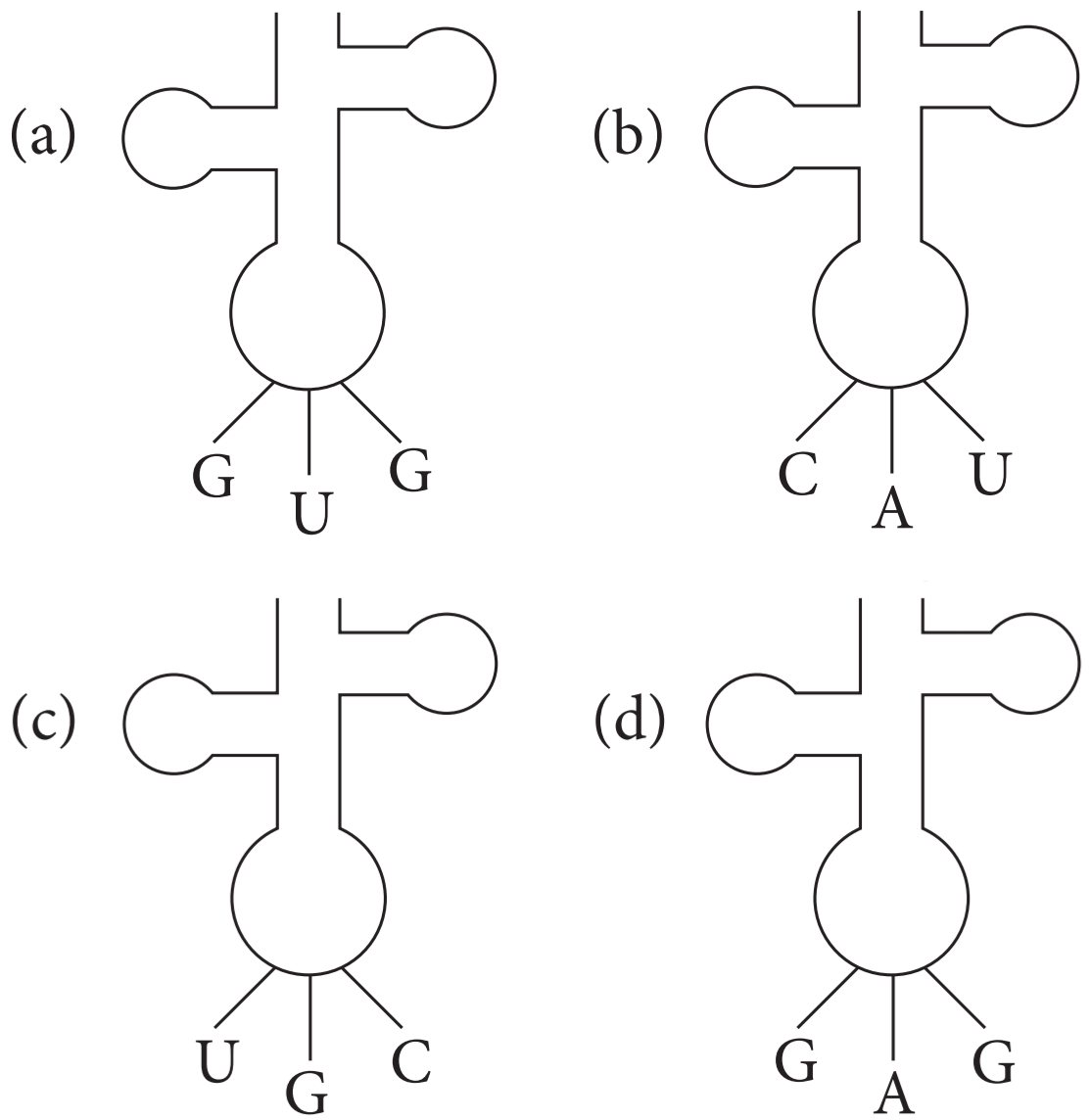
Which transfer RNA molecule is involved in the formation of this part of the sickle cell haemoglobin?

Read the following and answer any four questions from (i) to (v) given below:

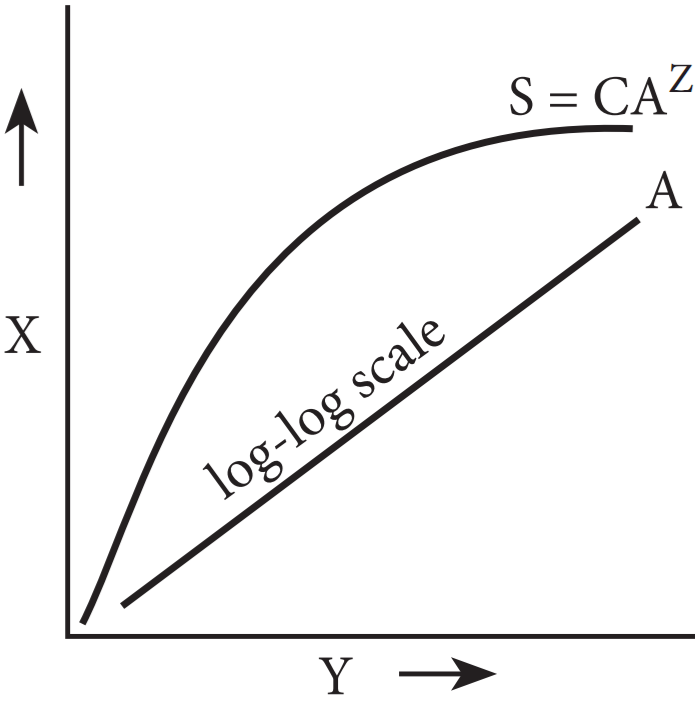
Within a region, species richness increases with increasing explored area, but only upto a limit. TI1e given graph explains this relationship.

  1. What does the given figure show?
  1. Rivet-popper hypothesis.
  2. Species-area relationship.
  3. Proportionate number of species of major taxa.
  4. $\alpha-\text{ecological diversity }$
  1. Equation for relationship (A) between species richness and area is:
  1. $\log\text{ S}=\log\text{ C}+\text{Z }\log\text{ A}$

  2. $\log\text{ C}=\log\text{ S}+\text{Z }\log\text{ A}$

  3. $\text{Z }\log\text{ A}=\log\text{ S}+\log\text{ C}$

  4. $\log\text{ S}=\log\text{ C}+\log\text{ A}$

  1. What is the value of slope of line or regression coefficient Z for frugivorous birds?
  1. 0.1 - 0.2
  2. 1.15
  3. 0.01 - 0.1
  4. 0.6 - 1.2
  1. The shape of curve for relationship between species richness and areas for wide variety of taxa is:
  1. Straight line.
  2. Parabola.
  3. Rectangular hyperbola.
  4. Bell shaped.
  1. Who gave this concept of increase in species richness with increasing offered area?
  1. Humboldt.
  2. Odum.
  3. Edward Wilson.
  4. Paul Ehrlich.
Read the following and answer any four questions from (i) to (v) given below:
A 23 year old Sahil has been diagnosed with an infection of reproductive tract caused by bacteria. He complains about burning sensation during urination, pus-containing discharge and pain around genitalia. This infection has incubation period of 2-5 days but can be cured.
  1. From which disease is Sahil suffering?
  1. Chlamydiasis.
  2. Herpes.
  3. Gonorrhoea.
  4. Syphilis.
  1. Which among the following reproductive tract infections is transmitted by bacteria?
  1. Trichomoniasis.
  2. Chancroid.
  3. Genital warts.
  4. Both (a) and (b).
  1. Which mode of treatment would be useful for Sahil?
  1. Cryosurgery.
  2. Use of Podophyllum preparation.
  3. Use of antibiotic ampicillin.
  4. It cannot be treated.
  1. What technique was used to diagnose Sahil's disease?
  1. Gram staining of discharge and culture.
  2. ELISA Test.
  3. Antibody detection.
  4. Antigen test.
  1. Find the odd one out.
  1. Treponema pallidum.
  2. Neisseria gonorrhoeae.
  3. Haernophilus ducreyi.
  4. Trichomonas vaginalis.
Read the following and answer any four questions from (i) to (v) given below:

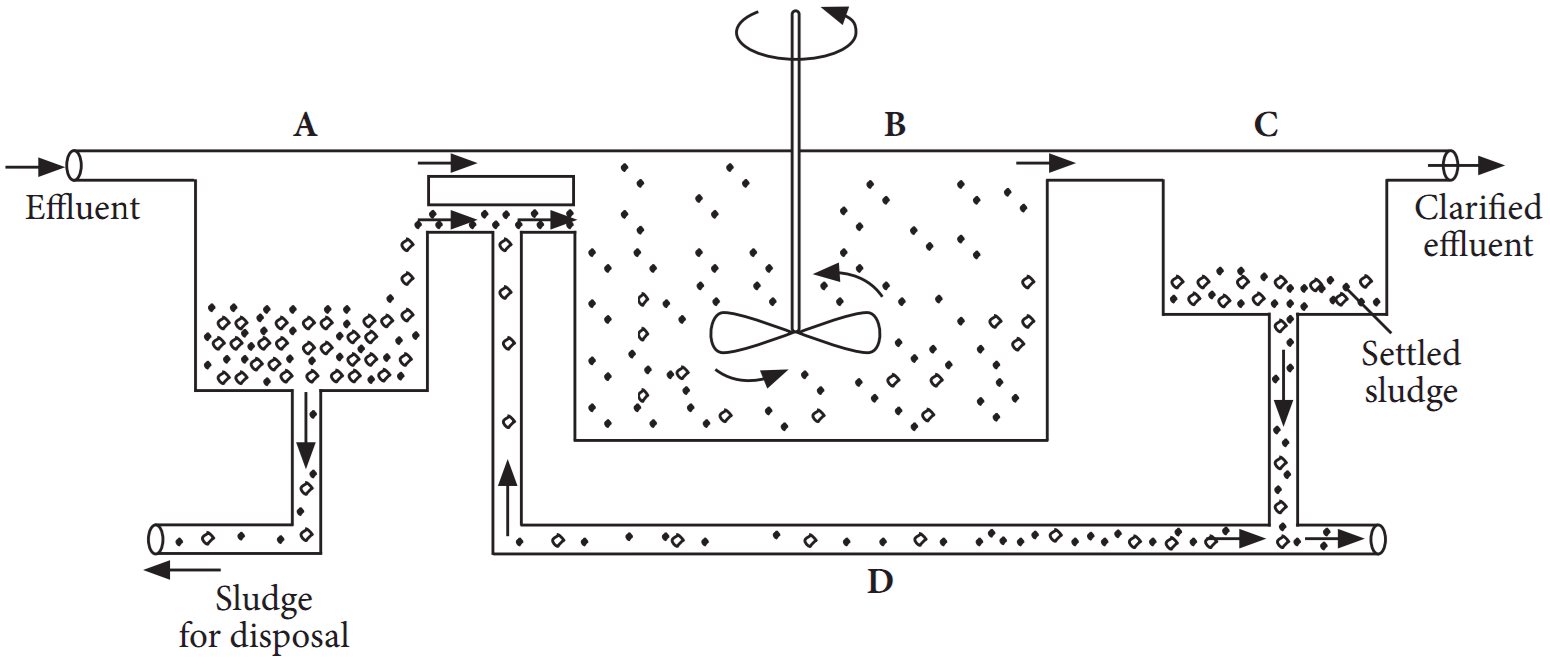
Saurin, a M.Sc student, get an assignment on sewage treatment plant (STP) to study the microbial load. After visiting such plant in his locality, he makes a simplified diagram of the STP for his project. Study the diagram given below and answer the following questions.

  1. In the diagram 'A' denotes:
  1. Aeration tank.
  2. Primary settling tank.
  3. Secondary settling tank.
  4. Sludge digester.
  1. Which of the following is incorrect regarding the sludge released from A?
  1. It is formed after primary treatment.
  2. It does not require aeration.
  3. It possesses floes of decomposer microbes.
  4. It is used in landfills.
  1. A large number of aerobic heterotrophic microbes grow in:
  1. A
  2. B
  3. C
  4. Both (a) and (b).
  1. What is denoted by 'D' in the given diagram?
  1. Primary sludge.
  2. Primary effluent.
  3. Activated sludge.
  4. Secondary effluent.
  1. Assertion: The colloided and finely suspended matter of sewage form aggregates which are called floes.

Reason: Floes contain masses of bacteria, slime and fungal filaments.

  1. Both assertion and reason are true and reason is the correct explanation of assertion.
  2. Both assertion and reason are true but reason is not the correct explanation of assertion.
  3. Assertion is true but reason is false.
  4. Both assertion and reason are false.
Read the following and answer any four questions from (i) to (v) given below:

Oogenesis is the process of formation of ovum in ovaries. It consists of three phases : multiplication, growth and maturation. Oogenesis is controlled by hormones GnRH, LH, FSH. GnRH secreted by the hypothalamus stimulates the anterior lobe of pituitary gland to secrete LH and FSH.

  1. What is the function of hormone FSH?
  1. It inhibits the formation of estrogen.
  2. It induces the release of secondary oocyte.
  3. It stimulates the growth of Graafian follicles.
  4. It causes ovulation.
  1. Which hormone induces the rupture of the mature Graafian follicle?
  1. Follicle stimulating hormone.
  2. Gonadotropin releasing hormone.
  3. Progesterone.
  4. Luteinising hormone.
  1. Which cell division is involved in the formation of secondary oocyte?
  1. Mitosis.
  2. Meiosis I.
  3. Amitosis.
  4. Meiosis II.
  1. Identify the function(s) of LH.
  1. Release of secondary oocyte from Graafian follicle.
  2. Stimulates corpus luteum to secrete progesterone.
  3. Stimulates estrogen formation.
  4. Promotes development of egg to form secondary oocyte.
  1. (A) and (B) only.
  2. (B) and (C) only.
  3. (A), (C) and (D) only.
  4. (B) only.
  1. Assertion: The increase in progesterone level exerts positive feedback on GnRH.

Reason: The rising level of progesterone stimulate production of FSH and LH.

  1. Both assertion and reason are true, and reason is the correct explanation of assertion.
  2. Both assertion and reason are true, but reason is not the correct explanation of assertion.
  3. Assertion is true, but reason is false.
  4. Both assertion and reason are false.
Explain population attributes.
Read the following and answer any four questions from (i) to (v) given below:

In prokaryotes, DNA is circular and present in the cytoplasm but in eukaryotes, DNA is linear and mainly confined to the nucleus. DNA or deoxyribonucleic acid is a long polymer of nucleotides. In 1953, the first correct double-helical structure of DNA was worked out by Watson and Crick. Based on the X-ray diffraction data produced by Maurice Wilkins and Rosalind Franklin. It is composed of three components, i.e., A phosphate group, a deoxyribose sugar and a nitrogenous base. Different forms of DNA are B-DNA, Z-DNA, A-DNA, C-DNA and D-DNA.

  1. Name the linkage present between the nitrogen base and pentose sugar in DNA.
  1. Phosphodiester bond
  2. Phosphodiester bond
  3. Hydrogen bond
  4. None of these
  1. The double helix structure of DNA was proposed by.
  1. James Watson and Francis Crick.
  2. Earwin Chargaff
  3. Federick Griffith
  4. Hershey and Chase.
  1. The double chain of B-DNA is coiled in a helical fashion. The spiral twisting of B-DNA duplex produces.
  1. Right and left part.
  2. Major and minor grooves.
  3. Upper and lower side.
  4. Linear and circular part.
  1. Assertion: The two strands of DNA helix have uniform distance between them.

Reason: A large sized purine always paired opposite to a small sized pyrimidine.

  1. Both assertion and reason are true and reason is the correct explanation of assertion.
  2. Both assertion and reason are true but reason is not the correct explanation of assertion.
  3. Assertion is true but reason is false.
  4. Both assertion and reason are false.
  1. Which of the following describes the structure of B-DNA?
S.no
Polynudeotide chains
(a)
Parallel
5
(b)
Anti-parallel
10
(c)
Parallel
15
(d)
Anti-parallel
20