Question
Read the following and answer any four questions from (i) to (v) given below:
Excessive exploitation of species, whether a plant or animal reduces the size of its population so it becomes vulnerable to extinction. Such as Dodo and passenger pigeon have become extinct due to over exploitation by humans. Thus the world is facing accelerated rates of species extinctions, largely due to human interference.
  1. Which of the following cause of biodiversity loss is not included in evil quartet?
  1. Coextinction.
  2. Pollution.
  3. Alien species invasion.
  4. Habitat loss and fragmentation.
  1. Identify the species that have become extinct due to over exploitation.
  1. Stellar sea cow.
  2. Yucca moth.
  3. Blatta orientalis.
  4. Nile Perch.
  1. Factors which make species susceptible to extinction are:
  1. Large population size.
  2. Lack of genetic variability.
  3. Ower status of trophic level.
  4. Ability to switch over to ahem ate foods.
  1. Assertion: Pollution reduces species biodiversity.
Reason: Spill over of oil in sea causes death of several marine animals.
  1. Both assertion and reason are true and reason is the correct explanation of assertion.
  2. Both assertion and reason are true but reason is not the correct explanation of assertion.
  3. Assertion is true but reason is false.
  4. Both assertion and reason are false.
  1. ________ is the first major cause of species extinction.
  1. Coextinction.
  2. Over exploitation.
  3. Habitat destruction.
  4. Alien species invasion.

Answer

  1. (b) Pollution
Explanation:

Evil quartet, i.e., four major causes of biodiversity loss are habitat loss and fragmentation, over exploitation, alien species invasion and co-extinction.
  1. (a) Stellar sea cow.
  1. (b) Lack of genetic variability.
Explanation:

Population traits which make species susceptible to extinction are: small population, higher status of trophic level and inability to switch over to alternate foods.
  1. (a) Both assertion and reason are true and reason is the correct explanation of assertion.
  1. (c) Habitat destruction.

Need a full question paper?

Generate a complete, print-ready paper with questions like this in minutes — across 16+ boards, with answer keys.

Start Generating Free

Similar questions

Read the following and answer any four questions from (i) to (v) given below:DNA replication is a complex multistep process that requires enzymes, protein factors and metal ions. DNA replication in eukaryotes occurs in the nucleus during the S-phase of the cell cycle. It is semidiscontinuous in eukaryotes. in prokaryotes, replication takes place in the cytoplasm. DNA replication in bacteria occurs prior to fission. Nucleoid or viral chromosome is a single molecule of nucleic acid, it may be linear of circular. Nucleic acid in a virus is either DNA or RNA but never both.
  1. In viral DNA, how many origin of replication are present?
  1. Single
  2. Twice
  3. Multiple
  4. None
  1. Select the main enzyme involved in DNA replication.
  1. DNA ligase
  2. DNA dependent DNA polymerase
  3. Topoisomerase
  4. Helicase
  1. Read the given statement and select the option that correctly fill in the blanks. Enzyme (i) acts over the Ori site and unwinds the two strands of DNA by destroying (ii) bonds.
  1. (i)-Helicase (ii) Glycosidic
  2. (i)-Helicase (ii)-Hydrogen
  3. (i)-Unwindase (ii)-Phosphodiester
  4. (i)-Unwindase (ii)-Glycosidic
  1. DNA strand, built up of Okazaki fragments, is called.
  1. Lagging strand.
  2. Leading strand.
  3. Complementary strand.
  4. Parental strand.
  1. Select the incorrect statement about DNA polymerase in eukaryotes.
  1. Polymerase $\alpha$ is required for initiation of replication.
  2. When the RNA primer gets removed the gap is filled by DNA polymerase $\beta$ in eukaryotes.
  3. Polymerase $\in$ helps in elongation of lagging strand.
  4. Polymerase $\delta$ is largest and main enzyme for DNA replication in eukaryotes.
Read the following text carefully and answer the questions that follow:
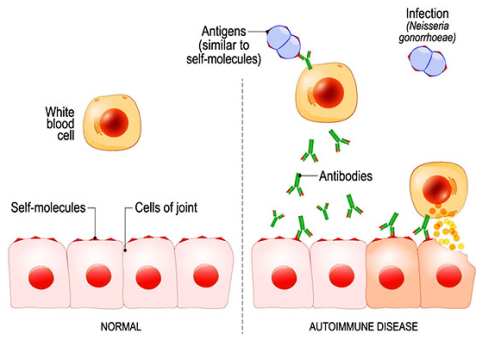
A healthy immune system defends the body against disease and infection. But if the immune system malfunctions, it mistakenly attacks healthy cells, tissues, and organs. Called autoimmune disease, these attacks can affect any part of the body, weakening bodily function and even turning life-threatening.
Image
i. Why are autoimmune diseases called degenerative diseases? (1)
ii. Name the autoimmune disease of body muscles. (1)
iii. Which types of immunity is provided by T-lymphocytes? (2)
OR
Which immune cells form humoral immune system? (2)
Highlight five areas where biotechnology has influenced our lives.
The bacterium Bacillus thuringiensis is widely used in contemporary biology as:
Read the following text carefully and answer the questions that follow:
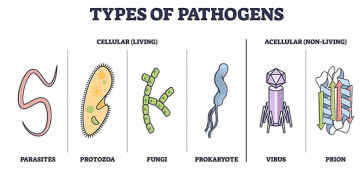
The pathogen of a disease depends on RBCs of human for growth and reproduction. The person with this
pathogen suffers with chill and high fever.
Image
i. Identify the disease. (1)
ii. Name the pathogen. (1)
iii. What is the cause of fever? (2)
OR
Represent the life cycle of the pathogen diagrammatically. (2)
Match the terms in Column I with those in Column II.
S. No Column I S. No Column II
(i) Gene therapy 1. Human insulin.
(ii) Cotton bollworm 2. Biopiracy.
(iii) Eli Lilly 3. Emphysema.
(iv) Basmati Rice 4. ADA deficiency.
(v) $\alpha-1\text{ antitrypsin}$ 5. Lepidopteran.
Read the following and answer any four questions from (i) to (v) given below:
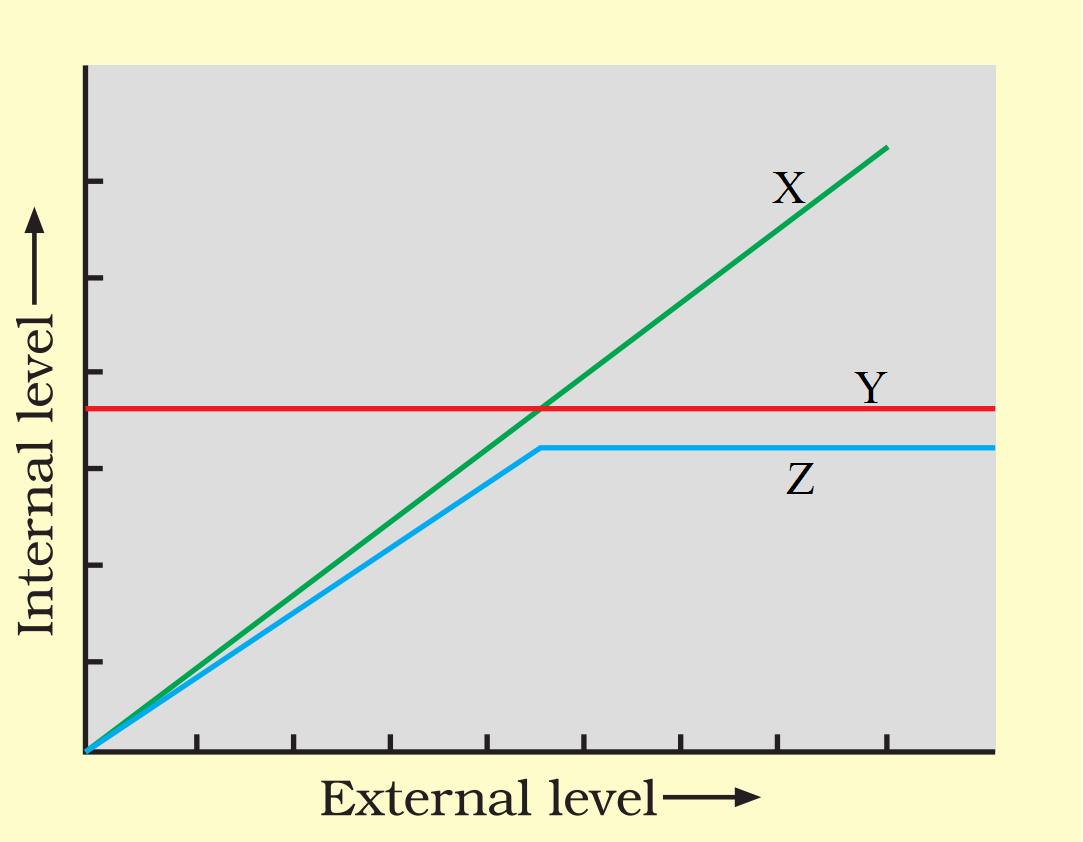
A desert lizard (an ectotherm) and a mouse (an endotherm) are placed inside a chamber at 15ºC and their body temperature [T(L) for the lizard and T(M) for the mouse] and metabolic rates [M(L) for lizard and M(M) for the mouse] are monitored.
  1. Which of the following is correct regardingT(L), M(L), T(M) and M(M)?
  1. T(L) and M(L) will fall while T(M) and M(M) will increase.
  2. T(L) and M(L) will increase while T(M) and M(M) will fall.
  3. T(L) and M(L) will fall, T(M) will remain same and M(M) will increase.
  4. T(L) and M(L) will remain same, T(M) and M(M) will decrease.
  1. It can be said that some animals in their evolutionary development preferred to be ectotherms than endotherms. Which of the following can be the best suited reason for it?
  1. The metabolic reactions of these organisms can occur at a very wide range of temperature.
  2. Maintaining homeostasis is an energetically expensive process.
  3. The enzymes of these organisms are functional at high temperatures.
  4. Both (b) and (c).
  1. Organisms that can maintain a constant internal temperature are called.
  1. Homoeothermic
  2. Poikilothermic
  3. Oligothennic
  4. Heterothennic
  1. An animal that survives at temperature of 10ºC and 40ºC both can be placed under the category of:
  1. Ectotherm.
  2. Endotherm.
  3. Modifiers.
  4. Migratory organisms.
  1. Study the graph carefully and select the correct option.
  1. X could be desert lizard.
  2. Y could be mouse.
  3. Z could be desert lizard.
  4. Both (a) and (b).
Read the following and answer any four questions from (i) to (v) given below:
RNA or ribonucleic acid is a single chain polyribonucleotide which functions as carrier of coded genetic or hereditary information from DNA to cytoplasm for taking part in protein and enzyme synthesis. Six types of RNAs are ribosomal, transfer, messenger, genomic, small nuclear and small cytoplasmic RNA. Out of these, rRNA, mRNA and tRNA are major classes of RNAs that are involved in gene expression.
  1. Which one is referred to a soluble RNA?
  1. mRNA
  2. tRNA
  3. rRNA
  4. hnRNA
  1. The RNA that picks up specific amino acid from amino acid pool in the cytoplasm to ribosome during protein synthesis is?
  1. rRNA
  2. hnRNA
  3. mRNA
  4. tRNA
  1. Which of the following is found in both DNA and messenger RNA?
  1. Double helix structure
  2. Ribose
  3. Sugar-phosphate chain
  4. Thymine
  1. Which of the following statements regarding RNA is correct?
  1. Messenger RN As carries coded information for synthesis of polypeptide.
  2. Ribosomal RNAs bind with tRNA to catalyse the formation of phosphodiester bonds.
  3. Genomic RNA is always single stranded.
  4. Synthesis of rRNA occurs in cytoplasm by RNA polymerase III
  1. In studying a virus, you find the following proportions of nitrogenous bases present: adenine 23%, guanine 37%, cytosine 23% uracil 17%. Which of the following statement(s) regarding this virus is/are correct?
  1. It probably uses RNA as its genetic material.
  2. The genetic material of this virus is probably single stranded.
  3. Base pairing rules in virus in this virus include adenine: cytosine.
  1. I only
  2. I and II only
  3. II and III only
  4. All of these.
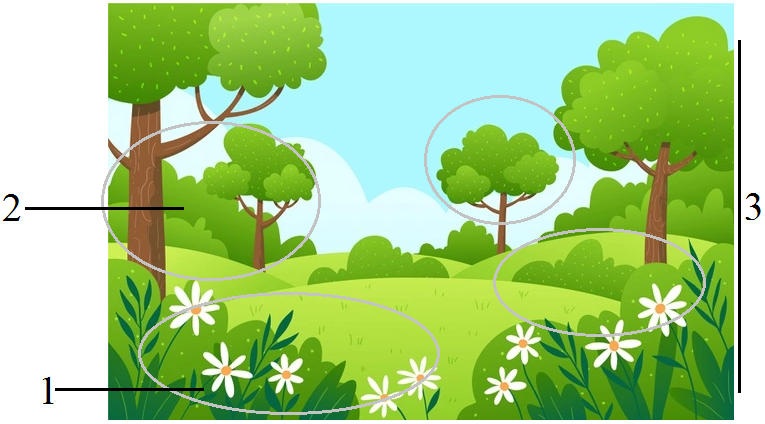
Read the following and answer any four questions from (i) to (v) given below: Ecosystem diversity is the variety of forms in the ecosystem due to diversity of niches, trophic levels and ecological processes like nutrient recycling, food webs, energy flow, etc. Study the given figure.
  1. Identify different types of diversity denoted by 1, 2 and 3 in the given figure.
 
1
2
3
(a)
Alpha diversity
Beta diversity
Gamma diversity
(b)
Gamma diversity
Alpha diversity
Beta diversity
(c)
Gamma diversity
Beta diversity
Alpha diversity
(d)
Beta diversity
Alpha diversity
Gamma diversity
  1. Alpha diversity is biodiversity present.
  1. Within conununity.
  2. Between conununities.
  3. In ranges of communities.
  4. None of these.
  1. Diversity represented by diversity of habitats over a total landscape area is:
  1. $\alpha-\text{diversity}$
  2. $\gamma-\text{diversity}$
  3. $\beta-\text{diversity}$
  4. $\delta-\text{diversity}$
  1. Concept of three types of ecological diversity was given by:
  1. Elton
  2. Odum
  3. Edward Wilson
  4. Whittaker
  1. The diversity of organisms sharing the same habitat or conununity is termed as:
  1. Alpha diversity.
  2. beta diversity.
  3. gamma diversity.
  4. delta diversity.
Explain: Acquired Immunity.