Question
Read the following and answer any four questions from (i) to (v) given below:
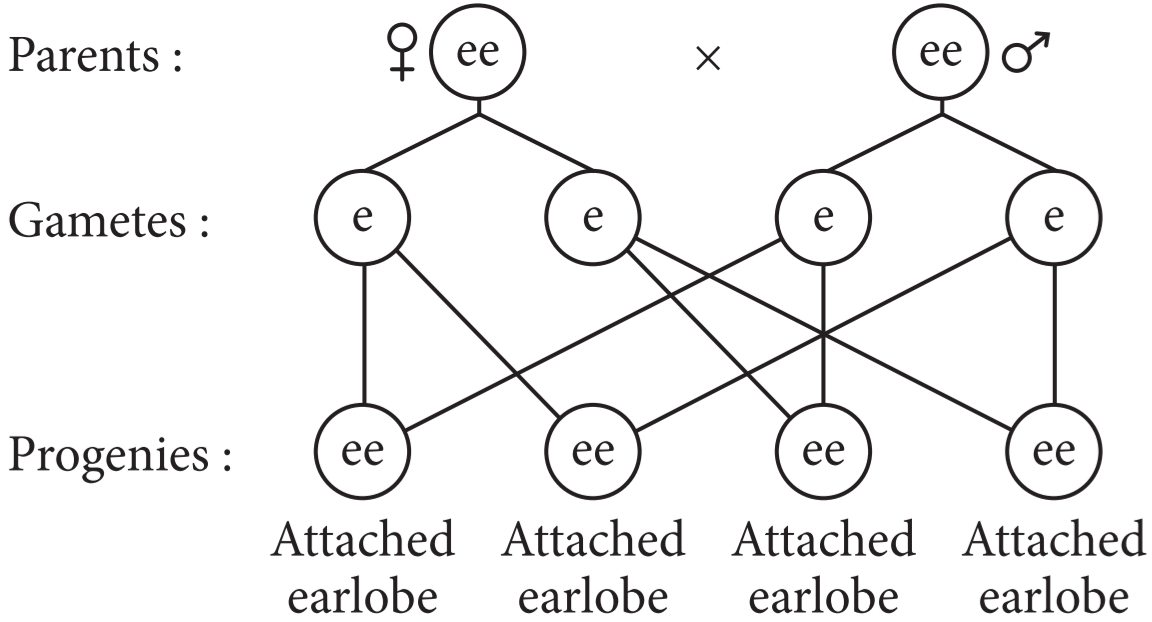
While studying inheritance of characters, a teacher gave the example of inheritance of attached earlobe and hypertrichosis of the ear to her students. A man with attached earlobes and extensive hair on pinna married a woman having free earlobes. The couple had four children, one son with attached earlobes and hairy pinna, one son with a free earlobes and hairy pinna and two daughters with attached earlobes. One of the daughters married a man with free earlobes and sparse hair on pinna. Teacher said if this couple would have sons there would be equal chances for both having free or attached earlobes and sparse hair on pinnae.
  1. Attached and free earlobe are respective example of?
  1. Dominant and recessive traits.
  2. Recessive and recessive traits.
  3. Recessive and dominant traits.
  4. Dominant and dominant traits.
  1. Hypertrichosis of the ear is.
  1. X linked trait
  2. Y linked trait
  3. Autosomal dominant trait
  4. Autosomal recessive trait.
  1. If a female with attached earlobe married a male homozygous for free earlobe sparse hair on pinna then what would be the chances of daughter to have attached earlobe?
  1. 0%
  2. 100%
  3. 25%
  4. 75%
  1. If a man with attached earlobe and hairy pinna married a woman with attached earlobe then what would be the chances of son to have hairy pinna?
  1. 50%
  2. 100%
  3. 75%
  4. 0%
  1. A male with attached earlobe, sparse hair on pinna married a female with attached earlobe. Which of the following is correct regarding their progenies?
  1. All sons have a free earlobe with hairy pinna.
  2. All daughters have an attached earlobe.
  3. 50% daughters have an attached earlobe whereas 50% daughters have a free earlobe.
  4. 50% sons have attached earlobe with hairy pinna and 50% sons have a free earlobe
Answer

  1. (c) Recessive and dominant traits.
Explanation:

ln humans, free earlobes is dominant over attached earlobes
  1. (b) Y linked trait
  2. (a) 0%
Explanation:

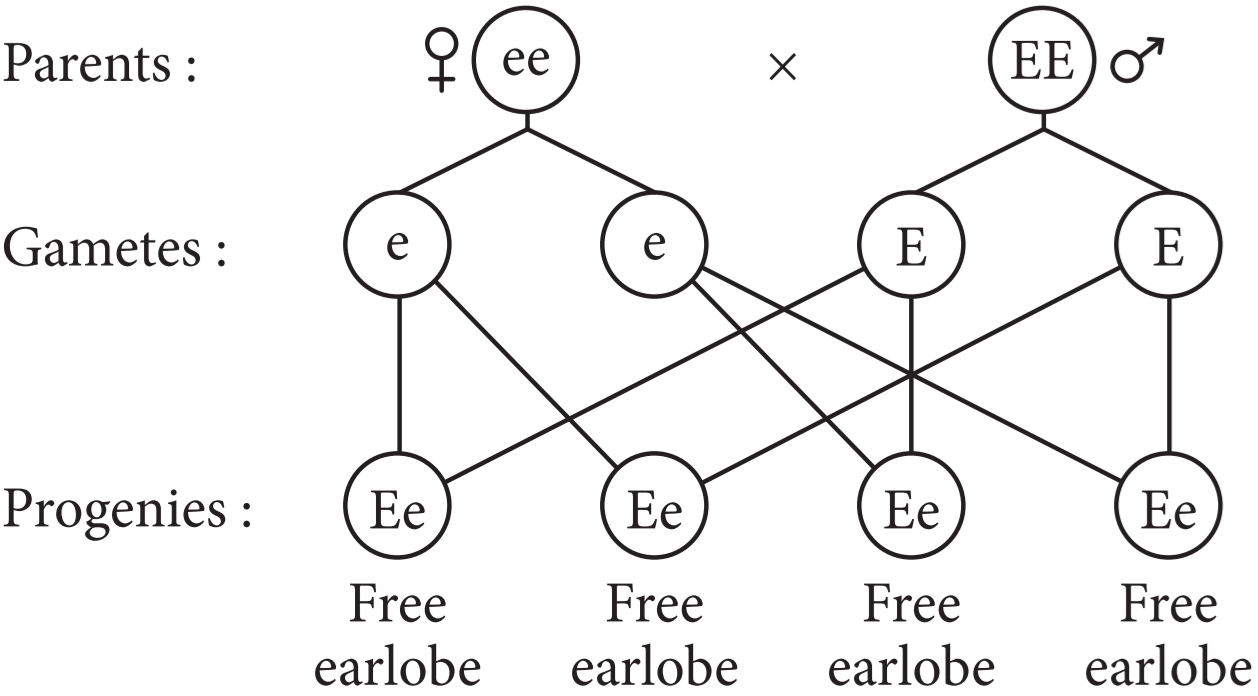
If a female with attached earlobes (ee) married a male with free lobe (EE) and sparse hair on pinna then chance of any progeny to have attached ear lobe is zero. It can be depicted as follows

  1. (b) 100%
Explanation:

If a man with attached earlobe (ee) and hairy pinna married a woman with attached earlobes (ee) than 100% chances of sons to have hairy pinna as hypertrichosis or hairy pinna is Y linked feature.
  1. (b) All daughters have an attached earlobe.
Explanation:

If a male with attached earlobe sparse hair on pinna married a female with attached earlobe then all daughters have an attached earlobe.

Need a full question paper?

Generate a complete, print-ready paper with questions like this in minutes — across 16+ boards, with answer keys.

Start Generating Free

Similar questions

Distinguish between: Spermatogenesis and Oogenesis.
Distinguish between: Blastula and Gastrula ### Give two differences between blastula and gastrula.
CellsFunctions
(1) T-lymphocytes(a) Phagocytic in function
(2) Neutrophils(b) Responsible for Humoral immunity
(3) Eosinophils/Acidophils(c) Responsible for cell-medicated immunity
(4) B-lymphocytes(d) Anti-allergic [Antihistamine] in function
Distinguish between : Pharynx and Larynx.
Column AColumn B
(1) Walter Rosen(a) Popularisation of term biodiversity
(2) David Tillman(b) Rivet Popper Hypothesis
(3) Paul Ehrlich(c) Productivity Stability Hypothesis
(4) Edward Wilson(d) Coined
Read the following and answer any four questions from (i) to (v) given below:
A young couple married for 5 years is unable to bear a child in spite of not practicing any birth control method. Upon consultation, doctor advised them an assisted reproductive technology involving transfer of gametes into oviducts.
  1. Identify the technique adopted by the couple.
  1. ZIFT
  2. JUI
  3. GIFT
  4. ICSI
  1. What is the pre-requisite of this technique?
  1. Gamete formation should be normal.
  2. Fallopian tubes should be normal.
  3. Female should have thick endometrial lining.
  4. Male should be able to copulate the female.
  1. Assertion: GIFT is an in-vitro fertilisation technique.
Reason: In GIFT, gametes are fertilised outside the female body.
  1. Both assertion and reason are true, and reason is the correct explanation of assertion.
  2. Both assertion and reason are true, but reason is not the correct explanation of assertion.
  3. Assertion is true, but reason is false.
  4. Both assertion and reason are false.
  1. The procedure advised to couple involves the transfer of:
  1. Fertilised ovum.
  2. Embryo with 8 blastomeres.
  3. Sperms and unfertilised ovum.
  4. Embryo with 16 blastomeres.
  1. What is the success rate of this procedure?
  1. 30-50%
  2. < 20%
  3. 80-85%
  4. 27-30%
Read the following and answer any four questions from (i) to (v) given below:
Age sex structure of a population can be depicted in the form of a pyramid by plotting the percentage of population of each sex in each age class. Two age sex pyramids are as follows.
  1. Which of the following is correct regarding pyramid B?
  1. It represents stable population.
  2. It represents expanding population.
  3. It represents declining population.
  4. Both (a) and (b).
  1. Total number of individuals of a species per unit area per unit time is called.
  1. Population size.
  2. Population density.
  3. Demography.
  4. Population dynamics.
  1. Which of the following is correct regarding age sex pyramid A and B?
  1. A represents the age sex pyramid of developed country.
  2. B represents the age sex pyramid of developing country.
  3. A represents rapidly growing population.
  4. Both (a) and (b).
  1. A population with a large proportion of older individuals than younger ones will likely to:
  1. Grow larger first and then decline.
  2. Continue to grow indefinitely.
  3. Decline.
  4. None of these.
  1. Assertion: Bell shaped age pyramid represents a stable population.
Reason: ln a stable population, proportion of individuals in reproductive age group is higher than the individuals in pre reproductive age group.
  1. Both assertion and reason are true and reason is the correct explanation of assertion.
  2. Both assertion and reason are true but reason is not the correct explanation of assertion.
  3. Assertion is true but reason is false.
  4. Both assertion and reason are false.
Column AColumn B
(1) Sir Edward Sharpey Schafer(a) Chemically synthesized DNA sequence of insulin
(2) Hakura(b) Discovery of insulin
(3) Gilbert and Villokomaroff(c) PCR
(4) K. Mullis (d) Insulin production using r-DNA technology
Read the following and answer any four questions from (i) to (v) given below:
Aditya went to his hometown located in countryside along with his parents during his summer vacations. His grand parents' house is surrounded by farmland from all sides. Lots of crops were growing nearby and Aditya was very excited to visit the crop fields. He seeked permission from his mother to play in farmland along with his friends and then went to play in the fields. On returning back he had running nose, watering eyes and continuous sneezing which was very frequent. TI1e symptoms worsened with time. Based on the above information, answer the following questions.
  1. What could be the possible reason for Aditya's condition?
  1. Allergy
  2. Infection
  3. Malnutrition
  4. Genetic disorder
  1. How can allergy be diagnosed in a person?
  1. Presence of large amount of IgE antibodies in the blood.
  2. Presence of large number of bacteria in the blood.
  3. Presence of bilirubin and bilirubin pigments in the stool.
  4. Presence of sickle shaped RBCs in the blood
  1. The symptoms which Aditya developed on account of being allergic are consequence of?
  1. Inflammation of membrane lining the nose and conjunctiva
  2. Swelling up of tissue surrounding bronchioles of lungs
  3. Dilation of all arteries so that large amount of fluid passes from blood to tissues.
  4. All of these.
  1. Name the type of allergy that Aditya developed.
  1. Asthma
  2. Anaphylaxis
  3. Hay fever
  4. Urticaria
  1. Assertion : Hay fever is the form of allergy due to pollens of grasses and other plants.
Reason : Hay fever symptoms are due to release of histamines and often respond well to treatment with antihistamines.
  1. Both assertion and reason are true, and reason is the correct explanation of assertion.
  2. Both assertion and reason are true, but reason is not the correct explanation of assertion.
  3. Assertion is true, but reason is false.
  4. Both assertion and reason are false.
Old or classical biotechnology and Modem biotechnology.