Question
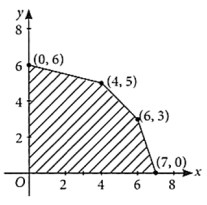
✓
Answer
When we solve an L.P.P. graphically, the optimal (or optimum) value of the objective function is attained at corner points of the feasible region.
ii. From the graph of 3x + 4y < 12 it is clear that it contains the origin but not the points on the line 3x + 4y = 12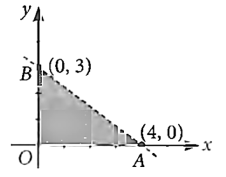
iii. Maximum of objective function occurs at corner points
OR
Value of $Z=p x+q y$ at $(15,15)=15 p+15 q$ and that at $(0,20)=20 q$. According to given condition, we have $15 p +15 q =20 q \Rightarrow 15 p =5 q \Rightarrow q =3 p$
ii. From the graph of 3x + 4y < 12 it is clear that it contains the origin but not the points on the line 3x + 4y = 12
iii. Maximum of objective function occurs at corner points
| Corner Points | Value of z = 2x + 5y |
| (0,0) | 0 |
| (7,0) | 14 |
| (6,3) | 27 |
| (4,5) | $33 \leftarrow$ Maximum |
| (0,6) | 30 |
Value of $Z=p x+q y$ at $(15,15)=15 p+15 q$ and that at $(0,20)=20 q$. According to given condition, we have $15 p +15 q =20 q \Rightarrow 15 p =5 q \Rightarrow q =3 p$
Need a full question paper?
Generate a complete, print-ready paper with questions like this in minutes — across 16+ boards, with answer keys.
Explore more
Similar questions
If y = f(u) is a differentiable function of u and u = g(x) is a differentiable function of x, then y = f(g(x)] is a differentiable function of x and $\frac{\text{dy}}{\text{dx}}=\frac{\text{dy}}{\text{du}}\times\frac{\text{du}}{\text{dx}}.$ This rule is also known as CHAIN RULE.
Based on the above information, find the derivative of functions w.r.t. x in the following questions.
→Based on the above information, find the derivative of functions w.r.t. x in the following questions.
- $\cos\sqrt{\text{x}}$
- $\frac{-\sin\sqrt{\text{x}}}{2\sqrt{\text{x}}}$
- $\frac{\sin\sqrt{\text{x}}}{2\sqrt{\text{x}}}$
- $\sin\sqrt{\text{x}}$
- $-\sin\sqrt{\text{x}}$
- $7^{\text{x}+\frac{1}{\text{x}}}$
- $\Big(\frac{\text{x}^2-1}{\text{x}^2}\Big)\cdot7^{\text{x}+\frac{1}{\text{x}}}\cdot\log7$
- $\Big(\frac{\text{x}^2+1}{\text{x}^2}\Big)\cdot7^{\text{x}+\frac{1}{\text{x}}}\cdot\log7$
- $\Big(\frac{\text{x}^2-1}{\text{x}^2}\Big)\cdot7^{\text{x}-\frac{1}{\text{x}}}\cdot\log7$
- $\Big(\frac{\text{x}^2+1}{\text{x}^2}\Big)\cdot7^{\text{x}-\frac{1}{\text{x}}}\cdot\log7$
- $\sqrt\frac{{1-\cos\text{x}}}{1+\cos\text{x}}$
- $\frac{1}{2}\sec^2\frac{\text{x}}{2}$
- $-\frac{1}{2}\sec^2\frac{\text{x}}{2}$
- $\sec^2\frac{\text{x}}{2}$
- $-\sec^2\frac{\text{x}}{2}$
- $\frac{1}{\text{b}}\tan^{-1}\Big(\frac{\text{x}}{\text{b}}\Big)+\frac{1}{\text{a}}\tan^{-1}\Big(\frac{\text{x}}{\text{a}}\Big)$
- $\frac{-1}{\text{x}^2+\text{b}^2}+\frac{1}{\text{x}^2+\text{a}^2}$
- $\frac{1}{\text{x}^2+\text{b}^2}+\frac{1}{\text{x}^2+\text{a}^2}$
- $\frac{1}{\text{x}^2+\text{b}^2}-\frac{1}{\text{x}^2+\text{a}^2}$
- None of these.
- $\sec^{-1}\text{x}+\text{cosec}^{-1}\frac{\text{x}}{\sqrt{\text{x}^2-1}}$
- $\frac{2}{\sqrt{\text{x}^2-1}}$
- $\frac{-2}{\sqrt{\text{x}^2-1}}$
- $\frac{1}{|\text{x}|\sqrt{\text{x}^2-1}}$
- $\frac{2}{|\text{x}|\sqrt{\text{x}^2-1}}$
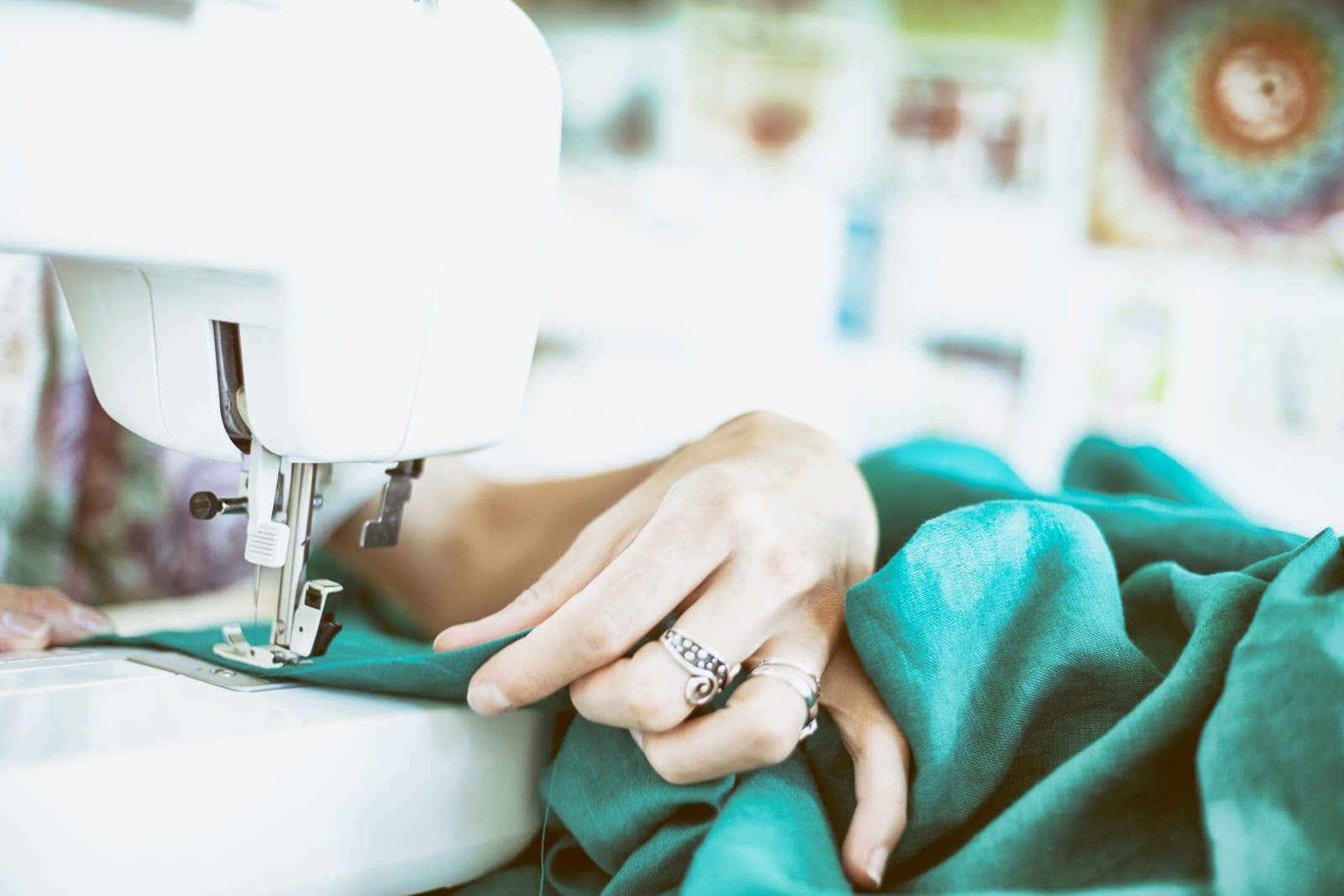
In a city there are two factories A and B. Each factory produces sports clothes for boys and girls. There are three types of clothes produced in both the factories, type I, II and III. For boys the number of units of types I, II and III respectively are 80, 70 and 65 in factory A and 85, 65 and 72 are in factory B. For girls the number of units of types I, II and III respectively are 80, 75, 90 in factory A and 50, 55, 80 are in factory B.
Based on the above information, answer the following questions:
→Based on the above information, answer the following questions:
- If P represents the matrix of number of units of each type produced by factory A for both boys and girls, then P is given by:
- $\begin{matrix}&\text{Boys}&\text{Girls}\end{matrix}\\\begin{matrix}\text{I}\\\text{II}\\\text{III}\end{matrix}\begin{bmatrix}85&50\\65&55\\72&80\end{bmatrix}$
- $\begin{matrix}&&&\text{I}\ \ \ &\text{II}&\text{III}\end{matrix}\\\begin{matrix}\text{Boys}\\\text{Girls}\end{matrix}\begin{bmatrix}50&55&80\\85&65&72\end{bmatrix}$
- $\begin{matrix}&&&\text{I}\ \ \ &\text{II}&\text{III}\end{matrix}\\\begin{matrix}\text{Boys}\\\text{Girls}\end{matrix}\begin{bmatrix}80&75&90\\80&70&65\end{bmatrix}$
- $\begin{matrix}&\text{Boys}&\text{Girls}\end{matrix}\\\begin{matrix}\text{I}\\\text{II}\\\text{III}\end{matrix}\begin{bmatrix}80&80\\70&75\\65&90\end{bmatrix}$
- If Q represents the matrix of number of units of each type produced by factory B for both boys and girls, then Q is given by:
- $\begin{matrix}&\text{Boys}&\text{Girls}\end{matrix}\\\begin{matrix}\text{I}\\\text{II}\\\text{III}\end{matrix}\begin{bmatrix}85&50\\65&55\\72&80\end{bmatrix}$
- $\begin{matrix}&&&\text{I}\ \ \ &\text{II}&\text{III}\end{matrix}\\\begin{matrix}\text{Boys}\\\text{Girls}\end{matrix}\begin{bmatrix}80&75&90\\80&70&65\end{bmatrix}$
- $\begin{matrix}&&&\text{I}\ \ \ &\text{II}&\text{III}\end{matrix}\\\begin{matrix}\text{Boys}\\\text{Girls}\end{matrix}\begin{bmatrix}80&75&90\\80&70&65\end{bmatrix}$
- $\begin{matrix}&\text{Boys}&\text{Girls}\end{matrix}\\\begin{matrix}\text{I}\\\text{II}\\\text{III}\end{matrix}\begin{bmatrix}80&80\\70&75\\65&90\end{bmatrix}$
- The total production of sports clothes of each type for boys is given by the matrix.
-
$\begin{matrix}\ \ \text{I}&\ \ \ \ \text{II}&\ \ \ \text{III}\end{matrix}\\\begin{matrix}[165&130&137]\end{matrix}\\$
-
$\begin{matrix}\ \ \text{I}&\ \ \ \ \text{II}&\ \ \ \text{III}\end{matrix}\\\begin{matrix}[130&165&137]\end{matrix}\\$
-
$\begin{matrix}\ \ \text{I}&\ \ \ \ \text{II}&\ \ \ \text{III}\end{matrix}\\\begin{matrix}[165&135&137]\end{matrix}\\$
-
$\begin{matrix}\ \ \text{I}&\ \ \ \ \text{II}&\ \ \ \text{III}\end{matrix}\\\begin{matrix}[137&135&165]\end{matrix}\\$
- The total production of sports clothes of each type for girls is given by the matrix.
- $\begin{matrix}\ \ \text{I}&\ \ \ \ \text{II}&\ \ \ \text{III}\end{matrix}\\\begin{matrix}[130&130&170]\end{matrix}\\$
- $\begin{matrix}\ \ \text{I}&\ \ \ \ \text{II}&\ \ \ \text{III}\end{matrix}\\\begin{matrix}[170&130&130]\end{matrix}\\$
- $\begin{matrix}\ \ \text{I}&\ \ \ \ \text{II}&\ \ \ \text{III}\end{matrix}\\\begin{matrix}[130&170&130]\end{matrix}\\$
- None of these
- Let R be a 3 × 2 matrix that represent the total production of sports dothes of each type for boys and girls, then transpose of R is:
- $\begin{bmatrix}165 & 135 & 137\\130 & 130 & 170 \end{bmatrix}$
- $\begin{bmatrix}130 & 130 & 170\\165 & 135 & 138 \end{bmatrix}$
- $\begin{bmatrix}165 & 132 \\135 & 130 \\137 & 170 \end{bmatrix}$
- $\begin{bmatrix}130 & 168 \\130 & 135 \\170 & 137 \end{bmatrix}$
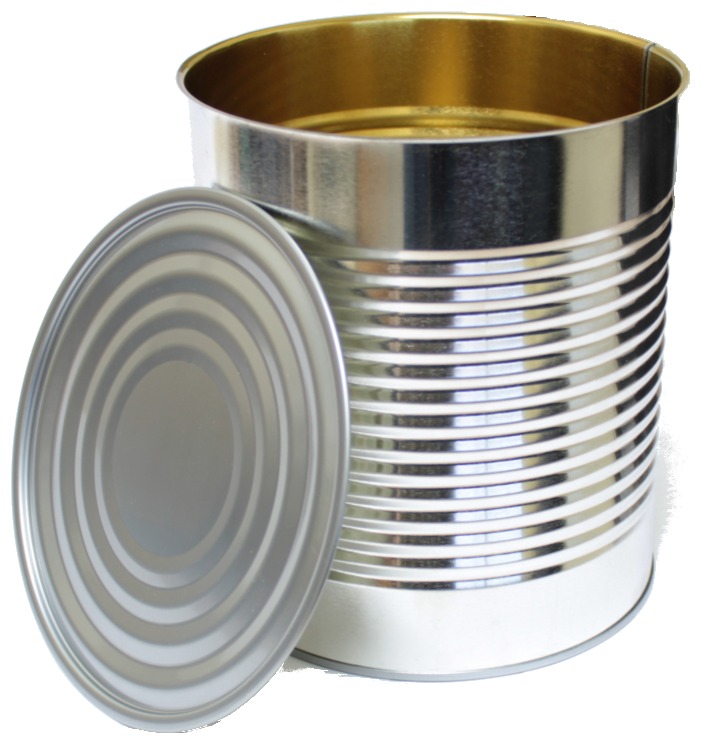
A tin can manufacturer designs a cylindrical tin can for a company making sanitizer and disinfector. The tin can is made to hold $3$ litres of sanitizer or disinfector.
Based on the above in formation, answer the following questions.
→Based on the above in formation, answer the following questions.
- If $r \ cm$ be the radius and $h \ cm$ be the height of the cylindrical tin can, then the surface area expressed as a function of r as.
- $2\pi\text{r}^2$
- $2\pi\text{r}^2+6000$
- $2\pi\text{r}^2+\frac{5000}{\text{r}}$
- $2\pi\text{r}^2+\frac{6000}{\text{r}}$
- The radius that will minimize the cost of the material to manufacture the tin can is.
- $\sqrt[3]{\frac{600}{\pi}}\text{cm}$
- $\sqrt{\frac{500}{\pi}}\text{cm}$
- $\sqrt[3]{\frac{1500}{\pi}}\text{cm}$
- $\sqrt{\frac{1500}{\pi}}\text{cm}$
- The height that will minimize the cost of the material to manufacture the tin can is.
- $\sqrt[3]{\frac{600}{\pi}}\text{cm}$
- $2\sqrt[3]{\frac{1500}{\pi}}\text{cm}$
- $\sqrt{\frac{1500}{\pi}}$
- $2\sqrt{\frac{1500}{\pi}}$
- If the cost of material used to manufacture the tin can is $₹\frac{100}{\text{m}^2}$ and $\sqrt[3]{\frac{1500}{\pi}}\approx7.8,$ then minimum cost is approximately.
- $₹\ 11.538$
- $₹\ 12$
- $₹\ 13$
- $₹\ 14$
- To minimize the cost of the material used to manufacture the tin can, we need to minimize the.
- Volume.
- Curved surface area.
- Total surface area.
- Surface area of the base.
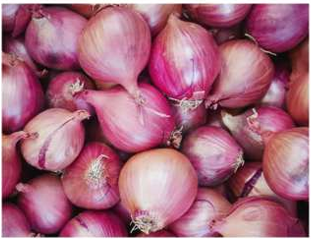
The Government declare that farmers can get ₹ 300 per quintal for their onions on 1st July and after that, the price will be dropped by ₹ 3 per quintal per extra day. Govind's father has 80 quintals of onions in the field on 1st July and he estimates that the crop is increasing at the rate of 1 quintal per day.
→
(i) If $x$ is the number of days after $1^{\text {st }}$ July, then express price and quantity of onion and the revenue as a function of $x$.
(ii) Find the number of days after 1st July, when Govind's father attains maximum revenue.
(iii) On which day should Govind's father harvest the onions to maximize his revenue?
OR
Find the maximum revenue collected by Govind's father.
Ramesh, the owner of a sweet selling shop, purchased some rectangular card board sheets of dimension 25 cm by 40 cm to make container packets without top. Let x cm be the length of the side of the square to be cut out from each corner to give that sheet the shape of the container by folding up the flaps.
Based on the above information answer the following questions.
(i) Express the volume (V) of each container as function of x only.
(ii) Find $\frac{d V}{d x}$
(iii) (a) for what value of x, the volume of each container is maximum ?
OR
(iii) (b) Check whether V has a point of inflection at x $x=\frac{65}{6}$ or not ?
→Based on the above information answer the following questions.
(i) Express the volume (V) of each container as function of x only.
(ii) Find $\frac{d V}{d x}$
(iii) (a) for what value of x, the volume of each container is maximum ?
OR
(iii) (b) Check whether V has a point of inflection at x $x=\frac{65}{6}$ or not ?
Three schools A, B and C organized a mela for collecting funds for helping the rehabilitation of flood victims. They sold handmade fans, mats, and plates from recycled material at a cost of ₹ 25 , ₹ 100 and ₹ 50 each. The number of articles sold by school A, B, C are given below.
→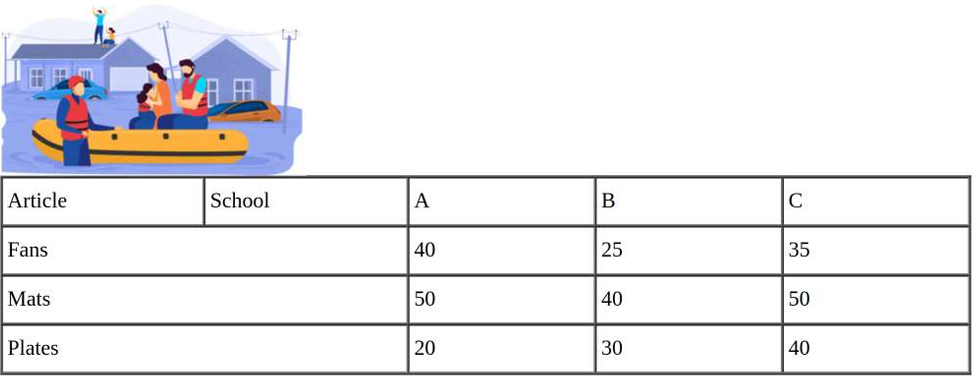
(i) Represent the sale of handmade fans, mats and plates by three schools A, B and C and the sale prices (in ₹) of given products per unit, in matrix form.
(ii) Find the funds collected by school A, B and C by selling the given articles.
(iii) If they increase the cost price of each unit by $20 \%$, then write the matrix representing new price.
OR
Find the total funds collected for the required purpose after $20 \%$ hike in price.
A trust fund has ₹ 35000 that must be invested in two different types of bonds, say X and Y. The first bond pays 10% interest p.a. which will be given to an old age home and second one pays 8% interest p.a. which will be given to WWA (Women Welfare Association).
Let A be a 1 × 2 matrix and B be a 2 × 1 matrix, representing the investment and interest rate on each bond respectively.

Based on the above information, answer the following questions.
→Let A be a 1 × 2 matrix and B be a 2 × 1 matrix, representing the investment and interest rate on each bond respectively.
Based on the above information, answer the following questions.
- If ₹ 15000 is invested in bond X, then
- $\begin{matrix}\ \ \ \ \ \ \ \ \ \ \ \ \ \text{investment}\end{matrix}\begin{matrix}&&&\text{X}&&\text{Y}\end{matrix}\\\begin{matrix}\text{A}\ =\text{X}\\\ \ \ \ \ \ \ \ \ \ \text{Y}\end{matrix}\begin{bmatrix}\ \ 15000\ \ \\\ \ 20000\ \end{bmatrix};\text{B}=\begin{bmatrix}0.1&0.08\end{bmatrix}\text{Interest rate.}$
- $\begin{matrix}&&&&&&&&\text{X}&\ \ \ \ \ \ \ \text{Y}\end{matrix}\begin{matrix}\ \ \ \ \ \ \ \ \ \ \ \ \ \ \ \ \ \ \ \ \ \ \ \text{investment}\end{matrix}\\\text{A = Investment}\begin{bmatrix}15000&20000\end{bmatrix};\ \begin{matrix}\text{B}\ =\text{X}\\\ \ \ \ \ \ \ \ \ \ \text{Y}\end{matrix}\begin{bmatrix}\ \ 0.1\ \ \\\ \ 0.08\ \end{bmatrix}$
- $\begin{matrix}&&&&&&&&\text{X}&\ \ \ \ \ \ \ \text{Y}\end{matrix}\begin{matrix}\ \ \ \ \ \ \ \ \ \ \ \ \ \ \ \ \ \ \ \ \ \ \ \text{investment}\end{matrix}\\\text{A = Investment}\begin{bmatrix}20000&15000\end{bmatrix};\ \begin{matrix}\text{B}\ =\text{X}\\\ \ \ \ \ \ \ \ \ \ \text{Y}\end{matrix}\begin{bmatrix}\ \ 0.08\ \ \\\ \ 0.1\ \end{bmatrix}$
- $\text{None of these}$
- If ₹ 15000 is invested in bond X, then total amount of interest received on both bonds is:
- ₹ 2000
- ₹ 2100
- ₹ 3100
- ₹ 4000
- If the trust fund obtains an annual total interest of ₹ 3200, then the investment in two bonds is:
- ₹ 15000 in X, ₹ 20000 in Y
- ₹ 17000 in X, ₹ 18000 in Y
- ₹ 20000 in X, ₹ 15000 in Y
- ₹ 18000 in X, ₹ 17000 in Y
- The total amount of interest received on both bonds is given by:
- AB
- A' B
- B' A
- None of these
- If the amount of interest given to old age home is ₹ 500, then the amount of investment in bond Y is:
- ₹ 20000
- ₹ 30000
- ₹ 15000
- ₹ 25000
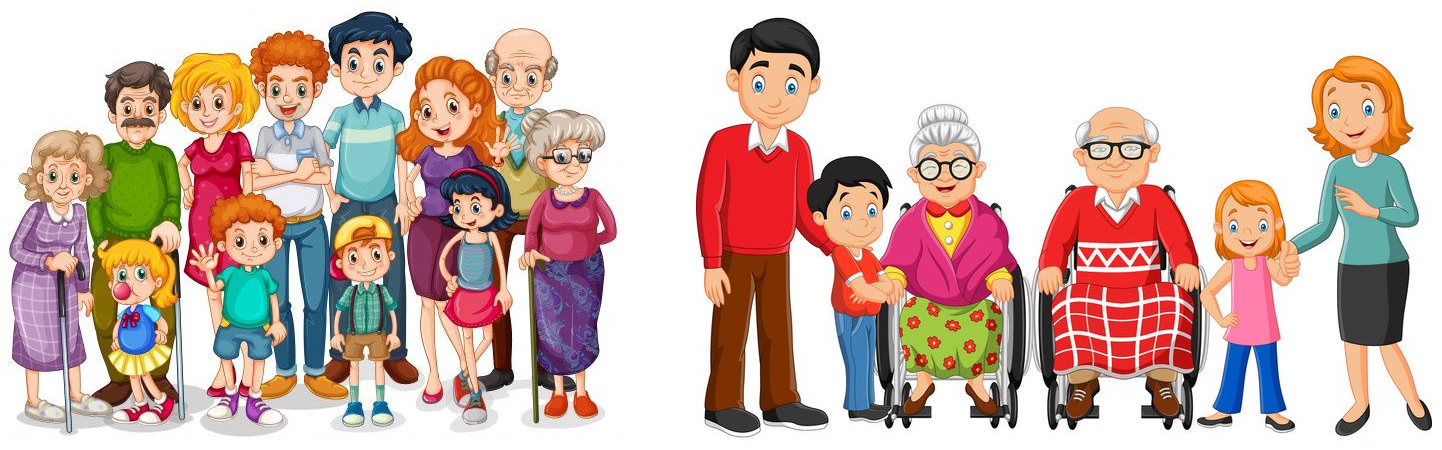
Consider $2$ families $A$ and $B$. Suppose there are $4$ men$,4$ women and $4$ children in family $A$ and $2$ men$, 2$ women and $2$ children in family $B$. The recommend daily amount of calories is $2400$ for a man, $1900$ for a woman$, 1800$ for a children and $45$ grams of proteins for a man$, 55$ grams for a woman and $33$ grams for children.
Based on the above information, answer the following questions.
→Based on the above information, answer the following questions.
- The requirement of calories and proteins for each person in matrix form can be represented as:
- $\begin{matrix}& \ \ \ \ \ \ \ \ \ \ \ \ \ \text{Calorise}&\text{Proteins}\end{matrix}\\\begin{matrix}\text{Man}\\\text{Woman}\\\text{Children}\end{matrix}\begin{bmatrix} \ \ 2400 \ \ \ & 45\\1900 & 55\\1800& \ 33&\end{bmatrix}$
- $\begin{matrix}& \ \ \ \ \ \ \ \ \ \ \ \ \ \text{Calorise}&\text{Proteins}\end{matrix}\\\begin{matrix}\text{Man}\\\text{Woman}\\\text{Children}\end{matrix}\begin{bmatrix} \ \ 1900 \ \ \ & 55\\2400 & 45\\1800& \ 33&\end{bmatrix}$
- $\begin{matrix}& \ \ \ \ \ \ \ \ \ \ \ \ \ \text{Calorise}&\text{Proteins}\end{matrix}\\\begin{matrix}\text{Man}\\\text{Woman}\\\text{Children}\end{matrix}\begin{bmatrix} \ \ 1800 \ \ \ & 33\\1900 & 55\\2400& \ 45&\end{bmatrix}$
- $\begin{matrix}& \ \ \ \ \ \ \ \ \ \ \ \ \ \text{Calorise}&\text{Proteins}\end{matrix}\\\begin{matrix}\text{Man}\\\text{Woman}\\\text{Children}\end{matrix}\begin{bmatrix} \ \ 2400 \ \ \ & 33\\1900 & 55\\1800& \ 45&\end{bmatrix}$
- Requirement of calories of family $A$ is:
- $24000$
- $24400$
- $15000$
- $15800$
- Requirement of proteins for family $B$ is:
- $560$ grams
- $332$ grams
- $266$ grams
- $300$ grams
- If $A$ and Bare two matrices such that $AB = B$ and $BA = A,$ then $A^2 + B^2$ equals.
- $2AB$
- $2BA$
- $A + B$
- $AB$
- If $\text{A}=(\text{a}_\text{ij})_{\text{m}\times\text{n}},\ \ \text{B}=(\text{b}_\text{ij})_{\text{n}\times\text{p}}$ and $\text{C}=(\text{c}_\text{ij})_{\text{p}\times\text{q}}$ then the product $(BC) A$ is possible only when.
- $m = q$
- $n = q$
- $p = q$
- $m = p$
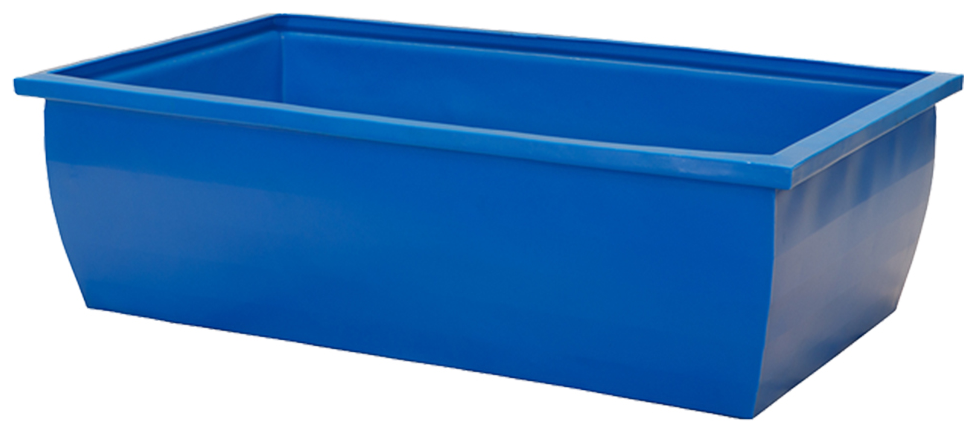
Nitin wants to construct a rectangular plastic tank for his house that can hold $80\ ft^3$ of water. The top of the tank is open. The width of tank will be $5\ ft$ but the length and heights are variables. Building the tank cost? $₹\ 20$ per sq. foot for the base and $₹\ 10$ per sq. foot for the side.
Based on the above information, answer the following questions.
→Based on the above information, answer the following questions.
- In order to make a least expensive water tank, Nitin need to minimize its.
- Volume
- Base
- Curved surface area
- Cost
- Total cost of tank as a function of $h$ can be represented as.
- $\ce{c(h) = 100h - 320 - 1600/ h}$
- $\ce{c(h) = 100h - 320h - 720h^2}$
- $\ce{c(h) = 100 + 320h + 1600h^2}$
- $\text{c}\big(\text{h}\big)=100\text{h}+320+\frac{1600}{\text{h}}$
- Range of $h$ is.
- $(3, 5)$
- $\big(0,\infty\big)$
- $(0, 8)$
- $(0, 3)$
- Value of hat which $c(h)$ is minimum, is.
- $4$
- $5$
- $6$
- $6, 7$
- The cost of least expensive tank is.
- $₹\ 1020$
- $₹\ 1100$
- $₹\ 1120$
- $₹\ 1220$
Western music concert is organised every year in the stadium that can hold 36000 spectators. With ticket price of ₹ 10, the average attendance has been 24000. Some financial expert estimated that price of a ticket should be determined by the function.
$\text{p}(\text{x})=15-\frac{\text{x}}{3000}$ where x is the number of tickets sold.

Based on the above information, answer the following questions.
→$\text{p}(\text{x})=15-\frac{\text{x}}{3000}$ where x is the number of tickets sold.
Based on the above information, answer the following questions.
- The revenue, R as a function of x can be represented as.
- $15\text{x}-\frac{\text{x}^2}{3000}$
- $15-\frac{\text{x}^2}{3000}$
- $15\text{x}-\frac{1}{3000}$
- $15\text{x}-\frac{\text{x}}{3000}$
- The range of x is.
- [24000, 36000]
- [0, 24000]
- [0, 36000]
- None of these
- The value of x for which revenue is maximum, is.
- 20000
- 21000
- 22500
- 25000
- When the revenue is maximum, the price of the ticket is.
- ₹ 5
- ₹ 5.5
- ₹ 7
- ₹ 7.5
- How many spectators should be present to maximize the revenue?
- 21500
- 21000
- 22000
- 22500