Questions

Case study (4 Marks)

Take a timed test

3 questions · self-marked practice — reveal the answer and mark yourself.

Question 14 Marks
Answer
When we solve an L.P.P. graphically, the optimal (or optimum) value of the objective function is attained at corner points of the feasible region.
ii. From the graph of 3x + 4y < 12 it is clear that it contains the origin but not the points on the line 3x + 4y = 12Image
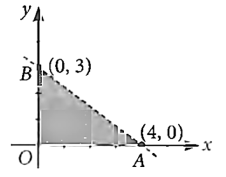
iii. Maximum of objective function occurs at corner points
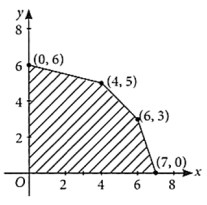
Corner PointsValue of z = 2x + 5y
(0,0)0
(7,0)14
(6,3)27
(4,5)$33 \leftarrow$ Maximum
(0,6)30
OR
Value of $Z=p x+q y$ at $(15,15)=15 p+15 q$ and that at $(0,20)=20 q$. According to given condition, we have $15 p +15 q =20 q \Rightarrow 15 p =5 q \Rightarrow q =3 p$
View full question & answer
Question 24 Marks
Read the following text carefully and answer the questions that follow:
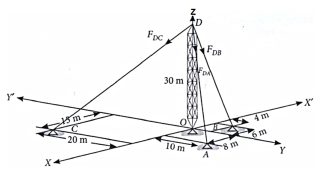
Consider the following diagram, where the forces in the cable are given.
Image
i. What is the equation of the line along cable $AD$ ? $(1)$
ii. What is length of cable $DC$ ? $(1)$
iii. Find vector $DB\ (2)$
OR
What is sum of vectors along the cable? $(2)$
Answer
$i.$ Clearly, the coordinates of $A$ are $(8, 10, 0)$ and $D$ are $(0, 0, 30)$
$\therefore$ Equation of $AD$ is given by
$\frac{x-0}{8-0}=\frac{y-0}{10-0}=\frac{z-30}{-30}$
$\Rightarrow \frac{z}{4}=\frac{y}{5}=\frac{30-z}{15}$
$ii$. The coordinates of point $C$ are $(15,20, 0)$ and $D$ are $(0, 0, 30)$
$\therefore$ Length of the cable $DC$
$=\sqrt{(0-15)^2+(0+20)^2+(30-0)^2}$
$=\sqrt{225+400+900}=\sqrt{1525}=5 \sqrt{61} m$
$iii.$ Since, the coordinates of point $B$ are $(-6, 4, 0) $ and $D$ are $(0, 0, 30),$
therefore vector $DB$ is
$(-6-0) \hat{i}+(4-0) \hat{j}+(0-30) \hat{k}$, i.e., $-6 \hat{i}+4 \hat{j}-30 \hat{k}$
OR
Required sum
$=(8 \hat{i}+10 \hat{j}-30 \hat{k})+(-6 \hat{i}+4 \hat{j}-30 \hat{k})+(15 \hat{i}-20 \hat{j}-30 \hat{k})$
$=17 \hat{i}-6 \hat{j}-90 \hat{k}$
View full question & answer
Question 34 Marks
Read the following text carefully and answer the questions that follow:
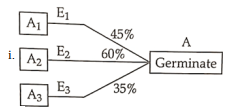
A shopkeeper sells three types of flower seeds $A_1 A_2 A_3$They are sold in the form of a mixture, where the proportions of these seeds are $4 : 4 : 2$ respectively. The germination rates of the three types of seeds are $45\%, 60\%$ and $35\%$ respectively.
Image
Based on the above information:
$i.$ Calculate the probability that a randomly chosen seed will germinate. $(1)$
$ii.$ Calculate the probability that the seed is of type $A2,$ given that a randomly chosen seed germinates. $(1)$
$iii.\ A$ die is throw and a card is selected at random from a deck of $52$ playing cards. Then find the probability of getting an even number on the die and a spade card. $(2)$
$OR$
If $A$ and $B$ are any two events such that $P(A) + P(B) - P(A$ and $B) = P(A) ,$ then find $P( A |B). 2)$
Answer
Image
$\text { Here, } P \left( E _1\right)=\frac{4}{10}, P \left( E _2\right)=\frac{4}{10}, P \left( E _3\right)=\frac{2}{10}$
$P\left(\frac{A}{E_1}\right)=\frac{45}{100}, P\left(\frac{A}{E_2}\right)=\frac{60}{100}, P\left(\frac{A}{E_3}\right)=\frac{35}{100}$
$\therefore P ( A )= P \left( E _1\right) \cdot P \left(\frac{A}{E_1}\right)+ P \left( E _2\right) \cdot P\left(\frac{A}{E_2}\right)+ P \left( E _3\right) \cdot P\left(\frac{A}{E_3}\right)$
$=\frac{4}{10} \times \frac{45}{100}+\frac{4}{10} \times \frac{60}{100}+\frac{2}{10} \times \frac{35}{100}$
$=\frac{180}{1000}+\frac{240}{1000}+\frac{70}{100}$
$=\frac{490}{1000}=4.9$
$\text  ii.$ Required probability $ =P\left(\frac{E_2}{A}\right)$
$=\frac{P\left(E_2\right) \cdot P\left(\frac{A}{E_2}\right)}{P(A)}$
$=\frac{\frac{4}{10} \times \frac{60}{100}}{\frac{490}{1000}}$
$=\frac{240}{490}=\frac{24}{49}$
$iii.$ Let,
$E_1=$ Event for getting an even number on die and
$E_2=$ Event that a spade card is selected
$\therefore P\left(E_1\right)=\frac{3}{6}$
$=\frac{1}{2}$
and $P\left(E_2\right)=\frac{13}{52}=\frac{1}{4}$
Then,$P \left( E _1 \cap E _2\right)= P \left( E _1\right) \cdot P \left( E _2\right)$
$=\frac{1}{2}, \frac{1}{4}=\frac{1}{8}$
$OR$
$P ( A )+ P ( B )- P ( A$ and $B )= P ( A )$
$\Rightarrow P(A)+P(B)-P(A \cap B)=P(A)$
$\Rightarrow P(B)-P(A \cap B)=0$
$\Rightarrow P(A \cap B)=P(B)$
$\therefore P ( A \mid B )=\frac{P(A \cap B)}{P(B)}$
$=\frac{P(B)}{P(B)}$
$=1$
View full question & answer