Question
Read the passage given below and answer the following questions:

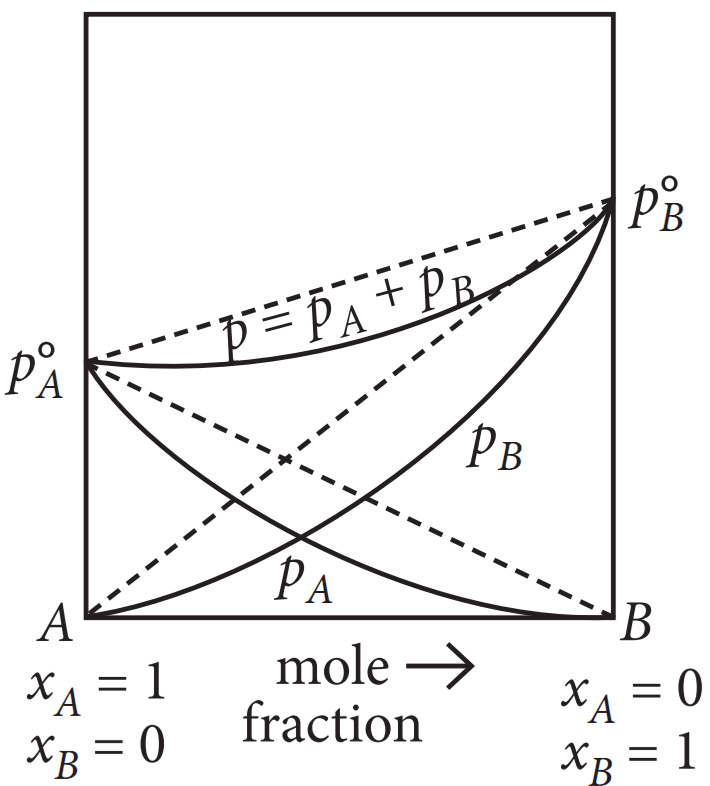
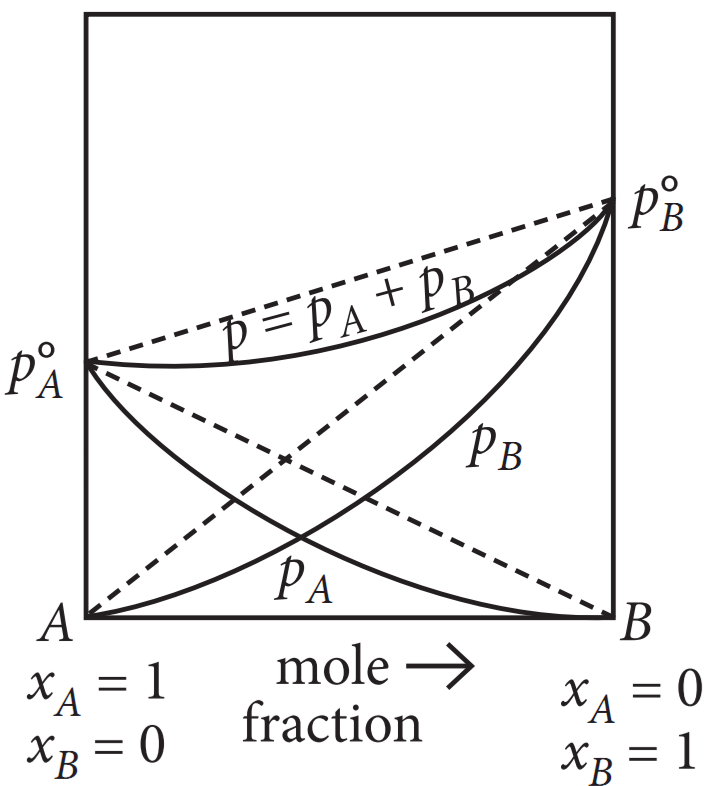
An ideal solution may be defined as the solution which obeys Raoult's law exactly over the entire range of concentration. The solutions for which vapour pressure is either higher or lower than that predicted by Raoult's law are called non-ideal solutions.Non-ideal solutions can show either positive or negative deviations from Raoult's law depending on whether the A-B interactions in solution are stronger or weaker than A - A and B - B interactions.

The following questions are multiple choice questions. Choose the most appropriate answer:

  1. Which of the following solutions is/are ideal solution(s)?
  1. Bromoethane and iodoethane.
  2. Acetone and chloroform
  3. Benzene and acetone
  4. n-heptane and n-hexane
  1. Only I
  2. I and II
  3. II and III
  4. I and Iv
  1. For which of the following solutions $\Delta\text{H}_{\text{mix}}$ and $\Delta\text{V}_{\text{mix}}$ is negative?
  1. Acetone and aniline
  2. Ethyl alcohol and cyclohexane
  3. Acetone and CS2
  4. Benzene and toluene
  1. Which of the following is not true for positive deviations?
  1. The A-B interactions in solution are weaker than the A - A and B - B interactions.
  2. $\text{P}_\text{A}<\text{P}\mathring{\text{A}}\ \text{x}_\text{A}$ and $\text{P}_\text{B}<\text{P}\mathring{\text{B}}\ \text{x}_\text{B}$
  3. Carbon tetrachloride and chloroform mixture is an example of positive deviations.
  4. All of these.
  1. For water and nitric acid mixture, which of the given graph is correct?
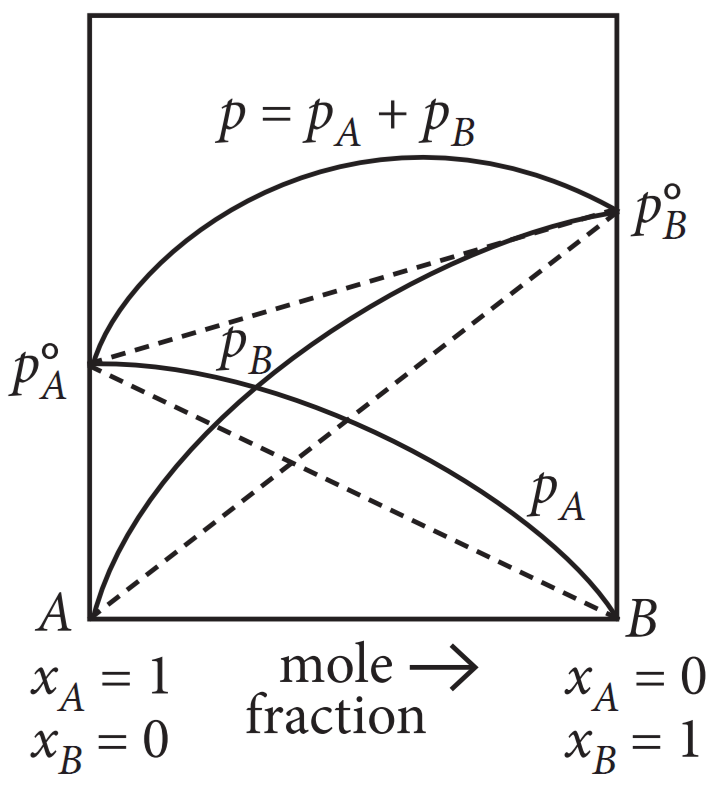
 

  1.  


  1.  

  1. Both of these
  2. None of these
  1. Water-HCI mixture.
  1. Shows positive deviations.
  2. Forms minimum boiling azeotrope.
  3. Shows negative deviations.
  4. Forms maximum boiling azeotrope.
  1. I and II
  2. I and III
  3. I and IV
  4. III and IV

Answer

  1. (d) I and Iv

Explanation:

II represents negative deviations and III represents positive deviations.

  1. (a) Acetone and aniline

Explanation:

Acetone and aniline mixture represents negative deviations from Raoult's law, hence for this mixture,

$\Delta\text{H}_{\text{mix}}$ and $\Delta\text{V}_{\text{mix}}$ is negative.

  1. (b) $\text{P}_\text{A}<\text{P}\mathring{\text{A}}\ \text{x}_\text{A}$ and $\text{P}_\text{B}<\text{P}\mathring{\text{B}}\ \text{x}_\text{B}$

Explanation:

For positive deviations $\text{P}_\text{A}<\text{P}\mathring{\text{A}}\ \text{x}_\text{A}$ and $\text{P}_\text{B}<\text{P}\mathring{\text{B}}\ \text{x}_\text{B}$

  1. (b) 

Explanation:

Water and nitric acid mixture shows negative deviations from Raoult's law, hence 

 $\text{P}_\text{A}<\text{P}\mathring{\text{A}}\ \text{x}_\text{A}$ and $\text{P}_\text{B}<\text{P}\mathring{\text{B}}\ \text{x}_\text{B}$

  1. (d) III and IV

Explanation:

Water-HCI mixture shows negative deviations from Raoult's law and solutions showing negative deviations from ideal behaviour form maximum boiling azeotrope.

Need a full question paper?

Generate a complete, print-ready paper with questions like this in minutes — across 16+ boards, with answer keys.

Start Generating Free

Similar questions

A reaction is said to be of the first order if the rate of the reaction depends upon one concentration term only. For a first order reaction of the type A → Products, the rate of the reaction is given as: rate = k[A]. The differential rate law is given as: $\frac{\text{dA}}{\text{dt}}=-\text{k}[\text{A}].$ The integrated rate law is: In $\frac{[\text{A}]}{[\text{A}]_0}=-\text{kt},$ [A] is the concentration of reactant left at time t and [A]0 is the initial concentration of the reactant, k is the rate constant.
The following questions are multiple choice questions. Choose the most appropriate answer:
  1. The unit of rate constant for a first order reaction is:
  1. S-1
  2. mol L-1 s-1
  3. L mol-1 s-1
  4. L2 mol-2 s-1
  1. Half-life period of a first order reaction is 10min. Starting with initial concentration 12M, the rate after 20min is:
  1. 0.693 × 3M min-1
  2. 0.0693 × 4M min-1
  3. 0.0693 × M min-1
  4. 0.0693 × 3M min-1
  1. 50% of a first order reaction is complete in 23 minutes. Calculate the ti me required to complete 90% of the reaction.
  1. 70.4 minutes.
  2. 76.4 minutes.
  3. 38.7 minutes.
  4. 35.2 minutes.
  1. For a first order reaction, (A) → products, the concentration of A changes from 0.1M to 0.025M in 40 minutes. The rate of reaction when the concentration of A is 0.01M, is:
  1. 3.47 × 10⁻⁴ M/ min
  2. 3.47 × 10⁻⁵ M/ min
  3. 1.73 × 10⁻⁴ M/ min
  4. 1.73 × 10⁻⁵ M/ min
  1. The half-life period ofa 1st order reaction is 60 minutes. What percentage will be left over after 240 minutes?
  1. 6.25%
  2. 4.25%
  3. 5%
  4. 6%
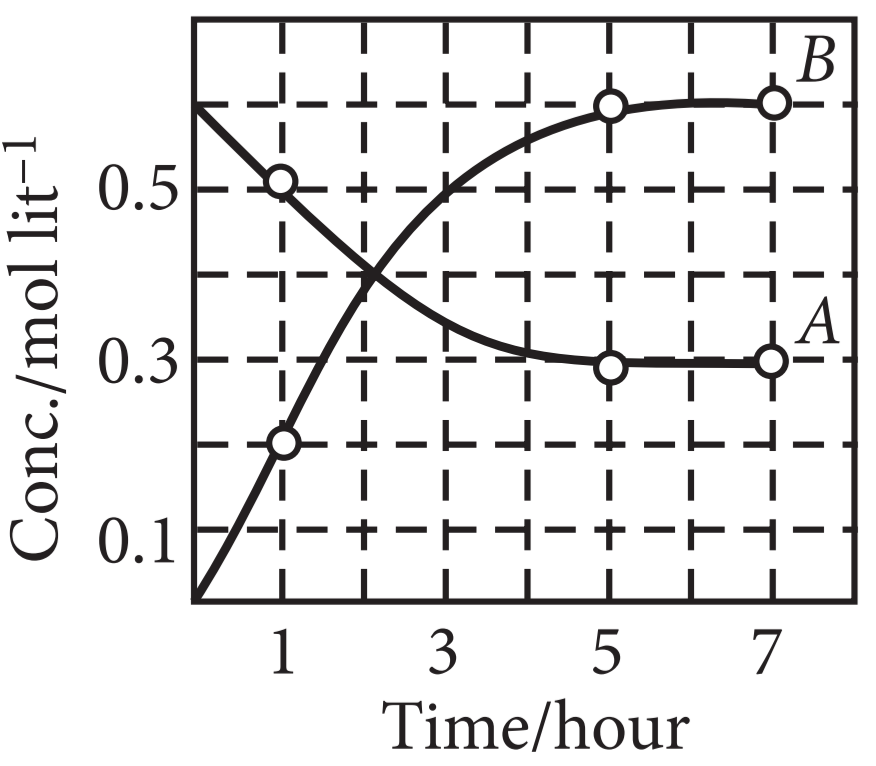
The progress of the reaction, $\text{A}\rightleftharpoons\text{nB}$ with time is represented in the following figure:

The following questions are multiple choice questions. Choose the most appropriate answer:
  1. What is the value of n?
  1. 1
  2. 2
  3. 3
  4. 4
  1. Find the value of the equilibrium constant.
  1. 0.6M
  2. 1.2M
  3. 0.3M
  4. 2.4M
  1. The initial rate of conversion of A will be:
  1. 0.1 mol L-1hr-1
  2. 0.2 mol L-1hr-1
  3. 0.4 mol L-1hr-1
  4. 0.8 mol L-1hr-1
  1. For the reaction, if $\frac{\text{d}[\text{B}]}{\text{dt}}=2\times10^{-4},$ value of $-\frac{\text{d}[\text{A}]}{\text{dt}}$ will be:
  1. 2 × 10-4
  2. 10-4
  3. 4 × 10-4
  4. 0.5 × 10⁻⁴
  1. Which factor has no effect on rate of reaction?
  1. Temperature.
  2. Nature of reactant.
  3. Concentration of reactant.
  4. Molecularity.
Number of molecules which must collide simultaneously to give product is called molecularity. It is equal to sum of coefficients of reactants present in stoichiometric chemical equation.

For reaction, m1A + m2B → Product

Molecularity = [m1 + m2]

ln complex reaction each step has its own molecularity which is equal to the sum of coefficients of reactants present in a particular step. Molecularity is a theoretical property. Its value is any whole number. Number of concentration terms on which rate of reaction depends is called order of reaction or sum of powers of concentration terms present in the rate equation is called order of reaction.

If rate equation ofreaction is: Rate $=\text{k}\cdot\text{C}^{\text{m}_1}_\text{A}\cdot\text{C}^{\text{m}_2}_\text{B}$

Then order of reaction = m1 + m2.

ln simple reaction, order and molecularity are same.

ln complex reaction, order of slowest step is the order ofover all reaction. This step is known as rate determining step. Order is an experimental property. Its value may be zero, fractional or negative.

The following questions are multiple choice questions. Choose the most appropriate answer:

  1. Higher order(> 3) reactions are rare due to:
  1. Shifting of equilibrium towards reactants due to elastic collisions.
  2. Loss of active species on collision.
  3. Low probability of simultaneous collision of all the reacting species.
  4. Increase in entropy and activation energy as more molecules are involved.
  1. The molecularity of the reaction:

$6\text{FeSO}_4+3\text{H}_2\text{SO}_4+\text{KClO}_3\rightarrow\text{KCl}+3\text{Fe}_2(\text{SO}_4)_3+3\text{H}_2\text{O}$ is:

  1. 6
  2. 10
  3. 3
  4. 7
  1. Which of the following statements is false in the following?
  1. Order of a reaction may be even zero.
  2. Molecularity of a reaction is always a whole number.
  3. Molecularity and order always have same values for a reaction.
  4. Order of a reaction depends upon the mechanism of the reaction.
  1. The rate of reaction, A + 2B → products, is given by the following equation:

$-\frac{\text{d}[\text{A}]}{\text{dt}}=\text{k}[\text{A}][\text{B}]^2$

If B is present in large excess, the order of the reaction is:

  1. Zero
  2. First
  3. Second
  4. Third
  1. The rate of the reaction, A + B + C → products, is given by $\text{r}=\frac{\text{d}[\text{A}]}{\text{dt}}=\text{k}[\text{A}]^\frac{1}{2}[\text{B}]^\frac{1}{3}[\text{C}]^\frac{1}{4}.$ The order of the reaction is:

  1. $\frac{1}{3}$​​​​​​​

  2. $\frac{1}{4}$

  3. $\frac{1}{2}$

  4. $\frac{13}{12}$

Read the passage given below and answer the following questions:

Williamson's synthesis is used for the preparation of symmetrical as well as unsymmerical ether. It is SN2 reaction mechanism. In Williamson's synthesis, 1º alkyl halide are used for preparation of ethers because 2º and 3º alkyl halide give alkene. Ethers are cleaved by hydrogen halides to alcohol and alkyl halide where alkyl halide is corresponding to that alkyl which has less number of carbon atom (it is because of less steric hindrance). In polar media unsymmetrical ether like tertiary butyl ethyl ether gives ethyl alcohol and tertiary butyl halide as reaction proceeds via carbocation.

In these questions (Q. No. i-iv), a statement of assertion followed by a statement of reason is given. Choose the correct answer out of the following choices.

  1. Assertion and reason both are correct statements and reason is correct explanation for assertion.
  2. Assertion and reason both are correct statements but reason is not correct explanation for assertion.
  3. Assertion is correct statement but reason is wrong statement.
  4. Assertion is wrong statement but reason is correct statement.
  1. Assertion: Rate of reaction of alkyl halide in Williamson's synthesis reaction is 1ºRX > 2ºRX > 3ºRX.

Reason: It is a type of bimolecular substitution reaction (SN2).

  1. Assertion: T-Butyl methyl ether is not prepared by the reaction of t-butyl bromide with sodium methoxide.

Reason: Sodium methoxide is a weak nucleophile.

  1. Assertion: Williamson's synthesis method cannot be used for preparing diphenyl ether.

Reason: Aryl halides do not undergo nucleophilic substitution easily.

  1. Assertion: When isopropyl bromide is treated with sodium isopropoxide, di-isopropyl ether is obtained as a major product.

Reason: With secondary alkyl halides, both substitution and elimination occur.

  1. Assertion: Both symmetrical and unsymmetrical ethers can be prepared by Williamson's synthesis.

Reason: Williamson's synthesis is an example of nucleophilic substitution reaction.

A reaction in which rate ofreaction is independent of concentration of the reactants is called zero order reaction. Photochemical combination of hydrogen and chlorine to give hydrogen chloride is an example of zero order reaction. The rate constant of a zero order reaction is equal to the rate of reaction. The half life period of a zero order reaction is directly proportional to initial concentration of the reactant. For a zero order reaction,

$\text{k}=\frac{1}{\text{t}}\left\{[\text{A}]-[\text{A}]\right\}$

In these questions (Q. No. i-iv), a statement of assertion followed by a statement of reason is given. Choose the correct answer out of the following choices.

  1. Assertion and reason both are correct statements and reason is correct explanation for assertion.
  2. Assertion and reason both are correct statements but reason is not correct explanation for assertion.
  3. Assertion is correct statement but reason is wrong statement.
  4. Assertion is wrong statement but reason is correct statement.
  1. Assertion: For a zero order reaction, plot of rate vs concentration will be a straight line parallel to concentration axis.

Reason: For a zero order reaction, rate is independent of concentration.

  1. Assertion: Photochemical combination of hydrogen and chlorine to give hydrogen chloride is an example of zero order reaction.

Reason: The rate of reaction depends on the concentration of hydrogen and independent of concentration of chlorine.

  1. Assertion: If in a zero order reaction, the concentration of the reactant is doubled, the half-life period is also doubled.

Reason: For a zero order reaction, the rate of reaction is independent of initial concentration.

  1. Assertion: ln a reaction A → products, the concentration of the reactant is reduced to zero after a finite time.

Reason: The order of reaction is zero.

  1. Assertion: Rate constant of a zero order reaction has same units as the rate of reaction.

Reason: Rate constant of a zero order reaction does not depend on the unit of concentration.

Two types of conductors are generally used, metallic and electrolytic. Free electrons are the current carrier in metallic and in electrolytic conductors, free ions. Specific conductance or conductivity of an electrolytic solution is given by

$\text{K}=\text{C}\times\frac{\text{l}}{\text{A}}$

where, $\text{C}\times\frac{1}{\text{R}}$ and $\frac{\text{l}}{\text{A}}=\text{G}^\star$ (cell constant)

Molar conductance $(\wedge_\text{m})$ and equivalent conductance $(\wedge_\text{e})$ of an electrolyte solution are calculated as

$\wedge_\text{m}=\frac{\text{K}\times1000}{\text{M}}$ or $\wedge_\text{e}=\frac{\text{K}\times1000}{\text{N}}$

where, M = molarity of solution and N is normality of solution. Molar conductance of strong electrolyte depends on the concentration.

$\wedge_\text{m}=\wedge^\circ_{\text{m}^-}\text{b}\sqrt{\text{C}}$

$\wedge^\circ_\text{m}=$ molar conductance at infinite dilution, b = constant, C = cone.of solution

In these questions (Q. No. i-iv), a statement of assertion followed by a statement of reason is given. Choose the correct answer out of the following choices.

  1. Assertion and reason both are correct statements and reason is correct explanation for assertion.
  2. Assertion and reason both are correct statements but reason is not correct explanation for assertion.
  3. Assertion is correct statement but reason is wrong statement.
  4. Assertion is wrong statement but reason is correct statement.
  1. Assertion: The molar conductivity of strong electrolyte decreases with increase in concentration.

Reason: At high concentration, migration ofions is slow.

  1. Assertion: The molar conductance of weak electrolyte at infinite dilution is equal to the sum of molar conductance of cations and anions.

Reason: Kohlrausch's law is applicable for strong electrolytes.

  1. Assertion: Equivalent conductance of all electrolytes increases with increasing concentration.

Reason: More number ofions are available per gram equivalent at higher concentration.

  1. Assertion: Specific conductance decreases with dilution whereas equivalent conductance increases.

Reason: On dilution, number of ions per millilitre decreases but total number ofions increases considerably.

  1. Assertion: The ratio of specific conductivity to the observed conductance does not depend upon the concentration of the solution taken in the conductivity cell.

Reason: Specific conductivity decreases with dilution whereas observed conductance increases with dilution.

Read the passage given below and answer the following questions:

Ligands are atoms or ions which can donate electrons to the central atoms. Ligands can be monodentate, bidentate or polydentate as well. Few ligands can coordinate with the central atom through more than one site, these are called ambidentate ligands. When a di- or polydentate ligand uses its two or more donor atoms to bind a single metal ion, it is said to be a chelating ligand.

In these questions (Q. No. i-iv), a statement of assertion followed by a statement ofreason is given. Choose the correct answer out of the following choices.

  1. Assertion and reason both are correct statements and reason is correct explanation for assertion.
  2. Assertion and reason both are correct statements but reason is not correct explanation for assertion.
  3. Assertion is correct statement but reason is wrong statement.
  4. Assertion is wrong statement but reason is correct statement.
The following questions are multiple choice questions. Choose the most appropriate answer:

  1. Assertion: Glycinate ion is an example of monodentate ligand.

Reason: Glycinate contains N and O as donor atoms.

  1. Assertion: EDTA forms complex with divalent metals of 3d-series in the ratio of 1 : 1.

Reason: EDTA has 4 - COOH groups.

  1. Assertion: Oxalate ion is a bidentate ligan.

Reason: Oxalate ion has two donor atoms.

  1. Assertion: A chelating ligand must possess two or more lone pairs at such a distance that it may form suitable strain free 5 and 6 membered rings with the metal ion.

Reason: H2N - NH2 is a chelating ligand.

  1. Assertion: In Zeise's salt coordination number of Pt is five.

Reason: Ethene is a monodentate ligand.

Read the passage given below and answer the following questions:
The concentration of a solute is very important in studying chemical reactions because it determines how often molecules collide in solution and thus indirectly determine the rate of reactions and the conditions at equilibrium. There are several ways to express the amount of solute present in a solution. The concentration of a solution is a measure of the amount of solute that has been dissolved in a given amount of solvent or solution. Concentration can be expressed in terms of molarity, molality, parts per million, mass percentage, volume percentage, etc.
The following questions are multiple choice questions. Choose the most appropriate answer:
  1. A solution is prepared using aqueous Kl which is turned out to be 20% w/w Density of Kl is 1.202 g/mL the molality of the given solution and mole fraction of solute are respectively.
  1. 1.95m, 0.120
  2. 1.5m, 0.0263
  3. 2.5m, 0.0569
  4. 3.0m, 0.0352
  1. The molarity (in mol L-1) of the given solution will be.
  1. 1.56
  2. 1.89
  3. 0.263
  4. 1.44
  1. Which of the following is correct relationship between mole fraction and molality?
  1. $\text{x}_2=\frac{\text{mM}_1}{1+\text{mM}_1}$
  2. $\text{x}_2=\frac{\text{mM}_1}{1-\text{mM}_1}$
  3. $\text{x}_2=\frac{1+\text{mM}_1}{\text{mM}_1}$
  4. $\text{x}_2=\frac{1-\text{mM}_1}{\text{mM}_1}$
  1. Which of the following is temperature dependent?
  1. Molarity
  2. Molality
  3. Mole fraction
  4. Mass percentage
  1. Which of the following is true for an aqueous solution of the solute in terms of concentration?
  1. 1M = 1m
  2. 1M > 1m
  3. 1M < 1m
  4. Cannot be predicted
Read the passage given below and answer the following questions:
To explain bonding in coordination compounds various theories were proposed. One of the important theory was valence bond theory. According to that, the central metal ion in the complex makes available a number of empty orbitals for the formation of coordination bonds with suitable ligands. The appropriate atomic orbitals of the metal hybridise to give a set of equivalent orbitals of definite geometry.
The d-orbitals involved in the hybridisation may be either inner d-orbitals i.e., (n - 1)d or outer d-orbitals i.e., nd. For example, Co3+ forms both inner orbital and outer orbital complexes, with ammonia it forms [Co(NH3)6]3+ and with fluorine it forms [CoF6]3- complex ion.
The following questions are multiple choice questions. Choose the most appropriate answer:
  1. Which of the following is not true for [CoF6]3-?
  1. It is paramagnetic.
  2. It has coordination number of 6.
  3. It is outer orbital complex.
  4. It involves d2sp3 hybridisation.
  1. [Cr(H2O)6]Cl3 (at. no. of Cr = 24) has a magnetic moment of 3.83B.M. The correct distribution of 3d-electrons in the central metal of the complex is:
  1. $3\text{d}^1_\text{xy},3\text{d}^1_{\text{x}^2-\text{y}^2},3\text{d}^1_\text{yz}$
  2. $3\text{d}^1_\text{xy},3\text{d}^1_{\text{yz}},3\text{d}^1_\text{zx}$
  3. $3\text{d}^1_\text{xy},3\text{d}^1_{\text{zy}},3\text{d}^1_{\text{z}^2}$
  4. $3\text{d}^1_{\text{x}^2-\text{y}^2},3\text{d}^1_{\text{z}^2},3\text{d}^1_\text{xz}$
  1. Which of the following is true for [Co(NH3)6]3+?
  1. It is an octahedral, di magnetic and outer orbital complex.
  2. It is an octahedral, paramagnetic and outer orbital complex.
  3. It is an octahedral, paramagnetic and inner orbital complex.
  4. It is an octahedral, di magnetic and inner orbital complex.
  1. The paramagnetism of [CoF6]3- is due to.
  1. 3 electrons.
  2. 4 electrons.
  3. 2 electrons.
  4. 1 electron.
  1. Which of the following is an inner orbital or low spin complex?
  1. [Ni(H2O)6]3+
  2. [FeF6]3-
  3. [Co(CN)6]3-
  4. [NiCl4]2-
What is fructose? Explain the structure of fructose.