Question
Read the passage given below and answer the following questions:

Williamson's synthesis is used for the preparation of symmetrical as well as unsymmerical ether. It is SN2 reaction mechanism. In Williamson's synthesis, 1º alkyl halide are used for preparation of ethers because 2º and 3º alkyl halide give alkene. Ethers are cleaved by hydrogen halides to alcohol and alkyl halide where alkyl halide is corresponding to that alkyl which has less number of carbon atom (it is because of less steric hindrance). In polar media unsymmetrical ether like tertiary butyl ethyl ether gives ethyl alcohol and tertiary butyl halide as reaction proceeds via carbocation.

In these questions (Q. No. i-iv), a statement of assertion followed by a statement of reason is given. Choose the correct answer out of the following choices.

  1. Assertion and reason both are correct statements and reason is correct explanation for assertion.
  2. Assertion and reason both are correct statements but reason is not correct explanation for assertion.
  3. Assertion is correct statement but reason is wrong statement.
  4. Assertion is wrong statement but reason is correct statement.
  1. Assertion: Rate of reaction of alkyl halide in Williamson's synthesis reaction is 1ºRX > 2ºRX > 3ºRX.

Reason: It is a type of bimolecular substitution reaction (SN2).

  1. Assertion: T-Butyl methyl ether is not prepared by the reaction of t-butyl bromide with sodium methoxide.

Reason: Sodium methoxide is a weak nucleophile.

  1. Assertion: Williamson's synthesis method cannot be used for preparing diphenyl ether.

Reason: Aryl halides do not undergo nucleophilic substitution easily.

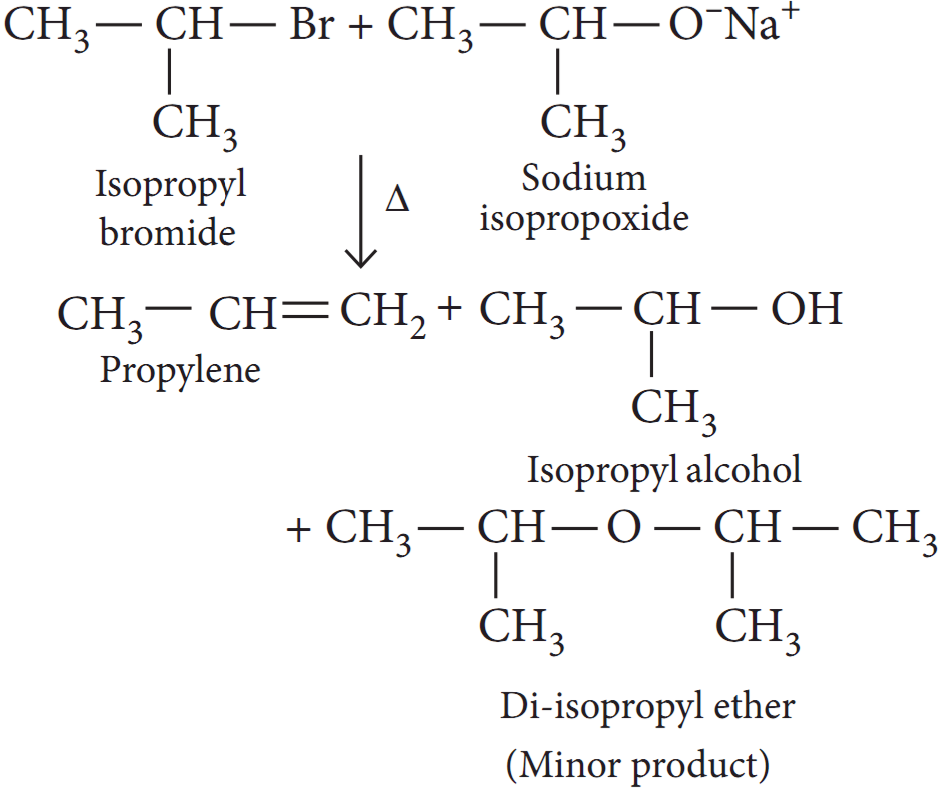
  1. Assertion: When isopropyl bromide is treated with sodium isopropoxide, di-isopropyl ether is obtained as a major product.

Reason: With secondary alkyl halides, both substitution and elimination occur.

  1. Assertion: Both symmetrical and unsymmetrical ethers can be prepared by Williamson's synthesis.

Reason: Williamson's synthesis is an example of nucleophilic substitution reaction.
Answer

  1. (a) Assertion and reason both are correct statements and reason is correct explanation for assertion.

Explanation:

Williamson's synthesis occurs by SN2 mechanism and primary alkyl halides are most reactive in SN2 reactions.

  1. (c) Assertion is correct statement but reason is wrong statement.

​​​​​​​​​​​​​​Explanation:

Sodium methoxide is a strong nucleophile. ln presence of a strong base, i.e., sodium methoxide, t-butyl bromide undergoes dehyrohalogenation to form isobutylene.

  1. (a) Assertion and reason both are correct statements and reason is correct explanation for assertion.

​​​​​​​​​​​​​​​​​​​​​Explanation:

Diary! ethers cannot be prepared by Williamson's synthesis since aryl halides do not undergo nucleophilic substitution easily.

  1. (d) Assertion is wrong statement but reason is correct statement.

​​​​​​​​​​​​​​​​​​​​​Explanation:

Since secondary and tertiary alkyl halides prefer to undergo elimination rather th an substitution, therefore, even symmetrical ethers containing secondary and tertiary alkyl groups cannot be prepared in good yields by Williamson synthesis.

  1. (b) Assertion and reason both are correct statements but reason is not correct explanation for assertion.

​​​​​​​​​​​​​​​​​​​​​​​​​​​​Explanation:

Depending upon whether the alkyl halide and the alkoxide ion carry the same or different alkyl groups, both symmetrical and unsymmetrical ethers can be prepared by Williamsons synthesis.


Need a full question paper?

Generate a complete, print-ready paper with questions like this in minutes — across 16+ boards, with answer keys.

Start Generating Free

Similar questions

Read the passage given below and answer the following questions:

Transition elements are elements that have partially filled d-orbitals. The configuration of these elements corresponds to (n - 1)d1-10ns1-2. It is important to note that the elements mercury, cadmium and zinc are not considered transition elements because of their electronic configurations, which corresponds to (n - 1)d10ns2. Some general properties of transition elements are:

These elements can fonn coloured compounds and ions due to d-d transition;

These elements exhibit many oxidation states;

A large variety of ligands can bind themselves to these elements, due to this, a wide variety of stable complexes formed by these ions. The boiling and melting point of these elements are high. These elements have a large ratio of charge to the radius.

In these questions (Q. No. i-iv), a statement of assertion followed by a statement ofreason is given. Choose the correct answer out of the following choices.

  1. Assertion and reason both are correct statements and reason is correct explanation for assertion.
  2. Assertion and reason both are correct statements but reason is not correct explanation for assertion.
  3. Assertion is correct statement but reason is wrong statement.
  4. Assertion is wrong statement but reason is correct statement.
  1. Assertion: Tungsten has very high melting point.

Reason: Tungsten is a covalent compound.

  1. Assertion: Zn, Cd and Hg are normally not considered transition metals.

Reason: d-Orbitals in Zn, Cd and Hg elements are completely filled, hence these metals do not show the general characteristics properties of the transition elements.

  1. Assertion: Copper metal gets readily corroded in acidic aqueous solution such as HCl and dil. H2SO4.

Reason: Free energy change for this process is positive.

  1. Assertion: Tailing of mercury occurs on passing ozone through it.

Reason: Due to oxidation of mercury.

  1. Assertion: Transition metals are poor reducing agents.

Reason: Transition metals fonn numerous alloys with other metals.

The following reaction, $\text{A}_{(\text{g})}\xrightarrow{\ \ \triangle\ \ \ }\text{P}_{(\text{g})}+\text{Q}_{(\text{g})}+\text{R}_{(\text{g})},$ follows first order kinetics. The half-life period of this reaction is 69.3s at 500ºC. The gas A is enclosed in a container at 500ºC and at a pressure of 0.4 atm.
The following questions are multiple choice questions. Choose the most appropriate answer:
  1. The rate constant for the reaction is:
  1. 0.4s-1
  2. 0.02s-1
  3. 0.01s-1
  4. 0.3s-1
  1. The pressure of the gas A after 230 s will be:
  1. 0.04 atm
  2. 0.36 atm
  3. 0.4 atm
  4. 0.036 atm
  1. The total pressure of the system after 230 swill be:
  1. 2.15 atm
  2. 1.12 atm
  3. 0.4 atm
  4. 3.08 atm
  1. The plot ofln[A] vs twill be:
  1. Linear with slope = k
  2. Linear with intercept = In[A]0
  3. Linear with slope = In[A]0
  4. Linear with intercept = [A]0
  1. Which of the following is not an example of first order reaction?
  1. $\text{C}_2\text{H}_{4(\text{g})}+\text{H}_{2(\text{g})}\rightarrow\text{C}_2\text{H}_{6(\text{g})}$
  2. $2\text{N}_2\text{O}_{5(\text{g})}\rightarrow4\text{NO}_{2(\text{g})}+\text{O}_{2(\text{g})}$
  3. $2\text{N}\text{H}_{3(\text{g})}\xrightarrow[\triangle]{\text{pt}}\text{N}_{2(\text{g})}+3\text{H}_{2(\text{g})}$
  4. $2\text{N}_2\text{O}_{(\text{g})}\xrightarrow{\ \ \triangle\ \ }2\text{N}_{2(\text{g})}+\text{O}_{2(\text{g})}$
Read the passage given below and answer the following questions:
Coordination compounds are formulated and named according to the IUPAC system.
Few rules for naming coordination compounds are:
  1. In ionic complex, the cation is named first and then the anion.
  2. In the coordination entity, the ligands are named first and then the central metal ion.
  3. When more than one type of ligands are present, they are named in alphabetical order of preference without any consideration of charge.
The following questions are multiple choice questions. Choose the most appropriate answer:
  1. The IUPAC name of the complex [Pt(NH3)3Br(NO2)Cl]Cl is:
  1. Triamminechlorobromonitroplatinum (IV) chloride.
  2. Triamminebromonitrochloroplatinum (IV) chloride.
  3. Triamminebromidochloridonitroplatinum (IV) chloride.
  4. Triamminenitrochlorobromoplatinum (IV) chloride.
  1. The IUPAC name of [Ni(CO)4] is:
  1. Tetracarbonylnickel (II).
  2. Tetracarbonylnickel (0).
  3. Tetracarbonylnickelate (II).
  4. Tetracarbonylnickelate (0).
  1. As per IUPAC nomenclature, the name of the complex [Co(H2O)4(NH3)2]Cl3 is:
  1. Tetraaquadiamminecobalt (II) chloride.
  2. Tetraaquadiamminecobalt (III) chloride.
  3. Diamminetetraaquacobalt (II) chloride.
  4. Diamminetetraaquacobalt (III) chloride.
  1. Which of the following represents correct formula of dichloridobis(ethane -1, 2-diamine)cobalt (III) ion?
  1. [CoCl2(en)]2+
  2. [CoCl2(en)2]2+
  3. [CoCl2(en)]+
  4. [CoCl2(en)2]+
  1. Correct formula of pentaamminenitro-O-cobalt (III) sulphate is:
  1. [Co(NO2)(NH3)5]SO4
  2. [Co(ONO)(NH3)5]SO4
  3. [Co(NO2)(NH3)4](SO4)2
  4. [Co(ONO)(NH3)4](SO4)2
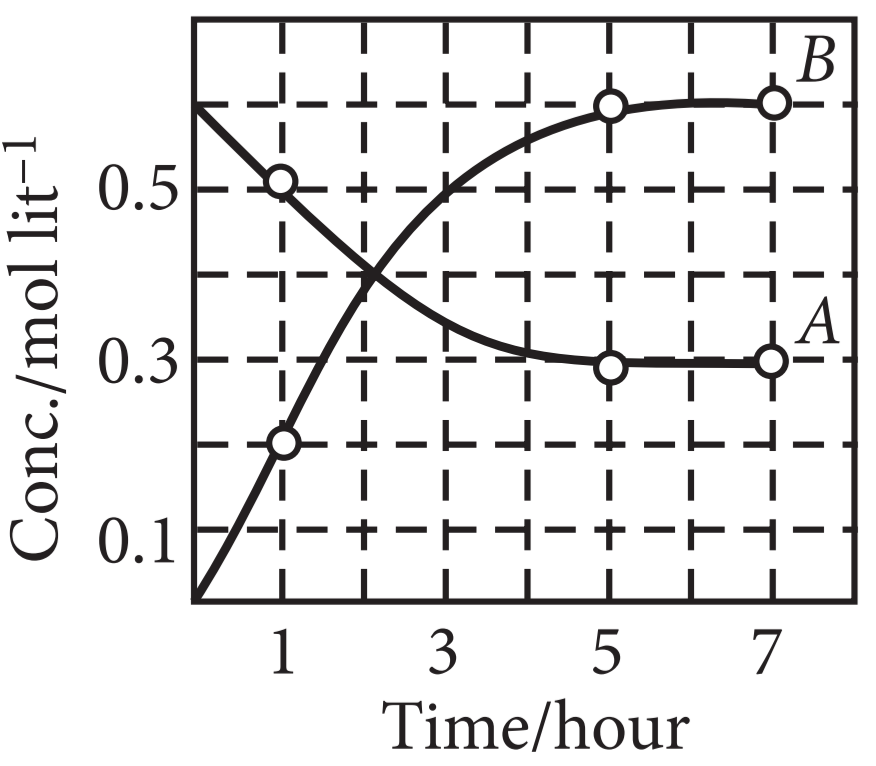
The progress of the reaction, $\text{A}\rightleftharpoons\text{nB}$ with time is represented in the following figure:

The following questions are multiple choice questions. Choose the most appropriate answer:
  1. What is the value of n?
  1. 1
  2. 2
  3. 3
  4. 4
  1. Find the value of the equilibrium constant.
  1. 0.6M
  2. 1.2M
  3. 0.3M
  4. 2.4M
  1. The initial rate of conversion of A will be:
  1. 0.1 mol L-1hr-1
  2. 0.2 mol L-1hr-1
  3. 0.4 mol L-1hr-1
  4. 0.8 mol L-1hr-1
  1. For the reaction, if $\frac{\text{d}[\text{B}]}{\text{dt}}=2\times10^{-4},$ value of $-\frac{\text{d}[\text{A}]}{\text{dt}}$ will be:
  1. 2 × 10-4
  2. 10-4
  3. 4 × 10-4
  4. 0.5 × 10⁻⁴
  1. Which factor has no effect on rate of reaction?
  1. Temperature.
  2. Nature of reactant.
  3. Concentration of reactant.
  4. Molecularity.
Read the passage given below and answer the following questions: Boiling point or freezing point of liquid solution would be affected by the dissolved solids in the liquid phase. A soluble solid in solution has the effect of raising its boiling point and depressing its freezing point. The addition of non-volatile substances to a solvent decreases the vapor pressure and the added solute particles affect the formation of pure solvent crystals. According to many researches the decrease in freezing point directly correlated to the concentration of solutes dissolved in the solvent. This phenomenon is expressed as freezing point depression and it is useful for several applications such as freeze concentration of liquid food and to find the molar mass of an unknown solute in the solution. Freeze concentration is a high quality liquid food concentration method where water is removed by forming ice crystals. This is done by cooling the liquid food below the freezing point of the solution. The freezing point depression is referred as a colligative property and it is proportional to the molar concentration of the solution (m), along with vapor pressure lowering, boiling point elevation, and osmotic pressure. These are physical characteristics of solutions that depend only on the identity of the solvent and the concentration of the solute. The characters are not depending on the solute’s identity.
  1. When a non volatile solid is added to pure water it will:
  1. boil above 100°C and freeze above 0°C
  2. boil below 100°C and freeze above 0°C
  3. boil above 100°C and freeze below 0°C
  4. boil below 100°C and freeze below 0°C
  1. Colligative properties are:
  1. dependent only on the concentration of the solute and independent of the solvent’s and solute’s identity.
  2. dependent only on the identity of the solute and the concentration of the solute and independent of the solvent's identity.
  3. dependent on the identity of the solvent and solute and thus on the concentration of the solute.
  4. dependent only on the identity of the solvent and the concentration of the solute and independent of the solute’s identity.
  1. Assume three samples of juices A, B and C have glucose as the only sugar present in them. The concentration of sample A, B and C are 0.1M, 5M and 0.2 M respectively. Freezing point will be highest for the fruit juice:
  1. A
  2. B
  3. C
  4. All have same freezing point
  1. Identify which of the following is a colligative property:
  1. freezing point
  2. boiling point
  3. osmotic pressure
  4. all of the above
Explain the structure of nucleic acid compounds.
The electrochemical cell shown below is concentration cell.

M|M2+ (saturated solution of a sparingly soluble salt, MX2) || M2+ (0.001 mol dm-3) |M The emfof the cell depends on the difference in concentrations of M2+ ions at the two electrodes. The emf of the cell at 298 K is 0.059V.

The following questions are multiple choice questions. Choose the most appropriate answer:

  1. The solubility product (Ksp' mol3 dm-9) of MX2 at 298 K based on the information available for the given concentration cell is $(\text{take }2.303 \times \text{R}\times \frac{298}{\text{F}} = 0.059)$
  1. 2 × 10-15
  2. 4 × 10-15
  3. 3 × 10-12
  4. 1 × 10-12
  1. The value of $\triangle\text{G}$ (in kJ mol-1) for the given cell is (take 1 F = 96500 C mol-1)

  1. 3.7
  2. -3.7
  3. 10.5
  4. -11.4
  1. The equilibrium constant for the foUowing reaction is:

$\text{Fe}^{2+}+\text{Ce}^{4+}\rightleftharpoons\text{Ce}^{3+}+\text{Fe}^{3+}$

(Given, $\text{E}^\circ_\frac{\text{Ce}^{4+}}{\text{Ce}^{3+}}=1.44\text{V}$ and $\text{E}^\circ_\frac{\text{Fe}^{3+}}{\text{Fe}^{2+}}=0.68\text{V}$)

  1. 7.6 × 10¹²
  2. 6.5 × 1010
  3. 5.2 × 109
  4. 3.4 × 1012
  1. The solubility product of a saturated solution of Ag2CrO4 in water at 298 K if the emf of the cell

Ag|Ag+ (satd. Ag2CrO4 soln) || Ag+ (0.1 M) | Ag

is 0.164V at 298 K, is:

  1. 3.359 × 10⁻¹² mol3 L-3
  2. 2.287 × 10⁻¹² mol3 L-3
  3. 1.158 × 10⁻¹² mol3 L-3
  4. 4.135 × 10⁻¹² mol3 L-3
  1. To calculate the emf of the cell, which of the foUowing options is correct?
  1. emf = Ecathode - Eanode
  2. emf = Eanode - Ecathode
  3. emf = Eanode + Ecathode
  4. None of these.

Read the passage given below and answer the following questions:

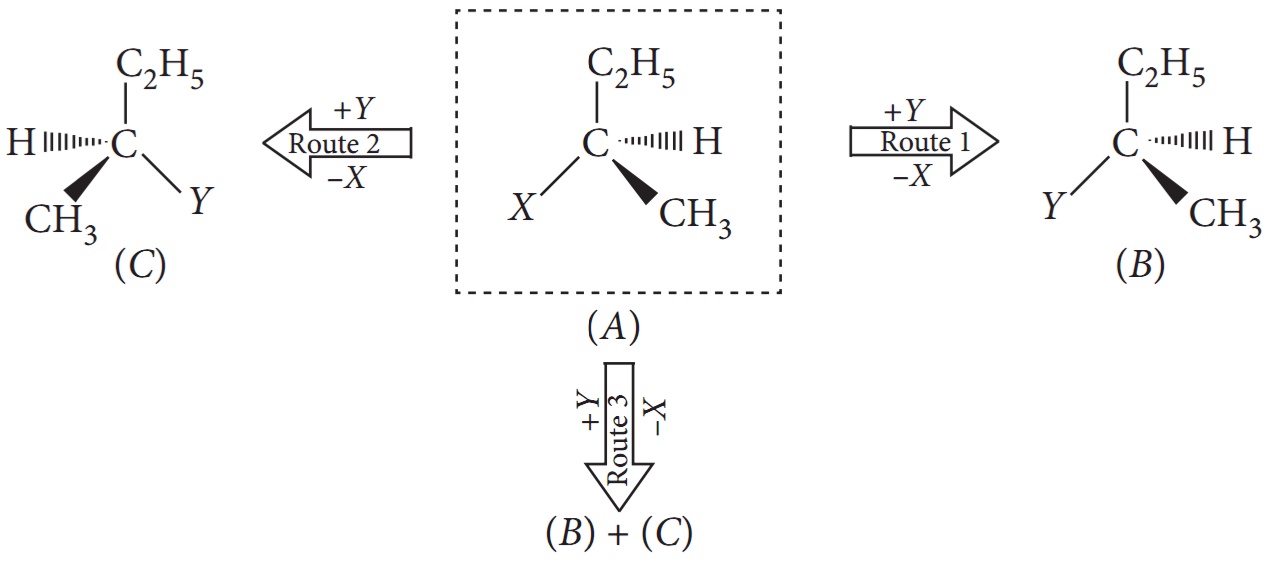
When a chemical reaction involves bond cleavage or bond formation at an asymmetric carbon atom, three different products may be formed. For example, during the substitution of a group X by Y in the following reaction, the three possible products may be shown below:

  1. If Bis the only product, the process is called retention of configuration because B has the same configuration as the starting reactant (A).
  2. If C is the only product, the process is called inversion of configuration because C has the configuration opposite to the starting reactant (A).
  3. If an equimolar mixture of Band C (r.e., a 50 : 50 mixture) is fanned, then the process is called racemisation and the product is optically inactive because one isomer will rotate the light in the direction opposite to another.

In these questions (Q. No. i-iv), a statement of assertion followed by a statement of reason is given. Choose the correct answer out of the following choices.

  1. Assertion and reason both are correct statements and reason is correct explanation for assertion.
  2. Assertion and reason both are correct statements but reason is not correct explanation for assertion.
  3. Assertion is correct statement but reason is wrong statement.
  4. Assertion is wrong statement but reason is correct statement.
  1. Assertion: A reaction is said to be stereospecific if a particular stereoisomer of the reactant produces a specific stereoisomer of the product.

Reason: Bromination of cis-2-butene gives meso-2, 3-dibromobutane which is stereospecific.

  1. Assertion: Addition of Br2 to cis-but-2-ene is stereoselective.

Reason: SN2 reactions are stereospecific as well as stereoselective.

  1. Assertion: Optically active 2-iodobutane on treatment with Nal in acetone undergoes recemization.

Reason: Repeated Walden inversions on the reactant and its product eventually gives a racemic mixture.

  1. Assertion: SN2 reaction of an optically active alkyl halide with an aqueous solution of KOH always gives an alcohol with opposite sign of rotation.

Reason: SN2 reactions always proceed with inversion of configuration.

  1. Assertion: Nudeophilic substitution reaction of an optically active alkyl halide gives a mixture of en an ti om ers.

Reason: The reaction occurs by SN2 mechanism.


A reaction in which rate ofreaction is independent of concentration of the reactants is called zero order reaction. Photochemical combination of hydrogen and chlorine to give hydrogen chloride is an example of zero order reaction. The rate constant of a zero order reaction is equal to the rate of reaction. The half life period of a zero order reaction is directly proportional to initial concentration of the reactant. For a zero order reaction,

$\text{k}=\frac{1}{\text{t}}\left\{[\text{A}]-[\text{A}]\right\}$

In these questions (Q. No. i-iv), a statement of assertion followed by a statement of reason is given. Choose the correct answer out of the following choices.

  1. Assertion and reason both are correct statements and reason is correct explanation for assertion.
  2. Assertion and reason both are correct statements but reason is not correct explanation for assertion.
  3. Assertion is correct statement but reason is wrong statement.
  4. Assertion is wrong statement but reason is correct statement.
  1. Assertion: For a zero order reaction, plot of rate vs concentration will be a straight line parallel to concentration axis.

Reason: For a zero order reaction, rate is independent of concentration.

  1. Assertion: Photochemical combination of hydrogen and chlorine to give hydrogen chloride is an example of zero order reaction.

Reason: The rate of reaction depends on the concentration of hydrogen and independent of concentration of chlorine.

  1. Assertion: If in a zero order reaction, the concentration of the reactant is doubled, the half-life period is also doubled.

Reason: For a zero order reaction, the rate of reaction is independent of initial concentration.

  1. Assertion: ln a reaction A → products, the concentration of the reactant is reduced to zero after a finite time.

Reason: The order of reaction is zero.

  1. Assertion: Rate constant of a zero order reaction has same units as the rate of reaction.

Reason: Rate constant of a zero order reaction does not depend on the unit of concentration.

Read the passage given below and answer the following questions:

For understanding the structure and bonding in transition metal complexes, the magnetic properties are very helpful. Low spin complexes are generally diamagnetic because of pairing of electrons, whereas high spin complexes are usually paramagnetic because of presence of unpaired electrons. Larger the number of unpaired electrons, stronger will be the paramagnetism. However magnetic behaviour of a complex can be confirmed from magnetic moment measurement. Magnetic moment $\mu=\sqrt{\text{n(n+2)}}\text{B.M.}$ where n = number of unpaired electrons. Greater the number of unpaired electrons, more will be the magnetic moment.

In these questions (Q. No. i-iv), a statement of assertion followed by a statement ofreason is given. Choose the correct answer out of the following choices.

  1. Assertion and reason both are correct statements and reason is correct explanation for assertion.
  2. Assertion and reason both are correct statements but reason is not correct explanation for assertion.
  3. Assertion is correct statement but reason is wrong statement.
  4. Assertion is wrong statement but reason is correct statement.
The following questions are multiple choice questions. Choose the most appropriate answer:

  1. Assertion: Both [Cr(H2O)6]2+ and [Fe(H2O)6]2+ have same magnetic moment.

Reason: Number of unpaired electrons in Cr2+ and Fe2+ are same.

  1. Assertion: [Fe(H2O)5NO]SO4 is paramagnetic.

Reason: The Fe in [Fe(H2O)5NO]SO4 has three unpaired electrons.

  1. Assertion: [Co(en)3]3+ is paramagnetic.

Reason: It is an inner orbital complex.

  1. Assertion: [Ni(CO)4] is diamagnetic and tetrahedral in shape.

Reason: [Ni(CO)4] contains no unpaired electrons and involves dsp2 hybridisation.

  1. Assertion: [Ni(CN)4]2- is diamagnetic complex.

Reason: It involves dsp2 hybridisation and there is no unpaired electron.