Question
Read the passage given below and answer the following questions:
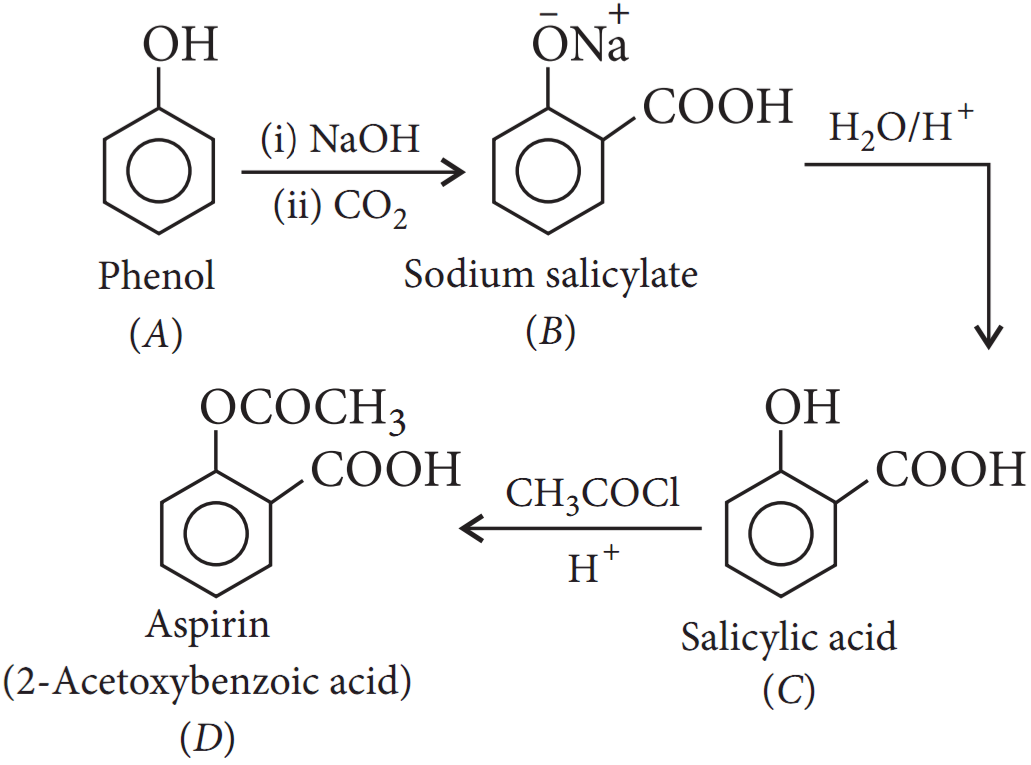
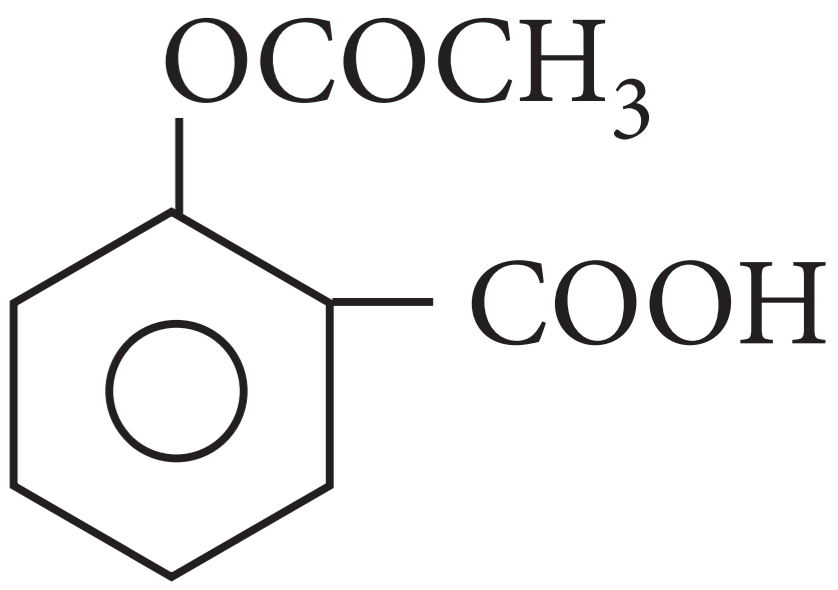
An organic compound (A) having molecular formula C6H6O gives a characteristic colour with aqueous FeCl3 solution. (A) on treatment with CO2 and NaOH at 400K under pressure gives (B), which on acidification gives a compound (C). The compound (C) reacts with acetyl chloride to give (D) which is a popular pain killer.
The following questions are multiple choice questions. Choose the most appropriate answer:
  1. Compound (A) is:
  1. 2-Hexanol.
  2. Dimethyl ether.
  3. Phenol.
  4. 2-Methyl pentanol.
  1. Compound (C) is:
  1. Salicylic acid.
  2. Salicyladehyde.
  3. Benzoic acid.
  4. Benzaldehyde.
  1. Number of carbon atoms in compound (D) is:
  1. 7
  2. 6
  3. 8
  4. 9
  1. The conversion of compound (A) to (C) is known as:
  1. Reimer-Tiemann reaction.
  2. Kolbe's reaction.
  3. Schimdt reaction.
  4. Swarts reaction.
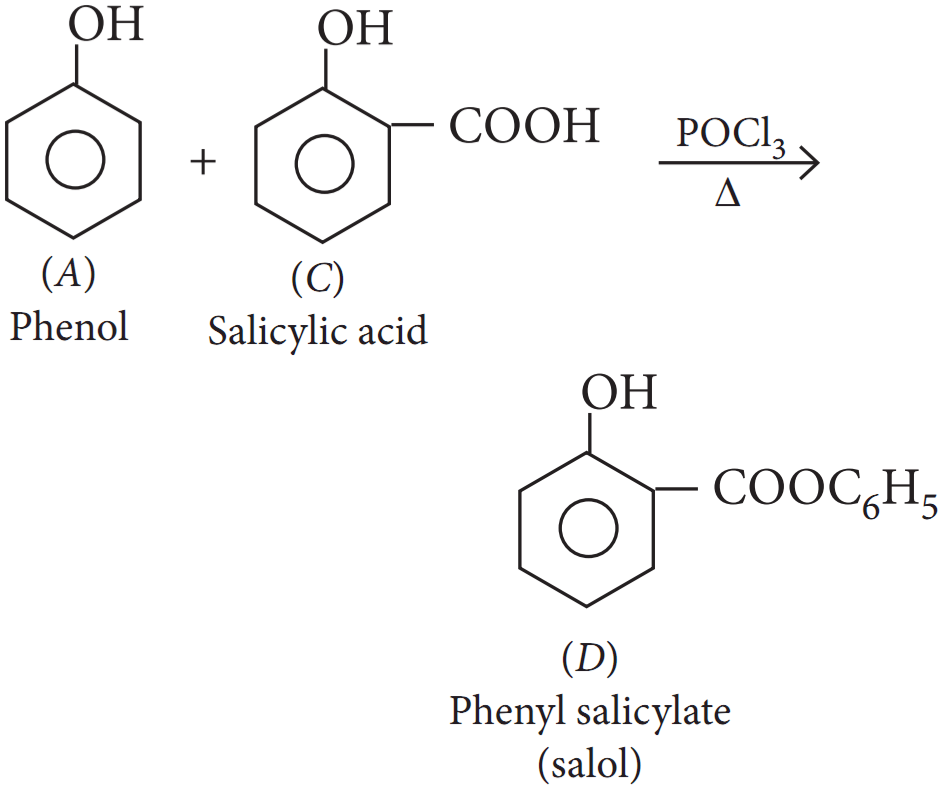
  1. Compound (A) on heating with compound (C) in presence of POCl3 gives a compound (D) which is used:
  1. In perfumery as a ftavouring agent
  2. As an antipyretic
  3. As an analgesic
  4. As an intestinal antiseptic.

Need a full question paper?

Generate a complete, print-ready paper with questions like this in minutes — across 16+ boards, with answer keys.

Start Generating Free

Similar questions

Read the passage given below and answer the following questions:
Nucleophilic substitution reactions are of two types; substitution nucleophilic bimolecular (SN2) and substitution nucleophilic unimolecular (SN1) depending on molecules taking part in determining the rate of reaction. Reactivity of alkyl halide towards SN1 and SN2 reactions depends on various factors such as steric hindrance, stability of intermediate or transition state, and polarity of solvent. SN2 reaction mechanism is favoured mostly by primary alkyl halide then secondary and then tertiary. This order is reversed in case of SN1 reactions.
The following questions are multiple choice questions. Choose the most appropriate answer:
  1. Which of the following is most reactive towards nucleophilic substitution reaction?
  1. C6H5Cl
  2. CH2 = CHCl
  3. ClCH2CH = CH2
  4. CH3CH = CHCl
  1. Isopropyl chloride undergoes hydrolysis by:
  1. SN1 mechanism.
  2. SN2 mechanism.
  3. SN1 and SN2 mechanism.
  4. Neither SN1 nor SN2 mechanism.
  1. The most reactive nucleophile among the following is:
  1. CH3O-
  2. C6H5O-
  3. (CH3)2CHO-
  4. (CH3)3CO-
  1. Tertiary alkyl halides are practically inert to substitution by SN2 mechanism because of:
  1. Insolubility.
  2. Instability.
  3. Inductive effect.
  4. Stearic hindrance.
  1. Which of the following is the correct order of decreasing SN2 reactivity?
  1. RCH2X > R2CHX > R3CX
  2. R3CX > R2CHX > RCH2X
  3. R2CHX > R3CX > RCH2X
  4. RCH2X > R3CX > R2CHX
Read the passage given below and answer the following questions:

Williamson's synthesis is used for the preparation of symmetrical as well as unsymmerical ether. It is SN2 reaction mechanism. In Williamson's synthesis, 1º alkyl halide are used for preparation of ethers because 2º and 3º alkyl halide give alkene. Ethers are cleaved by hydrogen halides to alcohol and alkyl halide where alkyl halide is corresponding to that alkyl which has less number of carbon atom (it is because of less steric hindrance). In polar media unsymmetrical ether like tertiary butyl ethyl ether gives ethyl alcohol and tertiary butyl halide as reaction proceeds via carbocation.

In these questions (Q. No. i-iv), a statement of assertion followed by a statement of reason is given. Choose the correct answer out of the following choices.

  1. Assertion and reason both are correct statements and reason is correct explanation for assertion.
  2. Assertion and reason both are correct statements but reason is not correct explanation for assertion.
  3. Assertion is correct statement but reason is wrong statement.
  4. Assertion is wrong statement but reason is correct statement.
  1. Assertion: Rate of reaction of alkyl halide in Williamson's synthesis reaction is 1ºRX > 2ºRX > 3ºRX.

Reason: It is a type of bimolecular substitution reaction (SN2).

  1. Assertion: T-Butyl methyl ether is not prepared by the reaction of t-butyl bromide with sodium methoxide.

Reason: Sodium methoxide is a weak nucleophile.

  1. Assertion: Williamson's synthesis method cannot be used for preparing diphenyl ether.

Reason: Aryl halides do not undergo nucleophilic substitution easily.

  1. Assertion: When isopropyl bromide is treated with sodium isopropoxide, di-isopropyl ether is obtained as a major product.

Reason: With secondary alkyl halides, both substitution and elimination occur.

  1. Assertion: Both symmetrical and unsymmetrical ethers can be prepared by Williamson's synthesis.

Reason: Williamson's synthesis is an example of nucleophilic substitution reaction.

Read the passage given below and answer the following questions:

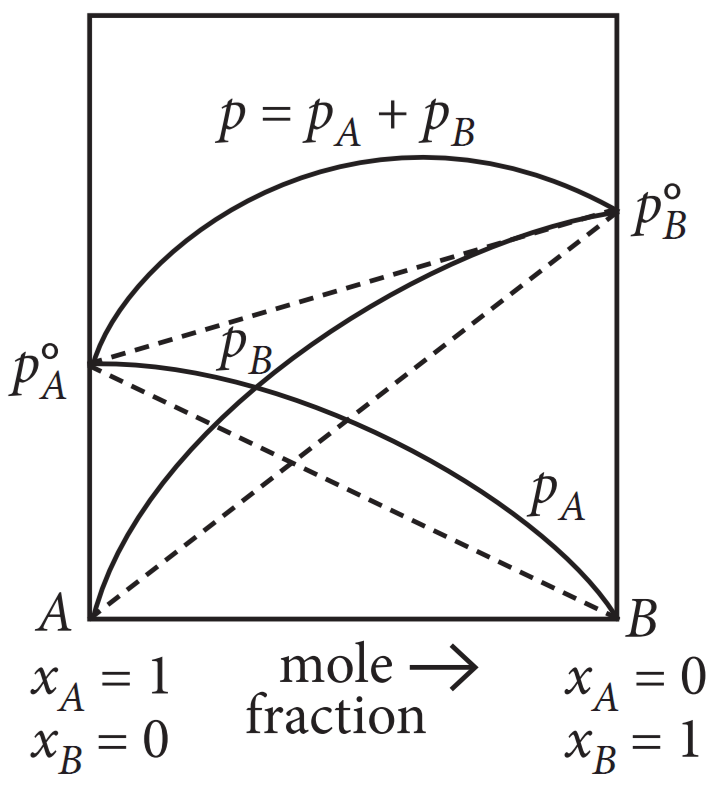
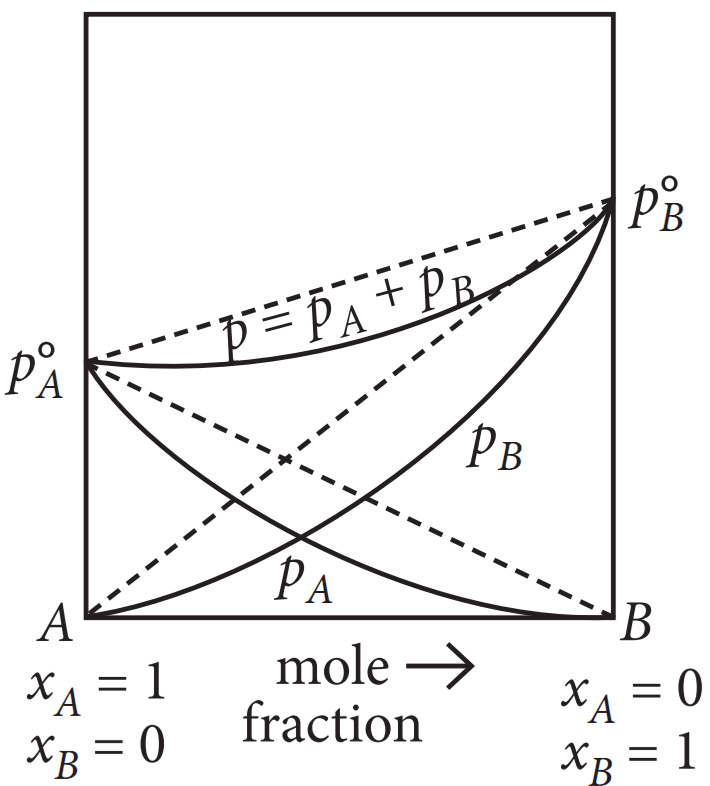
An ideal solution may be defined as the solution which obeys Raoult's law exactly over the entire range of concentration. The solutions for which vapour pressure is either higher or lower than that predicted by Raoult's law are called non-ideal solutions.Non-ideal solutions can show either positive or negative deviations from Raoult's law depending on whether the A-B interactions in solution are stronger or weaker than A - A and B - B interactions.

The following questions are multiple choice questions. Choose the most appropriate answer:

  1. Which of the following solutions is/are ideal solution(s)?
  1. Bromoethane and iodoethane.
  2. Acetone and chloroform
  3. Benzene and acetone
  4. n-heptane and n-hexane
  1. Only I
  2. I and II
  3. II and III
  4. I and Iv
  1. For which of the following solutions $\Delta\text{H}_{\text{mix}}$ and $\Delta\text{V}_{\text{mix}}$ is negative?
  1. Acetone and aniline
  2. Ethyl alcohol and cyclohexane
  3. Acetone and CS2
  4. Benzene and toluene
  1. Which of the following is not true for positive deviations?
  1. The A-B interactions in solution are weaker than the A - A and B - B interactions.
  2. $\text{P}_\text{A}<\text{P}\mathring{\text{A}}\ \text{x}_\text{A}$ and $\text{P}_\text{B}<\text{P}\mathring{\text{B}}\ \text{x}_\text{B}$
  3. Carbon tetrachloride and chloroform mixture is an example of positive deviations.
  4. All of these.
  1. For water and nitric acid mixture, which of the given graph is correct?


  1.  


  1.  

  1. Both of these
  2. None of these
  1. Water-HCI mixture.
  1. Shows positive deviations.
  2. Forms minimum boiling azeotrope.
  3. Shows negative deviations.
  4. Forms maximum boiling azeotrope.
  1. I and II
  2. I and III
  3. I and IV
  4. III and IV
Read the passage given below and answer the following questions:
The unique behaviour of Cu, having a positive E° accounts for its inability to liberate H2 from acids. Only oxidising acids (nitric and hot concentrated sulphuric acid) react with Cu, the acids being reduced. The stability of the half-filled (d5) subshell in Mn2+ and the completely filled (d10) configuration in Zn2+ are related to their $\text{E}^\circ\frac{\text{M}^{3+}}{\text{M}^{2+}}$ values. The low value for Sc reflects the stability of Sc3+ which has a noble gas configuration. The comparatively high value for Mn shows that Mn2+(d5) is particularly stable, whereas a comparatively low value for Fe shows the extra stability of Fe3+(d5). The comparatively low value for Vis related to the stability of v2+ (half-filled t2g level).
The following questions are multiple choice questions. Choose the most appropriate answer:
  1. Standard reduction electrode potential of $\frac{\text{Zn}^{2+}}{\text{Zn}}$ is 0.76V. This means
  1. ZnO cannot be reduced to Zn by H2 under standard conditions.
  2. Zn cannot liberate H2 with concentrated acids.
  3. Zn is generally the anode in an electrochemical cell.
  4. Zn is generally the cathode in an electrochemical cell.
  1. $\text{E}^\circ$ values for the couples $\frac{\text{Cr}^{3+}}{\text{Cr}^{2+}}$ and $\frac{\text{Mn}^{3+}}{\text{Mn}^{2+}}$ are -0.41 and +1.51 volts respectively. These values suggest that.
  1. Cr2+ acts as a reducing agent whereas Mn3+ acts as an oxidizing agent.
  2. Cr2+ is more stable th an Cr3+ state.
  3. Mn3+ is more stable than Mn2+.
  4. Cr2+ acts as an oxidizing agent whereas Mn3+ acts as a reducing agent..
  1. The reduction potential values of M, N and O are +2.46, -1.13 and -3.13V respectively. Which of the following order is correct regarding their reducing property?
  1. O > N > M
  2. O > M > N
  3. M > N > O
  4. M > O > N
  1. Which of the following statements are true?
  1. Mn2+ compounds are more stable than Fe2+ towards oxidation to +3 state.
  2. Titanium and copper both in the first series of transition metals exhibits +1 oxidation state most frequently.
  3. Cu+ ion is stable in aqueous solutions.
  4. The $\text{E}^\circ$ value for the $\frac{\text{Mn}^{3+}}{\text{Mn}^{2+}}$ couple is much more positive than that for $\frac{\text{Cr}^{3+}}{\text{Cr}^{2+}}$ or $\frac{\text{Fe}^{3+}}{\text{Fe}^{2+}}.$.
  1. (II) and (III)
  2. (I) and (IV)
  3. (I) and (III)
  4. (II) and (IV)
  1. The stability of $\text{Cu}^{2+}_\text{(aq)}$ rather than $\text{Cu}^{+}_\text{(aq)}$ is due to.
  1. More negative $\Delta_\text{hyd}\text{H}^\circ$ of $\text{Cu}^{2+}_\text{(aq)}.$
  2. Less negative $\Delta_\text{hyd}\text{H}^\circ$ of $\text{Cu}^{2+}_\text{(aq)}.$
  3. More positive $\Delta_\text{hyd}\text{H}^\circ$ of $\text{Cu}^{2+}_\text{(aq)}.$
  4. Less positive $\Delta_\text{hyd}\text{H}^\circ$ of $\text{Cu}^{2+}_\text{(aq)}.$
Describe detailed information on classification of carbohydrates.
Read the passage given below and answer the following questions:
The solubility of gases increases with increase of pressure. William Henry made a systematic investigation of the solubility of a gas in a liquid. According to Henry's law "the mass of a gas dissolved per unit volume of the solvent at constant temperature is directly proportional to the pressure of the gas in equilibrium with the solution". Dalton during the same period also concluded independently that the solubility of a gas in a ti quid solution depends upon the partial pressure of the gas. If we use the mole fraction of gas in the solution as a measure of its solubility, then Henry's law can be modified as "the partial pressure of the gas in the vapour phase is directly proportional to the mole fraction of the gas in the solution"
The following questions are multiple choice questions. Choose the most appropriate answer:
  1. Henry's law constant for the solubility of methane in benzene at 298K is 4.27 x 105mm Hg. The solubility of methane in benzene at 298K under 760mm Hg is:
  1. 4.27 × 10⁻⁵
  2. 1.78 × 10⁻³
  3. 4.27 × 10⁻³
  4. 1.78 × 10⁻⁵
  1. The partial pressure of ethane over a saturated solution containing 6.56 × 10-2g of ethane is I bar. If the solution contains 5.00 × 10⁻²g of ethane then what will be the partial pressure (in bar) of the gas?
  1. 0.762
  2. 1.312
  3. 3.81
  4. 5.0
  1. KH (K bar) values for Ar(g), CO2(g), HCHO(g) and CH4(g) are 40.39, 1.67, 1.83 × 10-5 and 0.413 respectively. Arrange these gases in the order of their increasing solubility. Arrange these gases in the order of their increasing solubility.
  1. HCHO < CH4 < CO2 < Ar
  2. HCHO < CO2 < CH4 < Ar
  3. Ar < CO2 < CH4 < HCHO
  4. Ar < CH4 < CO2 < HCHO
  1. When a gas is bubbled through water at 298K, a very dilute solution of the gas is obtained. Henry's law constant for the gas at 298K is 150 kbar. If the gas exerts a partial pressure of 2 bar, the number of millimoles of the gas dissolved in IL of water is:
  1. 0.55
  2. 0.87
  3. 0.37
  4. 0.66
  1. Which of the following statements is correct?
  1. KH increases with increase of temperature.
  2. KH decreases with increase of temperature.
  3. KH remains constant with increase of temperature.
  4. KH first increases then decreases, with increase of temperature.
Read the passage given below and answer the following questions:
Metal carbonyl is an example of coordination compounds in which carbon monoxide (CO) acts as ligand. These are also called homoleptic carbonyls. These compounds contain both $\sigma$ and $\pi$ character. Some carbonyls have metal-metal bonds. The reactivity of metal carbonyls is due to (i) the metal centre and (ii) the CO ligands. CO is capable of accepting an appreciable amount of electron density from the metal atom into their empty $\pi$ or $\pi-\text{orbital}.$ These types of ligands are called $\pi-\text{accepter}$ or $\pi-\text{acid}$ ligands. These interactions increases the $\Delta_0$ value.
The following questions are multiple choice questions. Choose the most appropriate answer:
  1. What is the oxidation state of metal in [Mn2(CO)10]?
  1. +1
  2. -1
  3. +2
  4. 0
  1. Among the following metal carbonyls, the C-O bond order is lowest in:
  1. [Mn(CO)6]+
  2. [Fe(CO)5]
  3. [Cr(CO)6]
  4. [V(CO)6]-
  1. Which of the following can be reduced easily?
  1. V(CO)6
  2. Mo(CO)6
  3. [Co(CO)4]-
  4. Fe(CO)5
  1. The oxidation state of cobalt in K[Co(CO)4] is:
  1. +1
  2. +3
  3. -1
  4. 0
  1. Structure of decacarbonyl manganese is:
  1. Trigonal bipyramidial
  2. Octahedral
  3. Tetrahedral
  4. Square pyramidal
Read the passage given below and answer the following questions:
To explain bonding in coordination compounds various theories were proposed. One of the important theory was valence bond theory. According to that, the central metal ion in the complex makes available a number of empty orbitals for the formation of coordination bonds with suitable ligands. The appropriate atomic orbitals of the metal hybridise to give a set of equivalent orbitals of definite geometry.
The d-orbitals involved in the hybridisation may be either inner d-orbitals i.e., (n - 1)d or outer d-orbitals i.e., nd. For example, Co3+ forms both inner orbital and outer orbital complexes, with ammonia it forms [Co(NH3)6]3+ and with fluorine it forms [CoF6]3- complex ion.
The following questions are multiple choice questions. Choose the most appropriate answer:
  1. Which of the following is not true for [CoF6]3-?
  1. It is paramagnetic.
  2. It has coordination number of 6.
  3. It is outer orbital complex.
  4. It involves d2sp3 hybridisation.
  1. [Cr(H2O)6]Cl3 (at. no. of Cr = 24) has a magnetic moment of 3.83B.M. The correct distribution of 3d-electrons in the central metal of the complex is:
  1. $3\text{d}^1_\text{xy},3\text{d}^1_{\text{x}^2-\text{y}^2},3\text{d}^1_\text{yz}$
  2. $3\text{d}^1_\text{xy},3\text{d}^1_{\text{yz}},3\text{d}^1_\text{zx}$
  3. $3\text{d}^1_\text{xy},3\text{d}^1_{\text{zy}},3\text{d}^1_{\text{z}^2}$
  4. $3\text{d}^1_{\text{x}^2-\text{y}^2},3\text{d}^1_{\text{z}^2},3\text{d}^1_\text{xz}$
  1. Which of the following is true for [Co(NH3)6]3+?
  1. It is an octahedral, di magnetic and outer orbital complex.
  2. It is an octahedral, paramagnetic and outer orbital complex.
  3. It is an octahedral, paramagnetic and inner orbital complex.
  4. It is an octahedral, di magnetic and inner orbital complex.
  1. The paramagnetism of [CoF6]3- is due to.
  1. 3 electrons.
  2. 4 electrons.
  3. 2 electrons.
  4. 1 electron.
  1. Which of the following is an inner orbital or low spin complex?
  1. [Ni(H2O)6]3+
  2. [FeF6]3-
  3. [Co(CN)6]3-
  4. [NiCl4]2-
Read the passage given below and answer the following questions:

If some solute is added to a solvent, the boiling point of solution increases. This is known as elevation in baiting point.

$\Delta\text{T}_\text{b}=\text{K}_\text{b}\text{m}$ where, Kb = Molal elevation constant,

$\Delta\text{T}_\text{b}\propto\text{m}$

Hence, it is a colligative property,

Also, $\text{K}_\text{b}=\frac{\text{MRT}^2_\text{b}}{\Delta\text{Vap}\text{H}\times1000}$

where, M = Molar mass of solvent,

$\Delta\text{vap}$ H = Enthalpy of vaporisation,

Molar mass can also be calculated using elevation in boiling point.

$\text{M}_\text{B}=\frac{\text{K}_\text{B}\times\text{W}_\text{B}\times1000}{\Delta\text{T}_\text{b}\times\text{W}_\text{A}}$

A statement of assertion followed by a statement of reason is given. Choose the correct answer out of the following choices.

  1. Assertion and reason both are correct statements and reason is correct explanation for assertion.
  2. Assertion and reason both are correct statements but reason is not correct explanation for assertion.
  3. Assertion is correct statement but reason is wrong statement.
  4. Assertion is wrong statement but reason is correct statement.
  1. Assertion: In a pressure cooker, the water is brought to boil. The cooker is then removed from the stove. Now on removing the lid of pressure cooker, the water starts boiling again.

Reason: The impurities in water bring down its boiling point.

  1. Assertion: On dissolving 3.24g of sulphur in 40g of benzene, boiling point of solution get higher than that of benzene by 0.081K, then the formula of sulphur is S8. (Kb for benzene = 2.53K kg mol-1)

Reason: Molecular mass of sulphur comes out to be 253.

  1. Assertion: When sugar is added to water, boiling point of water increases.

Reason: When a non-volatile solute is added to a solvent, elevation in boiling point is observed.

  1. Assertion: Cooking time in pressure cookers is reduced.

Reason: Boiling point inside the pressure cooker in raised.

  1. Assertion: Elevation in boiling point of two isotonic solutions is same.

Reason: Boiling point depends upon the concentration of the solute.

Read the passage given below and answer the following questions :
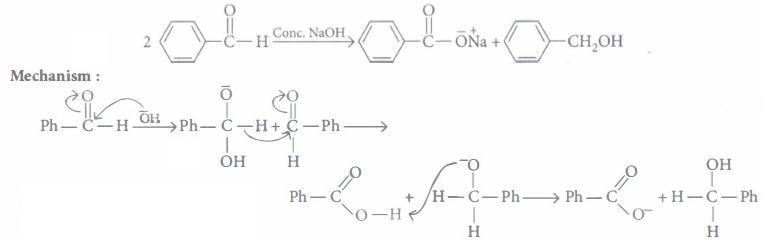
When an aldehyde with no a-hydrogen reacts with concentrated aqueous NaOH, half the aldehyde is converted to carboxylic acid salt and other half is converted to an alcohol. In other words, half of the reactant is oxidized
and other half is reduced. This reaction is known as Cannizzaro reaction

The following questions are multiple choice questions. Choose the most appropriate answer:
  1. A mixture of benzaldehyde and formaldehyde on heating with aqueous NaOH solution gives:
  1. Benzyl alcohol and sodium formate.
  2. Sodium benzoate and methyl alcohol.
  3. Sodium benzoate and sodium formate.
  4. Benzyl alcohol and methyl alcohol.
  1. Which of the following compounds will undergo Cannizzaro reaction?
  1. CH3CHO
  2. CH3COCH3
  3. C6H5CHO
  4. C6H5CH2CHO
  1. Trichloroacetaldehyde is subjected to Cannizzaro's reaction by using NaOH. The mixture of the products contains sodium trichloroacetate ion and another compound. The other compounds is:
  1. 2, 2, 2-trichloroethanol
  2. Trichloromethanol
  3. 2, 2, 2-trichloropropanol
  4. Chloroform
  1. Which of the following reaction will not result in the formation of carbon-carbon bonds?
  1. Cannizzaro reaction
  2. Wurtz reaction
  3. Reimer- Tiemann reaction
  4. Friedel - Crafts acylation