Question
Read the passage given below and answer the following questions :
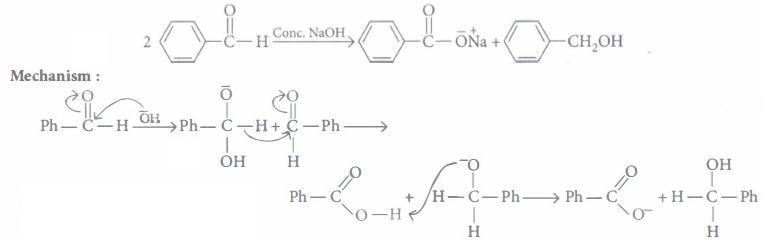
When an aldehyde with no a-hydrogen reacts with concentrated aqueous NaOH, half the aldehyde is converted to carboxylic acid salt and other half is converted to an alcohol. In other words, half of the reactant is oxidized
and other half is reduced. This reaction is known as Cannizzaro reaction
The following questions are multiple choice questions. Choose the most appropriate answer:
  1. A mixture of benzaldehyde and formaldehyde on heating with aqueous NaOH solution gives:
  1. Benzyl alcohol and sodium formate.
  2. Sodium benzoate and methyl alcohol.
  3. Sodium benzoate and sodium formate.
  4. Benzyl alcohol and methyl alcohol.
  1. Which of the following compounds will undergo Cannizzaro reaction?
  1. CH3CHO
  2. CH3COCH3
  3. C6H5CHO
  4. C6H5CH2CHO
  1. Trichloroacetaldehyde is subjected to Cannizzaro's reaction by using NaOH. The mixture of the products contains sodium trichloroacetate ion and another compound. The other compounds is:
  1. 2, 2, 2-trichloroethanol
  2. Trichloromethanol
  3. 2, 2, 2-trichloropropanol
  4. Chloroform
  1. Which of the following reaction will not result in the formation of carbon-carbon bonds?
  1. Cannizzaro reaction
  2. Wurtz reaction
  3. Reimer- Tiemann reaction
  4. Friedel - Crafts acylation

Answer

  1. (a) Benzyl alcohol and sodium formate.

Explanation:

It is an example of cross Cannizzaro reaction where aromatic aldehyde gets reduced to alcohol and aliphatic aldehyde gets oxidised to its sodium salt (both aldehydes must not contain any αα-hydrogen).

CBSE 12th Chemistry Aldehydes , Ketones and Carboxylic Acids Case Study Questions With Solution 2021

  1. (c) C6H5CHO
  1. (a) 2, 2, 2-trichloroethanol

Explanation:

The Cannizzaro product of given reaction yields 2, 2, 2-trichloroethanol.

CBSE 12th Chemistry Aldehydes , Ketones and Carboxylic Acids Case Study Questions With Solution 2021

  1. (a) Cannizzaro reaction

Explanation:

C - C bond is not formed in Cannizzaro reaction while other reactions result in the formation of C - C bond.

Need a full question paper?

Generate a complete, print-ready paper with questions like this in minutes — across 16+ boards, with answer keys.

Start Generating Free

Similar questions

Number of molecules which must collide simultaneously to give product is called molecularity. It is equal to sum of coefficients of reactants present in stoichiometric chemical equation.

For reaction, m1A + m2B → Product

Molecularity = [m1 + m2]

ln complex reaction each step has its own molecularity which is equal to the sum of coefficients of reactants present in a particular step. Molecularity is a theoretical property. Its value is any whole number. Number of concentration terms on which rate of reaction depends is called order of reaction or sum of powers of concentration terms present in the rate equation is called order of reaction.

If rate equation ofreaction is: Rate $=\text{k}\cdot\text{C}^{\text{m}_1}_\text{A}\cdot\text{C}^{\text{m}_2}_\text{B}$

Then order of reaction = m1 + m2.

ln simple reaction, order and molecularity are same.

ln complex reaction, order of slowest step is the order ofover all reaction. This step is known as rate determining step. Order is an experimental property. Its value may be zero, fractional or negative.

The following questions are multiple choice questions. Choose the most appropriate answer:

  1. Higher order(> 3) reactions are rare due to:
  1. Shifting of equilibrium towards reactants due to elastic collisions.
  2. Loss of active species on collision.
  3. Low probability of simultaneous collision of all the reacting species.
  4. Increase in entropy and activation energy as more molecules are involved.
  1. The molecularity of the reaction:

$6\text{FeSO}_4+3\text{H}_2\text{SO}_4+\text{KClO}_3\rightarrow\text{KCl}+3\text{Fe}_2(\text{SO}_4)_3+3\text{H}_2\text{O}$ is:

  1. 6
  2. 10
  3. 3
  4. 7
  1. Which of the following statements is false in the following?
  1. Order of a reaction may be even zero.
  2. Molecularity of a reaction is always a whole number.
  3. Molecularity and order always have same values for a reaction.
  4. Order of a reaction depends upon the mechanism of the reaction.
  1. The rate of reaction, A + 2B → products, is given by the following equation:

$-\frac{\text{d}[\text{A}]}{\text{dt}}=\text{k}[\text{A}][\text{B}]^2$

If B is present in large excess, the order of the reaction is:

  1. Zero
  2. First
  3. Second
  4. Third
  1. The rate of the reaction, A + B + C → products, is given by $\text{r}=\frac{\text{d}[\text{A}]}{\text{dt}}=\text{k}[\text{A}]^\frac{1}{2}[\text{B}]^\frac{1}{3}[\text{C}]^\frac{1}{4}.$ The order of the reaction is:

  1. $\frac{1}{3}$​​​​​​​

  2. $\frac{1}{4}$

  3. $\frac{1}{2}$

  4. $\frac{13}{12}$

Read the passage given below and answer the following questions:

Aldehydes and ketones having acetyl group $\left(\begin{array}{c}\ \ \ \ \ \ \ \ \ \ \ \ \text{O}\\\ \ \ \ \ \ \ \ \ \ \ \ ||\\\ \ \ \text{CH}_3-\text{C}-\end{array}\right)$ are oxidised by sodium hypohalate (NaOX) or halogen and alkali (X2 + OH-) to corresponding sodium salt having one carbon atoms less than the carbonyl compound and give a haloform.

$\ \ \ \ \ \ \ \ \text{O}\\\ \ \ \ \ \ \ \ ||\\\text{R}-\text{C}-\text{CH}_3\xrightarrow[\text{orX}_2+\text{NaOH}]{\text{NaOX}}\\ \ \ \ \ \ \ \ \ \text{O}\\\ \ \ \ \ \ \ \ ||\\\text{R}-\text{C}-\stackrel{-}{\hbox{ O}}\stackrel{+}{\hbox{Na}}+\text{CHX}_3(\text{X = Cl, Br, I})$

Sodium hypoiodite (NaOl) when treated with compounds containing CH3CO-group gives yellow precipitate of iodoform. Haloform reaction does not affect a carbon-carbon double bond present in the compound.

The following questions are multiple choice questions. Choose the most appropriate answer:

  1. Which of the following compounds will give positive iodoform test?
  1. Isopropyl alcohol.
  2. Propionaldehyde.
  3. Ethylphenyl ketone.
  4. Benzyl alcohol.
  1. Which of the following compounds is not formed in iodoform reaction of acetone?
  1. CH3COCH2l
  2. lCH2COCH2l
  3. CH3COCHl2
  4. CH3COCl3
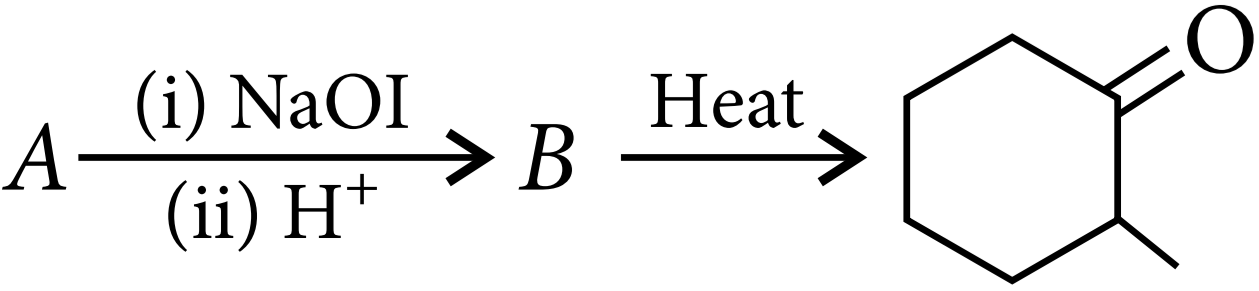
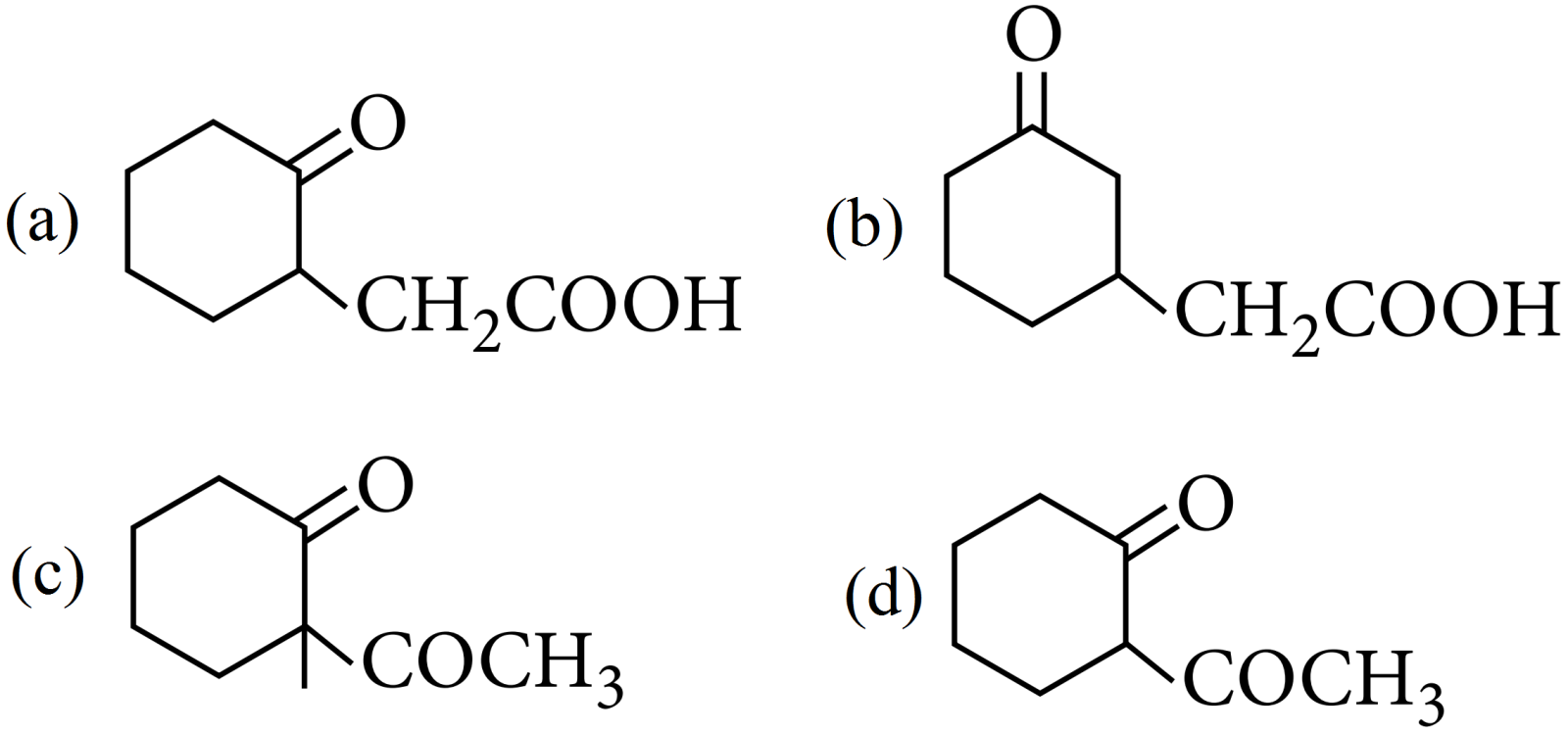
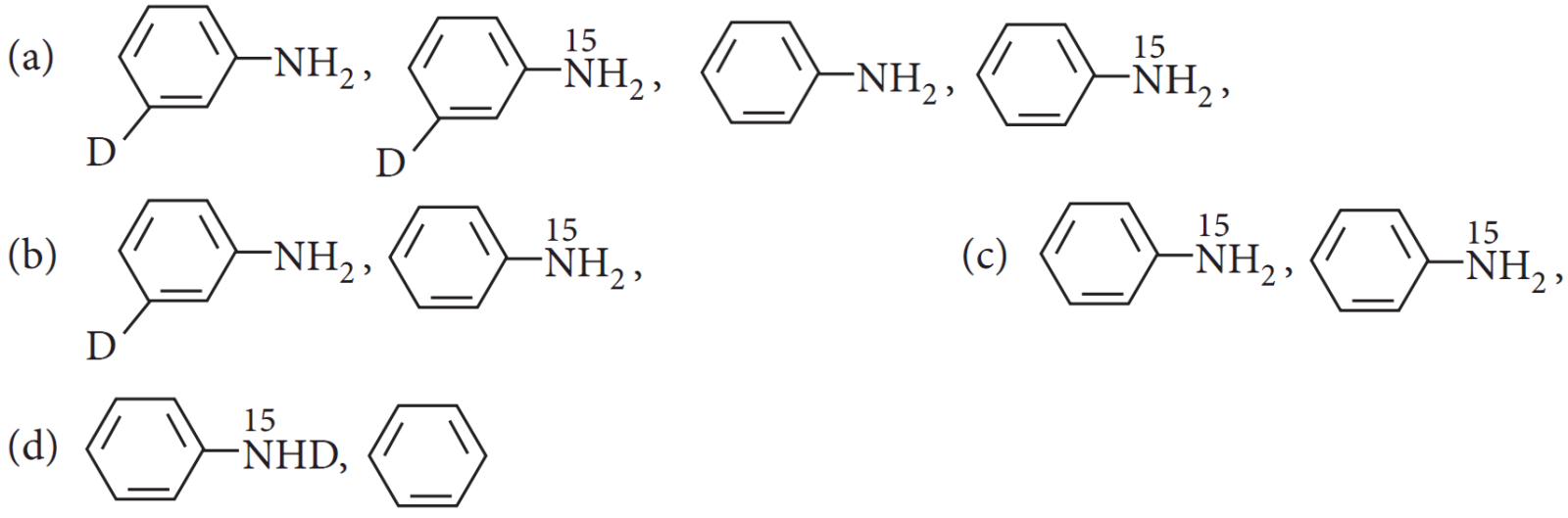
  1. For the given set of reactions,

starting compound A corresponds to:

  1. In the following reaction sequence, the correct structures of E, F and G are:

(* implies 13C labelled carbon)

  1. An organic compound 'A' has the molecular formula C3H6O. It undergoes iodoform test. When saturated with HCl it gives 'B' of molecular formula C9H14O. 'A' and 'B' respectively are:
  1. propanal and mesityl oxide.
  2. Propanone and mesityl oxide.
  3. propanone and 2,6-dimethyl-2,5-hepta-dien-4-one.
  4. propanone and propionaldehyde.
Read the passage given below and answer the following questions:
An organic compound (A) having molecular formula C6H6O gives a characteristic colour with aqueous FeCl3 solution. (A) on treatment with CO2 and NaOH at 400K under pressure gives (B), which on acidification gives a compound (C). The compound (C) reacts with acetyl chloride to give (D) which is a popular pain killer.
The following questions are multiple choice questions. Choose the most appropriate answer:
  1. Compound (A) is:
  1. 2-Hexanol.
  2. Dimethyl ether.
  3. Phenol.
  4. 2-Methyl pentanol.
  1. Compound (C) is:
  1. Salicylic acid.
  2. Salicyladehyde.
  3. Benzoic acid.
  4. Benzaldehyde.
  1. Number of carbon atoms in compound (D) is:
  1. 7
  2. 6
  3. 8
  4. 9
  1. The conversion of compound (A) to (C) is known as:
  1. Reimer-Tiemann reaction.
  2. Kolbe's reaction.
  3. Schimdt reaction.
  4. Swarts reaction.
  1. Compound (A) on heating with compound (C) in presence of POCl3 gives a compound (D) which is used:
  1. In perfumery as a ftavouring agent
  2. As an antipyretic
  3. As an analgesic
  4. As an intestinal antiseptic.

Read the passage given below and answer the following questions:

A primary alkyl halide (A) C4H9Br reacted with akoholic KOH to give compound (B). Compound (B) is reacted with HBr to give compound (C) which is an isomer of (A). When (A) reacted with sodium metal, it gave a compound (D) C8H18 that is different than the compound obtained when n-butyl bromide reacted with sodium metal.

The following questions are multiple choice questions. Choose the most appropriate answer:

  1. Compound (A) is:
  1. CH3CH2CH2CH2Br

  2. $\text{CH}_3\text{CH}-\text{CH}_2\text{Br}\\\ \ \ \ \ \ \ \ \ |\\\ \ \ \ \ \ \ \ \text{CH}_3$

  3. $\ \ \ \ \ \ \ \ \ \ \ \ \ \ \text{CH}_3\\\ \ \ \ \ \ \ \ \ \ \ \ \ \ \ |\\\text{CH}_3-\text{C}-\text{Br} \\\ \ \ \ \ \ \ \ \ \ \ \ \ \ \ \ |\\\ \ \ \ \ \ \ \ \ \ \ \ \ \ \ \text{CH}_3$

  4. CH3CH2CH2Br

  1. Which type of isomerism is present in compound (A) and (C)?
  1. Positional
  2. Functional
  3. Chain
  4. Both (a) and (c)
  1. Identify compound (B).
  1. $\text{CH}_3-\text{C}=\text{CH}_2 \ \ \\ \ \ \ \ \ \ \ \ \ \ \ \ \ \mid \\ \ \ \ \ \ \ \ \ \ \ \ \text{CH}_3$
  2. CH3 – CH = CH – CH3
  3. CH3 – CH2 – CH = CH2
  4. None of these.
  1. IUPAC name of compound (D) is:
  1. N - octane
  2. 2, 5 - dimethylhexane
  3. 2 - methylheptane
  4. 3, 4 - dimethyl hexane.
  1. When compoound (C) is treated with ale. KOH and then treated with presence of peroxide, the compound obtained is:
  1. $\ \ \ \ \ \ \ \ \ \ \ \ \ \ \text{CH}_3\\\ \ \ \ \ \ \ \ \ \ \ \ \ \ \ |\\\text{CH}_3-\text{C}-\text{Br} \\\ \ \ \ \ \ \ \ \ \ \ \ \ \ \ \ |\\\ \ \ \ \ \ \ \ \ \ \ \ \ \ \ \text{CH}_3$

  2. $\ \ \ \ \ \ \ \ \ \ \ \ \ \ \text{CH}_3\\\ \ \ \ \ \ \ \ \ \ \ \ \ \ \ |\\\text{CH}_3-\text{CH}-\text{CH}_2-\text{Br}$

  3. $\text{CH}_3\text{CH}_2\text{CH}_2\text{CH}_2\text{Br}$

  4. $$$\text{CH}_3\text{CH}_2\text{CH}_2\text{CH}-\text{Br}\\\ \ \ \ \ \ \ \ \ \ \ \ \ \ \ \ \ \ \ \ \ \ \ \ \ |\\\ \ \ \ \ \ \ \ \ \ \ \ \ \ \ \ \ \ \ \ \ \ \ \ \text{CH}_3$

Read the passage given below and answer the following questions:
Nucleophilic substitution reactions are of two types; substitution nucleophilic bimolecular (SN2) and substitution nucleophilic unimolecular (SN1) depending on molecules taking part in determining the rate of reaction. Reactivity of alkyl halide towards SN1 and SN2 reactions depends on various factors such as steric hindrance, stability of intermediate or transition state, and polarity of solvent. SN2 reaction mechanism is favoured mostly by primary alkyl halide then secondary and then tertiary. This order is reversed in case of SN1 reactions.
The following questions are multiple choice questions. Choose the most appropriate answer:
  1. Which of the following is most reactive towards nucleophilic substitution reaction?
  1. C6H5Cl
  2. CH2 = CHCl
  3. ClCH2CH = CH2
  4. CH3CH = CHCl
  1. Isopropyl chloride undergoes hydrolysis by:
  1. SN1 mechanism.
  2. SN2 mechanism.
  3. SN1 and SN2 mechanism.
  4. Neither SN1 nor SN2 mechanism.
  1. The most reactive nucleophile among the following is:
  1. CH3O-
  2. C6H5O-
  3. (CH3)2CHO-
  4. (CH3)3CO-
  1. Tertiary alkyl halides are practically inert to substitution by SN2 mechanism because of:
  1. Insolubility.
  2. Instability.
  3. Inductive effect.
  4. Stearic hindrance.
  1. Which of the following is the correct order of decreasing SN2 reactivity?
  1. RCH2X > R2CHX > R3CX
  2. R3CX > R2CHX > RCH2X
  3. R2CHX > R3CX > RCH2X
  4. RCH2X > R3CX > R2CHX

Read the passage given below and answer the following questions:

The aryl halides are relatively less reactive towards nucleophilic substitution reactions as compared to alkyl halides. This low reactivity can be attributed to the following factors:

  • The C - X bond in halobenzene has a partial double bond character due to involvement of halogen electrons in resonance with benzene ring.
  • The C - X bond in aryl halides is less polar as compared to that in alkyl halides as sp2 hyridised carbon is more electronegative than sp3 hybridised carbon.

In these questions (Q. No. i-Iv), a statement of assertion followed by a statement of reason is given. Choose the correct answer out of the following choices.

  1. Assertion and reason both are correct statements and reason is correct explanation for assertion.
  2. Assertion and reason both are correct statements but reason is not correct explanation for assertion.
  3. Assertion is correct statement but reason is wrong statement.
  4. Assertion is wrong statement but reason is correct statement.
  1. Assertion: Primary benzylic halides are more reactive than primary alkyl halides towards SN1 reactions.

Reason: Reactivity depends upon the nature of the nucleophile and the solvent.

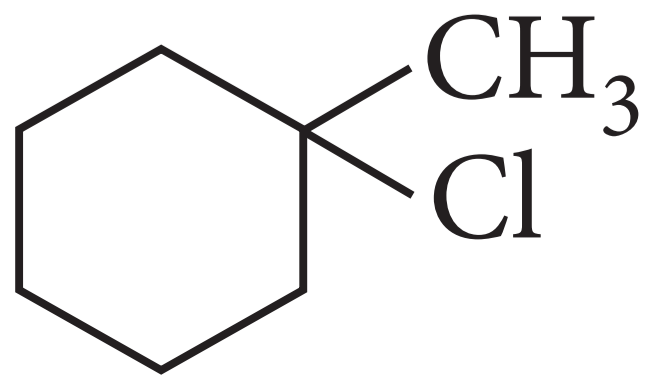
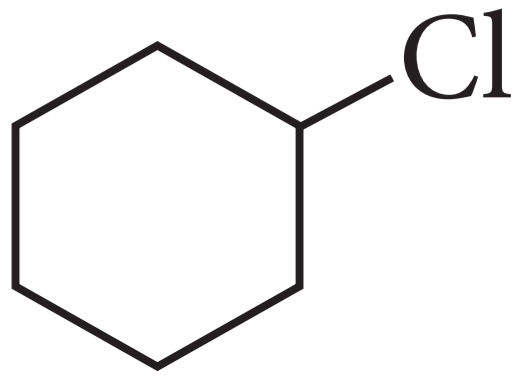
  1. Assertion: is more reactive than towards nucleophilic substitution reactions.
Reason: Tertiary alkyl halides react predominantly by SN1 mechanism.

  1. Assertion: Chlorobenzene is more reactive than p-chloroanisole to nucleophilic substitution reactions.

Reason: Greater the stability of carbanion, greater is its ease of formation and hence, more reactive is the aryl halide.

  1. Assertion: 4-Nitrochlorobenzene undergoes nucleophilic substitution more readily than chlorobenzene.

Reason: Chlorobenzene undergoes nucleophilic substitution by elimination-addition mechanism while 4-nitrochlorobenzene undergoes nucleophilic substitution by addition-elimination mechanism.

  1. Assertion: Chlorobenzene is less reactive than benzene towards the electrophilic substitution reaction.

Reason: Resonance destabilises the carbocation.

Two types of conductors are generally used, metallic and electrolytic. Free electrons are the current carrier in metallic and in electrolytic conductors, free ions. Specific conductance or conductivity of an electrolytic solution is given by

$\text{K}=\text{C}\times\frac{\text{l}}{\text{A}}$

where, $\text{C}\times\frac{1}{\text{R}}$ and $\frac{\text{l}}{\text{A}}=\text{G}^\star$ (cell constant)

Molar conductance $(\wedge_\text{m})$ and equivalent conductance $(\wedge_\text{e})$ of an electrolyte solution are calculated as

$\wedge_\text{m}=\frac{\text{K}\times1000}{\text{M}}$ or $\wedge_\text{e}=\frac{\text{K}\times1000}{\text{N}}$

where, M = molarity of solution and N is normality of solution. Molar conductance of strong electrolyte depends on the concentration.

$\wedge_\text{m}=\wedge^\circ_{\text{m}^-}\text{b}\sqrt{\text{C}}$

$\wedge^\circ_\text{m}=$ molar conductance at infinite dilution, b = constant, C = cone.of solution

In these questions (Q. No. i-iv), a statement of assertion followed by a statement of reason is given. Choose the correct answer out of the following choices.

  1. Assertion and reason both are correct statements and reason is correct explanation for assertion.
  2. Assertion and reason both are correct statements but reason is not correct explanation for assertion.
  3. Assertion is correct statement but reason is wrong statement.
  4. Assertion is wrong statement but reason is correct statement.
  1. Assertion: The molar conductivity of strong electrolyte decreases with increase in concentration.

Reason: At high concentration, migration ofions is slow.

  1. Assertion: The molar conductance of weak electrolyte at infinite dilution is equal to the sum of molar conductance of cations and anions.

Reason: Kohlrausch's law is applicable for strong electrolytes.

  1. Assertion: Equivalent conductance of all electrolytes increases with increasing concentration.

Reason: More number ofions are available per gram equivalent at higher concentration.

  1. Assertion: Specific conductance decreases with dilution whereas equivalent conductance increases.

Reason: On dilution, number of ions per millilitre decreases but total number ofions increases considerably.

  1. Assertion: The ratio of specific conductivity to the observed conductance does not depend upon the concentration of the solution taken in the conductivity cell.

Reason: Specific conductivity decreases with dilution whereas observed conductance increases with dilution.

Read the passage given below and answer the following questions:
The solubility of gases increases with increase of pressure. William Henry made a systematic investigation of the solubility of a gas in a liquid. According to Henry's law "the mass of a gas dissolved per unit volume of the solvent at constant temperature is directly proportional to the pressure of the gas in equilibrium with the solution". Dalton during the same period also concluded independently that the solubility of a gas in a ti quid solution depends upon the partial pressure of the gas. If we use the mole fraction of gas in the solution as a measure of its solubility, then Henry's law can be modified as "the partial pressure of the gas in the vapour phase is directly proportional to the mole fraction of the gas in the solution"
The following questions are multiple choice questions. Choose the most appropriate answer:
  1. Henry's law constant for the solubility of methane in benzene at 298K is 4.27 x 105mm Hg. The solubility of methane in benzene at 298K under 760mm Hg is:
  1. 4.27 × 10⁻⁵
  2. 1.78 × 10⁻³
  3. 4.27 × 10⁻³
  4. 1.78 × 10⁻⁵
  1. The partial pressure of ethane over a saturated solution containing 6.56 × 10-2g of ethane is I bar. If the solution contains 5.00 × 10⁻²g of ethane then what will be the partial pressure (in bar) of the gas?
  1. 0.762
  2. 1.312
  3. 3.81
  4. 5.0
  1. KH (K bar) values for Ar(g), CO2(g), HCHO(g) and CH4(g) are 40.39, 1.67, 1.83 × 10-5 and 0.413 respectively. Arrange these gases in the order of their increasing solubility. Arrange these gases in the order of their increasing solubility.
  1. HCHO < CH4 < CO2 < Ar
  2. HCHO < CO2 < CH4 < Ar
  3. Ar < CO2 < CH4 < HCHO
  4. Ar < CH4 < CO2 < HCHO
  1. When a gas is bubbled through water at 298K, a very dilute solution of the gas is obtained. Henry's law constant for the gas at 298K is 150 kbar. If the gas exerts a partial pressure of 2 bar, the number of millimoles of the gas dissolved in IL of water is:
  1. 0.55
  2. 0.87
  3. 0.37
  4. 0.66
  1. Which of the following statements is correct?
  1. KH increases with increase of temperature.
  2. KH decreases with increase of temperature.
  3. KH remains constant with increase of temperature.
  4. KH first increases then decreases, with increase of temperature.