Question
Read the passage given below and answer the following questions:

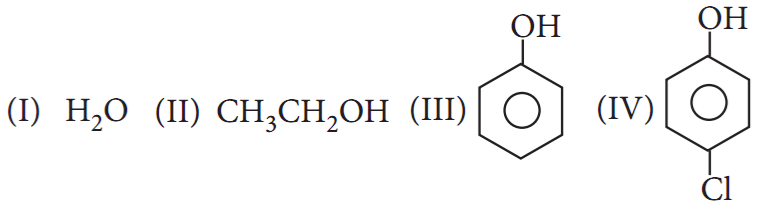
Due to intermolecular hydrogen bonding, the boiling points of alcohols and phenols are much higher than those of corresponding haloalkanes, haloarenes, aliphatic and aromatic hydrocarbons. Among isomeric alcohols, the boiling points follow the order: primary > secondary > tertiary. Boiling points of ethers are much lower than those of isomeric alcohols. The solubility of alcohols in water decreases as the molecular mass of alcohols increases. Amongst isomeric alcohols solubility increases with branching. The solubility of phenols in water is much lower than that of alcohols. Lower ethers such as dimethyl ether and ethyl methyl ether are soluble in water, but the solubility decreases as the molecular mass increases.

In these questions (Q. No. i-iv), a statement of assertion followed by a statement of reason is given. Choose the correct answer out of the following choices.

  1. Assertion and reason both are correct statements and reason is correct explanation for assertion.
  2. Assertion and reason both are correct statements but reason is not correct explanation for assertion.
  3. Assertion is correct statement but reason is wrong statement.
  4. Assertion is wrong statement but reason is correct statement.
  1. Assertion: Alcohols have higher boiling points than ethers of comparable molecular masses.

Reason: Alcohols and ethers are isomeric in nature.

  1. Assertion: The solubility of phenols in water is much lower than that of alcohols.

Reason: Phenols do not form H-bonds with water.

  1. Assertion: Among n-butane, ethoxyethane, 1-propanol and 2-propanol, the increasing order of boiling points is, 1-butanol < 1-propanol < ethoxyethane < n-butane.

Reason: Boiling point increases with increase in molecular mass.

  1. Assertion: Dimethyl ether and diethylether are soluble in water.

Reason: As the molecular mass increases, solubility of ethers in water decreases.

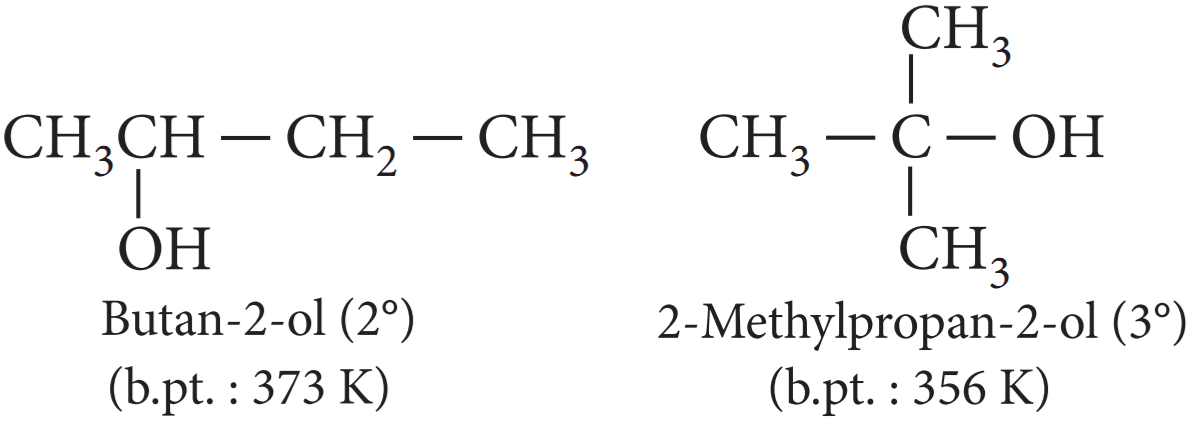
  1. Assertion: Butan-2-ol has higher boiling point than 2-methylpropan-2-ol.

Reason: Amongst isomeric alcohols, the boiling points decreases with branching.
Answer

  1. (b) Assertion and reason both are correct statements but reason is not correct explanation for assertion.

Explanation:

Due to the presence of intermolecular H-bondi ng in alcohols, they have higher boiling points than isomeric ethers.

  1. (c) Assertion is correct statement but reason is wrong statement.

​​​​​​​Explanation:

Like alcohols, phenols also form H-bond with water. But the solubility of phenols in water is much lower than that of alcohols because of the larger non-polar hydrocarbon part (benzene ring) present in their molecules.

  1. (d) Assertion is wrong statement but reason is correct statement.

​​​​​​​​​​​​​​​​​​​​​Explanation:

Boiling point increases with increase in molecular mass so, 1-butanol has higher boiling point than 1-propanol. Ethers do not form hydrogen bonds thus, they have lower boiling points than the corresponding alcohols.

Due to weak dipole-dipole interactions, the boiling points of lower ethers are only slightly higher than those of the n-alkanes having comparable molecular masses,

Thus, the increasing order of boiling points is n-butane < ethoxyethane < 1-propanol < l-butanol.

  1. (b) Assertion and reason both are correct statements but reason is not correct explanation for assertion.

​​​​​​​​​​​​​​​​​​​​​​​​​​​​Explanation:

The solubility of lower ethers in water is due to the formation of H-bonds between water and ether molecules. As the molecular mass increases, the solubility of ethers in water decreases due to corresponding increase in the hydrocarbon portion of the molecule.

  1. (a) Assertion and reason both are correct statements and reason is correct explanation for assertion.

​​​​​​​​​​​​​​​​​​​​​​​​​​​​​​​​​​​Explanation:

Amongst isomeric alcohols,the boiling points decrease with branching due to a corresponding decrease in surface area.

Need a full question paper?

Generate a complete, print-ready paper with questions like this in minutes — across 16+ boards, with answer keys.

Start Generating Free

Similar questions

Read the passage given below and answer the following questions:

Arrangement of ligands in order of their ability to cause splitting $(\Delta)$ is called spectrochemical series. Ligands which cause large splitting (large $\Delta$) are called strong field ligands while those which cause small splitting (small $\Delta$) are called weak field ligands. When strong field ligands approach metal atom/ ion, the value of $\Delta_0$ is large, so that electrons are forced to get paired up in lower energy t2g orbitals. Hence, a low-spin complex is resulted from strong field ligand. When weak field ligands approach metal atom/ ion, the value of $\Delta_0$ is small, so that electrons enter high energy eg orbitals rather than pairing in low energy t2g orbitals. Hence, a high-spin complex is resulted from weak field ligands. Strong field ligands have tendency to form inner orbital complexes by forcing the electrons to pair up. Whereas weak field ligands have tendency to form outer orbital complex because inner electrons generally do not pair up.

In these questions (Q. No. i-iv), a statement of assertion followed by a statement ofreason is given. Choose the correct answer out of the following choices.

  1. Assertion and reason both are correct statements and reason is correct explanation for assertion.
  2. Assertion and reason both are correct statements but reason is not correct explanation for assertion.
  3. Assertion is correct statement but reason is wrong statement.
  4. Assertion is wrong statement but reason is correct statement.
The following questions are multiple choice questions. Choose the most appropriate answer:

  1. Assertion: In tetrahedral coordination entity formation, the d orbital splitting is inverted and is smaller as compared to the octahedral field splitting.

Reason: Spectrochemical series is based on the absorption of light by complexes with different ligands.

  1. Assertion: In high spin situation, configuration of d5 ions will be $\text{t}^3_{2\text{g}}\text{e}^2_\text{g}.$

Reason: In high spin situation, pairing energy is less than crystal field energy.

  1. Assertion: F- ion is a weak field ligand and fonns outer orbital complex.

Reason: F- ion cannot force the electrons of dz2 and dx2-y2 orbitals of the inner shell to occupy dxy, dyz and dzx orbitals of the same shell.

  1. Assertion: The crystal field model is successful in explaining the formation, structures, colour and magnetic properties of coordination compounds.

Reason: In spectrochemical series, ligands are arranged in a series of increasing field strength.

  1. Assertion: NF3 is a weaker ligand than N(CH3)3.

Reason: NF3 ionizes to give F- ions in aqueous solution.

Read the passage given below and answer the following questions:

The order of reactivity towards SN1 reaction depends upon the stability of carbocation in the first step. Greater the stability of the carbocation, greater will be its ease of formation from alkyl halide and hence faster will be the rate of the reaction. As we know, 3º carbocation is most stable, therefore, the tert-alkyl that halides will undergo SN1 reaction very fast. For example, it has been observed that the reaction (CH3)3CBr with OH- ion to give 2-methyl-2-propanol is about I million times as fast as the corresponding reaction of the methyl bromide to give methanol.

The primary alkyl halides always react predominantly by SN2 mechanism. On the other hand, the tertiary alkyl halides react predominantly by SN1 mechanism. Secondary alkyl halides may react by either mechanism or by both the mechanisms without much preference depending upon the nature of the nucleophile and solvent.

In these questions (Q. No. i-tv), a statement of assertion followed by a statement of reason is given. Choose tile correct answer out of tile following choices.

  1. Assertion and reason both are correct statements and reason is correct explanation for assertion.
  2. Assertion and reason both are correct statements but reason is not correct explanation for assertion.
  3. Assertion is correct statement but reason is wrong statement.
  4. Assertion is wrong statement but reason is correct statement.
  1. Assertion: Low concentration of nudeophile favours SN1 mechanism.

Reason: 2º alkyl halides are less reactive than 1º towards SN1 reactions.

  1. Assertion: Polar solvent slows down SN2 reactions.

Reason: CH3-Br is less reactive than CH3Cl.

  1. Assertion: Benzyl bromide when kept in acetone- water it produces benzyl alcohol.

Reason: The reaction follows SN2 mechanism.

  1. Assertion: Rate of hydrolysis of methyl chloride to methanol is higher in DMF than in water.

Reason: Hydrolysis of methyl chloride follows second order kinetics.

  1. Assertion: SN1 reaction is carried out in the presence of a polar protic solvent.

Reason: A polar protic solvent increases the stability of carbocation due to solvation.

Read the passage given below and answer the following questions:

When a solution of an et-amino acid is placed in an electric field depending on the pH of the medium, following three cases may happen.

  1. In alkaline solution, CL-amino acids exist as anion II, and there is a net migration of amino acid towards the anode.
  2. In acidic solution, a-amino acids exist as cation III, and there is a net migration of amino acid towards the cathode.
  3. If II and III are exactly balanced there is no net migration; under such conditions any one molecule exists as a positive ion and as a negative ion for exactly the same amount of time, and any small movement in the direction of one electrode is subsequently cancelled by an equal movement back toward the other electrode. The pH of the solution in which a particular amino acid does not migrate under the influence of an electric field is called the is oelectric point of that amino acid.

The following questions are multiple choice questions. Choose the most appropriate answer:

  1.  

Arrange in order of increasing acid strengths. 

  1. X > Z > Y
  2. Z < X < Y
  3. X > Y > Z
  4. Z > X > Y
  1. In aqueous solutions, amino acids mostly exist as:
  1. NH2 - CHR - COOH
  2. NH2 - CHR - COO-
  3. $\stackrel{+}{\hbox{ N}}\text{H}_3\text{CHRCOOH}$

  4. $\text{H}_3\stackrel{{+}}{\hbox{N}}\text{CHRCOO}^-$

  1. Amino acids are least soluble:
  1. at pH 1
  2. at pH 7
  3. At their isoelectric points.
  4. None of these.
  1. The $\text{pK}_{\text{a}_1}$ and $\text{pK}_{\text{a}_2}$ of an amino acid are 2.3 and 9.7 respectively. The is oelectric point of the amino acid is:
  1. 12.0
  2. 7.4
  3. 6.0
  4. 3.7
  1. A tripeptide (X) on partial hydrolysis gave two dipeptides Cys-Gly and Glu-Cys. Identify the tripeptide.
  1. Glu-Cys-Gly
  2. Gly-Glu-Cys
  3. Cys-Gly-Glu
  4. Cys-Glu-Gly
Read the passage given below and answer the following questions:

Williamson's synthesis is used for the preparation of symmetrical as well as unsymmerical ether. It is SN2 reaction mechanism. In Williamson's synthesis, 1º alkyl halide are used for preparation of ethers because 2º and 3º alkyl halide give alkene. Ethers are cleaved by hydrogen halides to alcohol and alkyl halide where alkyl halide is corresponding to that alkyl which has less number of carbon atom (it is because of less steric hindrance). In polar media unsymmetrical ether like tertiary butyl ethyl ether gives ethyl alcohol and tertiary butyl halide as reaction proceeds via carbocation.

In these questions (Q. No. i-iv), a statement of assertion followed by a statement of reason is given. Choose the correct answer out of the following choices.

  1. Assertion and reason both are correct statements and reason is correct explanation for assertion.
  2. Assertion and reason both are correct statements but reason is not correct explanation for assertion.
  3. Assertion is correct statement but reason is wrong statement.
  4. Assertion is wrong statement but reason is correct statement.
  1. Assertion: Rate of reaction of alkyl halide in Williamson's synthesis reaction is 1ºRX > 2ºRX > 3ºRX.

Reason: It is a type of bimolecular substitution reaction (SN2).

  1. Assertion: T-Butyl methyl ether is not prepared by the reaction of t-butyl bromide with sodium methoxide.

Reason: Sodium methoxide is a weak nucleophile.

  1. Assertion: Williamson's synthesis method cannot be used for preparing diphenyl ether.

Reason: Aryl halides do not undergo nucleophilic substitution easily.

  1. Assertion: When isopropyl bromide is treated with sodium isopropoxide, di-isopropyl ether is obtained as a major product.

Reason: With secondary alkyl halides, both substitution and elimination occur.

  1. Assertion: Both symmetrical and unsymmetrical ethers can be prepared by Williamson's synthesis.

Reason: Williamson's synthesis is an example of nucleophilic substitution reaction.

Read the passage given below and answer the following questions:

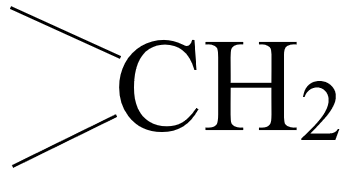
Aldehydes and ketones are reduced to primary and secondary alcohols respectively by NaBH4 or LiAlH4 as well as catalytic hydrogenation. The carbonyl group of aldehydes and ketones is reduced to  group on treatment with Zn-Hg and cone. HCl (Clemmensen reduction) or with hydrazine followed by NaOH or KOH in highly boiling solvent such as ethylene glycol (Wolff-Kishner reduction).Aldehydes differ from ketones in their oxidation reactions. Aldehydes are easily oxidised to carboxylic acids on treatment with HNO3, KMnO4, K2Cr2O7 etc. Even mild oxidising agents mainlyTollens' reagent and Fehling's solution also oxidise aldehydes. Ketones are generally oxidised under vigorous conditions i.e., strong oxidising agents and at elevated temperatures, to give mixture of carboxylic acids having lesser number of C-atoms than the parent ketone.
The following questions are multiple choice questions. Choose the most appropriate answer:

  1. Which of the following cannot be made by reduction of ketone or aldehyde with NaBH4 in methanol?
  1. 1-Butanol
  2. 2-Butanol
  3. 2-Methyl-1-propanol
  4. 2-Methyl-2-propanol
  1. The carbonyl compound producing an optically active product by reaction with LiAlH4 is:
  1. Propanone
  2. Butanone
  3. 3-pentanone
  4. Benzophenone
  1. A substance C4H10O (X) yields on oxidation a compound C4H8O which gives an oxime and a positive iodoform test. The substance X on treatment with cone. H2SO4 gives C4H8. The structure of the compound (X) is:
  1. CH3CH2CH2CH2OH
  2. CH3CH(OH)CH2CH3
  3. (CH3)3COH
  4. CH3CH- O - CH2CH3
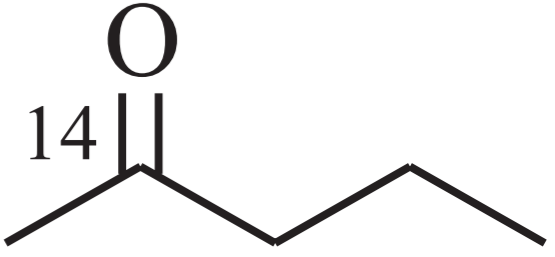
  1. In the oxidation of  by acidified K2Cr2O7, the products are:
  1. $\ \ \ \ \ \ \ \ \ \ \ \ \ \ \ \ \text{O}\\\ \ \ \ \ \ \ \ \ \ \ \ \ \ \ \ ||\\\text{CH}_3-\ ^\text{14}\text{C}-\text{OH}$ and $\text{CH}_3\text{CH}_2\text{COOH}$

  2. $\ \ \ \ \ \ \ \ \ \ \ \ \ \ \ \ \ \ \ \ \ \ \ \ \ \ \ \ \ \ \ \ \ \ \ \ \text{O}\\ \ \ \ \ \ \ \ \ \ \ \ \ \ \ \ \ \ \ \ \ \ \ \ \ \ \ \ \ \ \ \ \ \ \ \ \ \ ||\\\text{CH}_3(\text{CH}_2)_2\text{COOH}-\text{C}-\text{OH}$ and $ \ \ \ \ \ \ \ 14\\\text{CH}_3\text{CH}_2\text{COOH}$

  3. $\ \ \ \ \ \ \ \ \ \ \ \ \ \ \ \ \ \ \ \ \ \ \ \ \ \ \ \ \ \ \ \ \ \ \ \ \ \ \ \ \ \ 14\\\text{CH}_3\text{CH}_2\text{CH}_2\text{COOH}+\text{HCOOH}$

  4. None of these.

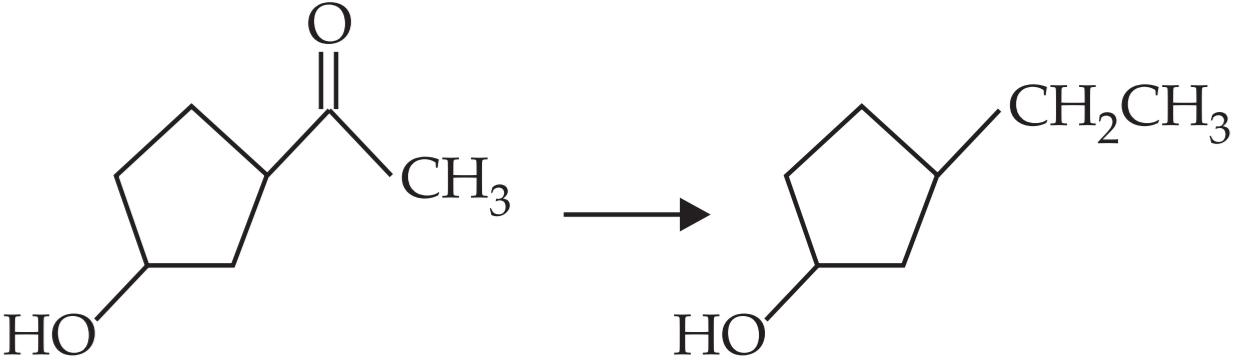
  1. The appropriate reagent for the following transformation is:

  1. $\text{Na}_2\text{NH}_2,^-\text{OH}$

  2. $\text{NaBH}_4$

  3. $\frac{\text{H}_2}{\text{Ni}}$

  4. $\text{AICl}_3$

Read the passage given below and answer the following questions:

If some solute is added to a solvent, the boiling point of solution increases. This is known as elevation in baiting point.

$\Delta\text{T}_\text{b}=\text{K}_\text{b}\text{m}$ where, Kb = Molal elevation constant,

$\Delta\text{T}_\text{b}\propto\text{m}$

Hence, it is a colligative property,

Also, $\text{K}_\text{b}=\frac{\text{MRT}^2_\text{b}}{\Delta\text{Vap}\text{H}\times1000}$

where, M = Molar mass of solvent,

$\Delta\text{vap}$ H = Enthalpy of vaporisation,

Molar mass can also be calculated using elevation in boiling point.

$\text{M}_\text{B}=\frac{\text{K}_\text{B}\times\text{W}_\text{B}\times1000}{\Delta\text{T}_\text{b}\times\text{W}_\text{A}}$

A statement of assertion followed by a statement of reason is given. Choose the correct answer out of the following choices.

  1. Assertion and reason both are correct statements and reason is correct explanation for assertion.
  2. Assertion and reason both are correct statements but reason is not correct explanation for assertion.
  3. Assertion is correct statement but reason is wrong statement.
  4. Assertion is wrong statement but reason is correct statement.
  1. Assertion: In a pressure cooker, the water is brought to boil. The cooker is then removed from the stove. Now on removing the lid of pressure cooker, the water starts boiling again.

Reason: The impurities in water bring down its boiling point.

  1. Assertion: On dissolving 3.24g of sulphur in 40g of benzene, boiling point of solution get higher than that of benzene by 0.081K, then the formula of sulphur is S8. (Kb for benzene = 2.53K kg mol-1)

Reason: Molecular mass of sulphur comes out to be 253.

  1. Assertion: When sugar is added to water, boiling point of water increases.

Reason: When a non-volatile solute is added to a solvent, elevation in boiling point is observed.

  1. Assertion: Cooking time in pressure cookers is reduced.

Reason: Boiling point inside the pressure cooker in raised.

  1. Assertion: Elevation in boiling point of two isotonic solutions is same.

Reason: Boiling point depends upon the concentration of the solute.

Read the passage given below and answer the following questions:

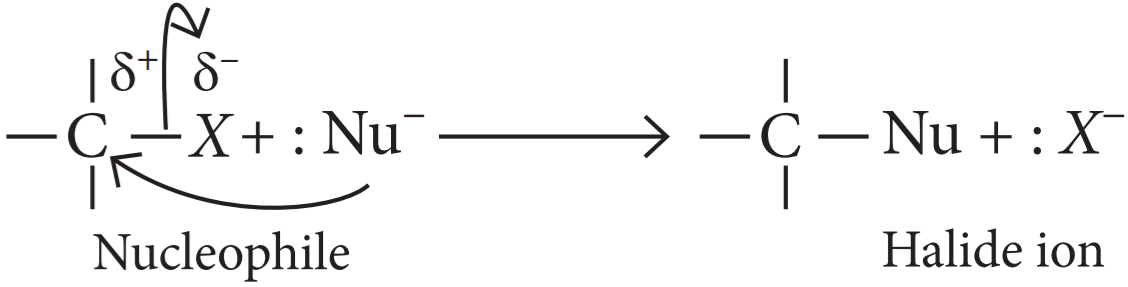
In haloalkanes, when a nucleophile stronger than the halide ion approaches the positively charged carbon atom of an alkyl halide, the halogen atom along with its bonding electron pair gets displaced and a new bond with the carbon and the nucleophile is formed. These reactions are called nucleophilic substitution reactions.

In these reactions the atom or group of atoms which loses its bond from carbon and takes on an additional pair of electrons is called leaving group. Halide ions are good leaving groups. Some important nucleophilic substitution reactions ofhaloalkanes with common nucleophiles are given in the table below.

 
Reagent
Nucleophile (Nu-)
Substitution product R-Nu
Class of main product
1.
NaOH or KOH or moist Ag2O
-OH
ROH
Alcohol
2.
H2O
H2O
ROH
Alcohol
3.
Nal
I-
R – I
Alkyl iodide
4.
R'NH2
$\text{R'}\ddot{\text{N}}\text{H}_2$
RNHR'
Sec. amine
5.
KCN
$\overline{\text{C}}\equiv\text{N}:$
RCN
Nitrile (cyanide)
6.
KNO2
O = N – O-
R – O – N = O
Alkvl nitrite

In these questions (Q. No. i-iv), a statement of assertion followed by a statement ofreason is given. Choose the correct answer out of the following choices.

  1. Assertion and reason both are correct statements and reason is correct explanation for assertion.
  2. Assertion and reason both are correct statements but reason is not correct explanation for assertion.
  3. Assertion is correct statement but reason is wrong statement.
  4. Assertion is wrong statement but reason is correct statement.
  1. Assertion: Alkyl halides are hydrolysed to alcohols by moist silver oxide.

Reason: RCI is hydrolysed to ROH easily but reactions slow down on addition of KI.

  1. Assertion: Alkyl halides fonn alkenes when heated above 300ºC.

Reason: CH3CH21 reacts slowly with strong base as compared to CD3CH2I.

  1. Assertion: RBr reacts with AgNO2 to give nitroalkane.

Reason: Silver nitrite (AgNO2) is an ionic compound, therefore the negative charge on nitrogen is the attacking site.

  1. Assertion: The nucleophilic substitution of vinyl chloride is difficult than ethyl chloride.

Reason: Vinyl group is electron donating group.

  1. Assertion: 2-Bromobutane on reaction with sodium ethoxide in ethanol gives 1-butene as the major product.

Reason: 1-Butene is less stable than 2-butene.

Read the passage given below and answer the following questions:
Iron forms many complexes in its +2 and +3 oxidation states such as [Fe(H2O)6]2+ (A); [Fe(CN)6]4- (B); [Fe(H2O)6]3+ (C); [Fe(CN)6]3- (D), etc., They exhibit, different magnetic properties and undergo different hybridisation of iron.
The following questions are multiple choice questions. Choose the most appropriate answer:
  1. Which of the following statements is correct?
  1. (B) is paramagnetic while (C) is diamagnetic.
  2. Both (B) and (D) are outer orbital complexe.
  3. Both (A) and (C) are paramagnetic.
  4. (A) is outer orbital complex and (C) is inner orbital complex.
  1. The complex having maximum magnetic moment is:
  1. (A)
  2. (B)
  3. (C)
  4. (D)
  1. Which of the following does not represent correct configuration of the d-orbitals in the given complexes?
  1. $\text{(A)}:\text{t}^4_{2\text{g}}\text{e}^2_\text{g}$
  2. $\text{(B)}:\text{t}^6_{2\text{g}}\text{e}^0_\text{g}$
  3. $\text{(C)}:\text{t}^4_{2\text{g}}\text{e}^1_\text{g}$
  4. $\text{(D)}:\text{t}^5_{2\text{g}}\text{e}^0_\text{g}$
  1. The spin only magnetic moment of complexes (A), (B), (C) and (D) are respectively (in BM).
  1. $2\sqrt{6},0,\sqrt{35},\sqrt{3}$
  2. $0,2\sqrt{6},\sqrt{35},\sqrt{3}$
  3. $\sqrt{15,}2\sqrt{6},\sqrt{3},0$
  4. $\sqrt{3},\sqrt{8},0,\sqrt{15}$
  1. Which of the given complexes are outer orbital complexes?
  1. (A) and (B) only
  2. (B) and (C) only
  3. (A) and (C) only
  4. (B) and (D) only
Read the passage given below and answer the following questions:
A mixture of two aromatic compounds (A) and (B) was separated by dissolving in chloroform followed by extraction with aqueous KOH solution. The organic layer containing compound (A), when heated with alcoholic solution of KOH produce C7H5N (C) associated with unpleasant odour.
The following questions are multiple choice questions. Choose the most appropriate answer:
  1. What is A?
  1. C6H5NH2
  2. C6H5CH3
  3. C6H5CH3
  4. None of these.
  1. The reaction of (A) with alcoholic solution of KOH to produce (C) of unpleasant odour is called:
  1. Sandmeyer reaction.
  2. Carbylamine reaction.
  3. Ullmann reaction.
  4. Reimer-Tiemann reaction..
  1. The alkaline aqueous layer (B) when heated with chloroform and then acidified give a mixture of isomeric compounds of molecular formula C7H6O2. (B) is:
  1. C6H5CHO
  2. C6H5COOH
  3. C6H5CH3
  4. C6H5OH
  1. In the chemical reaction, CH3CH2NH2 + CHCl3 + 3KOH → (A)+ (B) + 3H2O,
  1. C2H5NC and KCl
  2. C2H5CN and KCl
  3. CH3CH2CONH2 and KCl
  4. C2H5NC and K2CO3
  1. Direct nitration of an aromatic compound (A) is not feasible because:
  1. The reaction cannot be stopped at the mononitration stage.
  2. A mixture of o, m and p-nitroaniline is always obtained.
  3. Nitric acid oxidises most of the aromatic compound to give oxidation products along with only a small amount of nitrated products.
  4. All of the above.