Question
Read the passage given below and answer the following questions:
Electron microscopic study of crystal defects enables us not only to reveal various structural imperfections, but also to discover their formation, mechanisms and to understand their effects on the properties of solid materials. There are commonly two types of imperfections: electronic imperfections and atomic imperfections or point defects.Electronic imperfections correspond to defects in ionic crystal due to the electrons. Atomic imperfections or point defects correspond to the irregularity of atoms around a point or an atom. The point defects in ionic crystals may be classified as: defects in stoichiometric crystals, defects in non-stoichiometric crystals and impurity defects. In stoichiometric crystals, generally two types of defects are observed: Schottky defect and Frankel defect. Schottky defect arises when some of the atoms or ions are missing from their normal lattice sites. Due to the schottky defect, density of ionic crystals decreases markedly. For example NaCl, KCl, CsCl, AgBr ionic solids have schottky defects. It has been observed that in NaCl, there are about $10^6$ Schottky pairs per cm 'at room temperature. Frankel defect arises when an ion is missing from its normal position and occupies an interstitial site between the lattice points. It does not affect the density of the crystals. In non-stoichiometric crystals, two types of defects are there ; metal excess defects and metal deficient defects. In metal excess defect, the positive ions are in excess whereas in metal deficient defects, number of positive ions are less than the negative ions. Impurity defects arise due to presence of some impurity ions at the lattice sites.
In these questions (Q. No. i-iv), a statement of assertion followed by a statement of reason is given. Choose the correct answer out of the following choices.
  1. Assertion and reason both are correct statements, and reason is correct explanation for assertion.
  2. Assertion and reason both are correct statements, but reason is not correct explanation for assertion.
  3. Assertion is correct statement, but reason is wrong statement.
  4. Assertion is wrong statement, but reason is correct statement.
  1. Assertion: In any ionic solid (MX) with Schottky defects, the number of positive and negative ions are same.
Reason: Equal number of cation and anion vacancies are present.
  1. Assertion: Due to Frenkel defect, there is no effect on the density of the crystalline solid.
Reason: In Frenkel defect, no cation or anion leaves the crystal.
  1. Assertion: The presence of a large number of Schottky defects in NaCl lowers its density.
Reason: In NaCl, there are approximately $10^6$ Schottky pairs per $cm^3$ at room temperature.
  1. Assertion: No compound has both Schottky and Frenkel defects.
Reason: Schottky defects change the density of the solid.
  1. Assertion: NaCl and KCl show metal excess defect.
Reason: Zinc oxide is white in colour at room temperature and on heating it loses oxygen and turns yellow due to metal excess defect.

Answer

  1. (a) Assertion and reason both are correct statements, and reason is correct explanation for assertion.
Explanation:
In Schottky defect, equal number of cations and anions are missing from their lattice sites. Therefore, an ionic solid MX with Schottky defect will still have the same number of anions and cations.
  1. (a) Assertion and reason both are correct statements, and reason is correct explanation for assertion.
Explanation:
In a Frenkel defect, an ion leaves its position in the lattice and occupies normally vacant interstitial position.
  1. (b) Assertion and reason both are correct statements, but reason is not correct explanation for assertion.
Explanation:
Schottky defects arise because of missing of cations or anions from their lattice sites, which lowers the density of crystal system.
  1. (d) Assertion is wrong statement, but reason is correct statement.
Explanation:
AgBr has both Schottky and Frenkel defect. Schottky defects lower the density of the crystal.
  1. (b) Assertion and reason both are correct statements, but reason is not correct explanation for assertion.
Explanation:
ZnO shows such colour due to metal excess defect because of the presence of extra cation in interstitial sites.

Need a full question paper?

Generate a complete, print-ready paper with questions like this in minutes — across 16+ boards, with answer keys.

Start Generating Free

Similar questions


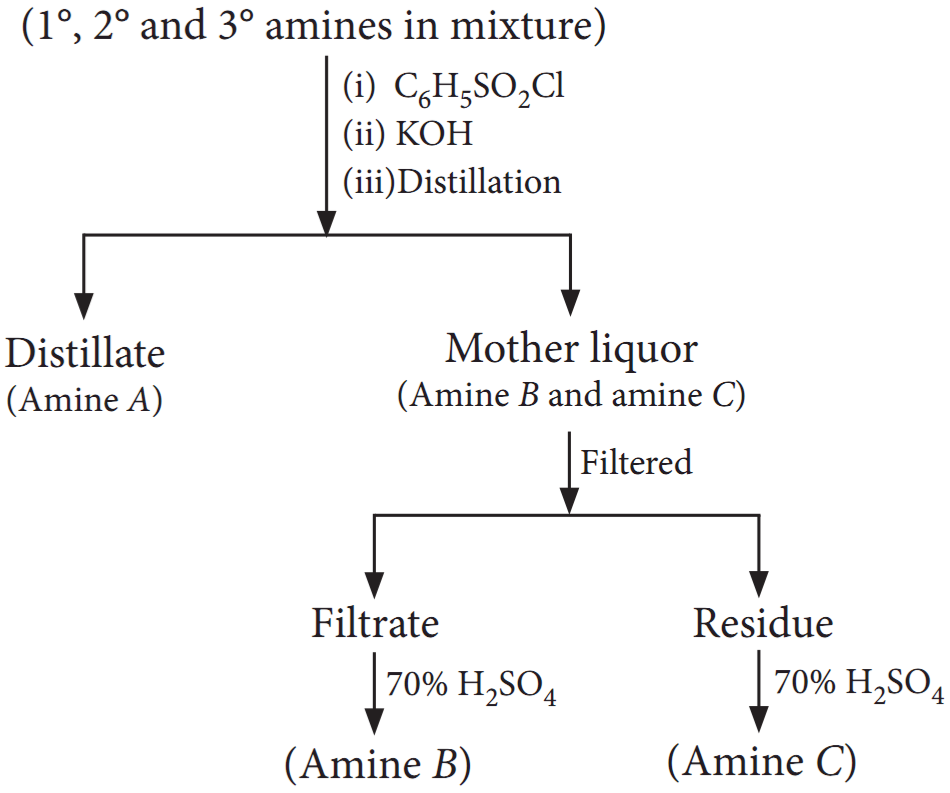
When the mixture contains the three amine salts (1º, 2º and 3º) along with quaternary salt, it is distilled with KOH solution. The three amines distill, leaving the quaternary salt unchanged in the solution. Then the mixture of amines is separated by fractional distillation, Hinsberg's method and Hoffmann's method.

The following questions are multiple choice questions. Choose the most appropriate answer:
  1. Hinsberg reagent is:
  1. Aliphatic sulphonyl chloride.
  2. Phthalamide.
  3. Aromatic sulphonyl chloride.
  4. Anhydrous ZnCl2 + cone. HCI.
  1. Primary amine with Hinsberg's reagent forms:
  1. N-alkyl benzene sulphonamide soluble in KOH solution.
  2. N-alkyl benzene sulphonamide insoluble in KOH solution.
  3. N, N-alkyl benzene sulphonamide soluble in KOH solution.
  4. N, N-alkyl benzene sulphonamide insoluble in KOH solution.
  1. Secondary amine with Hinsberg's reagent forms:
  1. N-alkyl benzene sulphonamide soluble in KOH solution.
  2. N-alkyl benzene sulphonamide insoluble in KOH solution.
  3. N,N-dialkyl benzene sulphonamide soluble in KOH solution.
  4. N,N-dialkyl benzene sulphonamide insoluble in KOH solution.
  1. To separate amines in a mixture Hoffmann's method is used. The Hoffman n's reagent is:
  1. Benzenesulphonyl chloride.
  2. Diethyl oxalate.
  3. Benzeneisocyanide.
  4. P-toulenesulphonic acid.
  1. 3º amines with Hinsberg's reagent give:
  1. No reaction.
  2. Product which is same as that of 1° amine.
  3. Product which is same as that of 2° amine.
  4. Products which is a quaternary salt.
Read the passage given below and answer the following questions:In contrast to the disorders of gases and liquids, there is translational order in crystals. However, disordered or amorphous solids also exist which lack such order, they are really highly viscous liquids. In translational order entire structure or lattice, can be generated by repeated replication of a small regular figure, termed as unit cell. The planes of any crystalline structure can be specified using Miller indices, which is also serve to identify single crystal faces.The ordered structure, or lattice, of a solid can be determined by X-ray or neutron diffraction studies, in which a beam of X-rays of neutrons is scattered from the sample to produce a diffraction pattern which can be analyzed to reveal the crystal structure of the sample. All crystal lattices can be classified into 14 Bravais lattices belonging to 7 systems. For example, the simple cubic, face-centred cubic and body-centred cubic lattices are the 3 lattices of the cubic system. Cubic and hexagonal close-packed structures have the structure of tightly packed spheres, where each sphere touches 12 neighbours, 6 in the same plane and 3 above and 3 below. These two dose-packed structures differ in the placement of successive planes or layers. For the hexagonal close packing, a third layer is laid down to reproduce the first layer, so that the structure could be represented by ABABAB …. For cubic close packing, third layer is again displaced, corresponding to ABCABC.
The following questions are multiple choice questions. Choose the most appropriate answer:
  1. In hexagonal close packing, a sphere has coordination number of.
  1. 4
  2. 6
  3. 8
  4. 12
  1. Which of the following arrangements correctly represents hexagonal and cubic close packed structure respectively?
  1. ABCABC...and ABAB...
  2. ABAB...and ABCABC...
  3. Both have ABAB ... arrangement.
  4. Both have ABCABC... Arrangement.
  1. The arrangement of the first two layers, one above the other, in hep and ccp arrangements is.
  1. Exactly same in both cases
  2. Partly same and partly different
  3. Different from each other
  4. Nothing definite.
  1. Which of the following statements is not correct?
  1. The amorphous solids have a random, disordered arrangement of constituents.
  2. The simple cubic, face-centred and body-centred are the three lattices of the cubic system.
  3. The number of Bravais lattice in which a crystal can be categorized is 7.
  4. A metal that crystallizes in hep structure has coordination number 12.
  1. Which of the following statements about amorphous solids is incorrect?
  1. They melt over a range of temperature.
  2. There is no orderly arrangement of particles.
  3. They are anisotropic.
  4. They are rigid and incompressible.
In these questions, a statement of assertion followed by a statement of reason is given. Choose the correct answer out of the following choices.
Assertion: Gases are easily adsorbed on the surface of metals especially transition metals.
Reason: Transition metals have free valencies.
Read the passage given below and answer the following questions:
Amines are basic in nature. The basic strength of amines can be expressed by their dissociation constant, $K_b$ or $pK_b$.
$\text{RNH}_2+\text{H}_2\text{O}\rightleftharpoons\text{RNH}^+_3+\text{OH}^-$
$\text{k}_\text{b}=\frac{[\text{RNH}^+_3][\text{OH}^-]}{[\text{RNH}_2]}\text{and}\text{ pk}_\text{b}=-\log\text{k}_\text{b}$
Greater the $K_b$ value or smaller the $pK_b$​​​​​​​ value, more is the basic strength of a mine. Aryl amines such as aniline are less basic than aliphatic amines due to the involvement of lone pair of electrons on N-atom with the resonance in benzene. In derivatives of aniline, the electron releasing groups increase the basic strength while electron withdrawing groups decrease the basic strength. The base weakening effect of electron withdrawing group and base strengthening effect of electron releasing group is more marked at p-position than at m-position. a-Substituted aniline is less basic than aniline due to ortho effect and is probable due to combination of electronic and steric effect.
The following questions are multiple choice questions. Choose the most appropriate answer:
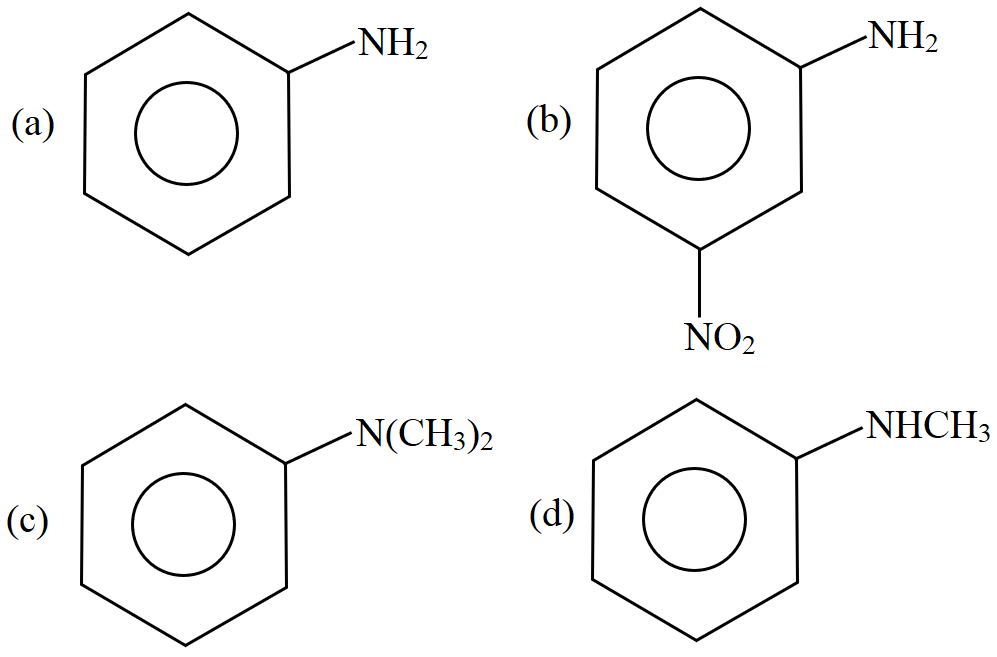
  1. Which of the following has lowest $pK_b$ value?
  1. The strongest base among the following is:
  1. $C_6H_5NH_2$
  2. $p-NO_2 - C_6H_4NH_2$
  3. $m-NO_2 - C_6H_4NH_2$
  4. $C_6H_5CH_2NH_2$
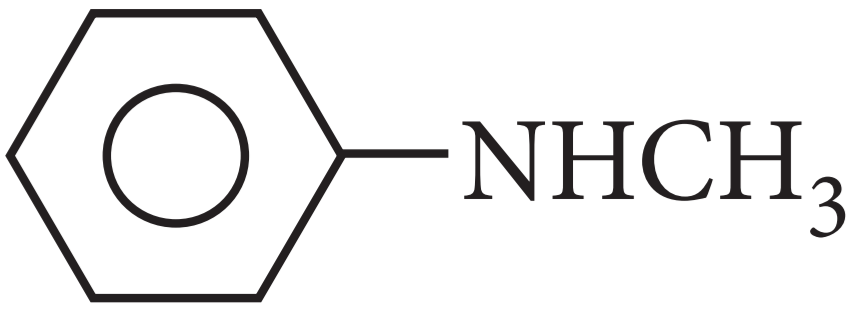
  1. Maximum $pK_b​​​​​​​$​​​​​​​ value of:
  1.  
  1.  
  1. $(CH_3CH_2)_2NH$
  2. $(CH_3)_2NH$
  1. The order of basic strength among the following amines in benzene solution is:
  1. Methylamine is more basic than $NH_3$.
  2. Amines form hydrogen bonds.
  3. Ethylamine has higher boiling point than propane.
  4. Dimethylamine is less basic than methylamine.
  1. $CH_3CH_2NH_2$ contains a basic $-NH_2$ group, but $CH_3CONH_2$​​​​​​​ does not because:
  1. Acetamide is amphoteric in character.
  2. In ethylamine the electron pair on N-atom is delocalised by resonance.
  3. In ethylamine there is no resonance while in acetamide the lone pair of electrons on N-atom is delocalised and is less available for protonation.
  4. None of these.
Decrease in concentration of reactant or increase in concentration of product per unit time is called rate of reaction. lt is of two types:
  1. Instantaneous rate of reaction: Rate of change of concentration of reactant or product at a particular time is called instantaneous rate of reaction.
$\text{r}_\text{inst.}=\frac{\text{dC}}{\text{dt}}$
where, dC = infinitely small change in concentration
dt = infinitely small change in time.
  1. Average rate of reaction: Ratio of change in concentration and time required for the change is average rate of reaction.
$\text{r}_\text{av}=\frac{\triangle\text{x}}{\triangle\text{t}}=\frac{\text{Change in concentration}}{\text{Time required for the change}}$
For a reaction of the type, $m_1A + m_2B → n_1C + n_2D$
Rate of reaction is given as
$\frac{1}{\text{m}_1}\frac{\text{d[A]}}{\text{dt}}=-\frac{1}{\text{m}_2}\frac{\text{d[B]}}{\text{dt}}=+\frac{1}{\text{n}_1}\frac{\text{d[C]}}{\text{dt}}=+\frac{1}{\text{n}_2}\frac{\text{d[D]}}{\text{dt}}$
In these questions (Q. No. i-iv), a statement of assertion followed by a statement ofreason is given. Choose the correct answer out of the following choices.
  1. Assertion and reason both are correct statements and reason is correct explanation for assertion.
  2. Assertion and reason both are correct statements but reason is not correct explanation for assertion.
  3. Assertion is correct statement but reason is wrong statement.
  4. Assertion is wrong statement but reason is correct statement.
  1. Assertion: The kinetics of the reaction, $\text{mA}+\text{nB}+\text{pC}\rightarrow\text{m}'\text{ X}+\text{n}'\text{ Y}+\text{p}'\text{ Z}$ obey the rate expression as $\frac{\text{dx}}{\text{dt}}=\text{k}[\text{A}]^\text{m}[\text{B}]^\text{n}.$
Reason: The rate of the reaction does not depend upon the concentration of C.
  1. Assertion: Instantaneous rate of reaction is equal to $\frac{\text{dx}}{\text{dt}}.$
Reason: lt is the rate of reaction at any particular instant of time.
  1. Assertion: For the reaction, $\text{RCl}+\text{NaOH}\rightarrow\text{ROH}+\text{NaCl},$ the rate of reaction is reduced to half on reducing the concentration of RCl to half.
Reason: The rate of reaction is represented by k[RCl].
  1. Assertion: ln rate law, unlike in the expression for equilibrium constants, the exponents for concentrations do not necessarily match the stoichiometric coefficients.
Reason: It is the mechanism and not the balanced chemical equation for the overall change that governs the reaction rate.
  1. Assertion: ln a reaction, $2A + B → A_2B$, the reactant B will disappear at twice the rate as A will decrease.
Reason: The rate of disappearance of reactant will be $-\frac{1}{2}\frac{\text{d[A]}}{\text{dt}}=-\frac{\text{d[B]}}{\text{dt}}$
Read the passage given below and answer the following questions: The order of reactivity towards $S_N1$ reaction depends upon the stability of carbocation in the first step. Greater the stability of the carbocation, greater will be its ease of formation from alkyl halide and hence faster will be the rate of the reaction. As we know, $3^\circ$ carbocation is most stable, therefore, the tert-alkyl that halides will undergo $S_N1$ reaction very fast. For example, it has been observed that the reaction $(CH_3)_3CBr$ with $OH^-$ ion to give 2-methyl-2-propanol is about I million times as fast as the corresponding reaction of the methyl bromide to give methanol. The primary alkyl halides always react predominantly by $S_N2$ mechanism. On the other hand, the tertiary alkyl halides react predominantly by $S_N1$ mechanism. Secondary alkyl halides may react by either mechanism or by both the mechanisms without much preference depending upon the nature of the nucleophile and solvent. In these questions (Q. No. i-tv), a statement of assertion followed by a statement of reason is given. Choose tile correct answer out of tile following choices.
  1. Assertion and reason both are correct statements and reason is correct explanation for assertion.
  2. Assertion and reason both are correct statements but reason is not correct explanation for assertion.
  3. Assertion is correct statement but reason is wrong statement.
  4. Assertion is wrong statement but reason is correct statement.
  1. Assertion: Low concentration of nudeophile favours $S_N1$ mechanism.
Reason: $2^\circ$ alkyl halides are less reactive than $1^\circ$ towards $S_N1$ reactions.
  1. Assertion: Polar solvent slows down $S_N2$ reactions.
Reason: $CH_3-Br$ is less reactive than $CH_3Cl.$
  1. Assertion: Benzyl bromide when kept in acetone- water it produces benzyl alcohol.
Reason: The reaction follows $S_N2$ mechanism.
  1. Assertion: Rate of hydrolysis of methyl chloride to methanol is higher in DMF than in water.
Reason: Hydrolysis of methyl chloride follows second order kinetics.
  1. Assertion: $S_N1$ reaction is carried out in the presence of a polar protic solvent.
Reason: A polar protic solvent increases the stability of carbocation due to solvation.
Read the passage given below and answer the following questions:
Ozone is an unstable, dark blue diamagnetic gas. It absorbs the UV radiation strongly, thus protecting the people on earth from the harmful UV-radiation from the sun. The use of chlorofluorocarbon (CFC) in aerosol and refrigerators and their subsequent escape into the atmosphere, is blamed for making holes in the ozone layer over the Antarctica. Ozone acts as a strong oxidising agent in acidic and alkaline medium. for this property, ozone is used as a germicide and disinfectant for sterilizing water. It is also used in laboratory for the ozonolysis of organic compounds and in industry for the manufacture of potassium permanganate, artificial silk, etc.
The following questions are multiple choice questions. Choose the most appropriate answer:
  1. Which of the following statements is not correct for ozone?
  1. lt oxidises lead sulphide.
  2. It oxidises potassium iodide.
  3. It oxidises mercury.
  4. It cannot act as bleaching agent in dry state.
  1. Ozone gives carbonyl compounds with.
  1. Alkyl chloride
  2. Alkanes
  3. Alkenes followed by decomposition with $\frac{\text{Zn}}{\text{H}_2\text{O}}.$
  4. Alcohols followed by decomposition with $\frac{\text{Zn}}{\text{H}_2\text{O}}.$
  1. Ozone reacts with moist iodine gives.
  1. $HI$
  2. $HIO_3$
  3. $I_2O_5$
  4. $I_2O_4$
  1. Ozone acts as an oxidising agent due to.
  1. Iiberation of nascent oxygen.
  2. Iiberation of nascent oxygen.
  3. Both $(a)$ and $(b).$
  4. Both $(a)$ and $(b).$
  1. The colour of ozone molecule is:
  1. White.
  2. Blue.
  3. Pale green.
  4. Pale yellow.
Read the passage given below and answer the following questions:
Glucose is known as dextrose because it occurs in nature as the optically active dextrorotatory isomer. lt is essential constituent of human blood. The blood normally contains $65$ to $110mg$ of glucose per 100mL (hence named Blood sugar). The level may be much higher in diabetic persons. The urine of diabetic persons also contain considerable amount of glucose. ln combined form, it occurs in cane sugar and polysaccharides such as starch and cellulose.
Glucose has an aldehyde group $(-CHO)$, one primary alcoholic group $(-CH_2OH)$ and four secondary alcoholic groups $(-CHOH)$ in their structure. Due to the presence five hydroxyl groups $(-OH)$. glucose undergoes acetylation. Glucose also undergoes oxidation with mild oxidising agents like bromine water as well as with strong oxidising agents like nitric acid. Since glucose is readily oxidised, it acts as a strong reducing agent and reduces Tollen's reagent and Fehling solution. Glucose exists in two crystalline forms: $\alpha$-D-glucose and $\beta$-D-glucose. If either of the two forms is dissolved in water and allowed to stand, the specific rotation of the solution changes gradually, until a constant value is obtained. This change is called mutarotation.
A statement of assertion followed by a statement of reason is given. Choose the correct answer out of the following choices.
  1. Assertion and reason both are correct statements and reason is correct explanation for assertion.
  2. Assertion and reason both are correct statements but reason is not correct explanation for assertion.
  3. Assertion is correct statement but reason is wrong statement.
  4. Assertion is wrong statement but reason is correct statement.
  1. Assertion: A diabetic person carries a packet of glucose with him always.
Reason: Glucose increases the blood sugar level almost instantaneously.
  1. Assertion: On oxidation with nitric acid, glucose as well as gluconic acid both yield saccharic acid.
Reason: The pentaacetate of glucose does not react with hydroxylamine indicating the absence of free $-CHO$ group.
  1. Assertion: Glucose reacts with acetyl chloride to form pentaacetyl glucose.
Reason: The formation of pentaacetyl derivative confirms the presence of five $-OH$ groups in glucose.
  1. Assertion: A certain compound gives negative test with ninhydrin and positive test with Benedict's solution, the compound is an amino acid.
Reason: Glucose is a monosaccharide.
  1. Assertion: The rapid interconversion of $\alpha$-D-glucose and $\beta$-D-glucose in solution is known as racemisation.
Reason: Hydrolysis reaction will take place when a mineral acid is treated with sugar.
Read the passage given below and answer the following questions:
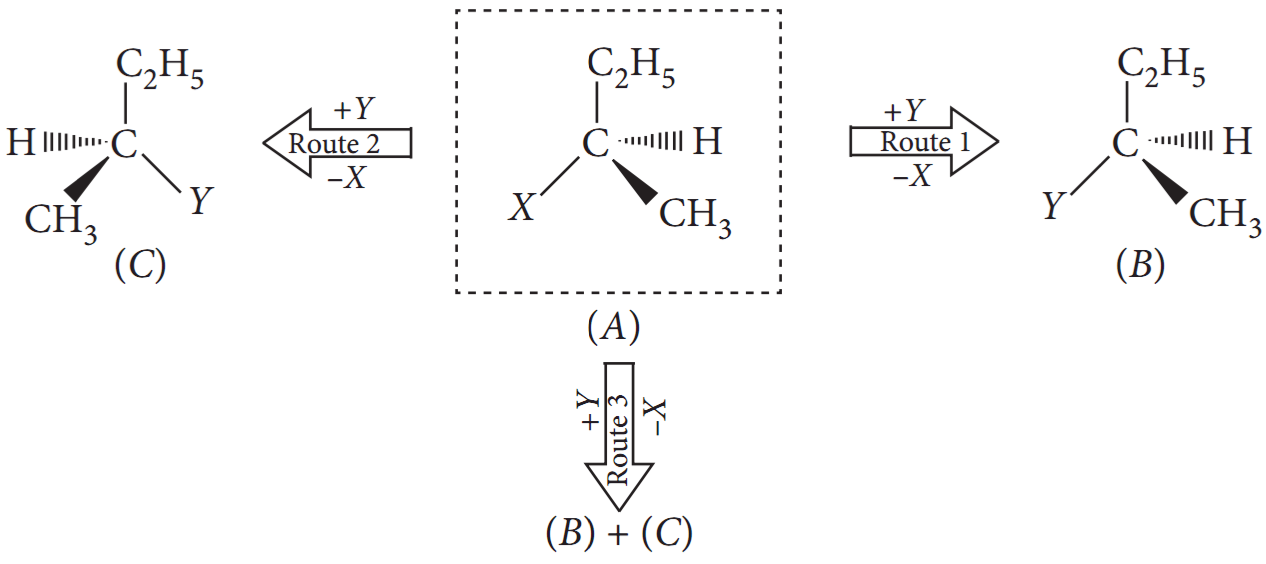
When a chemical reaction involves bond cleavage or bond formation at an asymmetric carbon atom, three different products may be formed. For example, during the substitution of a group $X$ by $Y$ in the following reaction, the three possible products may be shown below:
  1. If Bis the only product, the process is called retention of configuration because $B$ has the same configuration as the starting reactant $(A).$
  2. If C is the only product, the process is called inversion of configuration because $C$ has the configuration opposite to the starting reactant $(A).$
  3. If an equimolar mixture of Band $C (r.e., a 50 : 50$ mixture$)$ is fanned, then the process is called racemisation and the product is optically inactive because one isomer will rotate the light in the direction opposite to another.
In these questions (Q. No. i-iv), a statement of assertion followed by a statement of reason is given. Choose the correct answer out of the following choices.
  1. Assertion and reason both are correct statements and reason is correct explanation for assertion.
  2. Assertion and reason both are correct statements but reason is not correct explanation for assertion.
  3. Assertion is correct statement but reason is wrong statement.
  4. Assertion is wrong statement but reason is correct statement.
  1. Assertion: A reaction is said to be stereospecific if a particular stereoisomer of the reactant produces a specific stereoisomer of the product.
Reason: Bromination of cis$-2-$butene gives meso$-2, 3-$dibromobutane which is stereospecific.
  1. Assertion: Addition of $Br_2$ to cis-but-2-ene is stereoselective.
Reason: $S_N2$ reactions are stereospecific as well as stereoselective.
  1. Assertion: Optically active $2-$iodobutane on treatment with Nal in acetone undergoes recemization.
Reason: Repeated Walden inversions on the reactant and its product eventually gives a racemic mixture.
  1. Assertion: $S_N2$ reaction of an optically active alkyl halide with an aqueous solution of $KOH$ always gives an alcohol with opposite sign of rotation.
Reason: $S_N2$ reactions always proceed with inversion of configuration.
  1. Assertion: Nudeophilic substitution reaction of an optically active alkyl halide gives a mixture of en an ti om ers.
Reason: The reaction occurs by $S_N2$ mechanism.
The concentration of potassium ions inside a biological cell is at least twenty times higher than the outside. The resulting potential difference across the cell is important in several processes such as transmission of nerve impulses and maintaining the ion balance. A simple model for such a concentration cell involving a metal $M$ is,
$M_{(s)} | M^+(aq.; 0.05$ molar$) || M^+(aq; 1$ molar$) | M_{(s)}$
The following questions are multiple choice questions. Choose the most appropriate answer:
  1. For the above cell,
  1. $\text{E}_\text{cell}<0;\Delta\text{G}>0$
  2. $\text{E}_\text{cell}>0;\Delta\text{G}<0$
  3. $\text{E}_\text{cell}<0;\Delta\text{G}^\circ>0$
  4. $\text{E}_\text{cell}>0;\Delta\text{G}^\circ<0$
  1. If the 0.05 molar solution of $M^+$ is replaced by a $0.0025$ molar $M^+$ solution, then the magnitude of the cell potential would be:
  1. $130mV$
  2. $185mV$
  3. $154mV$
  4. $600mV$
  1. The value of equilibrium constant for a feasible cell reaction is:
  1. $< 1$
  2. $= 1$
  3. $> 1$
  4. Zero
  1. What is the emf of the cell when the cell reaction attains equilibrium?
  1. $1$
  2. $0$
  3. $> 1$
  4. $< 1$
  1. The potential of an electrode change with change in:
  1. Concentration ofions in solution.
  2. Position of electrodes.
  3. Voltage of the cell.
  4. All of these.