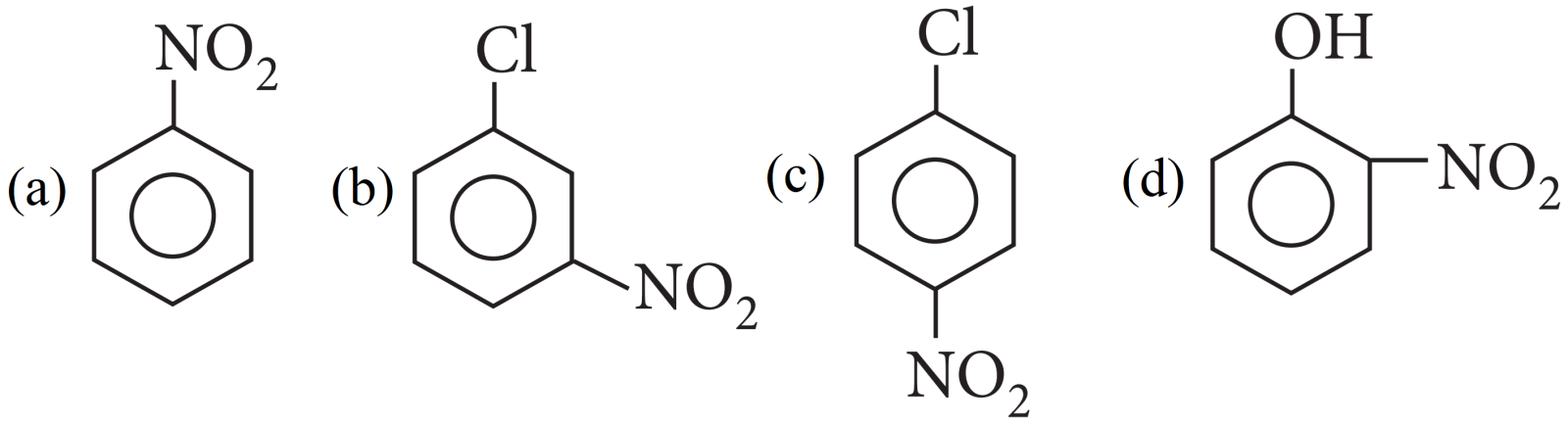
Question
Read the passage given below and answer the following questions:
Glucose is known as dextrose because it occurs in nature as the optically active dextrorotatory isomer. lt is essential constituent of human blood. The blood normally contains $65$ to $110mg$ of glucose per 100mL (hence named Blood sugar). The level may be much higher in diabetic persons. The urine of diabetic persons also contain considerable amount of glucose. ln combined form, it occurs in cane sugar and polysaccharides such as starch and cellulose.
Glucose has an aldehyde group $(-CHO)$, one primary alcoholic group $(-CH_2OH)$ and four secondary alcoholic groups $(-CHOH)$ in their structure. Due to the presence five hydroxyl groups $(-OH)$. glucose undergoes acetylation. Glucose also undergoes oxidation with mild oxidising agents like bromine water as well as with strong oxidising agents like nitric acid. Since glucose is readily oxidised, it acts as a strong reducing agent and reduces Tollen's reagent and Fehling solution. Glucose exists in two crystalline forms: $\alpha$-D-glucose and $\beta$-D-glucose. If either of the two forms is dissolved in water and allowed to stand, the specific rotation of the solution changes gradually, until a constant value is obtained. This change is called mutarotation.
A statement of assertion followed by a statement of reason is given. Choose the correct answer out of the following choices.
  1. Assertion and reason both are correct statements and reason is correct explanation for assertion.
  2. Assertion and reason both are correct statements but reason is not correct explanation for assertion.
  3. Assertion is correct statement but reason is wrong statement.
  4. Assertion is wrong statement but reason is correct statement.
  1. Assertion: A diabetic person carries a packet of glucose with him always.
Reason: Glucose increases the blood sugar level almost instantaneously.
  1. Assertion: On oxidation with nitric acid, glucose as well as gluconic acid both yield saccharic acid.
Reason: The pentaacetate of glucose does not react with hydroxylamine indicating the absence of free $-CHO$ group.
  1. Assertion: Glucose reacts with acetyl chloride to form pentaacetyl glucose.
Reason: The formation of pentaacetyl derivative confirms the presence of five $-OH$ groups in glucose.
  1. Assertion: A certain compound gives negative test with ninhydrin and positive test with Benedict's solution, the compound is an amino acid.
Reason: Glucose is a monosaccharide.
  1. Assertion: The rapid interconversion of $\alpha$-D-glucose and $\beta$-D-glucose in solution is known as racemisation.
Reason: Hydrolysis reaction will take place when a mineral acid is treated with sugar.

Answer

  1. (a) Assertion and reason both are correct statements and reason is correct explanation for assertion.
  1. (b) Assertion and reason both are correct statements but reason is not correct explanation for assertion.
Explanation:

$\ \text{CHO}\ \ \ \ \ \ \ \ \ \ \ \ \ \ \ \ \ \ \ \ \text{COOH}\ \ \ \ \ \ \ \ \ \ \ \ \ \ \ \ \ \text{COOH}\\\ \ |\ \ \ \ \ \ \ \ \ \ \ \ \ \ \ \ \ \ \ \ \ \ \ \ \ \ \ \ |\ \ \ \ \ \ \ \ \ \ \ \ \ \ \ \ \ \ \ \ \ \ \ \ \ \ \ \ |\$\text{CHOH})_4\xrightarrow[\text{HNO}_3]{[\text{O}]}(\text{COOH})_4\xleftarrow[\text{[O]}]{\text{HNO}_3}(\text{CHOH})_4\\\ \ |\ \ \ \ \ \ \ \ \ \ \ \ \ \ \ \ \ \ \ \ \ \ \ \ \ \ \ \ |\ \ \ \ \ \ \ \ \ \ \ \ \ \ \ \ \ \ \ \ \ \ \ \ \ \ \ \ |\\\ \text{CH}_2\text{OH}\ \ \ \ \ \ \ \ \ \ \ \ \ \ \ \text{COOH}\ \ \ \ \ \ \ \ \ \ \ \ \ \ \ \ \ \ \text{CH}_2\text{OH}\\\ \text{Glucose}\ \ \ \ \ \ \ \ \ \text{Saccharic acid}\ \ \ \ \ \ \ \text{Gluconic acid}$
Strong oxidising agents like nitric acid oxidises both the terminal $-CHO$ and $-CH_2OH$ groups of glucose to give the dibasic acid, saccharic acid.
  1. (b) Assertion and reason both are correct statements but reason is not correct explanation for assertion.
  1. (d) Assertion is wrong statement but reason is correct statement.
Explanation:

If a certain compound gives negative test with ninhydrin and positive test with Benedict's solution then the compound should be a monosaccharide.
  1. (d) Assertion is wrong statement but reason is correct statement.
Explanation:

The rapid interconversion of $\alpha$-Dvgfucose and $\beta$-D-glucose in solution is known as mutarotation. Sugar gets hydrolysed with mineral acids.
$\text{C}_{12}\text{H}-{22}+\text{H}_2\text{O}\xrightarrow{\text{H}^+}\text{C}_6\text{H}_{12}\text{O}_6+\text{C}_6\text{H}_{12}\text{O}_6\\\ \ \ \ \text{Sugar}\ \ \ \ \ \ \ \ \ \ \ \ \ \ \ \ \ \ \ \ \ \ \ \ \ \ \ \ \text{Glucose}\ \ \ \ \ \text{Fructose}$

Need a full question paper?

Generate a complete, print-ready paper with questions like this in minutes — across 16+ boards, with answer keys.

Start Generating Free

Similar questions

Read the passage given below and answer the following questions:
Noble gases are inert gases with general electronic configuration of $ns^2np^6$. These are monoatomic, colourless, odourless and tasteless gases. The first compound of noble gases was obtained by the reaction of Xe with $PtF_6.$ A large number of compounds of Xe and fluorine have been prepared till now. The structure of these compounds can be explained on the basis of VSEPR theory as well as concept of hybridisation. The compounds of krypton are fewer. Only the diftuoride of krypton $(KrF_2)$ has been studied in detail. Compounds of radon have not isolated but only identified by radio tracer technique. However, no true compounds of helium, neon or argon are yet known.
The following questions are multiple choice questions. Choose the most appropriate answer:
  1. The formula of the compound when $Xe$ and $PtF_6$ are mixed, is:
  1. $XeF_6$
  2. $XeF_4$
  3. $Xe_2PtF_6$
  4. $Xe^+[PtF_6]^-$
  1. The shape and hybridisation of some xenon oxy-fluoride and fluoride compounds are given below. Find the incorrect one.
  1. $XeOF_2 - T-$shape $- sy^3d$
  2. $XeOF_4 -$ square pyramidal $- sp^3d^2$
  3. $XeF_2 -$ linear $- sp^3d$
  4. $XeF_6 -$ square planar $- dsp^2$
  1. Which of the following is not formed by $Xe?$
  1. $XeF_5$
  2. $XeF$
  3. $XeF_3$
  4. All of these.
  1. The number oflone pairs and bond pairs of electrons around $Xe$ in $XeOF_4$ respectively are,
  1. $0$ and $5$
  2. $1$ and $5$
  3. $1$ and $4$
  4. $2$ and $3$
  1. Which of the following compounds has more than one lone pair of electrons around central atom?
  1. $XeO_3$
  2. $XeF_2$
  3. $XeOF_4$
  4. $XeO_2F_2$
In these questions, a statement of assertion followed by a statement of reason is given. Choose the correct answer out of the following choices.
Assertion: In chemisorption, adsorption keeps on increasing with temperature.
Reason: Chemisorption increases with increase of pressure.
Read the passage given below and answer the following questions:
In an ideal crystal, there must be regular repeating arrangement of the constituting particles and its entropy must be zero at absolute zero temperature. However, it is impossible to obtain an ideal crystal, and it suffers from certain defects called imperfections. In pure crystal, these defects arises either due to disorder or dislocation of the constituting particles from their normal positions or due to the movement of the particles even at absolute zero temperature. Such defects increase with rise in temperature. In addition to this, certain defects arise due to the presence of some impurities. Such defects not only modify the existing properties of the crystalline solids, but also impart certain new characteristics to them.
The following questions are multiple choice questions. Choose the most appropriate answer:
  1. $AgCl$ is crystallized from molten $AgCl$ containing a little $CdCl_2$ The solid obtained will have.
  1. Cationic vacancies equal to number of $Cd^{2+}$ ions incorporated.
  2. Cationic vacancies equal to double the number of $Cd^{2+}$ ions.
  3. Anionic vacancies.
  4. Neither cationic nor anionic vacancies.
  1. Lattice defect per $10^{15}$ $NaCl$ is $1$. What is the number of lattice defects in a mole of $NaCl?$
  1. $6.02 \times 10^{23}$
  2. $6.02 x 10^8$
  3. $10^{14}$
  4. None of these
  1. The ionic substances in which the cation and anion are of almost similar size shows.
  1. Non-stoichiometric defect
  2. Schottky defect
  3. Frenkel defect
  4. All of these.
  1. If $Al^{3+}$ ions replace $Na^+$ ions at the edge centres of $NaCl$ lattice, then the number of vacancies in $1$ mole of $NaCl$ will be.
  1. $3.01 \times 10^{23}$
  2. $6.02 \times 10^{23}$
  3. $9.03 \times 10^{23}$
  4. $12.04 \times 10^{23}$
  1. Which of the following gives both Frenkel and Schottky defect?
  1. $AgCl$
  2. $CsCl$
  3. $KCl$
  4. $AgBr$

Read the passage given below and answer the following questions:
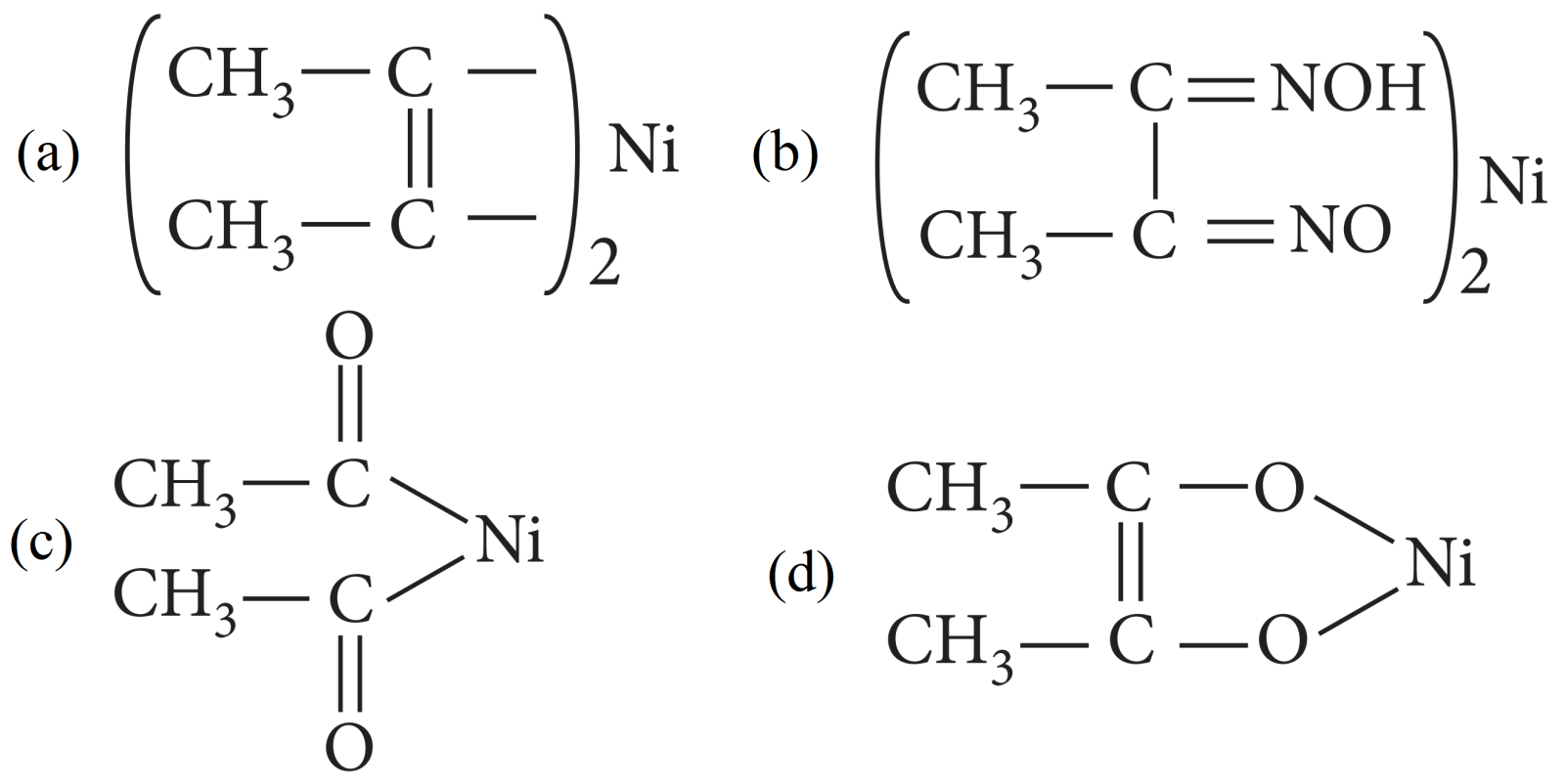
The molecular compounds which are formed from the combination of two or more simple stable compounds and retain their identity in the solid as well as in the dissolved state are called coordination compounds. Their properties are completely different from the constituents. ln coordination compounds, the central metal atom or ion is linked to a number ofions or neutral molecules, called ligands, by coordinate bonds. For example, Dimethylglyoxime (dmg) is a bid en date ligand chelating large amounts of metals. When dimethyl glyoxime is added to alcoholic solution of $NiCl_2$ and ammonium hydroxide is slowly added to it, a rosy red precipitate of a complex is formed.
The following questions are multiple choice questions. Choose the most appropriate answer:
  1. The structure of the complex is:
  1. Oxidation number of Ni in the given complex is:
  1. $+3$
  2. $+1$
  3. $+2$
  4. $Zero$
  1. Hybridisation and structure of the complex is:
  1. $Sp^3$​​​​​​​, tetrahedral.
  2. $dsp^2$​​​​​​​, square planar.
  3. $Sp^3$​​​​​​​, square planar.
  4. $Sp^3d$, trigonal bipyramidal.
  1. Which of the following is true about this complex?
  1. It is paramagnetic, containing $2$ unpaired electrons.
  2. It is paramagnetic, containing $1$ unpaired electron.
  3. It is paramagnetic, containing $4$ unpaired electrons.
  4. It is diamagnetic with no unpaired electron.
  1. Which one will give test for $Fe^{3+}$​​​​​​​ ions in the solution?
  1. $[Fe(CN)_6]^{3-}$
  2. $[Fe(CN)_6]^{2-}$
  3. $(NH_4)_2SO_4·FeSO_4·6H_2O$
  4. $Fe_2(S0_4)_3$​​​​​​​
The potential of each electrode is known as electrode potential. Standard electrode potential is the potential when concentration of each species taking part in electrode reaction is unity and the reaction is taking place at 298K. By convention, the standard electrode potential of hydrogen (SHE) is $0.0V.$ The electrode potential value for each electrode process is a measure of relative tendency of the active species in the process to remain in the oxidised/ reduced form. The negative electrode potential means that the redox couple is stronger reducing agent than $\frac{\text{H}^+}{\text{H}_2}$ couple. A positive electrode potential means that the redox couple is a weaker reducing agent than the $\frac{\text{H}^+}{\text{H}_2}$ couple. Metals which have higher positive value of standard reduction potential form the oxides of greater thermal stability.
In these questions (Q. No. i-iv), a statement of assertion followed by a statement ofreason is given. Choose the correct answer out of the following choices.
  1. Assertion and reason both are correct statements and reason is correct explanation for assertion.
  2. Assertion and reason both are correct statements but reason is not correct explanation for assertion.
  3. Assertion is correct statement but reason is wrong statement.
  4. Assertion is wrong statement but reason is correct statement.
  1. Assertion: An electrochemical cell can be set-up only if the redox reaction is spontaneous.
Reason: A reaction is spontaneous if the free energy change is negative.
  1. Assertion: The standard electrode potential of hydrogen is $0.0V.$
Reason: It is by convention.
  1. Assertion: The more negative is the standard reduction potential, greater is its ability to displace $H_2$ from acid.
Reason: Strength of reducing agent increases with the increase in negative value of the standard reduction potential.
  1. Assertion: The negative value of standard reduction potential means that reduction takes place on this electrode with reference to hydrogen electrode.
Reason: The standard electrode potential of a half cell has a fixed value.
  1. Assertion: The absolute value of electrode potential cannot be determined experimentally.
Reason: The electrode potential values are generally determined with respect to SHE.
Read the passage given below and answer the following questions: An organic compound (A) having molecular formula $C_6H_6O$ gives a characteristic colour with aqueous $FeCl_3$ solution. (A) on treatment with $CO_2$ and $NaOH$ at $400K$ under pressure gives (B), which on acidification gives a compound (C). The compound (C) reacts with acetyl chloride to give (D) which is a popular pain killer. The following questions are multiple choice questions. Choose the most appropriate answer:
  1. Compound (A) is:
  1. 2-Hexanol.
  2. Dimethyl ether.
  3. Phenol.
  4. 2-Methyl pentanol.
  1. Compound (C) is:
  1. Salicylic acid.
  2. Salicyladehyde.
  3. Benzoic acid.
  4. Benzaldehyde.
  1. Number of carbon atoms in compound (D) is:
  1. 7
  2. 6
  3. 8
  4. 9
  1. The conversion of compound (A) to (C) is known as:
  1. Reimer-Tiemann reaction.
  2. Kolbe's reaction.
  3. Schimdt reaction.
  4. Swarts reaction.
  1. Compound (A) on heating with compound (C) in presence of $POCl_3$​​​​​​​ gives a compound (D) which is used:
  1. In perfumery as a ftavouring agent
  2. As an antipyretic
  3. As an analgesic
  4. As an intestinal antiseptic.
Read the passage given below and answer the following questions:
A mixture of two aromatic compounds $(A)$ and $(B)$ was separated by dissolving in chloroform followed by extraction with aqueous $KOH$ solution. The organic layer containing compound $(A)$, when heated with alcoholic solution of KOH produce $C_7H_5N (C)$ associated with unpleasant odour.
The following questions are multiple choice questions. Choose the most appropriate answer:
  1. What is A?
  1. $C_6H_5NH_2$
  2. $C_6H_5CH_3$
  3. $C_6H_5CH_3$
  4. None of these.
  1. The reaction of $(A)$ with alcoholic solution of $KOH$ to produce $(C)$ of unpleasant odour is called:
  1. Sandmeyer reaction.
  2. Carbylamine reaction.
  3. Ullmann reaction.
  4. Reimer-Tiemann reaction..
  1. The alkaline aqueous layer $(B)$ when heated with chloroform and then acidified give a mixture of isomeric compounds of molecular formula $C_7H_6O_2. (B)$ is:
  1. $C_6H_5CHO$
  2. $C_6H_5COOH$
  3. $C_6H_5CH_3$
  4. $C_6H_5OH$
  1. In the chemical reaction, $CH_3CH_2NH_2 + CHCl_3 + 3KOH \rightarrow (A)+ (B) + 3H_2O,$
  1. $C_2H_5NC$ and $KCl$
  2. $C_2H_5CN$ and $KCl$
  3. $CH_3CH_2CONH_2$ and $KCl$
  4. $C_2H_5NC$ and $K_2CO_3$
  1. Direct nitration of an aromatic compound (A) is not feasible because:
  1. The reaction cannot be stopped at the mononitration stage.
  2. A mixture of o, m and p-nitroaniline is always obtained.
  3. Nitric acid oxidises most of the aromatic compound to give oxidation products along with only a small amount of nitrated products.
  4. All of the above.
Read the passage given below and answer the following questions:
The unique behaviour of $Cu, $ having a positive $E^\circ$ accounts for its inability to liberate $H_2$ from acids. Only oxidising acids (nitric and hot concentrated sulphuric acid) react with $Cu,$ the acids being reduced. The stability of the half-filled $(d^5)$ subshell in $Mn^{2+}$ and the completely filled $(d^{10})$ configuration in $Zn^{2+}$ are related to their $\text{E}^\circ\frac{\text{M}^{3+}}{\text{M}^{2+}}$ values. The low value for Sc reflects the stability of $Sc^{3+}$ which has a noble gas configuration. The comparatively high value for Mn shows that $Mn^{2+}(d^5)$ is particularly stable, whereas a comparatively low value for Fe shows the extra stability of $Fe^{3+}(d^5)$. The comparatively low value for Vis related to the stability of $v^{2+} ($half-filled $t_{2g}$ level$)$.
The following questions are multiple choice questions. Choose the most appropriate answer:
  1. Standard reduction electrode potential of $\frac{\text{Zn}^{2+}}{\text{Zn}}$ is 0.76V. This means
  1. $ZnO$ cannot be reduced to $Zn$ by $H_2$ under standard conditions.
  2. $Zn$ cannot liberate $H_2$ with concentrated acids.
  3. $Zn$ is generally the anode in an electrochemical cell.
  4. $Zn$ is generally the cathode in an electrochemical cell.
  1. $\text{E}^\circ$ values for the couples $\frac{\text{Cr}^{3+}}{\text{Cr}^{2+}}$ and $\frac{\text{Mn}^{3+}}{\text{Mn}^{2+}}$ are $-0.41$ and $+1.51$ volts respectively. These values suggest that.
  1. $Cr^{2+}$ acts as a reducing agent whereas $Mn^{3+}$ acts as an oxidizing agent.
  2. $Cr^{2+}$ is more stable th an $Cr^{3+}$ state.
  3. $Mn^{3+}$ is more stable than $Mn^{2+}$.
  4. $Cr^{2+}$ acts as an oxidizing agent whereas $Mn^{3+}$ acts as a reducing agent..
  1. The reduction potential values of $M, N$ and $O$ are $+2.46, -1.13$ and $-3.13V$ respectively. Which of the following order is correct regarding their reducing property?
  1. $O > N > M$
  2. $O > M > N$
  3. $M > N > O$
  4. $M > O > N$
  1. Which of the following statements are true?
  1. $Mn^{2+}$ compounds are more stable than $Fe^{2+}$ towards oxidation to $+3$ state.
  2. Titanium and copper both in the first series of transition metals exhibits $+1$ oxidation state most frequently.
  3. $Cu^+$ ion is stable in aqueous solutions.
  4. The $\text{E}^\circ$ value for the $\frac{\text{Mn}^{3+}}{\text{Mn}^{2+}}$ couple is much more positive than that for $\frac{\text{Cr}^{3+}}{\text{Cr}^{2+}}$ or $\frac{\text{Fe}^{3+}}{\text{Fe}^{2+}}.$.
  1. $(II)$ and $(III)$
  2. $(I)$ and $(IV)$
  3. $(I)$ and $(III)$
  4. $(II)$ and $(IV)$
  1. The stability of $\text{Cu}^{2+}_\text{(aq)}$ rather than $\text{Cu}^{+}_\text{(aq)}$ is due to.
  1. More negative $\Delta_\text{hyd}\text{H}^\circ$ of $\text{Cu}^{2+}_\text{(aq)}.$
  2. Less negative $\Delta_\text{hyd}\text{H}^\circ$ of $\text{Cu}^{2+}_\text{(aq)}.$
  3. More positive $\Delta_\text{hyd}\text{H}^\circ$ of $\text{Cu}^{2+}_\text{(aq)}.$
  4. Less positive $\Delta_\text{hyd}\text{H}^\circ$ of $\text{Cu}^{2+}_\text{(aq)}.$
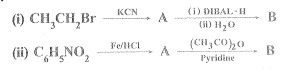
Give the structures of A and B in the following reactions
Image
Read the passage given below and answer the following questions:
Consider the given sequence of reactions:

The following questions are multiple choice questions. Choose the most appropriate answer:
  1. Identify W.
  1. Compound Y is:
  1. When X reacts with $CH_3COCl$ in presence of anhy. $AlCl_3$, the reaction is known as:
  1. Fittig reaction.
  2. Ullmann reaction.
  3. Wurtz-Fittig reaction.
  4. Friedel-Crafts acylation reaction.
  1. When X is treated Ni-Al/ NaOH the product obtained is:
  1. Benzene.
  2. Phenol.
  3. P-chlorophenol.
  4. Triphenyl.
  1. Compound Z is:
  1. Phenol.
  2. P-chlorophenol.
  3. P-nitrophenol.
  4. Nitrobenzene.