Question
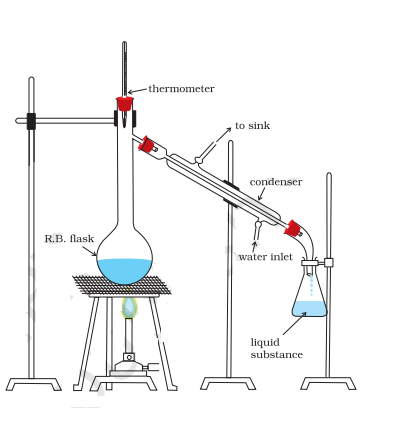
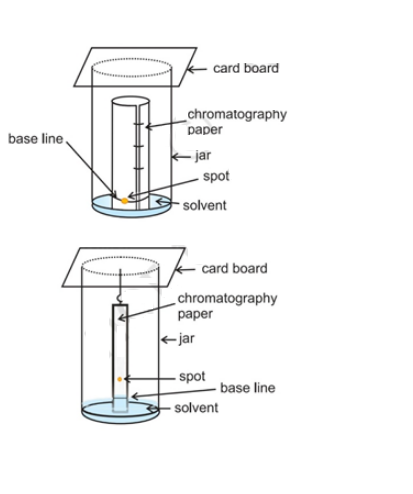
✓
Answer
- (a) $\sigma$
- (d) All the above
- (c) Sublimation
- b) no bond resonance
- b) stationery
Need a full question paper?
Generate a complete, print-ready paper with questions like this in minutes — across 16+ boards, with answer keys.
Explore more
Similar questions
A less obvious example of electron transfer is realised when hydrogen combines with oxygen to form water by the reaction: $2\text{H}_2(\text{g}) + \text{O}_2 (\text{g}) → 2\text{H}_2\text{O} (\text{l})$ Though not simple in its approach, yet we can visualise the H atom as going from a Neutral (zero) state in H2 to a positive state in H2O, the O atom goes from a zero state in O2 To a dinegative state in H2O. It is assumed that There is an electron transfer from H to O and Consequently H2 is oxidised and O2 is reduced. However, as we shall see later, the charge Transfer is only partial and is perhaps better Described as an electron shift rather than a Complete loss of electron by H and gain by O. Two examples of this class Of the reactions are: $\text{H}_2 (\text{s}) + \text{Cl}_2(\text{g}) → 2\text{HCl} (\text{g})$ And, $\text{CH}_4 (\text{g}) + 4\text{Cl}_2 (\text{g}) → \text{CCl}_4(\text{l}) + 4\text{HCl (g)}$ In order to keep track of electron shifts in Chemical reactions involving formation of Covalent compounds, a more practical method Of using oxidation number has been Developed. In this method, it is always Assumed that there is a complete transfer of Electron from a less electronegative atom to a More electonegative atom. For example, we Rewrite equations to show Charge on each of the atoms forming part of The reaction: 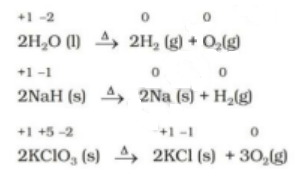 It may be emphasised that the assumption Of electron transfer is made for book-keeping Purpose only and it will become obvious at a Later stage in this unit that it leads to the simple Description of redox reactions. Oxidation number denotes the Oxidation state of an element in a Compound ascertained according to a set Of rules formulated on the basis that electron pair in a covalent bond belongs Entirely to more electronegative element. It is not always possible to remember or Make out easily in a compound/ ion, which Element is more electronegative than the other. Therefore, a set of rules has been formulated To determine the oxidation number of an Element in a compound/ ion. We may at this stage, state the rules for the Calculation of oxidation number. These rules are: 1.) In elements, in the free or the uncombined State, each atom bears an oxidation Number of zero. Evidently each atom in H2, O2, Cl2, O3, P4, S8, Na, Mg, Al has the Oxidation number zero. 2.) For ions composed of only one atom, the Oxidation number is equal to the charge On the ion. Thus Na+ Ion has an oxidation Number of +1, Mg2+ ion +2 , Fe3+ ion, +3, Cl – Ion, –1, O2 – ion, –2; and so on. In their Compounds all alkali metals have Oxidation number of +1, and all alkaline Earth metals have an oxidation number of +2. Aluminium is regarded to have an Oxidation number of +3 in all its Compounds. 3.) The oxidation number of oxygen in most Compounds is –2. However, we come across Two kinds of exceptions here. One arises In the case of peroxides and superoxides, The compounds of oxygen in which oxygen Atoms are directly linked to each other. While in peroxides (e.g., H2 O2, Na2 O2), each Oxygen atom is assigned an oxidation Number of –1, in superoxides (e.g., K O2, Rb O2) each oxygen atom is assigned an Oxidation number of –(½). The second Exception appears rarely, i.e. when oxygen Is bonded to fluorine. In such compounds e.g., oxygen difluoride (OF2) and dioxygen difluoride (O2F2), the oxygen is assigned an oxidation number of +2 and +1, respectively. The number assigned to oxygen will depend upon the bonding state of oxygen but this number would now be a positive figure only. 4.) The oxidation number of hydrogen is +1, Except when it is bonded to metals in binary Compounds (that is compounds containing Two elements). For example, in LiH, NaH, And Ca H2, its oxidation number is –1. 5.) In all its compounds, fluorine has an Oxidation number of –1. Other halogens (Cl, Br, and I) also have an oxidation number Of –1, when they occur as halide ions in Their compounds. Chlorine, bromine and Iodine when combined with oxygen, for Example in oxoacids and oxoanions, have Positive oxidation numbers. 6.) The algebraic sum of the oxidation number Of all the atoms in a compound must be Zero. In polyatomic ion, the algebraic sum Of all the oxidation numbers of atoms of The ion must equal the charge on the ion. Thus, the sum of oxidation number of three Oxygen atoms and one carbon atom in the Carbonate ion, (CO3) 2– must equal –2. A term that is often used interchangeably With the oxidation number is the oxidation State. Thus in CO2, the oxidation state of Carbon is +4, that is also its oxidation number And similarly the oxidation state as well as Oxidation number of oxygen is – 2. This implies That the oxidation number denotes the Oxidation state of an element in a compound. The oxidation number/state of a metal in a Compound is sometimes presented according To the notation given by German chemist, Alfred Stock. It is popularly known as Stock Notation. According to this, the oxidation Number is expressed by putting a Roman Numeral representing the oxidation number In parenthesis after the symbol of the metal in The molecular formula. Thus aurous chloride And auric chloride are written as Au(I)Cl and Au(III)Cl3. Similarly, stannous chloride and Stannic chloride are written as Sn(II) Cl2 and Sn(IV)Cl4. This change in oxidation number Implies change in oxidation state, which in Turn helps to identify whether the species is Present in oxidised form or reduced form. Thus, Hg2(I) Cl2 is the reduced form of Hg(II) Cl2.
→ It may be emphasised that the assumption Of electron transfer is made for book-keeping Purpose only and it will become obvious at a Later stage in this unit that it leads to the simple Description of redox reactions. Oxidation number denotes the Oxidation state of an element in a Compound ascertained according to a set Of rules formulated on the basis that electron pair in a covalent bond belongs Entirely to more electronegative element. It is not always possible to remember or Make out easily in a compound/ ion, which Element is more electronegative than the other. Therefore, a set of rules has been formulated To determine the oxidation number of an Element in a compound/ ion. We may at this stage, state the rules for the Calculation of oxidation number. These rules are: 1.) In elements, in the free or the uncombined State, each atom bears an oxidation Number of zero. Evidently each atom in H2, O2, Cl2, O3, P4, S8, Na, Mg, Al has the Oxidation number zero. 2.) For ions composed of only one atom, the Oxidation number is equal to the charge On the ion. Thus Na+ Ion has an oxidation Number of +1, Mg2+ ion +2 , Fe3+ ion, +3, Cl – Ion, –1, O2 – ion, –2; and so on. In their Compounds all alkali metals have Oxidation number of +1, and all alkaline Earth metals have an oxidation number of +2. Aluminium is regarded to have an Oxidation number of +3 in all its Compounds. 3.) The oxidation number of oxygen in most Compounds is –2. However, we come across Two kinds of exceptions here. One arises In the case of peroxides and superoxides, The compounds of oxygen in which oxygen Atoms are directly linked to each other. While in peroxides (e.g., H2 O2, Na2 O2), each Oxygen atom is assigned an oxidation Number of –1, in superoxides (e.g., K O2, Rb O2) each oxygen atom is assigned an Oxidation number of –(½). The second Exception appears rarely, i.e. when oxygen Is bonded to fluorine. In such compounds e.g., oxygen difluoride (OF2) and dioxygen difluoride (O2F2), the oxygen is assigned an oxidation number of +2 and +1, respectively. The number assigned to oxygen will depend upon the bonding state of oxygen but this number would now be a positive figure only. 4.) The oxidation number of hydrogen is +1, Except when it is bonded to metals in binary Compounds (that is compounds containing Two elements). For example, in LiH, NaH, And Ca H2, its oxidation number is –1. 5.) In all its compounds, fluorine has an Oxidation number of –1. Other halogens (Cl, Br, and I) also have an oxidation number Of –1, when they occur as halide ions in Their compounds. Chlorine, bromine and Iodine when combined with oxygen, for Example in oxoacids and oxoanions, have Positive oxidation numbers. 6.) The algebraic sum of the oxidation number Of all the atoms in a compound must be Zero. In polyatomic ion, the algebraic sum Of all the oxidation numbers of atoms of The ion must equal the charge on the ion. Thus, the sum of oxidation number of three Oxygen atoms and one carbon atom in the Carbonate ion, (CO3) 2– must equal –2. A term that is often used interchangeably With the oxidation number is the oxidation State. Thus in CO2, the oxidation state of Carbon is +4, that is also its oxidation number And similarly the oxidation state as well as Oxidation number of oxygen is – 2. This implies That the oxidation number denotes the Oxidation state of an element in a compound. The oxidation number/state of a metal in a Compound is sometimes presented according To the notation given by German chemist, Alfred Stock. It is popularly known as Stock Notation. According to this, the oxidation Number is expressed by putting a Roman Numeral representing the oxidation number In parenthesis after the symbol of the metal in The molecular formula. Thus aurous chloride And auric chloride are written as Au(I)Cl and Au(III)Cl3. Similarly, stannous chloride and Stannic chloride are written as Sn(II) Cl2 and Sn(IV)Cl4. This change in oxidation number Implies change in oxidation state, which in Turn helps to identify whether the species is Present in oxidised form or reduced form. Thus, Hg2(I) Cl2 is the reduced form of Hg(II) Cl2. - H atom goes from a … state in H2 to a positive state in H2O in water formation.
- Neutral
- Positive
- Negative
- All the above
- In oxidation number method, there is a complete transfer of electron from a …. electronegative atom to a … electonegative atom.
- more, less
- less, more
- non, more
- non, less
- Oxidation number of Mg2 + ion is:
- -2
- -1
- +2
- +1
- In Na2O2 each oxygen atom is assigned an oxidation number of …
- +1
- -2
- +2
- -1
- The algebraic sum of the oxidation number of all the atoms in a compound must be…
- 0
- 1
- 2
- -2
Read the passage given below and answer the following questions from (i) to (v). The covalent bond may be classified into twotypes depending upon the types ofoverlapping:(i) Sigma(σ) bond, and (ii) pi($\pi$) bond
→- Sigma(σ) bond: This type of covalent bondis formed by the end to end (head-on)overlap of bonding orbitals along theinternuclear axis. This is called as headon overlap or axial overlap. This can beformed by any one of the following typesof combinations of atomic orbitals.
s-s overlapping: In this case, there isoverlap of two half filled s-orbitals alongthe internuclear axis.
s-p overlapping: This type of overlapoccurs between half filled s-orbitals of oneatom and half filled p-orbitals of anotheratom.
p–p overlapping: This type of overlaptakes place between half filled p-orbitalsof the two approaching atoms.
- pi($\pi$) bond: In the formation of $\pi$ bondthe atomic orbitals overlap in such a waythat their axes remain parallel to each otherand perpendicular to the internuclear axis.The orbitals formed due to sidewiseoverlapping consists of two saucer type charged clouds above and below the planeof the participating atoms.
- The number of hybrid orbitals is equal tothe number of the atomic orbitals that gethybridised.
- The hybridised orbitals are alwaysequivalent in energy and shape.
- The hybrid orbitals are more effective informing stable bonds than the pure atomicorbitals.
- These hybrid orbitals are directed in spacein some preferred direction to haveminimum repulsion between electronpairs and thus a stable arrangement.Therefore, the type of hybridisationindicates the geometry of the molecules. Important conditions for hybridisation
- The orbitals present in the valence shell of the atom are hybridised.
- The orbitals undergoing hybridisation should have almost equal energy.
- Promotion of electron is not essential condition prior to hybridisation.
- It is not necessary that only half filled orbitals participate in hybridisation.
- sp hybridisation: This type ofhybridisation involves the mixing of one s andone p orbital resulting in the formation of twoequivalent sp hybrid orbitals. The suitableorbitals for sp hybridisation are s and pz, ifthe hybrid orbitals are to lie along the z-axis. Example of molecule having sphybridisationBeCl2: The ground state electronicconfiguration of Be is 1s22s2. In the exited stateone of the 2s-electrons is promoted to vacant 2p orbital to account for its bivalency.One 2s and one 2p-orbital gets hybridised toform two sp hybridised orbitals.
- sp2 hybridisation : In this hybridisationthere is involvement of one s and twop-orbitals in order to form three equivalent sp2hybridised orbitals. For example, in BCl3molecule, the ground state electronicconfiguration of central boron atom is1s22s22p1. In the excited state, one of the 2selectrons is promoted to vacant 2p orbital as a result boron has three unpaired electrons.These three orbitals (one 2s and two 2p)hybridise to form three sp2 hybrid orbitals.
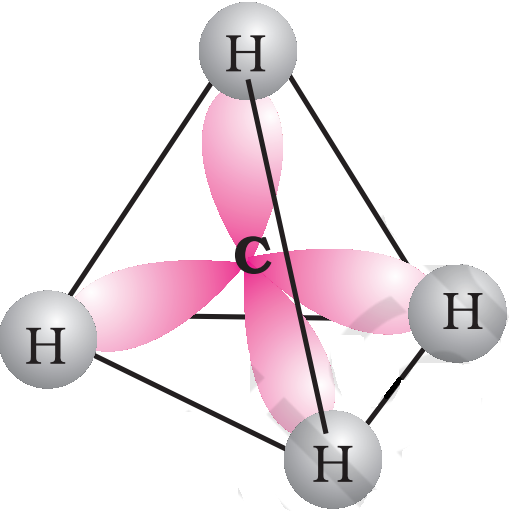
- sp3 hybridisation: This type ofhybridisation can be explained by taking theexample of CH4 molecule in which there ismixing of one s-orbital and three p-orbitals ofthe valence shell to form four sp3 hybrid orbitalof equivalent energies and shape. There is 25%s-character and 75% p-character in each sp3hybrid orbital. The four sp3 hybrid orbitals soformed are directed towards the four cornersof the tetrahedron. The angle between sp3hybrid orbital is 109.5°.
- ....ntroduced the concept of hybridisation.
- Pauling
- Lewis
- Nyholm
- Gillespie
- Which of the following is an example of sp3 hybridization?
- BeCl2
- Ch4
- BCl3
- C2H4
- The angle between sp3 hybrid orbital is ….
- 5°
- 9°
- 109.5°
- 120°
- A sigma bond is formed by the overlapping of …
- s−s,
- s−p
- p−p
- All the above
- When one 2s and three 2p-orbitals of carbon hybridise, there is the formation of four new … hybrid orbitals.
- sp3
- sp2
- sp
- None of above
The existing large number of organic compounds and their ever-increasing numbers has made it necessary to classify them on the basis of their structures. Organic compounds are broadly classified as open-chain compounds which are also called aliphatic compounds. Aliphatic compounds further classified as homocyclic and heterocyclic compounds. Aromatic compounds are special types of compounds. Alicyclic compounds, aromatic compounds may also have heteroatom in the ring. Such compounds are called heterocyclic aromatic compounds. Organic compounds can also be classified on the basis of functional groups, into families or homologous series. The members of a homologous series can be represented by general molecular formula and the successive members differ from each other in a molecular formula by a $- CH _2$ unit.
1. The successive members of a homologous series differ by which mass of amu? (1)
2. Does Pyridine, pyrrole, thiophene are all heteroaromatic compounds (1)
3. Difference between heterocyclic and homocyclic compound. (2)
OR
Is tetrahydrofuran is aromatic compounds? (2)
→1. The successive members of a homologous series differ by which mass of amu? (1)
2. Does Pyridine, pyrrole, thiophene are all heteroaromatic compounds (1)
3. Difference between heterocyclic and homocyclic compound. (2)
OR
Is tetrahydrofuran is aromatic compounds? (2)
In order to explain the characteristic geometrical shapes of polyatomic molecules, Pauling introduced the concept of hybridisation. The orbitals undergoing hybridisation should have nearly the same energy. There are various type of hybridisations involving s, p and d-type of orbitals. The type of hybridisation gives the characteristic shape of the molecule or ion.
1. Why all the orbitals in a set of hybridised orbitals have the same shape and energy?
2. Out of $XeF _2$ and $SF _2$ which molecule has the same shape as $NO _2^{+}$ion?
3. Out of $XeF _4$ and $XeF _2$ which molecule doesn't have the same type of hybridisation as P (Phosphorus) has in $PF _5$ ?
OR
Unsaturated compounds undergo additional reactions. Why?
→→→1. Why all the orbitals in a set of hybridised orbitals have the same shape and energy?
2. Out of $XeF _2$ and $SF _2$ which molecule has the same shape as $NO _2^{+}$ion?
3. Out of $XeF _4$ and $XeF _2$ which molecule doesn't have the same type of hybridisation as P (Phosphorus) has in $PF _5$ ?
OR
Unsaturated compounds undergo additional reactions. Why?
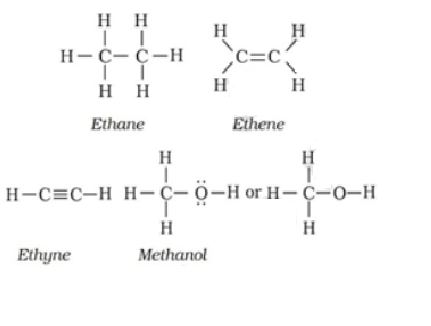
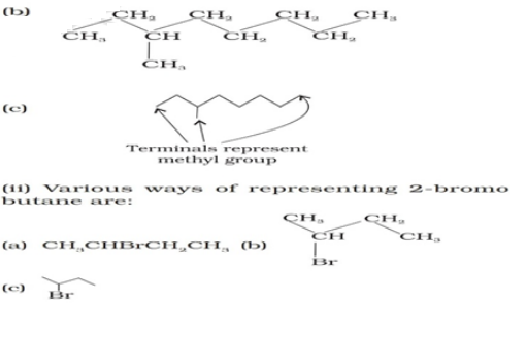
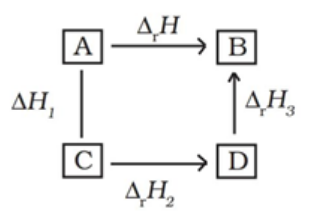
Read the passage given below and answer the following questions from (i) to (vi).
The atomic theory of matter was first proposed on afirm scientific basis by JohnDalton, a British schoolteacher in 1808. His theory, called Dalton’s atomictheory, regarded the atom as the ultimate particle ofmatter Dalton’s atomic theory was able to explainthe law of conservation of mass, law of constantcomposition and law of multiple proportion verysuccessfully. However, it failed to explain the results ofmany experiments.In mid 1850s many scientists mainlyFaraday began to study electrical dischargein partially evacuated tubes, known ascathode ray discharge tubes.Electrical discharge carried out in the modifiedcathode ray tube led to the discovery of canalrays carrying positively charged particles. Thecharacteristics of these positively chargedparticles are listed below.
proton. This positively charged particle wascharacterised in 1919. Later, a need was feltfor the presence of electrically neutral particleas one of the constituent of atom. Theseparticles were discovered by Chadwick (1932)by bombarding a thin sheet of beryllium byα-particles. When electrically neutral particleshaving a mass slightly greater than that ofprotons were emitted. He named theseparticles as neutrons.J. J. Thomson, in 1898, proposed that an atom possesses a spherical shape (radiusapproximately 10–10 m) in which the positivecharge is uniformly distributed. The electronsare embedded into it in such a manner as togive the most stable electrostatic arrangementMany different names are given tothis model, for example, plum pudding, raisinpudding or watermelon. This model can be visualised as a pudding or watermelon ofpositive charge with plums or seeds (electrons)embedded into it. An important feature of thismodel is that the mass of the atom is assumed to be uniformly distributed over theatom.Rutherford and his students (Hans Geiger andErnest Marsden) bombarded very thin gold foilwith α–particles. Rutherford’s famous α–particle scattering experiment.The observations of Scattering experiment are as follows-:
The atomic theory of matter was first proposed on afirm scientific basis by JohnDalton, a British schoolteacher in 1808. His theory, called Dalton’s atomictheory, regarded the atom as the ultimate particle ofmatter Dalton’s atomic theory was able to explainthe law of conservation of mass, law of constantcomposition and law of multiple proportion verysuccessfully. However, it failed to explain the results ofmany experiments.In mid 1850s many scientists mainlyFaraday began to study electrical dischargein partially evacuated tubes, known ascathode ray discharge tubes.Electrical discharge carried out in the modifiedcathode ray tube led to the discovery of canalrays carrying positively charged particles. Thecharacteristics of these positively chargedparticles are listed below.
- Unlike cathode rays, mass of positivelycharged particles depends upon thenature of gas present in the cathode raytube. These are simply the positivelycharged gaseous ions.
- The charge to mass ratio of the particlesdepends on the gas from which theseoriginate.
- Some of the positively charged particlescarry a multiple of the fundamental unitof electrical charge.
- The behaviour of these particles in themagnetic or electrical field is opposite tothat observed for electron or cathoderays.
proton. This positively charged particle wascharacterised in 1919. Later, a need was feltfor the presence of electrically neutral particleas one of the constituent of atom. Theseparticles were discovered by Chadwick (1932)by bombarding a thin sheet of beryllium byα-particles. When electrically neutral particleshaving a mass slightly greater than that ofprotons were emitted. He named theseparticles as neutrons.J. J. Thomson, in 1898, proposed that an atom possesses a spherical shape (radiusapproximately 10–10 m) in which the positivecharge is uniformly distributed. The electronsare embedded into it in such a manner as togive the most stable electrostatic arrangementMany different names are given tothis model, for example, plum pudding, raisinpudding or watermelon. This model can be visualised as a pudding or watermelon ofpositive charge with plums or seeds (electrons)embedded into it. An important feature of thismodel is that the mass of the atom is assumed to be uniformly distributed over theatom.Rutherford and his students (Hans Geiger andErnest Marsden) bombarded very thin gold foilwith α–particles. Rutherford’s famous α–particle scattering experiment.The observations of Scattering experiment are as follows-:
- most of the α–particles passed throughthe gold foil undeflected.
- a small fraction of the α–particles wasdeflected by small angles.
- a very few α–particles (∼1 in 20,000)bounced back, that is, were deflected bynearly 180°.
- The positive charge and most of the massof the atom was densely concentrated inextremely small region. This very smallportion of the atom was called nucleusby Rutherford.
- The nucleus is surrounded by electronsthat move around the nucleus with a veryhigh speed in circular paths called orbits.Thus, Rutherford’s model of atomresembles the solar system in which thenucleus plays the role of sun and theelectrons that of revolving planets.
- Electrons and the nucleus are held together by electrostatic forces of attraction.
- The atomic theory of matter was first proposed on afirm scientific basis by:
- John Dalton
- Ernest Rutherford
- J.Thomson
- Henry Moseley
- The cathode rays start from … and move towards the….
- Anode, Cathode
- Centre, Anode
- Cathod, Anode
- Cathod, Centre
- Negativelycharged particles in atoms, called…
- Protons
- Electrons
- Neutron
- Positron
- The smallest and lightest positive ion wasobtained from …. and was called proton.
- Oxygen
- Nitrogen
- Carbon
- Hydrogen
- Electrically neutral particles having a mass slightly greater than that of protons, these particles termed as:
- Protons
- Electrons
- Neutron
- Positron
- J.J. Thomson’s atomic model is also named as:
- Plum pudding
- Raisin pudding
- Watermelon
- All the above
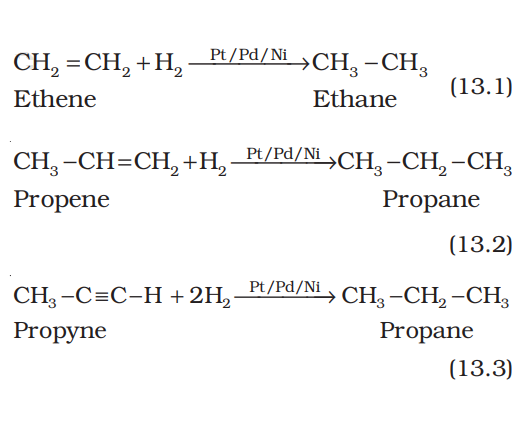
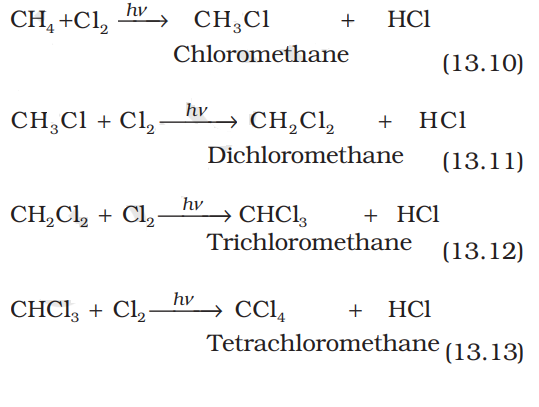
Read the passage given below and answer the following questions from 1 to 5.
After having some idea about the terms atomsand molecules, it is appropriate here tounderstand what do we mean by atomic andmolecular masses.One atomicmass unit is defined as a mass exactly equal to one-twelfth of the mass of one carbon – 12 atom.Molecular mass is the sum of atomic masses of the elements present in a molecule. It is obtained by multiplying the atomic mass of each element by the number of its atoms and adding them together. Some substances, such as sodium chloride, do not contain discrete molecules as their constituent units. In such compounds, positive (sodium ion) and negative (chloride ion) entities are arranged in a three dimensional structure. The mole, symbol mol, is the SI unit of amount of substance. One mole contains exactly 6.02214076× 10²³ elementary entities. This number is the fixed numerical value of the Avogadro constant, NA , when expressed in the unit mol–1 and is called the Avogadro number. The amount of substance, symbol n, of a system is a measure of the number of specified elementary entities. An elementary entity may be an atom, a molecule, an ion, an electron, any other particle or specified group of particles. It may be emphasised that the mole of a substance always contains the same number of entities, no matter what the substance may be. In order to determine this number precisely, the mass of a carbon–12 atom was determined by a mass spectrometer and found to be equal to 1.992648 × 10⁻²³ g. Knowing that one mole of carbon weighs 12 g, the number of atoms in it is equal to:
12 g /mol C-12 .
1.992648 × 10²³ g / C- 12 atom. = 6.0221367 × 10²³ atoms/mol.
The mass of one mole of a substance in grams is called its molar mass. the molar mass in grams is numerically equal to atomic molecular/formula mass in u.An empirical formula represents the simplestwhole number ratio of various atoms present ina compound, whereas, the molecular formulashows the exact number of different types ofatoms present in a molecule of a compound. If the mass per cent of variouselements present in a compound is known, its empiricalformula can be determined. Molecular formulacan further be obtained if the molar mass isknown.Many a time, reactions are carried out with the Amounts of reactants that are different than The amounts as required by a balanced chemical reaction. In such situations, one Reactant is in more amount than the amount required by balanced chemical reaction. The reactant which is present in the least amount Many a time, reactions are carried out with the
amounts of reactants that are different than the amounts as required by a balanced chemical reaction. In such situations, one reactant is in more amount than the amount required by balanced chemical reaction. The reactant which is present in the least amount gets consumed after sometime and after that further reaction does not take place whatever be the amount of the other reactant. Hence, the reactant, which gets consumed first, limits the amount of product formed and is, therefore, called the limiting reagent.
After having some idea about the terms atomsand molecules, it is appropriate here tounderstand what do we mean by atomic andmolecular masses.One atomicmass unit is defined as a mass exactly equal to one-twelfth of the mass of one carbon – 12 atom.Molecular mass is the sum of atomic masses of the elements present in a molecule. It is obtained by multiplying the atomic mass of each element by the number of its atoms and adding them together. Some substances, such as sodium chloride, do not contain discrete molecules as their constituent units. In such compounds, positive (sodium ion) and negative (chloride ion) entities are arranged in a three dimensional structure. The mole, symbol mol, is the SI unit of amount of substance. One mole contains exactly 6.02214076× 10²³ elementary entities. This number is the fixed numerical value of the Avogadro constant, NA , when expressed in the unit mol–1 and is called the Avogadro number. The amount of substance, symbol n, of a system is a measure of the number of specified elementary entities. An elementary entity may be an atom, a molecule, an ion, an electron, any other particle or specified group of particles. It may be emphasised that the mole of a substance always contains the same number of entities, no matter what the substance may be. In order to determine this number precisely, the mass of a carbon–12 atom was determined by a mass spectrometer and found to be equal to 1.992648 × 10⁻²³ g. Knowing that one mole of carbon weighs 12 g, the number of atoms in it is equal to:
12 g /mol C-12 .
1.992648 × 10²³ g / C- 12 atom. = 6.0221367 × 10²³ atoms/mol.
The mass of one mole of a substance in grams is called its molar mass. the molar mass in grams is numerically equal to atomic molecular/formula mass in u.An empirical formula represents the simplestwhole number ratio of various atoms present ina compound, whereas, the molecular formulashows the exact number of different types ofatoms present in a molecule of a compound. If the mass per cent of variouselements present in a compound is known, its empiricalformula can be determined. Molecular formulacan further be obtained if the molar mass isknown.Many a time, reactions are carried out with the Amounts of reactants that are different than The amounts as required by a balanced chemical reaction. In such situations, one Reactant is in more amount than the amount required by balanced chemical reaction. The reactant which is present in the least amount Many a time, reactions are carried out with the
amounts of reactants that are different than the amounts as required by a balanced chemical reaction. In such situations, one reactant is in more amount than the amount required by balanced chemical reaction. The reactant which is present in the least amount gets consumed after sometime and after that further reaction does not take place whatever be the amount of the other reactant. Hence, the reactant, which gets consumed first, limits the amount of product formed and is, therefore, called the limiting reagent.
- One atomic mass unit (amu) is defined as a mass exactly equal to one-twelfth of the mass of one …atom.
- Hydrogen – 1
- Carbon – 12
- Oxygen -12
- Chlorine – 35
- The mass of one mole of a substance in grams is called its..
- Atomic mass
- Molecular Weight
- Molecular mass
- Molar mass.
- … is the sum of atomic massesof the elements present in a molecule.
- Atomic mass
- Molecular Weight
- Molecular mass
- Molar mass.
- One mole contains exactly …elementary entities.
- 02214076 × 1021
- 02214076 × 1022
- 6.02214076 × 10²³
- 02214076 × 1024
- For which of the following compound , formula mass is preferred instead of molecular mass?
- NaCl
- C2H6
- N2
- H2O
The idea of oxidation number has been invariably applied to define oxidation, reduction, oxidising agent (oxidant), reducing agent (reductant) and the redox reaction. To summarise, we may say that:
Oxidation: An increase in the oxidation number of the element in the given substance.
Reduction: A decrease in the oxidation number of the element in the given substance.
Oxidising agent: A reagent which can increase the oxidation number of an element in a given substance. These reagents are called as oxidants also.
Reducing agent: A reagent which lowers the oxidation number of an element in a given substance. These reagents are also called as reductants.
Redox reactions: Reactions which involve change in oxidation number of the interacting species.
Types of Redox Reactions
1.) Combination reactions -A combination reaction may be denoted in the manner:
A + B → C
Either A and B or both A and B must be in the elemental form for such a reaction to be a redox reaction. All combustion reactions, which make use of elemental dioxygen, as well as other reactions involving elements other than dioxygen, are redox reactions. Some important examples of this category are:
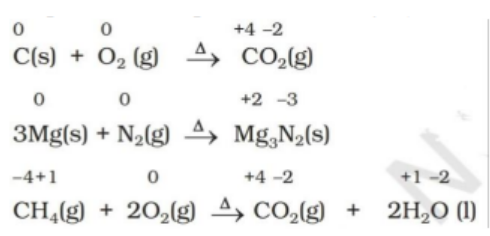
2.) Decomposition reactions- Decomposition reactions are the opposite of combination reactions. Precisely, a decomposition reaction leads to the breakdown of a compound into two or more components at least one of which must be in the elemental state.
Examples of this class of reactions are:
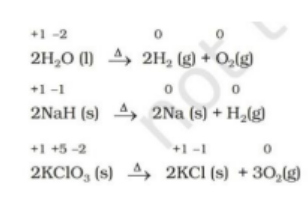
It may carefully be noted that there is no change in the oxidation number of hydrogen in methane under combination reactions and that of potassium in potassium chlorate in reaction. This may also be noted here that all decomposition reactions are not redox reactions. For example, decomposition of calcium carbonate is not a redox reaction.
3.) Displacement reactions- In a displacement reaction, an ion (or an atom) in a compound is replaced by an ion (or an atom) of another element. It may be denoted as:
X + YZ → XZ + Y
Displacement reactions fit into two categories: metal displacement and non-metal displacement.
(a) Metal displacement: A metal in a compound can be displaced by another metal in the uncombined state. Metal displacement reactions find many applications in metallurgical processes in which pure metals are obtained from their compounds in ores.
(b) Non-metal displacement: The non-metal displacement redox reactions include hydrogen displacement and a rarely occurring reaction involving oxygen displacement. All alkali metals and some alkaline earth metals (Ca, Sr, and Ba) which are very good reductants, will displace hydrogen from cold water. Many metals, including those which do not react with cold water, are capable of displacing hydrogen from acids. Dihydrogen from acids may even be produced by such metals which do not react with steam. Cadmium and tin are the examples of such metals.
4.) Disproportionation reactions – Disproportionation reactions are a special type of redox reactions. In a disproportionation reaction an element in one oxidation state is simultaneously oxidised and reduced. One of the reacting substances in a disproportionation reaction always contains an element that can exist in at least three oxidation states. The element in the form of reacting substance is in the intermediate oxidation state; and both higher and lower oxidation states of that element are formed in the reaction. The decomposition of hydrogen peroxide is a familiar example of the reaction, where oxygen experiences disproportionation.
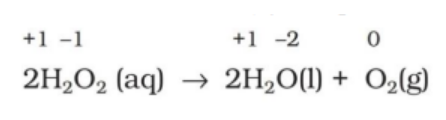
Here the oxygen of peroxide, which is present in –1 state, is converted to zero oxidation state in O2 and decreases to –2 oxidation state in H2O.
Oxidation: An increase in the oxidation number of the element in the given substance.
Reduction: A decrease in the oxidation number of the element in the given substance.
Oxidising agent: A reagent which can increase the oxidation number of an element in a given substance. These reagents are called as oxidants also.
Reducing agent: A reagent which lowers the oxidation number of an element in a given substance. These reagents are also called as reductants.
Redox reactions: Reactions which involve change in oxidation number of the interacting species.
Types of Redox Reactions
1.) Combination reactions -A combination reaction may be denoted in the manner:
A + B → C
Either A and B or both A and B must be in the elemental form for such a reaction to be a redox reaction. All combustion reactions, which make use of elemental dioxygen, as well as other reactions involving elements other than dioxygen, are redox reactions. Some important examples of this category are:
2.) Decomposition reactions- Decomposition reactions are the opposite of combination reactions. Precisely, a decomposition reaction leads to the breakdown of a compound into two or more components at least one of which must be in the elemental state.
Examples of this class of reactions are:
It may carefully be noted that there is no change in the oxidation number of hydrogen in methane under combination reactions and that of potassium in potassium chlorate in reaction. This may also be noted here that all decomposition reactions are not redox reactions. For example, decomposition of calcium carbonate is not a redox reaction.
3.) Displacement reactions- In a displacement reaction, an ion (or an atom) in a compound is replaced by an ion (or an atom) of another element. It may be denoted as:
X + YZ → XZ + Y
Displacement reactions fit into two categories: metal displacement and non-metal displacement.
(a) Metal displacement: A metal in a compound can be displaced by another metal in the uncombined state. Metal displacement reactions find many applications in metallurgical processes in which pure metals are obtained from their compounds in ores.
(b) Non-metal displacement: The non-metal displacement redox reactions include hydrogen displacement and a rarely occurring reaction involving oxygen displacement. All alkali metals and some alkaline earth metals (Ca, Sr, and Ba) which are very good reductants, will displace hydrogen from cold water. Many metals, including those which do not react with cold water, are capable of displacing hydrogen from acids. Dihydrogen from acids may even be produced by such metals which do not react with steam. Cadmium and tin are the examples of such metals.
4.) Disproportionation reactions – Disproportionation reactions are a special type of redox reactions. In a disproportionation reaction an element in one oxidation state is simultaneously oxidised and reduced. One of the reacting substances in a disproportionation reaction always contains an element that can exist in at least three oxidation states. The element in the form of reacting substance is in the intermediate oxidation state; and both higher and lower oxidation states of that element are formed in the reaction. The decomposition of hydrogen peroxide is a familiar example of the reaction, where oxygen experiences disproportionation.
Here the oxygen of peroxide, which is present in –1 state, is converted to zero oxidation state in O2 and decreases to –2 oxidation state in H2O.
- In … an ion (or an atom) in a compound is replaced by an ion (or an atom) of another element.
- displacement reaction
- decomposition reaction
- disproportionation reaction
- combination reaction
- leads to the breakdown of a compound into two or more components at least one of which must be in the elemental state.
- displacement reaction
- decomposition reaction
- disproportionation reaction
- combination reaction
- In …. an element in one oxidation state is simultaneously oxidised and reduced.
- displacement reaction
- decomposition reaction
- disproportionation reaction
- combination reaction
- Reactions which involve change in oxidation number of the interacting species…
- Exothermic reaction
- Endothermic reaction
- Neutralization reaction
- Redox reaction
- One of the reacting substances in a disproportionation reaction always contains an element that can exist in at least … oxidation states.
- 1
- 2
- 3
- 4