Question
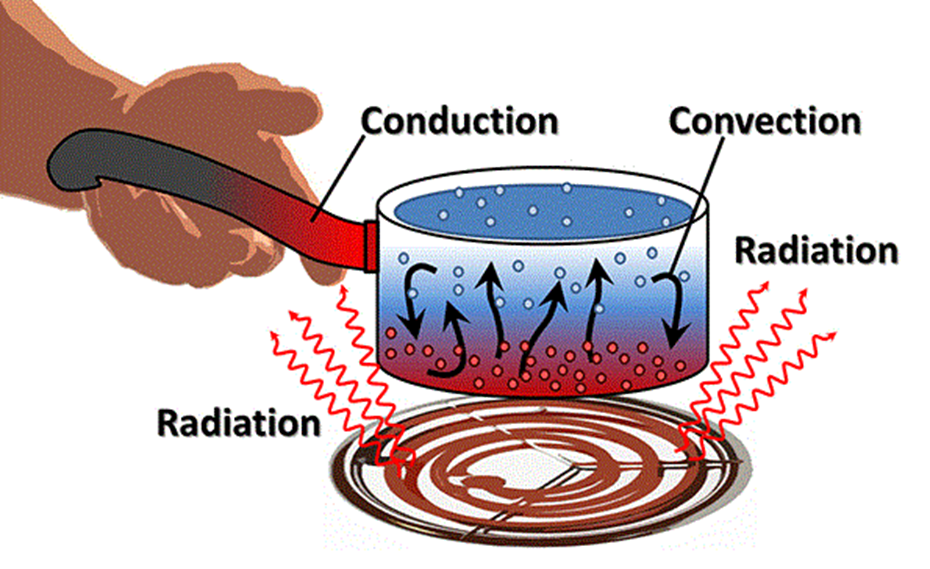
Read the passage given below and answer the following questions from (i) to (v). The figure shows the different modes of transfer of heat, heat transfer is defined as the movement of heat across the border of the system due to a difference in temperature between the system and its surroundings. The temperature difference exists between the two systems, heat will find a way to transfer from the higher to the lower system.
  1. The sea breeze is caused by:
    1. conduction
    2. convection
    3. radiation
    4. none of these
  2. At what factor heat absorbed on radiation by the body depends on?
    1. distance between body
    2. source of heat
    3. its color
    4. all of the above
  3. When heat is transferred by molecular collision, it is referred to as heat transfer by:
    1. convection
    2. conduction
    3. radiation
    4. convection and radiation
  4. Thermal conductivity of air with rise in temperature:
    1. increase
    2. decrease
    3. constant
    4. none of these
  5. Mass transfer does not take place in:
    1. conduction
    2. convection
    3. radiation
    4. none of these

Answer

  1. (b) convection
  2. (d) all of the above
  3. (a) convection
  4. (a) increase
  5. (c) radiation

Need a full question paper?

Generate a complete, print-ready paper with questions like this in minutes — across 16+ boards, with answer keys.

Start Generating Free

Similar questions

Read the passage given below and answer the following questions from (i) to (v). The velocity of an object, in general, changes during its course of motion. Initially, at the time of Galileo, it was thought that, this change m could be described by the rate of change of velocity with distance. But, through his studies of motion of freely falling objects and motion of objects on an inclined plane, Galileo concluded that, the rate of change of velocity with time is a constant of motion for all objects in free fall. This led to the concept of acceleration as the rate of change of velocity with time. The motion in which the acceleration remains constant is known as to be uniformly accelerated motion. There are certain equations which are used to relate the displacement (x), time taken (t), initial velocity (u), final velocity (v) and acceleration (a) a for such a motion and are known as kinematics equations for uniformly accelerated motion.
  1. The displacement of a body in 8s starting from rest with an acceleration of $20\ cms^{-2}$ is:
  1. $64m$
  2. $640m$
  3. $64cm$
  4. $0.064m$
  1. A particle starts with a velocity of $2ms^{-1}$ and moves in a straight line with a retardation of $0.1ms^{-2}$. The first time at which the particle is $15\ m$ from the starting point is:
  1. $10s$
  2. $20s$
  3. $30s$
  4. $40s$
  1. If a body starts from rest and travels $120cm$ in 6th second, then what is its acceleration?
  1. $0.20 ms^{-2}$
  2. $0.027ms^{-2}$
  3. $0.218ms^{-2}$
  4. $003. ms^{-2}$
  1. An object starts from rest and moves with uniform acceleration a. The final velocity of the particle in terms of the distance x covered by it is given as:
  1. $\sqrt{2\text{ax}}$
  2. $2\text{ax}$
  3. $\sqrt{\frac{\text{ax}}{2}}$
  4. $\sqrt{\text{ax}}$
  1. A body travelling with uniform acceleration crosses two points A and B with velocities $20ms^{-1}$ and $30ms^{-1}$​​​​​​​, respectively. The speed of the body at mid-point of A and B is:
  1. $25\text{ms}^{-1}$
  2. $25.5\text{ms}^{-1}$
  3. $24\text{ms}^{-1}$
  4. $10\sqrt{6}\text{ms}^{-1}$
The weight Mg of an extended body is generally shown in a diagram to act through the centre of mass. Does it mean that the earth does not attract other particles?
What can be said about the centre of mass of a uniform hemisphere without making any calculation? Will its distance from the centre be more than $\frac{\text{r}}{2}$ or less than $\frac{\text{r}}{2}?$
The dimensions $\text{ML}^{-1}\text{T}^{-2}$ may correspond to:
  1. Work done by a force.
  2. Linear momentum.
  3. Pressure.
  4. Energy per unit volume.
You are holding a cage containing a bird. Do you have to make less effort if the bird flies from its position in the cage and manages to stay in the middle without touching the walls of the cage? Does it make a difference whether the cage is completely closed or it has rods to let air pass?
Find the change in the volume of 1.0 litre kerosene when it is subjected to an extra pressure of $2.0 \times 10^5 \mathrm{~N} / \mathrm{m}^2$ from the following data. Density of kerosene $=800 \mathrm{~kg} / \mathrm{m}^3$ and speed of sound in kerosene $=1330 \mathrm{~m} / \mathrm{s}$.
The magnetic moment of the assumed dipole at the earth's centre is $8.0 \times 10^{22}A-m^2$. Calculate the magnetic field B at the geomagnetic poles of the earth. Radius of the earth is 6400km.
A car starts from rest on a half kilometer long bridge. The coefficient of friction between the tyre and the road is $1.0$. Show that one cannot drive through the bridge in less than $10s$.
In motor vehicles, a convex mirror is attached near the driver's seat to give him the view of the traffic behind. What is the special function of this convex mirror which a plane mirror can not do?
On a winter day, the outside temperature is 0°C and relative humidity 40%. The air from outside comes into a room and is heated to 20°C. What is the relative humidity in the room? The saturation vapour pressure at 0°C is 4.6mm of mercury and at 20°C it is 18mm of mercury.