Question
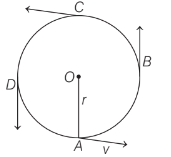
Read the passage given below and answer the following questions from (i) to (v). When an object follows a circular path at a constant speed, the motion of the object is called uniform circular motion. The word
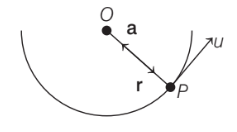
uniform refers to the speed which is uniform (constant) throughout the motion. Although the speed does not vary, the particle is accelerating because the velocity changes its direction at every point on the circular track. The figure shows a particle P which moves along a circular track of radius r with a uniform speedu.
  1. A circular motion:
  1. Is one-dimensional motion.
  2. Is two-dimensional motion.
  3. It is represented by combination of two variable vectors.
  4. Both (b) and (c)
  1. For a particle performing uniform circular motion, choose the incorrect statement from the following.
  1. Magnitude of particle velocity (speed) remains constant.
  2. Particle velocity remains directed perpendicular to radius vector.
  3. Direction of acceleration keeps changing as particle moves.
  4. Angular momentum is constant in magnitude but direction keeps changing.
  1. Two cars A and B move along a concentric circular path of radius $r_A$ and $r_B$ with velocities $v_A$ and $v_B$ maintaining constant distance, then $\frac{\text{v}_{\text{A}}}{\text{v}_\text{B}}$ is equal to:
  1. $\frac{\text{r}_{\text{B}}}{\text{r}_\text{A}}$
  2. $\frac{\text{r}_{\text{A}}}{\text{r}_\text{B}}$
  3. $\frac{\text{r}_{\text{A}}^2}{\text{r}_\text{B}^2}$
  4. $\frac{\text{r}_{\text{B}}^2}{\text{r}_\text{A}^2}$
  1. A car runs at a constant speed on a circular track of radius 100m, taking 62.8s for every circular lap. The average velocity and average speed for each circular lap, respectively is:
  1. $0,0$
  2. $0,10ms^{-1}$
  3. $10ms^{-1}, 10ms^{-1}$
  4. $10ms^{-1}, 0$
  1. A particle is revolving at 1200 rpm in acircle of radius 30cm. Then, its acceleration is:
  1. $1600ms^{-2}$
  2. $4740ms^{-2}$
  3. $2370ms^{-2}$
  4. $5055ms^{-2}$

Answer

  1. (d) Both (b) and (c)
Explanation:
Circular motion is an example of two-dimensional motion with radius vector as
$\text{r}=\text{a}\cos\omega\text{t}\hat{\text{i}}+\text{a}\sin\omega\text{t}\hat{\text{j}}$
Both the components $\text{r}=\text{a}\cos\omega\text{t}\hat{\text{i}}$ and $\text{a}\sin\omega\text{t}\hat{\text{j}}$ are perpendicular to each other.
  1. (c) Direction of acceleration keeps changing as particle moves.
Explanation:
If a particle is performing uniform circular motion, then its
  1. Speed will be constant throughout the motion.
  2. Velocity will be tangential in the direction of motion at a particular point.
  1. Acceleration, $\text{a}=\frac{\text{v}^2}{\text{r}}$ will always be towards centre of the circular path.
  2. Angular momentum (mvr) is constant in magnitude but direction keeps on changing.
  1. (b) $\frac{\text{r}_{\text{A}}}{\text{r}_\text{B}}$
Explanation:
Angular velocity $\omega$ is constant.
$\text{v}=\text{r}\omega$
$\therefore\text{v}\propto\text{r}$ or $\frac{\text{v}_\text{A}}{\text{v}_\text{B}}=\frac{\text{r}_{\text{A}}}{\text{r}_{\text{B}}}$
  1. (b) $0,10ms^{-1}$
Explanation:
On a circular path in completing one turn,the distance travelled is $2\pi\text{r},$ while displacement
is zero. Hence, average velocity
$=\frac{\text{displacement}}{\text{time interval}}=\frac{0}{\text{t}}=0$
Average speed $=\frac{\text{Distance}}{\text{Time interval}}$
$=\frac{2\pi\text{r}}{\text{t}}=\frac{2\times3.14\times100}{62.8}=10\text{ms}^{-1}$
  1. (b) $4740ms^{-2}$
Explanation:
Given, V = 1200 rpm $\frac{1200}{60}\text{rps}$
$\text{r}=30\text{cm}=\frac{30}{100}\text{m}$
Acceleration of the particle = Centripetal acceleration
$=\omega^2\text{r}=(2\pi\text{v})^2\text{r}$
$=\Big(2\times\frac{22}{7}\times\frac{1200}{60}\Big)^2\times\frac{30}{100}\approx4740\text{ms}^{-2}$

Need a full question paper?

Generate a complete, print-ready paper with questions like this in minutes — across 16+ boards, with answer keys.

Start Generating Free

Similar questions

A short magnet makes 40 oscillations per minute when used in an oscillation magnetometer at a place where the earth's horizontal magnetic field is $2\mu\text{T.}$ Another short magnet of magnetic moment $1.6A-m^2$ is placed 20cm east of the oscillating magnet. Find the new frequency of oscillation if the magnet has its north pole:
  1. Towards north.
  2. Towards south.
If the earth's magnetic field has a magnitude $3.4 \times 10^{-5} T$ at the magnetic equator of the earth what would be its value at the earth's geomagnetic poles?
Read the passage given below and answer the following questions from 1 to 5.
When we speak, the sound moves outward from us, without any flow of air from one part of the medium to another. The disturbances produced in air are much less obvious and only our ears or a microphone can detect them. These patterns, which move without the actual physical transfer or flow of matter as a whole, are called waves. The most familiar type of waves such as waves on a string, water waves, sound waves, seismic waves, etc. is the so-called mechanical waves. These waves require a medium for propagation, they cannot propagate through vacuum. They involve oscillations of constituent particles and depend on the elastic properties of the medium. The electromagnetic waves that you will learn in Class XII are a different type of wave. Electromagnetic waves do not necessarily require a medium – they can travel through vacuum. Light, radio waves, X-rays, are all electromagnetic waves. We have seen that motion of mechanical waves involves oscillations of constituents of the medium. If the constituents of the medium oscillate perpendicular to the direction of wave propagation, we call the wave a transverse wave. If they oscillate along the direction of wave propagation, we call the wave a longitudinal wave. In transverse waves, the particle motion is normal to the direction of propagation of the wave. Therefore, as the wave propagates, each element of the medium undergoes a shearing strain. Transverse waves can, therefore, be propagated only in those media, which can sustain shearing stress, such as solids and not in fluids. Fluids, as well as, solids can sustain compressive strain; therefore, longitudinal waves can be propagated in all elastic media.
For example, in medium like steel, both transverse and longitudinal waves can propagate, while air can sustain only longitudinal waves. Answer the following.
  1. Air can sustain:
  1. Transverse waves
  2. Longitudinal waves
  3. Both a and b
  4. None of these
  1. The electromagnetic waves can pass through
  1. Solids only
  2. Fluids only
  3. Any medium even through vacuum
  4. None of these
  1. Define Transverse waves
  1. Define longitudinal waves
  1. Differentiate between Transverse waves and longitudinal waves
Read the passage given below and answer the following questions from 1 to 5. Every measurement involves errors. Thus, the result of measurement should be reported in a way that indicates the precision of measurement. Normally, the reported result of measurement is a number that includes all digits in the number that are known reliably plus the first digit that is uncertain. The reliable digits plus the first uncertain digit are known as significant digits or significant figures. If we say the period of oscillation of a simple pendulum is 1.62 s, the digits 1 and 6 are reliable and certain, while the digit 2 is uncertain. Thus, the measured value has three significant figures.A choice of change of different units does not change the number of significant digits or figures in a measurement. This important remark makes most of the following observations clear,
  • All the non-zero digits are significant.
  • All the zeros between two non-zero digits are significant, no matter where the decimal point is, if at all.
  • If the number is less than 1, the zero(s) on the right of decimal point but to the left of the first non-zero digit are not significant.
  • The terminal or trailing zero(s) in a number without a decimal point are not significant.[Thus 123 m = 12300 cm = 123000 mm has three significant figures, the trailing zero(s) being not significant.
  • The trailing zero(s) in a number with a decimal point are significant. [The numbers 3.500 or 0.06900 have four significant figures each]
  • For a number greater than 1, without any decimal, the trailing zero(s) are not significant.
  • For a number with a decimal, the trailing zero(s) are significant
(b) The digit 0 conventionally put on the left of a decimal for a number less than 1 (like 0.1250) is never significant. However, the zeroes at the end of such number are significant in a measurement. (c) The multiplying or dividing factors which are neither rounded numbers nor numbers representing measured values are exact and have infinite number of significant digits. (d) In multiplication or division, the final result should retain as many significant figures as are there in the original number with the least significant figures.In addition or subtraction, the final result should retain as many decimal places as are there in the number with the least decimal places. For example, the sum of the numbers 436.32 g, 227.2 g and 0.301 g by mere arithmetic addition, is 663.821 g. But the least precise measurement (227.2 g) is correct to only one decimal place. The final result should, therefore, be rounded off to 663.8 g.
  1. Significant figures in 12300 cm are:
  1. 5
  2. 4
  3. 3
  4. None of these
  1. All the non-zero digits are:
  1. Significant
  2. Non significant
  3. None of these
  1. Give rules for significant figures
  1. Give rules for addition and subtraction operations with significant figure
  1. Give rules for multiplication and division operations with significant figure
The saturation current from a thoriated-tungsten cathode at 2000 K is 100 mA . What will be the saturation current for a pure-tungsten cathode of the same surface area operating at the same temperature? The constant A in the Richardson-Dushman equation is $60 \times 10^4 \mathrm{Am}^{-2} \mathrm{~K}^{-2}$ for pure tungsten and $3.0 \times 10^4 \mathrm{Am}^{-2} \mathrm{k}^{-2}$ for thoriated tungsten. The work function of pure tungsten is 4.5 eV and that of thoriated tungsten is 2.6 eV .
$\int\frac{\text{dx}}{\sqrt{2\text{ax}-\text{x}^2}}=\text{a}^{\text{n}}\sin^{-1}\Big[\frac{\text{x}}{\text{a}}-1\Big].$ The value of n is:
The dynamic plate resistance of a triode value is $10\text{k}\Omega$ Find the change in the plate current if the plate voltage is changed from 200V to 220V.
Read the passage given below and answer the following questions from 1 to 5. Newton’s first law of motion states that If the net external force on a body is zero, its acceleration is zero. Acceleration can be non zero only if there is a net external force on the body. To summaries, if the net external force is zero, a body at rest continues to remain at rest and a body in motion continues to move with a uniform velocity. This property of the body is called inertia. Inertia means ‘resistance to change’. A body does not change its state of rest or uniform motion, unless an external force compels it to change that state. In other words, all objects resist a change in their state of motion. In a qualitative way, the tendency of undisturbed objects to stay at rest or to keep moving with the same velocity is called inertia. Consider a book at rest on a horizontal surface. It is subject to two external forces: the force due to gravity (i.e. its weight W) acting downward and the upward force on the book by the table, the normal force R. R is a self-adjusting force. This is an example of the kind of situation mentioned above. The forces are not quite known fully but the state of motion is known. We observe the book to be at rest. Therefore, we conclude from the first law that the magnitude of R equals that of W. A statement often encountered is : Since W = R, forces cancel and, therefore, the book is at rest”. This is incorrect reasoning. The correct statement is: “Since the book is observed to be at rest, the net external force on it must be zero, according to the first law. This implies that the normal force R must be equal and opposite to the weight W.
  1. The book on table is at rest. The force of gravity here is balanced by:
  1. Force of friction.
  2. Normal reaction by table on book.
  3. Weight of table.
  4. None of these.
  1. If no external force acts on object which is at rest. it will
  1. Remain at rest.
  2. Start to move.
  3. Both a and b can possible.
  4. None of these.
  1. Define inertia.
  1. State Newton’s first law of motion.
  1. Explain why book on table remains at rest.
If a mosquito is dipped into water and released, it is not able to fly till it is dry again. Explain.
The plate current in a triode can be written as $\text{i}_\text{p}=\text{k}\Big(\text{V}_\text{g}+\frac{\text{V}_\text{p}}{\mu}\Big)^{\frac{3}{2}}$ Show that the mutual conductance is proportional to the cube root of the plate current.