Question
Read the passage given below and answer the following questions:
Most important crystal lattices are the simple cubic, body centred cubic and face centred cubic. In simple cubic lattice, all the atoms are present at all the corners of the cube. In body-centred cubic lattice, atoms are present at all the corners and at the body-centre. In face-centred cubic lattice, atoms are present at the corners and at the centers of all six faces. In the formation of crystals, the constituent particles get closely packed together. The closely packed arrangement is that in which maximum available space is occupied, leaving minimum vacant space. The most efficient close packing, can be achieved in two ways, one which is called hexagonal close packing.(hcp) and the other, cubic close packing (ccp or fcc)
In these questions (Q. No. i-iv) a statement of assertion followed by a statement of reason is given. Choose the correct answer out of the following choices.
  1. Assertion and reason both are correct statements, and reason is correct explanation for assertion.
  2. Assertion and reason both are correct statements, but reason is not correct explanation for assertion.
  3. Assertion is correct statement, but reason is wrong statement.
  4. Assertion is wrong statement, but reason is correct statement.
  1. Assertion: Face centred cubic cell has $4$ atoms per unit cell.
Reason: ln fee unit cell, there are $8$ atoms at the corners and $ 6$ atoms at face centres
  1. Assertion: CsCl has body-centred cubic arrangement.
Reason: CsCl has one $Cs^+$ ion and $8$ $CI^-$ ions in its unit cell.
  1. Assertion: fcc and hcp have same packing efficiency.
Reason: bcc and fcc both have same number of atoms per unit cell and same arrangement.
  1. Assertion: The total number of atoms present in a simple cubic unit cell is one.
Reason: Simple cubic unit cell has atoms at its corners, each of which is shared between eight adjacent unit cells.
  1. Assertion: The packing efficiency is maximum for the fee structure.
Reason: The coordination number is $12$ in fcc structures.

Answer

  1. (a) Assertion and reason both are correct statements, and reason is correct explanation for assertion.
  2. (a) Assertion and reason both are correct statements, and reason is correct explanation for assertion.
Explanation:

CsCl has body-centred cubic arrangement in which atoms are present at the corners and at the body center. Now, $Cs^+$ is present at the body centre while$ Cl$ ions are present at the corners. So, number of $Cl^- ions = 8$ Number of $Cs^+ ion = 1$
  1. (c) Assertion is correct statement, but reason is wrong statement.
Explanation:

fcc and hcp both have $74\%$ packing efficiency. In bee there are $2$ atoms per unit cell while in fee there are $4$ atoms per unit cell and both have different arrangements.
  1. (a) Assertion and reason both are correct statements, and reason is correct explanation for assertion.
  2. (b) Assertion and reason both are correct statements, but reason is not correct explanation for assertion.
Explanation:

The no. of atoms in fee structure is $4$ per unit cell, which provides a maximum efficiency as $74\%.$

Need a full question paper?

Generate a complete, print-ready paper with questions like this in minutes — across 16+ boards, with answer keys.

Start Generating Free

Similar questions

Read the passage given below and answer the following questions:
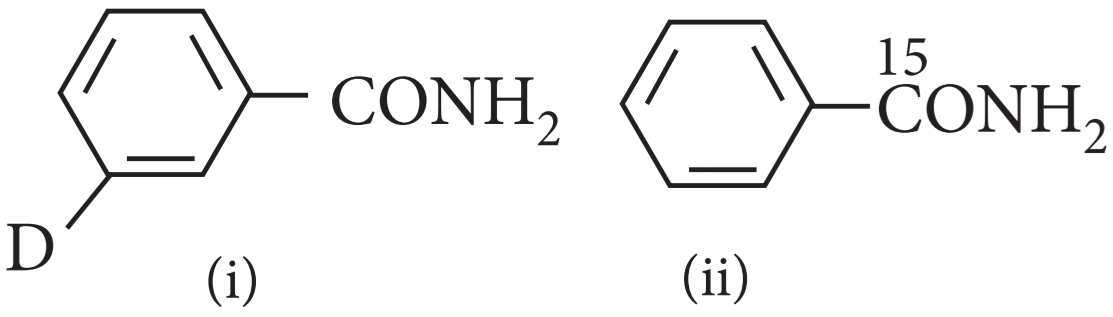
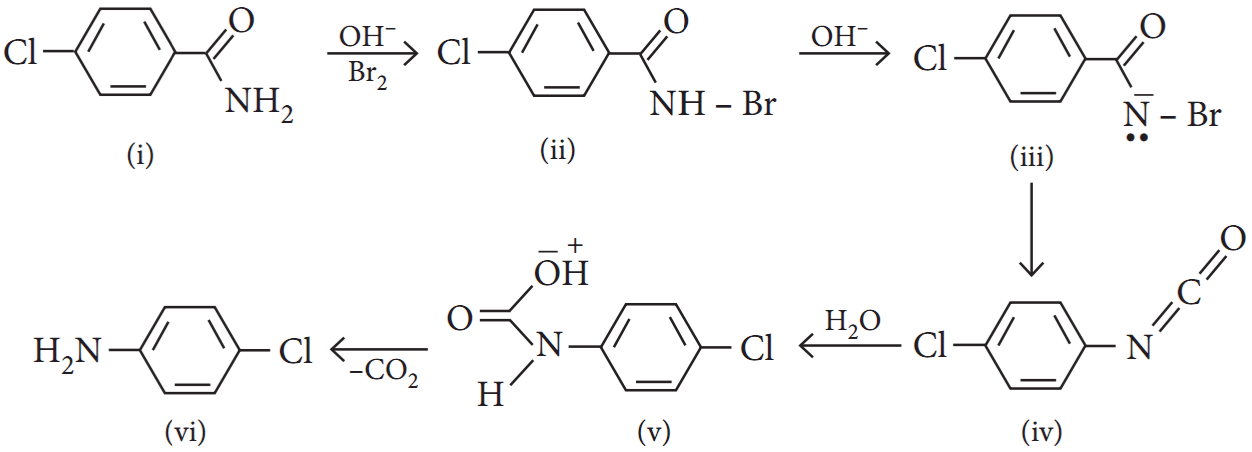
$RCONH_2$ is converted into $RNH_2$ by means of Hoffmann bromamide degradation. During the reaction amide is treated with $Br_2$ and alkali to get amine. This reaction is used to descend the series in which carbon atom is removed as carbonate ion $(\text{CO}^{2-}_3)$ Hoffmann bromide degradation reaction can be written as:

The following questions are multiple choice questions. Choose the most appropriate answer:
  1. Hoffmann bromamide degradation is used for the preparation of
  1. Primary amines.
  2. Secondary amines.
  3. Tertiary amines.
  4. Secondary aromatic amines.
  1. Which is the rate determining step in Hoffmann bromamide degradation?
  1. Formation of (i)
  2. Formation of (ii)
  3. Formation of (iii)
  4. Formation of (iv).
  1. Which of the following are used for the conversion of (i) to (ii)?
  1. $KBr$
  2. $KBr + CH_3ONa$
  3. $KBr + KOH$
  4. $Br_2 + KOH$
  1. Identify Bin the following reaction.
$\text{R}-\text{C}\equiv\text{N}\xrightarrow[\text{(Partially hydrolysis) }]{\text{Cone. HCI}}\text{A}\xrightarrow{\frac{\text{Br}_2}{\text{KOH}}}\text{B}$
  1. $RCONH_2$
  2. $RNH_2$
  3. $RNHBr$
  4. $R = N = C = O$
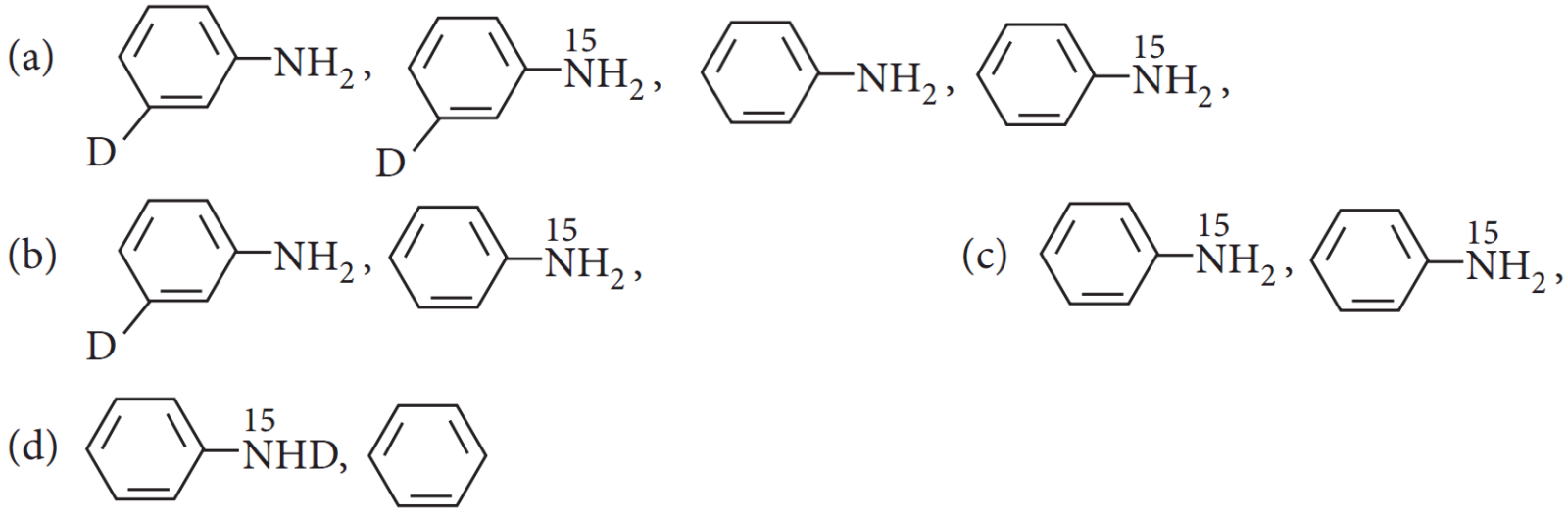
  1. What are the constituent amines formed when the mixture of (i) and (ii) undergoes Hoffmann bromamide degradation?

Standard electrode potentials are used for various processes:
  • It is used to measure relative strengths of various oxidants and reductants.
  • It is used to calculate standard cell potential.
  • It is used to predict possible reactions.
A set of half-reactions (in acidic medium) along with their standard reduction potential, $E^\circ ($in volt$)$ values are given below:
$I_2 + 2e^- \rightarrow 2I^- ; E^\circ = 0.54 V$
$Cl_2 + 2e^- \rightarrow 2Cl^- ; E^\circ = 1.36 V$
$Mn^{3+} +e^- \rightarrow Mn^{2+}; E^\circ = 1.50 V$
$Fe^{3+} + e^- \rightarrow Fe^{2+}; E^\circ = 0.77 V$
$O_2 + 4H^+ + 4e^- \rightarrow 2H_2O ; E^\circ = 1.23 V$
The following questions are multiple choice questions. Choose the most appropriate answer:
  1. Which of the following statements is correct?
  1. $Cl^-$ is oxidised by $O_2.$
  2. $Fe^{2+}$ is oxidised by iodine.
  3. $I^-$ is oxidised by chlorine.
  4. $Mn^{2+}$ is oxidised by chlorine.
  1. $Mn^{3+}$ is not stable in acidic medium, while $Fe^{3+}$ is stable because:
  1. $O_2$ oxidises $Mn^{2+}$ to $Mn^{3+}$
  2. $O_2$ oxidises both $Mn^{2+}$ to $Mn^{3+}$ and $Fe^{2+}$ to $Fe^{3+}$
  3. $Fe^{3+}$ oxidises $H_2O$ to $O_2$
  4. $Mn^{3+}$ oxidises $H_2O$ to $O_2$
  1. The strongest reducing agent in the aqueous solution is:
  1. $I^-$
  2. $Cl^-$
  3. $Mn^{2+}$
  4. $Fe^{2+}$
  1. The emf for the following reaction is:
$\text{I}_2+\text{KCl}\rightleftharpoons2\text{KI}+\text{Cl}_2$
  1. $-0.82\ V$
  2. $+0.82\ V$
  3. $-0.73\ V$
  4. $+0.73\ V$
  1. Which of the following statements is correct for the following reaction?
$Fe^{3+} + Mn^{2+} \rightarrow Fe^{2+}+ Mn^{3+}$
  1. The emf of the cell is positive.
  2. $Fe^{3+}$ oxidises $Mn^{2+}.$
  3. The reaction does not occur.
  4. All are correct.

 
Molar conductivity of ions are given as product of charge on ions to their ionic mobilities and Faradays constant.
$\lambda_\text{A}\text{n}+=\text{n}\mu_\text{A}\text{n}+\text{F}$ (here $\mu$ is the ionic mobility of $A^{n+})$
For electrolytes say $A_xB_y,$ molar conductivity is given by
$\lambda_{\text{m}(\text{A}_\text{x}\text{B}_\text{y})}=\text{x}_\text{n}\mu_{\text{A}^\text{n}}+\text{F}+\text{y}_\text{m}\lambda_{\text{A}^\text{m}}-\text{F}$
Ions
Ionic mobility
$K^+$
$7.616 \times 10^{-4}$
$Ca^{2+}$
$12.33 \times 10^{-4}$
$Br^-$
$8.09 \times 10^{-4}$
$\text{SO}_{4}^{2-}$
$16.58 \times 10^{-4}$
The following questions are multiple choice questions. Choose the most appropriate answer:
  1. At infinite dilution, the equivalent conductance of $CaSO_4$ is:
  1. $256 \times 10^{-4}$
  2. $279$
  3. $23.7$
  4. $2.0 \times 10^{-8}$
  1. If the degree of dissociation of $CaSO_4$ solution is $10\%$ then equivalent conductance of $CaSO_4$ is:
  1. $3.59$
  2. $36.9$
  3. $27.9$
  4. $30.6$
  1. The correct order of equivalent conductance at infinite dilution of LiCl, NaCl, KCl is:
  1. $LiCl = NaCl = KCl$
  2. $LiCl > NaCl > KCl$
  3. $KCl > LiCl > NaCl$
  4. $KCl > NaCl > LiCl$
  1. What is the unit of equivalent conductivity?
  1. $ohm^{-1}\ cm^2\ eq^{-1}$
  2. $ohm\ cm^2\ eq-1$
  3. $ohm^{-1}\ cm\ eq^{-1}$
  4. $ohm\ cm^{-2}\ eq^{-2}$
  1. If the molar conductance value of $Ca^{2+}$ and $Cl^-$ at infinite dilution are $118.88 \times 10^{-4}m^2$ mho $mol^{-1}$ and $77.33 \times 10^{-4}m^2$ mho $mol^{-1}$ respectively then the molar conductance of $CaCl_2 ($in $m^2$ mho $mol^{-1})$ will be:
  1. $120.18 \times 10^{-4}$
  2. $135 \times 10^{-4}$
  3. $273.54 \times 10^{-4}$
  4. $192.1 \times 10^{-4}$
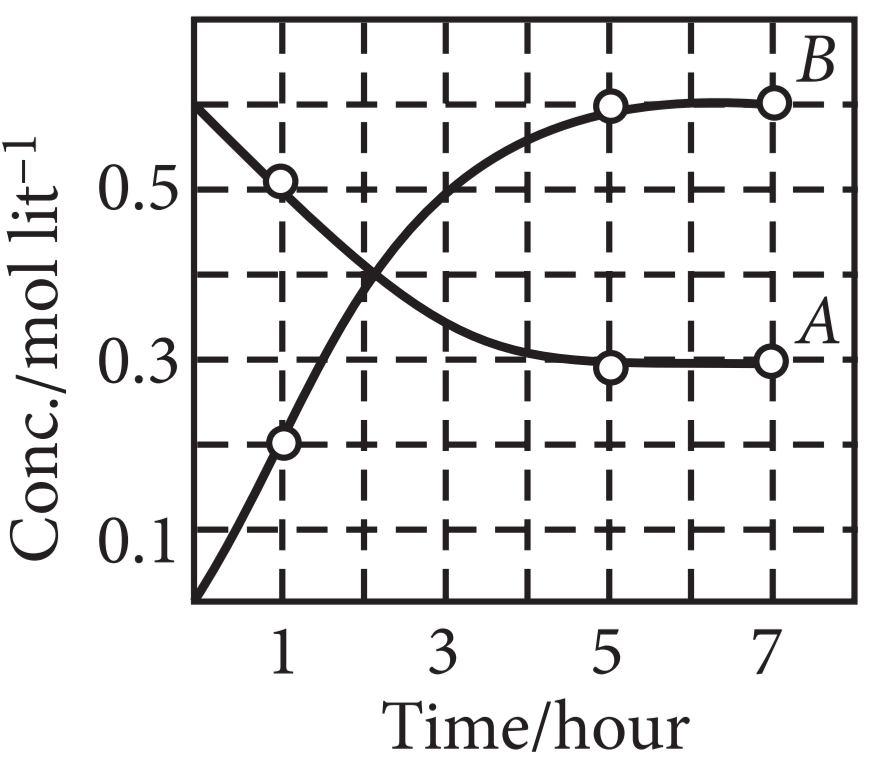
The progress of the reaction, $\text{A}\rightleftharpoons\text{nB}$ with time is represented in the following figure:

The following questions are multiple choice questions. Choose the most appropriate answer:
  1. What is the value of n?
  1. 1
  2. 2
  3. 3
  4. 4
  1. Find the value of the equilibrium constant.
  1. 0.6M
  2. 1.2M
  3. 0.3M
  4. 2.4M
  1. The initial rate of conversion of A will be:
  1. $0.1 mol ~L^{-1}hr^{-1}$
  2. $0.2 mol ~L^{-1}hr^{-1}$
  3. $0.4 mol ~L^{-1}hr^{-1}$
  4. $0.8 mol ~L^{-1}hr^{-1}$
  1. For the reaction, if $\frac{\text{d}[\text{B}]}{\text{dt}}=2\times10^{-4},$ value of $-\frac{\text{d}[\text{A}]}{\text{dt}}$ will be:
  1. $2 \times 10^{-4}$
  2. $10^{-4}$
  3. $4 \times 10^{-4}$
  4. $0.5 \times 10^{-4}$
  1. Which factor has no effect on rate of reaction?
  1. Temperature.
  2. Nature of reactant.
  3. Concentration of reactant.
  4. Molecularity.
In these questions, a statement of assertion followed by a statement of reason is given. Choose the correct answer out of the following choices.
Assertion: The molecules on the surface have lesser energy than the molecules inside.
Reason: During adsorption, the surface of solid is in a state of strain.

Read the passage given below and answer the following questions:
When a solution of an et-amino acid is placed in an electric field depending on the pH of the medium, following three cases may happen.
  1. In alkaline solution, CL-amino acids exist as anion II, and there is a net migration of amino acid towards the anode.
  2. In acidic solution, a-amino acids exist as cation III, and there is a net migration of amino acid towards the cathode.
  3. If II and III are exactly balanced there is no net migration; under such conditions any one molecule exists as a positive ion and as a negative ion for exactly the same amount of time, and any small movement in the direction of one electrode is subsequently cancelled by an equal movement back toward the other electrode. The pH of the solution in which a particular amino acid does not migrate under the influence of an electric field is called the is oelectric point of that amino acid.
The following questions are multiple choice questions. Choose the most appropriate answer:
  1.  

Arrange in order of increasing acid strengths.
  1. X > Z > Y
  2. Z < X < Y
  3. X > Y > Z
  4. Z > X > Y
  1. In aqueous solutions, amino acids mostly exist as:
  1. $NH_2 - CHR - COOH$
  2. $NH_2 - CHR - COO^-$
  3. $\stackrel{+}{\hbox{ N}}\text{H}_3\text{CHRCOOH}$
  4. $\text{H}_3\stackrel{{+}}{\hbox{N}}\text{CHRCOO}^-$
  1. Amino acids are least soluble:
  1. at pH 1
  2. at pH 7
  3. At their isoelectric points.
  4. None of these.
  1. The $\text{pK}_{\text{a}_1}$ and $\text{pK}_{\text{a}_2}$ of an amino acid are 2.3 and 9.7 respectively. The is oelectric point of the amino acid is:
  1. 12.0
  2. 7.4
  3. 6.0
  4. 3.7
  1. A tripeptide (X) on partial hydrolysis gave two dipeptides Cys-Gly and Glu-Cys. Identify the tripeptide.
  1. Glu-Cys-Gly
  2. Gly-Glu-Cys
  3. Cys-Gly-Glu
  4. Cys-Glu-Gly
Read the passage given below and answer the following questions:
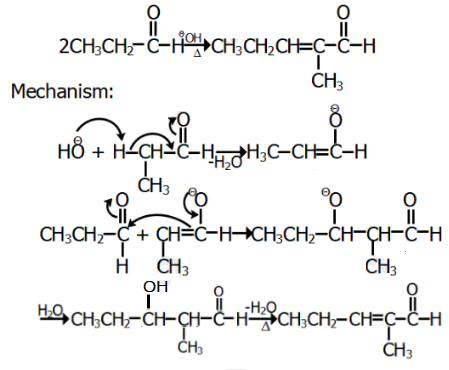
The addition reaction of enol or enolate to the carbonyl functional group of aldehyde or ketone is known as aldol addition. The β-hydroxyaldehyde or ββ-hydroxyketone so obtained undergo dehydration in second step to produce a conjugated enone. The first part of reaction is an addition reaction and the second part is an elimination reaction. Carbonyl compound having αα-hydrogen undergoes aldol condensation reaction.
  1. Condensation reaction is the reverse of which of the following reaction?
  1. Lock and key hypothesis
  2. Oxidation
  3. Hydrolysis
  4. Glycogen formation
  1. Which of the following compounds would be the main product of an aldol condensation of acetaldehyde and acetone?
  1. $CH_3CH=CHCHO$
  2. $CH_3CH=CHCOCH_3$
  3. $(CH_3)_2C=CHCHO$
  4. $(CH_3)_2C=CHCOCH_3$
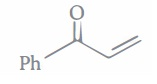
  1. Which combination of carbonyl compounds gives phenyl vinyl ketone by an aldol condensation?
  1. Acetophenone and Formaldehyde
  2. Acetophenone and acetaldehyde
  3. Benzaldehyde and acetaldehyde
  4. Benzaldehyde and acetone
  5. Which of the following will undergo aldol condensation?
  1. $HCHO$
  2. $CH_3CH_2OH$
  3. $C_6H_5CHO$
  4. $CH_3CH_2CHO$
Read the passage given below and answer the following questions:
The unique behaviour of $Cu, $ having a positive $E^\circ$ accounts for its inability to liberate $H_2$ from acids. Only oxidising acids (nitric and hot concentrated sulphuric acid) react with $Cu,$ the acids being reduced. The stability of the half-filled $(d^5)$ subshell in $Mn^{2+}$ and the completely filled $(d^{10})$ configuration in $Zn^{2+}$ are related to their $\text{E}^\circ\frac{\text{M}^{3+}}{\text{M}^{2+}}$ values. The low value for Sc reflects the stability of $Sc^{3+}$ which has a noble gas configuration. The comparatively high value for Mn shows that $Mn^{2+}(d^5)$ is particularly stable, whereas a comparatively low value for Fe shows the extra stability of $Fe^{3+}(d^5)$. The comparatively low value for Vis related to the stability of $v^{2+} ($half-filled $t_{2g}$ level$)$.
The following questions are multiple choice questions. Choose the most appropriate answer:
  1. Standard reduction electrode potential of $\frac{\text{Zn}^{2+}}{\text{Zn}}$ is 0.76V. This means
  1. $ZnO$ cannot be reduced to $Zn$ by $H_2$ under standard conditions.
  2. $Zn$ cannot liberate $H_2$ with concentrated acids.
  3. $Zn$ is generally the anode in an electrochemical cell.
  4. $Zn$ is generally the cathode in an electrochemical cell.
  1. $\text{E}^\circ$ values for the couples $\frac{\text{Cr}^{3+}}{\text{Cr}^{2+}}$ and $\frac{\text{Mn}^{3+}}{\text{Mn}^{2+}}$ are $-0.41$ and $+1.51$ volts respectively. These values suggest that.
  1. $Cr^{2+}$ acts as a reducing agent whereas $Mn^{3+}$ acts as an oxidizing agent.
  2. $Cr^{2+}$ is more stable th an $Cr^{3+}$ state.
  3. $Mn^{3+}$ is more stable than $Mn^{2+}$.
  4. $Cr^{2+}$ acts as an oxidizing agent whereas $Mn^{3+}$ acts as a reducing agent..
  1. The reduction potential values of $M, N$ and $O$ are $+2.46, -1.13$ and $-3.13V$ respectively. Which of the following order is correct regarding their reducing property?
  1. $O > N > M$
  2. $O > M > N$
  3. $M > N > O$
  4. $M > O > N$
  1. Which of the following statements are true?
  1. $Mn^{2+}$ compounds are more stable than $Fe^{2+}$ towards oxidation to $+3$ state.
  2. Titanium and copper both in the first series of transition metals exhibits $+1$ oxidation state most frequently.
  3. $Cu^+$ ion is stable in aqueous solutions.
  4. The $\text{E}^\circ$ value for the $\frac{\text{Mn}^{3+}}{\text{Mn}^{2+}}$ couple is much more positive than that for $\frac{\text{Cr}^{3+}}{\text{Cr}^{2+}}$ or $\frac{\text{Fe}^{3+}}{\text{Fe}^{2+}}.$.
  1. $(II)$ and $(III)$
  2. $(I)$ and $(IV)$
  3. $(I)$ and $(III)$
  4. $(II)$ and $(IV)$
  1. The stability of $\text{Cu}^{2+}_\text{(aq)}$ rather than $\text{Cu}^{+}_\text{(aq)}$ is due to.
  1. More negative $\Delta_\text{hyd}\text{H}^\circ$ of $\text{Cu}^{2+}_\text{(aq)}.$
  2. Less negative $\Delta_\text{hyd}\text{H}^\circ$ of $\text{Cu}^{2+}_\text{(aq)}.$
  3. More positive $\Delta_\text{hyd}\text{H}^\circ$ of $\text{Cu}^{2+}_\text{(aq)}.$
  4. Less positive $\Delta_\text{hyd}\text{H}^\circ$ of $\text{Cu}^{2+}_\text{(aq)}.$
In these questions, a statement of assertion followed by a statement of reason is given. Choose the correct answer out of the following choices.
Assertion: Gases are easily adsorbed on the surface of metals especially transition metals.
Reason: Transition metals have free valencies.
Read the passage given below and answer the following questions:
If some solute is added to a solvent, the boiling point of solution increases. This is known as elevation in baiting point.
$\Delta\text{T}_\text{b}=\text{K}_\text{b}\text{m}$ where, $K_b =$ Molal elevation constant,
$\Delta\text{T}_\text{b}\propto\text{m}$
Hence, it is a colligative property,
Also, $\text{K}_\text{b}=\frac{\text{MRT}^2_\text{b}}{\Delta\text{Vap}\text{H}\times1000}$
where, $M =$ Molar mass of solvent,
$\Delta\text{vap}$ $H = $Enthalpy of vaporisation,
Molar mass can also be calculated using elevation in boiling point.
$\text{M}_\text{B}=\frac{\text{K}_\text{B}\times\text{W}_\text{B}\times1000}{\Delta\text{T}_\text{b}\times\text{W}_\text{A}}$
A statement of assertion followed by a statement of reason is given. Choose the correct answer out of the following choices.
  1. Assertion and reason both are correct statements and reason is correct explanation for assertion.
  2. Assertion and reason both are correct statements but reason is not correct explanation for assertion.
  3. Assertion is correct statement but reason is wrong statement.
  4. Assertion is wrong statement but reason is correct statement.
  1. Assertion: In a pressure cooker, the water is brought to boil. The cooker is then removed from the stove. Now on removing the lid of pressure cooker, the water starts boiling again.
Reason: The impurities in water bring down its boiling point.
  1. Assertion: On dissolving $3.24g$ of sulphur in $40g$ of benzene, boiling point of solution get higher than that of benzene by $0.081K$, then the formula of sulphur is $S_8. (K_b$ for benzene $= 2.53K\ kg\ mol^{-1})$
Reason: Molecular mass of sulphur comes out to be $253.$
  1. Assertion: When sugar is added to water, boiling point of water increases.
Reason: When a non-volatile solute is added to a solvent, elevation in boiling point is observed.
  1. Assertion: Cooking time in pressure cookers is reduced.
Reason: Boiling point inside the pressure cooker in raised.
  1. Assertion: Elevation in boiling point of two isotonic solutions is same.
Reason: Boiling point depends upon the concentration of the solute.