Question

Read the passage given below and answer the following questions:
When a solution of an et-amino acid is placed in an electric field depending on the pH of the medium, following three cases may happen.

  1. In alkaline solution, CL-amino acids exist as anion II, and there is a net migration of amino acid towards the anode.
  2. In acidic solution, a-amino acids exist as cation III, and there is a net migration of amino acid towards the cathode.
  3. If II and III are exactly balanced there is no net migration; under such conditions any one molecule exists as a positive ion and as a negative ion for exactly the same amount of time, and any small movement in the direction of one electrode is subsequently cancelled by an equal movement back toward the other electrode. The pH of the solution in which a particular amino acid does not migrate under the influence of an electric field is called the is oelectric point of that amino acid.
The following questions are multiple choice questions. Choose the most appropriate answer:
  1.  

Arrange in order of increasing acid strengths.
  1. X > Z > Y
  2. Z < X < Y
  3. X > Y > Z
  4. Z > X > Y
  1. In aqueous solutions, amino acids mostly exist as:
  1. $NH_2 - CHR - COOH$
  2. $NH_2 - CHR - COO^-$
  3. $\stackrel{+}{\hbox{ N}}\text{H}_3\text{CHRCOOH}$
  4. $\text{H}_3\stackrel{{+}}{\hbox{N}}\text{CHRCOO}^-$
  1. Amino acids are least soluble:
  1. at pH 1
  2. at pH 7
  3. At their isoelectric points.
  4. None of these.
  1. The $\text{pK}_{\text{a}_1}$ and $\text{pK}_{\text{a}_2}$ of an amino acid are 2.3 and 9.7 respectively. The is oelectric point of the amino acid is:
  1. 12.0
  2. 7.4
  3. 6.0
  4. 3.7
  1. A tripeptide (X) on partial hydrolysis gave two dipeptides Cys-Gly and Glu-Cys. Identify the tripeptide.
  1. Glu-Cys-Gly
  2. Gly-Glu-Cys
  3. Cys-Gly-Glu
  4. Cys-Glu-Gly

Answer

  1. (a) X > Z > Y
Explanation:
Carboxytic acids are stronger acids than $-\stackrel{{+}}{\hbox{N}}\text{H}_3,$ therefore X is the strongest acid. Since –COOH has -I effect which decreases with distance therefore, effect is more pronounced on Z than on Y.
As a result Z is more acidic than Y, therefore, overall order of increasing acid strength is X > Z > Y.
  1. (d) $\text{H}_3\stackrel{{+}}{\hbox{N}}\text{CHRCOO}^-$
Explanation:
In aqueous solutions, amino acids mostly exist as zwitter ion or dipolar ion.
$\ \ \ \ \ \ \ \ \ \ \ \ \ \ \text{R}\\\ \ \ \ \ \ \ \ \ \ \ \ \ \ \ |\\\stackrel{{+}}{\hbox{N}}\text{H}_3-\text{CH}-\text{COO}^-\\\ \ \ \ \ \ \ \ \ \ \text{Zwitter ion}$
  1. (c) At their isoelectric points.
Explanation:
Amino acids are least soluble at their isoelectric points. At a specific pH, called isoelectric point, the positive and negative charges balance each other and the net charge becomes zero. If there is a charge, the amino acid prefers to interact with water, rather than other amino acid molecules, this charge makes it more soluble.
  1. (c) 6.0
Explanation:
$\text{Isoelectric point}=\frac{2.3+9.7}{2}=6$
  1. (a) Glu-Cys-Gly
Explanation:
Since the tripeptide on hydrolysis gave two dipeptides Glu-Cys and Cys-Gly, hence, cysteine must be in between glutamic acid and glycine as given below:
$\ \ \ \ \ \ \ \ \ \text{CH}_2\text{CH}_2\text{COOH}\\\ \ \ \ \ \ \ \ \ \ |\\\stackrel{{+}}{\hbox{N}}\text{H}_3\text{CH}-\text{C}-\text{NHCH}-\text{CNHCH}_2\text{CO}^-\\\ \ \ \ \ \ \ \ \ \ \ \ \ \ \ \ \ \ \ \ ||\ \ \ \ \ \ \ \ \ \ \ \ |\ \ \ \ \ \ \ \ \ ||\ \ \ \ \ \ \ \ \ \ \ \ \ \ \ ||\\\ \ \ \ \ \ \ \ \ \ \ \ \ \ \ \ \ \ \ \ \text{O}\ \ \ \ \ \ \text{HSCH}_2\ \ \text{O}\ \ \ \ \ \ \ \ \ \ \ \ \ \ \text{O}\\\ \ \ \ \ \ \ \ \ \ \ \ \ \ \ \ \ \ \ \ \ \ \text{Glu-Cys-Gly}$

Need a full question paper?

Generate a complete, print-ready paper with questions like this in minutes — across 16+ boards, with answer keys.

Start Generating Free

Similar questions

Read the passage given below and answer the following questions
Few colligative properties are:
  1. Relative lowering of vapour pressure: depends only on molar concentration of solute (mole fraction) and independent of its nature.
  2. Depression in freezing point: it is proportional to the molal concentration of solution.
  3. Elevation of boiling point: it is proportional to the molal concentration of solute.
  4. Osmotic pressure: it is proportional to the molar concentration of solute
A solution of glucose is prepared with $0.052$ g at glucose in $80.2$ g of water. $\left(\mathrm{KJ}=1.86 \mathrm{~K} \mathrm{~kg} \mathrm{~mol}^{-1}\right.$ and $\left.\mathrm{K}_{\mathrm{b}}=5.2 \mathrm{~K} \mathrm{~kg} \mathrm{~mol}^{-1}\right)$ The following questions are multiple choice questions. Choose the most appropriate answer:
  1. Molality of the given solution is.
  1. $0.0052m$
  2. $0.0036m$
  3. $0.0006m$
  4. $1.29m$
  1. Boiling point for the solution will be.
  1. $373.05K$
  2. $373.15K$
  3. $373.02K$
  4. $373.02K$
  1. The depression in freezing point of solution will be.
  1. $0.0187K$
  2. $0.035K$
  3. $0.082K$
  4. $0.067K$
  1. Mole fraction of glucose in the given solution is.
  1. $6.28 \times 10^{-5}$
  2. $6.28 \times 10^{-4}$
  3. $0.00625$
  4. $0.00028$
  1. If same amount of sucrose $(C_{12} H_{22} O_{11})$ is taken instead of glucose, then.
  1. Elevation in boiling point will be higher.
  2. Depression in freezing point will be higher.
  3. Depression in freezing point will be lower.
  4. Both $(a)$ and $(b).$

Read the passage given below and answer the following questions:
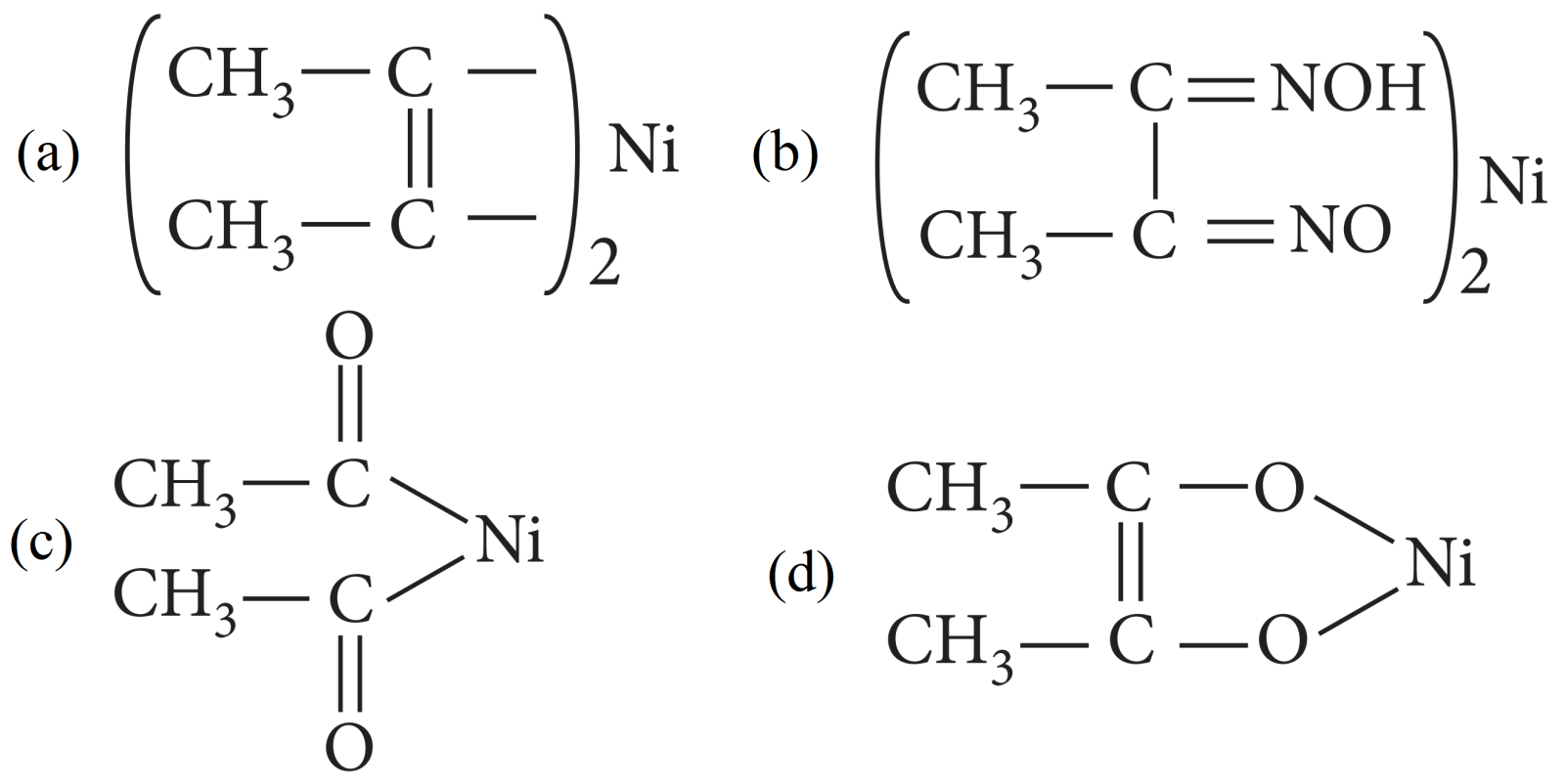
The molecular compounds which are formed from the combination of two or more simple stable compounds and retain their identity in the solid as well as in the dissolved state are called coordination compounds. Their properties are completely different from the constituents. ln coordination compounds, the central metal atom or ion is linked to a number ofions or neutral molecules, called ligands, by coordinate bonds. For example, Dimethylglyoxime (dmg) is a bid en date ligand chelating large amounts of metals. When dimethyl glyoxime is added to alcoholic solution of $NiCl_2$ and ammonium hydroxide is slowly added to it, a rosy red precipitate of a complex is formed.
The following questions are multiple choice questions. Choose the most appropriate answer:
  1. The structure of the complex is:
  1. Oxidation number of Ni in the given complex is:
  1. $+3$
  2. $+1$
  3. $+2$
  4. $Zero$
  1. Hybridisation and structure of the complex is:
  1. $Sp^3$​​​​​​​, tetrahedral.
  2. $dsp^2$​​​​​​​, square planar.
  3. $Sp^3$​​​​​​​, square planar.
  4. $Sp^3d$, trigonal bipyramidal.
  1. Which of the following is true about this complex?
  1. It is paramagnetic, containing $2$ unpaired electrons.
  2. It is paramagnetic, containing $1$ unpaired electron.
  3. It is paramagnetic, containing $4$ unpaired electrons.
  4. It is diamagnetic with no unpaired electron.
  1. Which one will give test for $Fe^{3+}$​​​​​​​ ions in the solution?
  1. $[Fe(CN)_6]^{3-}$
  2. $[Fe(CN)_6]^{2-}$
  3. $(NH_4)_2SO_4·FeSO_4·6H_2O$
  4. $Fe_2(S0_4)_3$​​​​​​​
Read the passage given below and answer the following questions:
Werner, a Swiss chemist in $1892$ prepared and characterised a large number of coordination compounds and studied their physical and chemical behaviour. He proposed that, in coordination compounds, metals possess two types of valencies, viz. primary valencies, which are normally ionisable and secondary valencies which are non-ionisable. ln a series of compounds of cobalt (III) chloride with ammonia, it was found that some of the chloride ions could be precipitated as $AgCl$ on adding excess of $AgNO_3$ solution in cold, but some remained in solution. The number ofions furnished by a complex in a solution can be determined by precipitation reactions. The measurement of molar conductance of solutions of coordination compounds helps to estimate the number of ions furnished by the compound in solution.
In these questions (Q. No. i-iv), a statement of assertion followed by a statement ofreason is given. Choose the correct answer out of the following choices.
  1. Assertion and reason both are correct statements and reason is correct explanation for assertion.
  2. Assertion and reason both are correct statements but reason is not correct explanation for assertion.
  3. Assertion is correct statement but reason is wrong statement.
  4. Assertion is wrong statement but reason is correct statement.
The following questions are multiple choice questions. Choose the most appropriate answer:
  1. Assertion: The complex $[Co(NH_3)_3Cl_3]$ does not give precipitate with silver nitrate solution.
Reason: The given complex is non-ionisable.
  1. Assertion: The complex $[Co(NH_3)_4Cl_2]Cl$ gives precipitate corresponding to 2 mol of AgCl with $AgNO_3$ solution.
Reason: It ionises as $[Co(NH_3)_4Cl_2]^+ + Cl^-.$
  1. Assertion: $CoCl_3. 4NH_3$ gives 1 mol of AgCl on reacting with $AgNO_3$​​​​​​​, its secondary valency is 6.
Reason: Secondary valency corresponds to coordination number.
  1. Assertion: 1 mol of $[CrCl_2(H_2O)_4]Cl· 2H_2O$ will give 1 mol of AgCl on treating with $AgNO_3$​​​​​​​.
Reason: $Cl^-$ ions satisfying secondary valanceis will not be precipitated.
  1. Assertion: $CoCl_3. 3NH_3$ is not conducting while $CoCl_3. 5NH_3$​​​​​​​ is conducting.
Reason: The complex of $CoCl_3. 3NH_3$ is $[CoCl_3(NH_3)_3]$ while that of $CoCl_3· 5NH_3$ is $[CoCl(NH_3)_5]Cl_3$.
Read the passage given below and answer the following questions:In contrast to the disorders of gases and liquids, there is translational order in crystals. However, disordered or amorphous solids also exist which lack such order, they are really highly viscous liquids. In translational order entire structure or lattice, can be generated by repeated replication of a small regular figure, termed as unit cell. The planes of any crystalline structure can be specified using Miller indices, which is also serve to identify single crystal faces.The ordered structure, or lattice, of a solid can be determined by X-ray or neutron diffraction studies, in which a beam of X-rays of neutrons is scattered from the sample to produce a diffraction pattern which can be analyzed to reveal the crystal structure of the sample. All crystal lattices can be classified into 14 Bravais lattices belonging to 7 systems. For example, the simple cubic, face-centred cubic and body-centred cubic lattices are the 3 lattices of the cubic system. Cubic and hexagonal close-packed structures have the structure of tightly packed spheres, where each sphere touches 12 neighbours, 6 in the same plane and 3 above and 3 below. These two dose-packed structures differ in the placement of successive planes or layers. For the hexagonal close packing, a third layer is laid down to reproduce the first layer, so that the structure could be represented by ABABAB …. For cubic close packing, third layer is again displaced, corresponding to ABCABC.
The following questions are multiple choice questions. Choose the most appropriate answer:
  1. In hexagonal close packing, a sphere has coordination number of.
  1. 4
  2. 6
  3. 8
  4. 12
  1. Which of the following arrangements correctly represents hexagonal and cubic close packed structure respectively?
  1. ABCABC...and ABAB...
  2. ABAB...and ABCABC...
  3. Both have ABAB ... arrangement.
  4. Both have ABCABC... Arrangement.
  1. The arrangement of the first two layers, one above the other, in hep and ccp arrangements is.
  1. Exactly same in both cases
  2. Partly same and partly different
  3. Different from each other
  4. Nothing definite.
  1. Which of the following statements is not correct?
  1. The amorphous solids have a random, disordered arrangement of constituents.
  2. The simple cubic, face-centred and body-centred are the three lattices of the cubic system.
  3. The number of Bravais lattice in which a crystal can be categorized is 7.
  4. A metal that crystallizes in hep structure has coordination number 12.
  1. Which of the following statements about amorphous solids is incorrect?
  1. They melt over a range of temperature.
  2. There is no orderly arrangement of particles.
  3. They are anisotropic.
  4. They are rigid and incompressible.
Read the passage given below and answer the following questions:
When a protein in its native form, is subjected to physical changes like change in temperature or chemical changes like change in pH, the hydrogen bonds are disturbed. Due to this, globules unfold and helix get uncoiled and protein loses its biological activity. This is called denaturation of protein.
The denaturation causes change in secondary and tertiary structures but primary structures remains intact. Examples of denaturation of protein are coagulation of egg white on boiling, curdling of milk, formation of cheese when an acid is added to milk.
The following questions are multiple choice questions. Choose the most appropriate answer:
  1. Mark the wrong statement about denaturation of proteins.
  1. The primary structure of the protein does not change.
  2. Globular proteins are converted into fibrous proteins.
  3. Fibrous proteins are converted into globular proteins.
  4. The biological activity of the protein is destroyed.
  1. Which structure(s) of proteins remains(s) intact during denaturation process?
  1. Both secondary and tertiary structures.
  2. Primary structure only.
  3. Secondary structure only.
  4. Tertiary structure only.
  1. $\alpha$-helix and $\beta$-pleated structures of proteins are classified as:
  1. Primary structure.
  2. Secondary structure.
  3. Tertiary structure.
  4. Quaternary structure.
  1. Cheese is a:
  1. Globular protein.
  2. Conjugated protein.
  3. Denatured protein.
  4. Derived protein.
  1. Secondary structure of protein refers to:
  1. Mainly denatured proteins and structure of prosthetic groups.
  2. Three-dimensional structure, especially the bond between amino acid residues that are distant from each other in the polypeptide chain.
  3. Linear sequence of amino acid residues in the polypeptide chain.
  4. Regular folding patterns of continuous portions of the polypeptide chain.

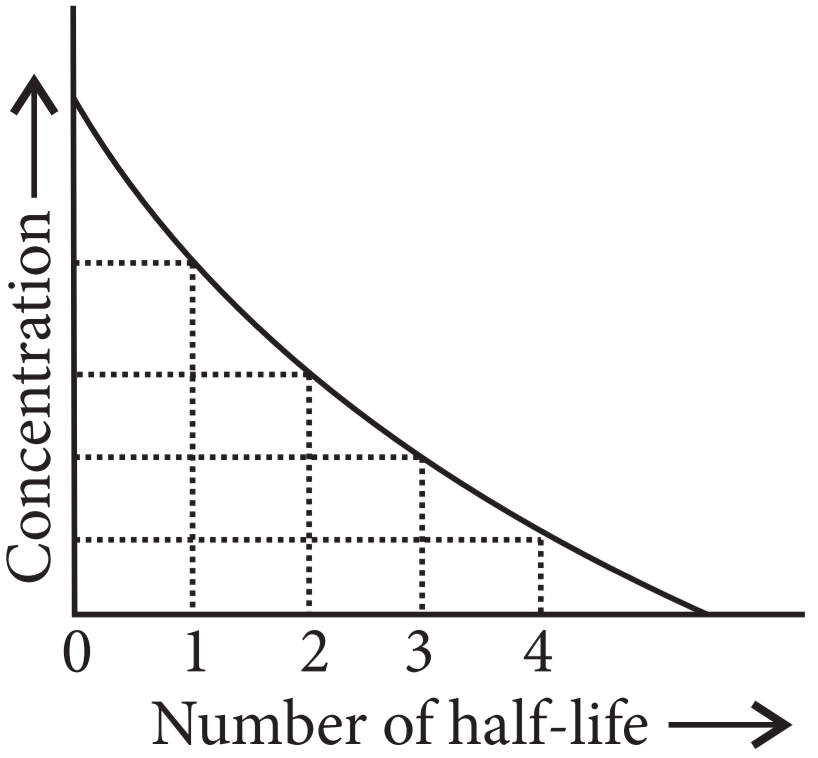
The half-life of a reaction is the time required for the concentration of reactant to decrease by half, i.e.,

$[\text{A}]_\text{t}=\frac{1}{2}[\text{A}]$
For first order reaction,
$\text{t}_\frac{1}{2}=\frac{0.693}{\text{k}}$
this means $\text{t}\frac{1}{2}$ is independent of initial concentration. Figure shows that typical variation of concentration of reactant exhibiting first order kinetics. It may be noted that though the major portion of the first order kinetics may be over in a finite time, but the reaction will never cease as the concentration of reactant will be zero only at infinite time.
The following questions are multiple choice questions. Choose the most appropriate answer:
  1. A first order reaction has a rate constant $k = 3.01 \times 10^{-3} /s.$ How long it will take to decompose half of the reactant?
  1. 2.303s
  2. 23.03s
  3. 230.3s
  4. 2303s
  1. The rate constant for a first order reaction is $7.0 \times 10^{-4} s^{-1}$. If initial concentration ofreactant is 0.080 M, what is the half life of reaction?
  1. 990s
  2. 79.2s
  3. 12375s
  4. $10.10 \times 10^{-4}s$
  1. For the half-life period of a first order reaction, which one of the following statements is generally false?
  1. It is independent of initial concentration.
  2. It is independent of temperature.
  3. It decreases with the introduction of a catalyst.
  4. None of these.
  1. The rate of a first order reaction is 0.04 mol $L^{-1} s^{-1}​​​​​​​$​​​​​​​ at 10 minutes and 0.03 mol $L^{-1} s^{-1}​​​​​​​$ at 20 minutes after initiation. The half-life of the reaction is:
  1. 4.408 min
  2. 44.086 min
  3. 24.086 min
  4. 2.408 min
  1. The plot of $\text{t}_\frac{1}{2}$ vs initial concentration $[A]_0​​​​​​​$​​​​​​​ for a first order reaction is given by:
Read the passage given below and answer the following questions:
Valence bond theory considers the bonding between the metal ion and the ligands as purely covalent. On the other hand, crystal field theory considers the metal-ligand bond to be ionic arising from electrostatic interaction between the metal ion and the ligands. In coordination compounds, the interaction between the ligand and the metal ion causes the five d-orbitals to split-up. This is called crystal field splitting and the energy difference between the two sets of energy level is called crystal field splitting energy. The crystal field splitting energy $(\Delta_0)$ depends upon the nature of the ligand. The actual configuration of complexes is divided by the relative values of $\Delta_0$ and P (pairing energy).
If $\Delta_0<\text{P},$ then complex will be high spin.
If $\Delta_0>\text{P},$ then complex will be low spin
The following questions are multiple choice questions. Choose the most appropriate answer:
  1. Which of the following ligand has lowest $\Delta_0$ value?
  1. $CN^-$
  2. $CO$
  3. $F^-$
  4. $NH_3$
  1. The crystal field splitting energy for octahedral $(\Delta_0)$ and tetrahedral $(\Delta_t)$ complex is related as:
  1. $\Delta_\text{t}=\frac{1}{2}\Delta_0$
  2. $\Delta_\text{t}=\frac{4}{9}\Delta_0$
  3. $\Delta_\text{t}=\frac{3}{5}\Delta_0$
  4. $\Delta_\text{t}=\frac{2}{5}\Delta_0$
  1. On the basis of crystal field theory, the electronic configuration of $d_4$ in two situations : (i) t.0 > P and (ii) t.0
  (i) (ii)
(a) $\text{t}^4_{2\text{g}}\text{e}^0_\text{g}$ $\text{t}^3_{2\text{g}}\text{e}^1_\text{g}$
(b) $\text{t}^3_{2\text{g}}\text{e}^1_\text{g}$ $\text{t}^4_{2\text{g}}\text{e}^0_\text{g}$
(c) $\text{t}^3_{2\text{g}}\text{e}^1_\text{g}$ $\text{t}^3_{2\text{g}}\text{e}^1_\text{g}$
(d) $\text{t}^4_{2\text{g}}\text{e}^0_\text{g}$ $\text{t}^4_{2\text{g}}\text{e}^0_\text{g}$
  1. Using crystal field theory, calculate magnetic moment of central metal ion of $[FeF_6]^{4-}$.
  1. 1.79B.M.
  2. 2.83B.M.
  3. 3.85B.M.
  4. 4.9B.M.
  1. Electronic configuration of d-orbitals in $[Ti(H_2O)_6]^{3+}$​​​​​​​ ion in an octahedral crystal field is:
  1. $\text{t}^1_{2\text{g}}\text{e}^0_\text{g}$
  2. $\text{t}^2_{2\text{g}}\text{e}^0_\text{g}$
  3. $\text{t}^0_{2\text{g}}\text{e}^1_\text{g}$
  4. $\text{t}^1_{2\text{g}}\text{e}^1_\text{g}$
In these questions, a statement of assertion followed by a statement of reason is given. Choose the correct answer out of the following choices.
Assertion: Soap and detergent are macromolecular colloids.
Reason: Macromolecular colloids are formed by molecules of large size.
Read the passage given below and answer the following questions:
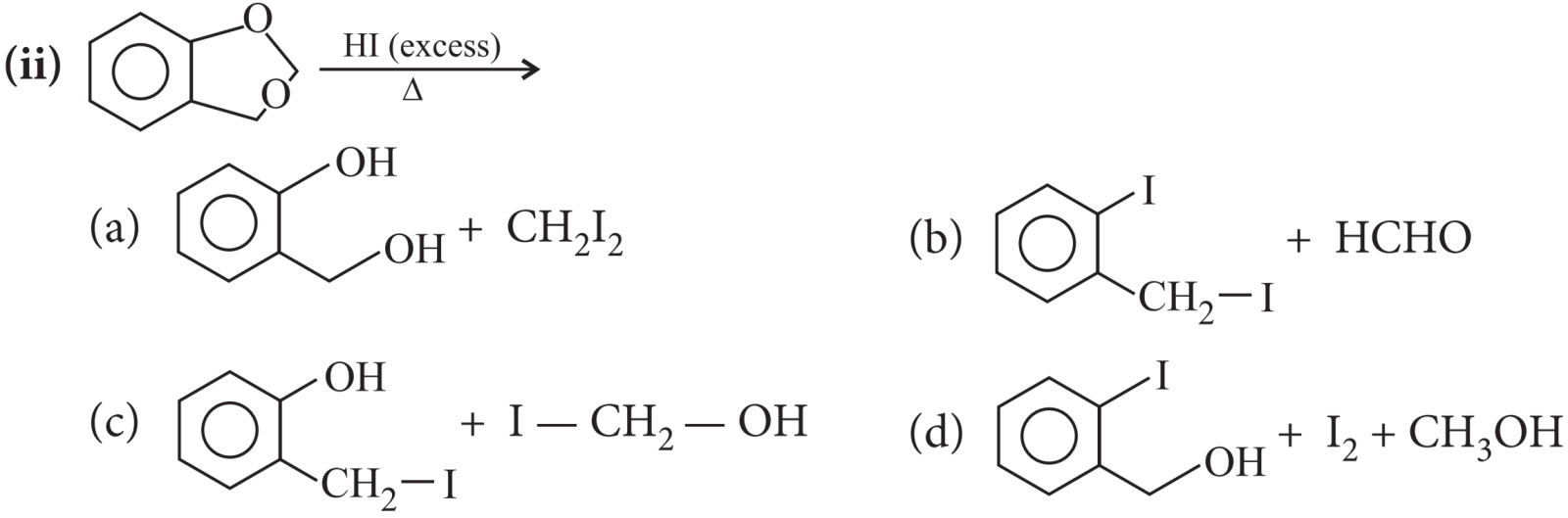
Ethers are readily cleaved by HI or HBr at 373K to form an alcohol and an alkyl halide.
$\text{R}-\text{O}-\text{R}+\text{HX}\xrightarrow{373\text{K}}\text{R}-\text{X}+\text{R}-\text{OH}$
$\text{R}-\text{OH}+\text{HX}\xrightarrow{373\text{K}}\text{R}-\text{X}+\text{H}_2\text{O}$
Mixed ether, containing primary or secondary alkyl group, when heated with hydrogen halide, the lower alkyl group forms halide and higher will form an alcohol. Tertiary alkyl ether when heated with hydrogen halide gives tertiary alkyl halide.
The following questions are multiple choice questions. Choose the most appropriate answer:
  1. Among the following ethers, which one will produce methyl alcohol on treatment with hot concentrated HI?
  1. $\ \ \ \ \ \ \ \ \ \ \ \ \text{CH}_3\\\ \ \ \ \ \ \ \ \ \ \ \ \ \ |\\\text{CH}_3-\text{C}-\text{O}- \text{CH}_3\\\ \ \ \ \ \ \ \ \ \ \ \ \ \ |\\\ \ \ \ \ \ \ \ \ \ \ \ \ \text{CH}_3 $
  2. $\text{CH}_3-\text{CH}-\text{CH}_2-\text{O}-\text{CH}_3\\\ \ \ \ \ \ \ \ \ \ \ \ \ |\\\ \ \ \ \ \ \ \ \ \ \ \text{CH}_3$
  3. $\text{CH}_3-\text{CH}_2-\text{CH}_2-\text{CH}_2-\text{O}-\text{CH}_3$
  4. $\text{CH}_3-\text{CH}_2-\text{CH}-\text{O}-\text{CH}_3\\\ \ \ \ \ \ \ \ \ \ \ \ \ \ \ \ \ \ \ \ \ \ \ \ \ \ |\\\ \ \ \ \ \ \ \ \ \ \ \ \ \ \ \ \ \ \ \ \ \ \ \ \ \text{CH}_3$
  1. When $CH_2 = CH - O - CH_2 - CH_3$ reacts with one mole of HI, one of the products formed is:
  1. Ethane.
  2. Ethanol.
  3. Iodoethene.
  4. Ethanal.
  1. $(CH_3)_3COCH_3$ and $CH_3OC_2H_5$​​​​​​​ are treated with hydroiodic acid. The fragments obtained after reactions are respectively:
  1. $(CH_3)_3CI + CH_3OH; CH_3I + C_2H_5OH$
  2. $(CH_3)_3CI + CH_3OH; CH_3OH + C_2H_5I$
  3. $(CH_3)_3COH + CH_3I; CH_3OH + C_2H_5I$
  4. $CH_3I + (CH_3)_3COH; CH_3I + C_2H_5OH$
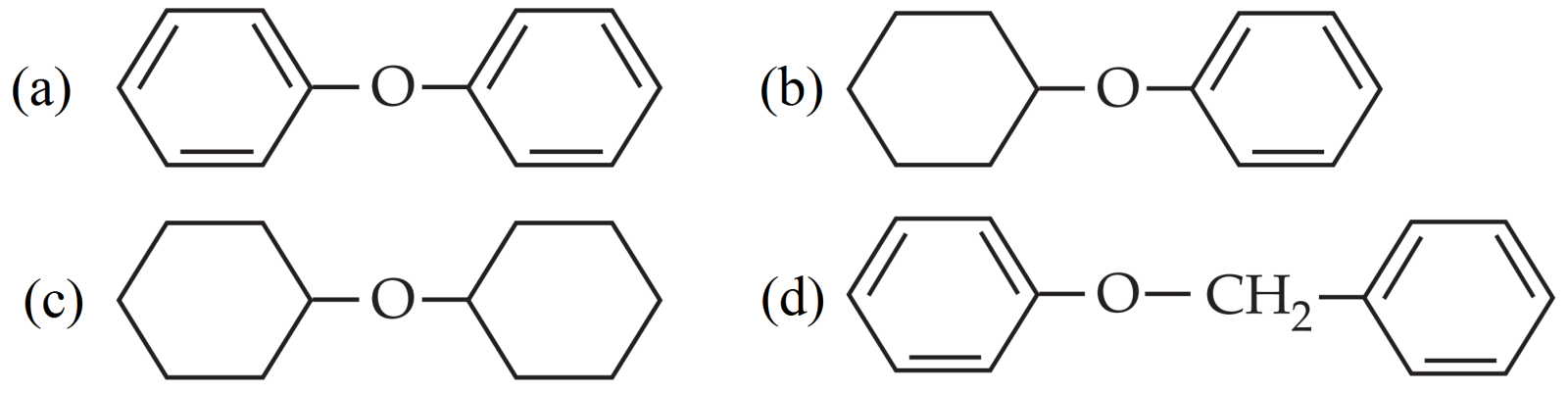
  1. Which of the following ether is unlikely to be cleaved by hot cone. HBr?
Read the passage given below and answer the following questions: Aniline activates the benzene ring by increasing electron density at ortho- and para-positions. Hence, it is o-, p-directing. -NH2 group strongly activates the ring therefore it is difficult to stop the reaction at monosubstitution stage. Among electrophilic substitution reaction, direct nitration of aniline is not done to get o- and p-nitroaniline because lone pair of electrons present at nitrogen atom will accept proton from nitrating mixture to give anilinium ion which is meta-directing. Aniline with $NaNO_2$ and HCI forms benzene diazonium chloride at very low temperature. Aromatic amines react with nitrous acid to form a yellow oily liquid known as N-nitrosoamines. A statement of assertion followed by a statement of reason is given. Choose the correct answer out of the following choices.
  1. Assertion and reason both are correct statements and reason is correct explanation for assertion.
  2. Assertion and reason both are correct statements but reason is not correct explanation for assertion.
  3. Assertion is correct statement but reason is wrong statement.
  4. Assertion is wrong statement but reason is correct statement.
  1. Assertion: Nitrating mixture used for carrying out nitration of benzene consists of cone. $HNO_3$ + cone. $H_2SO_4$.
Reason: In presence of $H_2SO_4, HNO_3$ acts as a base and produces $\text{NO}^+_2$ ions.
  1. Assertion: Anilinium chloride is more acidic than ammonium chloride.
Reason: Anilinium ion is not resonance-stabilised.
  1. Assertion: Nitrobenzene can be prepared from benzene by using mixture of cone. $HNO_3$ and cone. $H_2SO_4$.
Reason: In the mixture, $H_2SO_4$ act as a acid.
  1. Assertion: In strongly acidic solution, aniline becomes less reactive towards electrophilic reagents.
Reason: The amino group being completely protonated in strongly acidic solution, the lone pair of electrons on the nitrogen is no longer available for resonance.
  1. Assertion: Nitration of aniline can be done conveniently by protecting $-NH_2$ group through acetylation.
Reason: Acetylation of aniline results in the increase of electron density in the benzene ring.