Question
Read the passage given below and answer the following questions:
The transition elements have incompletely filled d-subshells in their ground state or in any of their oxidation states. The transition elements occupy position in betweens- and p-blocks in groups 3-12 of the Periodic table. Starting from fourth period, transition elements consists of four complete series : Sc to Zn, Y to Cd and La, Hf to Hg and Ac, Rf to Cn. In general, the electronic configuration of outer orbitals of these elements is (n - 1)d1-10 n1-2. The electronic configurations of outer orbitals of Zn, Cd, Hg and Cn are represented by the general formula (n - 1)d10ns2. All the transition elements have typical metallic properties such as high tensile strength, ductility, malleability. Except mercury, which is liquid at room temperature, other transition elements have typical metallic structures. The transition metals and their compounds also exhibit catalytic property and paramagnetic behaviour. Transition metal also forms alloys. An alloy is a blend of metals prepared by mixing the components. Alloys may be homogeneous solid solutions in which the atoms of one metal are distributed randomly among the atoms of the other.
The following questions are multiple choice questions. Choose the most appropriate answer:
  1. Which of the following characteristics of transition metals is associated with higher catalytic activity?
  1. High enthalpy of atomisation.
  2. Variable oxidation states.
  3. Paramagnetic behaviour.
  4. Colour of hydrated ions.
  1. Transition elements form alloys easily because they have.
  1. Same atomic number.
  2. Same electronic configuration.
  3. Nearly same atomic size.
  4. Same oxidation states.
  1. The electronic configuration of tantalum (Ta) is:
  1. [Xe]4f05d16s2
  2. [Xe]4f145d26s2
  3. [Xe]4f145d36s2
  4. [Xe]4f145d46s2
  1. Which one of the following outer orbital configurations may exhibit the largest number of oxidation states?
  1. 3d54s1
  2. 3d54s2
  3. 3d24s2
  4. 3d34s2
  1. The correct statement(s) among the following is/ are:
  1. All d and f-block elements are metals.
  2. All d and f-block elements form coloured ions.
  3. All d and f-block elements are paramagnetic.
  1. (I) only
  2. (I) and (II) only
  3. (II) and (III) only
  4. (I), (II) and (III)

Answer

  1. (b) Variable oxidation states.

Explanation:

The transition metals and their compounds are known for their catalytic activity. This activity is ascribed to their ability to adopt multiple oxidation states to form complexes.

  1. (c) Nearly same atomic size.

Explanation:

Because of similar radii and other characteristics of transition metals, alloys are readily formed by these metals.

  1. (c) [Xe]4f145d36s2
  2. (b) 3d54s2

Explanation:

Greater the number of valence electrons, more will be the number of oxidation states exhibited by the element.

  1. (a) (i) only

Explanation:

All the d-block elements are metals, they exhibit most properties of metals like lustre, malleability, ductility, high density, high melting and boiling point, hardness, conduction of heat and electricity, etc. All the f-block elements are also metals but they are not good conductors of heat and electricity.

Need a full question paper?

Generate a complete, print-ready paper with questions like this in minutes — across 16+ boards, with answer keys.

Start Generating Free

Similar questions

Read the passage given below and answer the following questions:

The phenomenon of the flow of solvent through a semipermeable membrane from pure solvent to the solution is called osmosis.

Sometimes a pressure is applied to stop the process of osmosis, this is known as osmotic pressure. It is denoted by $\pi.$ Osmotic pressure is expressed as : $\pi=\text{CRT}$

Since, osmotic pressure depends upon the molar concentration of solution, therefore it is a colligative property.

A statement of assertion followed by a statement of reason is given. Choose the correct answer out of the following choices.

  1. Assertion and reason both are correct statements and reason is correct explanation for assertion.
  2. Assertion and reason both are correct statements but reason is not correct explanation for assertion.
  3. Assertion is correct statement but reason is wrong statement.
  4. Assertion is wrong statement but reason is correct statement.
  1. Assertion: If red blood cells were removed from the body and placed in pure water, pressure inside the cells increases.

Reason: The concentration of salt content in the cells increases.

  1. Assertion: The osmotic pressure of a solution obtained by mixing 100mL of 3.4% solution of urea and 100mL of 1.6% solution of cane sugar at 293K is 7.46 bar.

Reason: The total osmotic pressure will be equal to the sum of partial osmotic pressures.

  1. Assertion: When a solution is separated from the pure solvent by a semipermeable membrane, the solvent molecules pass through it from pure solvent side to the solution side.

Reason: Diffusion of solvent occurs from a region of high concentration to a region of low concentration solution.

  1. Assertion: Two solutions having same osmotic pressure at a given temperature are called isotonic solutions.

Reason: Osmotic pressure is not a colligative property.

  1. Assertion: The preservation of meat by salting and fruits by adding sugar protects against bacterial action.

Reason: A bacterium on salted meat or candid fruit loses water due to osmosis shrivels and ultimately dies.

Nemst equation relates the reduction potential of an electrochemical reaction to the standard potential and activities of the chemical species undergoing oxidation and reduction.

Let us consider the reaction, $\text{M}^{\text{n+}}_{(\text{aq})}\xrightarrow{\ \ \ \ \ \ \ \ }\text{nM}_\text{(s)}$

For this reaction, the electrode potential measured with respect to standard hydrogen electrode can be given as

$\text{E}_{\Big(\frac{\text{M}^{\text{n+}}}{\text{M}}\Big)}=\text{E}^\circ_{\Big(\frac{\text{M}^\text{n+}}{\text{M}}\Big)}-\frac{\text{RT}}{\text{nF}}\text{ln}\frac{[\text{M}]}{[\text{M}^{\text{n}+}]}$

In these questions (Q. No. i-iv), a statement of assertion followed by a statement ofreason is given. Choose the correct answer out of the following choices.

  1. Assertion and reason both are correct statements and reason is correct explanation for assertion.
  2. Assertion and reason both are correct statements but reason is not correct explanation for assertion.
  3. Assertion is correct statement but reason is wrong statement.
  4. Assertion is wrong statement but reason is correct statement.
  1. Assertion: For concentration cell, $\text{Zn}_{(\text{s})}|\text{ Zn}^{2+}_{\text{(aq)}}||\text{ Zn}^{2+}_{(\text{aq})}|\text{ Zn}\\\ \ \ \ \ \ \ \ \ \ \ \ \text{C}_1\ \ \ \ \ \ \ \ \text{C}_2$

For spontaneous cell reaction, C1 < C2

Reason: For concentration cell, $\text{E}_\text{cell}=\frac{\text{RT}}{\text{nF}}\log\frac{\text{C}_2}{\text{C}_1}$

For spontaneous reaction, $\text{E}_\text{cell}=+\text{ve}\Rightarrow\text{C}_2>\text{C}_1$

  1. Assertion: For the cell reaction, $\text{Zn}_{(\text{s})}+\text{Cu}^{2+}_{(\text{aq})}\xrightarrow{\ \ \ \ \ }\text{Zn}^{2+}_{(\text{aq})}+\text{Cu}_{(\text{s})}$ voltmeter gives zero reading at equilibrium.

Reason: At the equilibrium, there is no change in concentration of Cu2+ and Zn2+ ions.

  1. Assertion: The Nernst equation gives the concentration dependence of emf of the cell.

Reason: In a cell, current flows from cathode to anode.

  1. Assertion: Increase in the concentration of copper half cell in a cell, increases the emfofthe cell.

Reason: $\text{E}_\text{cell}=\text{E}^\circ_\text{cell}+\frac{0.059}{2}\log\frac{[\text{Cu}^{2+}]}{[\text{Zn}^{2+}]}$

  1. Assertion: Electrode potential for the electrode $\frac{\text{Mn}^+}{\text{Mn}}$ with concentration is given by the expression under STP conditions.

$\text{E}=\text{E}^\circ+\frac{0.059}{\text{n}}\log[\text{Mn}^{+}]$

Reason: STP conditions require the temperature to be 273K.

Read the passage given below and answer the following questions:
The solubility of gases increases with increase of pressure. William Henry made a systematic investigation of the solubility of a gas in a liquid. According to Henry's law "the mass of a gas dissolved per unit volume of the solvent at constant temperature is directly proportional to the pressure of the gas in equilibrium with the solution". Dalton during the same period also concluded independently that the solubility of a gas in a ti quid solution depends upon the partial pressure of the gas. If we use the mole fraction of gas in the solution as a measure of its solubility, then Henry's law can be modified as "the partial pressure of the gas in the vapour phase is directly proportional to the mole fraction of the gas in the solution"
The following questions are multiple choice questions. Choose the most appropriate answer:
  1. Henry's law constant for the solubility of methane in benzene at 298K is 4.27 x 105mm Hg. The solubility of methane in benzene at 298K under 760mm Hg is:
  1. 4.27 × 10⁻⁵
  2. 1.78 × 10⁻³
  3. 4.27 × 10⁻³
  4. 1.78 × 10⁻⁵
  1. The partial pressure of ethane over a saturated solution containing 6.56 × 10-2g of ethane is I bar. If the solution contains 5.00 × 10⁻²g of ethane then what will be the partial pressure (in bar) of the gas?
  1. 0.762
  2. 1.312
  3. 3.81
  4. 5.0
  1. KH (K bar) values for Ar(g), CO2(g), HCHO(g) and CH4(g) are 40.39, 1.67, 1.83 × 10-5 and 0.413 respectively. Arrange these gases in the order of their increasing solubility. Arrange these gases in the order of their increasing solubility.
  1. HCHO < CH4 < CO2 < Ar
  2. HCHO < CO2 < CH4 < Ar
  3. Ar < CO2 < CH4 < HCHO
  4. Ar < CH4 < CO2 < HCHO
  1. When a gas is bubbled through water at 298K, a very dilute solution of the gas is obtained. Henry's law constant for the gas at 298K is 150 kbar. If the gas exerts a partial pressure of 2 bar, the number of millimoles of the gas dissolved in IL of water is:
  1. 0.55
  2. 0.87
  3. 0.37
  4. 0.66
  1. Which of the following statements is correct?
  1. KH increases with increase of temperature.
  2. KH decreases with increase of temperature.
  3. KH remains constant with increase of temperature.
  4. KH first increases then decreases, with increase of temperature.

Read the passage given below and answer the following questions:

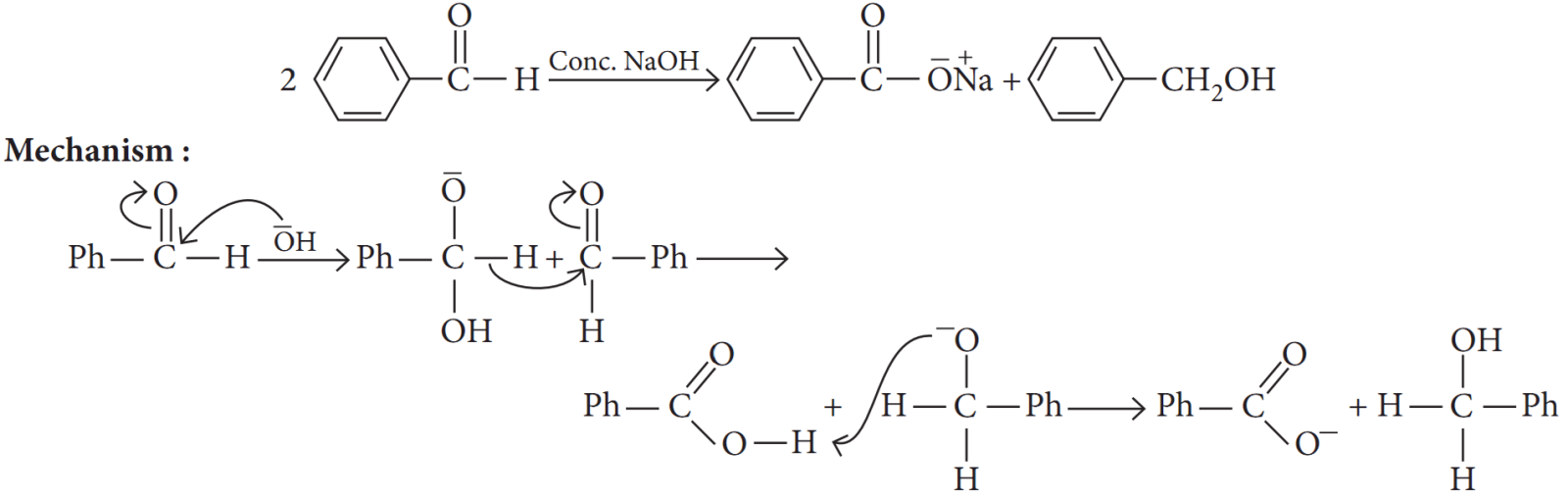
When an aldehyde with no et-hydrogen reacts with concentrated aqueous NaOH, half the aldehyde is converted to carboxylic acid salt and other half is converted to an alcohol. In other words, half of the reactant is oxidized and other half is reduced. This reaction is known as Cannizzaro reaction.

The following questions are multiple choice questions. Choose the most appropriate answer:

  1. A mixture of benzaldehyde and formaldehyde on heating with aqueous NaOH solution gives:
  1. Benzyl alcohol and sodium formate.
  2. Sodium benzoate and methyl alcohol.
  3. Sodium benzoate and sodium formate.
  4. Benzyl alcohol and methyl alcohol.
  1. Which of the following compounds will undergo Cannizzaro reaction?
  1. CH3CHO
  2. CH3COCH3
  3. C6H5CHO
  4. C6H5CH2CHO
  1. Trichloroacetaldehyde is subjected to Cannizzaro's reaction by using NaOH. The mixture of the products contains sodium trichloroacetate ion and another compound. The other compounds is:
  1. 2, 2, 2-trichloroethanol.
  2. Trichloromethanol.
  3. 2, 2, 2-trichloropropanol.
  4. Chloroform.
  1. In Cannizzaro reaction given below:

$2\text{PhCHO}\xrightarrow{\stackrel{-}{\hbox{ OH}}}\text{PhCH}_2+\text{OH}+\text{PhCO}_2^-$ the slowest step is:

  1. The attack -OH at the carboxyl group.
  2. The transfer of hydride to the carbonyl group.
  3. The abstraction of proton from the carboxylic group.
  4. The deprotonation of PhCH2OH.
  1. Which of the following reaction will not result in the formation of carbon-carbon bonds?
  1. Cannizzaro reaction.
  2. Wurtz reaction.
  3. Reimer-Tiemann reaction.
  4. Friedel-Crafts' acylation.
Read the passage given below and answer the following questions:
Nucleophilic substitution reactions are of two types; substitution nucleophilic bimolecular (SN2) and substitution nucleophilic unimolecular (SN1) depending on molecules taking part in determining the rate of reaction. Reactivity of alkyl halide towards SN1 and SN2 reactions depends on various factors such as steric hindrance, stability of intermediate or transition state, and polarity of solvent. SN2 reaction mechanism is favoured mostly by primary alkyl halide then secondary and then tertiary. This order is reversed in case of SN1 reactions.
The following questions are multiple choice questions. Choose the most appropriate answer:
  1. Which of the following is most reactive towards nucleophilic substitution reaction?
  1. C6H5Cl
  2. CH2 = CHCl
  3. ClCH2CH = CH2
  4. CH3CH = CHCl
  1. Isopropyl chloride undergoes hydrolysis by:
  1. SN1 mechanism.
  2. SN2 mechanism.
  3. SN1 and SN2 mechanism.
  4. Neither SN1 nor SN2 mechanism.
  1. The most reactive nucleophile among the following is:
  1. CH3O-
  2. C6H5O-
  3. (CH3)2CHO-
  4. (CH3)3CO-
  1. Tertiary alkyl halides are practically inert to substitution by SN2 mechanism because of:
  1. Insolubility.
  2. Instability.
  3. Inductive effect.
  4. Stearic hindrance.
  1. Which of the following is the correct order of decreasing SN2 reactivity?
  1. RCH2X > R2CHX > R3CX
  2. R3CX > R2CHX > RCH2X
  3. R2CHX > R3CX > RCH2X
  4. RCH2X > R3CX > R2CHX
Write detailed note on: Starch
Read the passage given below and answer the following questions:

According to Raoult's law, the partial pressure of two components of the solution maybe given as:

$\text{P}_\text{A}=\stackrel{{0}}{\hbox{PA }}\text{x}_\text{A}$ and $\text{P}_\text{B}=\stackrel{{0}}{\hbox{PB }}\text{x}_\text{B}$

For an ideal solution (obeys Raoult's law always)

$\Delta\text{H}_\text{mix}=0,\Delta\text{mix}=0$

All solutions do not obey Raoults law over entire range of concentration. These are known as non-ideal solutions.

For non-ideal solutions, $\text{P}_\text{A}\not=\stackrel{{0}}{\hbox{PA }}\text{x}_\text{A}$ or $\text{P}_\text{B}\not=\stackrel{{0}}{\hbox{PB }}\text{x}_\text{B}$

Positive deviation $\Rightarrow\text{P}_\text{A}>\stackrel{{0}}{\hbox{PA }}\text{x}_\text{A}$ and $\text{P}_\text{B}>\stackrel{{0}}{\hbox{PB }}\text{x}_\text{B}$

Negative deviation $\text{P}_\text{A}<\stackrel{{0}}{\hbox{PA }}\text{x}_\text{A}$ and $\text{P}_\text{B}\stackrel{{0}}{\hbox{PB }}\text{x}_\text{B}$

A statement of assertion followed by a statement ofreason is given. Choose the correct answer out of the following choices.

  1. Assertion and reason both are correct statements and reason is correct explanation for assertion.
  2. Assertion and reason both are correct statements but reason is not correct explanation for assertion.
  3. Assertion is correct statement but reason is wrong statement.
  4. Assertion is wrong statement but reason is correct statement.
  1. Assertion: An ideal solution obeys Raoult's law.

Reason: In an ideal solution, solute-solute as well as solvent-solvent interactions are similar to solute-solvent interactions.

  1. Assertion: Acetone and aniline show negative deviations.

Reason: H-bonding between acetone and aniline is stronger than that between acetone-acetone and aniline-aniline.

  1. Assertion: Azeotropic mixtures are formed only by non-ideal solutions and they may have boiling points either greater than both the components or lesser than both the components.

Reason: The composition of the vapour phase is same as that of the liquid phase of an azeotropic mixture.

  1. Assertion: The solutions which show negative deviations from Raoult's law are called maximum boiling azeotropes.

Reason: 68% nitric acid and 32% water by mass fonn maximum boiling azeotrope.

  1. Assertion: $\Delta\text{H}_{\text{mix}}$ mix and $\Delta\text{V}_{\text{mix}}$ are positive for an ideal solution.

Reason: The interactions between the particles of the components of an ideal solution are almost identical as between particles in the liquids.

Describe detailed information on classification of carbohydrates.
Read the passage given below and answer the following questions:

Carbohydrates are polyhydroxy aldehydes and ketones and those compounds which on hydrolysis give such compounds are also carbohydrates. The carbohydrates which are not hydrolysed are called monosaccharides. Monosaccharides with aldehydic group are called aldose and those which free ketonic groups are called ketose. Carbohydrates are optically active. Number of optical isomers = 2n

Where n = numberofasymmetric carbons. Carbohydrates are mainlysynthesised by plants during photosynthesis. The monosaccharides give the characteristic reactions of alcohols and carbonyl group (aldehydes and ketones). It has been found that these monosaccharides exist in the form of cyclic structures. In cyctization, the -OH groups (generally C5 or C4 in aldohexoses and C5 or C6 in ketohexoses) combine with the aldehyde or keto group. As a result, cyclic structures of five or six membered rings containing one oxygen atom are formed, e.g., glucose forms a ring structure. Glucose contains one aldehyde group, one IO alcoholic group and four 2° alcoholic groups in its open chain structure.

The following questions are multiple choice questions. Choose the most appropriate answer:

  1. First member of ketos sugar is:
  1. Ketotriose.
  2. Ketotetrose.
  3. Ketopentose.
  4. Ketohexose.
  1. In CH2OHCHOHCHOHCHOHCHOHCHO, the number of optical isomers will be:
  1. 16
  2. 8
  3. 32
  4. 4
  1. Some statements are given below:
  1. Glucose is aldohexose.
  2. Naturally occurring glucose is dextrorotatory.
  3. Glucose contains three chiral centres.
  4. Glucose contains one 1° alcoholic group and four 2° alcoholic groups.

Among the above, correct statements are:

  1. 1 and 2 only
  2. 3 and 4 only
  3. 1, 2 and 4 only
  4. 1, 2, 3 and 4
  1. Two hexoses fonn the same osazone, find the correct statement about these hexoses.
  1. Both of them must be aldoses.
  2. They are epimers at C-3.
  3. The carbon atoms I and 2 in both have the same configuration.
  4. The carbon atoms 3, 4 and 5 in both have the same configuration.
  1. Which of the following reactions of glucose can be explained only by its cyclic structure?
  1. Glucose forms cyanohydrin with HCN.
  2. Glucose reacts with hydroxylamine to form an oxime.
  3. Pentaacetate of glucose does not react with hydroxylamine.
  4. Glucose is oxidised by nitric acid to gluconic acid.
Read the passage given below and answer the following questions:
Valence bond theory considers the bonding between the metal ion and the ligands as purely covalent. On the other hand, crystal field theory considers the metal-ligand bond to be ionic arising from electrostatic interaction between the metal ion and the ligands. In coordination compounds, the interaction between the ligand and the metal ion causes the five d-orbitals to split-up. This is called crystal field splitting and the energy difference between the two sets of energy level is called crystal field splitting energy. The crystal field splitting energy $(\Delta_0)$ depends upon the nature of the ligand. The actual configuration of complexes is divided by the relative values of $\Delta_0$ and P (pairing energy).
If $\Delta_0<\text{P},$ then complex will be high spin.
If $\Delta_0>\text{P},$ then complex will be low spin
The following questions are multiple choice questions. Choose the most appropriate answer:
  1. Which of the following ligand has lowest $\Delta_0$ value?
  1. CN-
  2. CO
  3. F-
  4. NH3
  1. The crystal field splitting energy for octahedral $(\Delta_0)$ and tetrahedral $(\Delta_t)$ complex is related as:
  1. $\Delta_\text{t}=\frac{1}{2}\Delta_0$
  2. $\Delta_\text{t}=\frac{4}{9}\Delta_0$
  3. $\Delta_\text{t}=\frac{3}{5}\Delta_0$
  4. $\Delta_\text{t}=\frac{2}{5}\Delta_0$
  1. On the basis of crystal field theory, the electronic configuration of d4 in two situations : (i) t.0 > P and (ii) t.0
  (i) (ii)
(a) $\text{t}^4_{2\text{g}}\text{e}^0_\text{g}$ $\text{t}^3_{2\text{g}}\text{e}^1_\text{g}$
(b) $\text{t}^3_{2\text{g}}\text{e}^1_\text{g}$ $\text{t}^4_{2\text{g}}\text{e}^0_\text{g}$
(c) $\text{t}^3_{2\text{g}}\text{e}^1_\text{g}$ $\text{t}^3_{2\text{g}}\text{e}^1_\text{g}$
(d) $\text{t}^4_{2\text{g}}\text{e}^0_\text{g}$ $\text{t}^4_{2\text{g}}\text{e}^0_\text{g}$
  1. Using crystal field theory, calculate magnetic moment of central metal ion of [FeF6]4-.
  1. 1.79B.M.
  2. 2.83B.M.
  3. 3.85B.M.
  4. 4.9B.M.
  1. Electronic configuration of d-orbitals in [Ti(H2O)6]3+ ion in an octahedral crystal field is:
  1. $\text{t}^1_{2\text{g}}\text{e}^0_\text{g}$
  2. $\text{t}^2_{2\text{g}}\text{e}^0_\text{g}$
  3. $\text{t}^0_{2\text{g}}\text{e}^1_\text{g}$
  4. $\text{t}^1_{2\text{g}}\text{e}^1_\text{g}$