Question
Read the passage given below and answer the following questions:

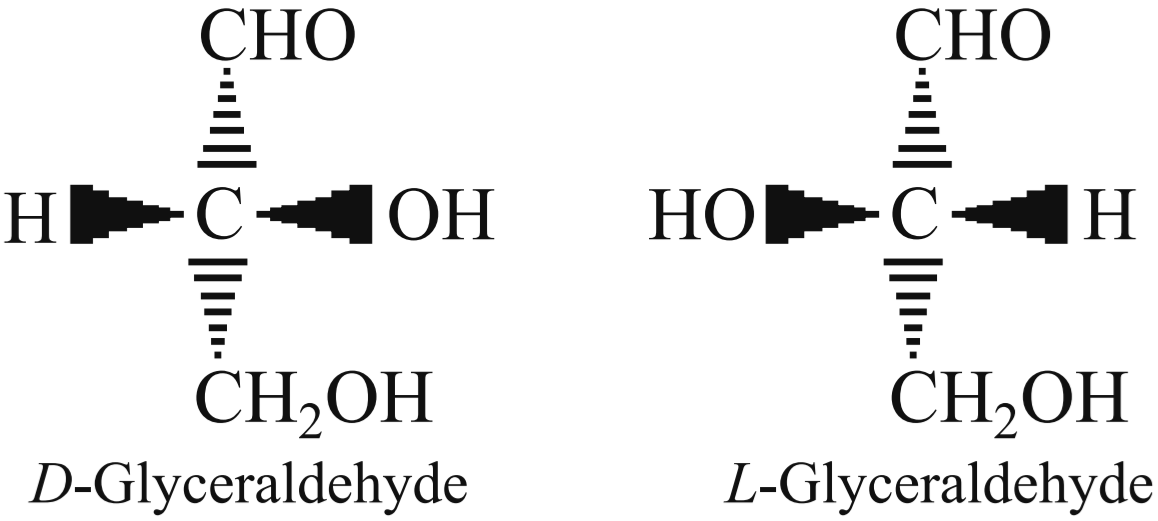
Carbohydrates are polyhydroxy aldehydes and ketones and those compounds which on hydrolysis give such compounds are also carbohydrates. The carbohydrates which are not hydrolysed are called monosaccharides. Monosaccharides with aldehydic group are called aldose and those which free ketonic groups are called ketose. Carbohydrates are optically active. Number of optical isomers = 2n

Where n = numberofasymmetric carbons. Carbohydrates are mainlysynthesised by plants during photosynthesis. The monosaccharides give the characteristic reactions of alcohols and carbonyl group (aldehydes and ketones). It has been found that these monosaccharides exist in the form of cyclic structures. In cyctization, the -OH groups (generally C5 or C4 in aldohexoses and C5 or C6 in ketohexoses) combine with the aldehyde or keto group. As a result, cyclic structures of five or six membered rings containing one oxygen atom are formed, e.g., glucose forms a ring structure. Glucose contains one aldehyde group, one IO alcoholic group and four 2° alcoholic groups in its open chain structure.

The following questions are multiple choice questions. Choose the most appropriate answer:

  1. First member of ketos sugar is:
  1. Ketotriose.
  2. Ketotetrose.
  3. Ketopentose.
  4. Ketohexose.
  1. In CH2OHCHOHCHOHCHOHCHOHCHO, the number of optical isomers will be:
  1. 16
  2. 8
  3. 32
  4. 4
  1. Some statements are given below:
  1. Glucose is aldohexose.
  2. Naturally occurring glucose is dextrorotatory.
  3. Glucose contains three chiral centres.
  4. Glucose contains one 1° alcoholic group and four 2° alcoholic groups.

Among the above, correct statements are:

  1. 1 and 2 only
  2. 3 and 4 only
  3. 1, 2 and 4 only
  4. 1, 2, 3 and 4
  1. Two hexoses fonn the same osazone, find the correct statement about these hexoses.
  1. Both of them must be aldoses.
  2. They are epimers at C-3.
  3. The carbon atoms I and 2 in both have the same configuration.
  4. The carbon atoms 3, 4 and 5 in both have the same configuration.
  1. Which of the following reactions of glucose can be explained only by its cyclic structure?
  1. Glucose forms cyanohydrin with HCN.
  2. Glucose reacts with hydroxylamine to form an oxime.
  3. Pentaacetate of glucose does not react with hydroxylamine.
  4. Glucose is oxidised by nitric acid to gluconic acid.
Answer

  1. (a) Ketotriose.
  1. (a) 16
  1. (c) 1, 2 and 4 only

Explanation:

Glucose contains four chiral centres.

  1. (d) The carbon atoms 3, 4 and 5 in both have the same configuration.

Explanation:

In the formation of osazone, C-1 and C-2 react with phenylhydrazine to form phenylhydrazone. If C-3, C-4, C-5 have same configuration they will form same osazone even if they differ in configuration at C-1 or C-2.

  1.  (c) Pentaacetate of glucose does not react with hydroxylamine.

Explanation:

Pentacetate of glucose does not react with hydroxylamine showing absence of free -CHO group. This cannot be explained by open structure of glucose.

Need a full question paper?

Generate a complete, print-ready paper with questions like this in minutes — across 16+ boards, with answer keys.

Start Generating Free

Similar questions

Read the passage given below and answer the following questions:

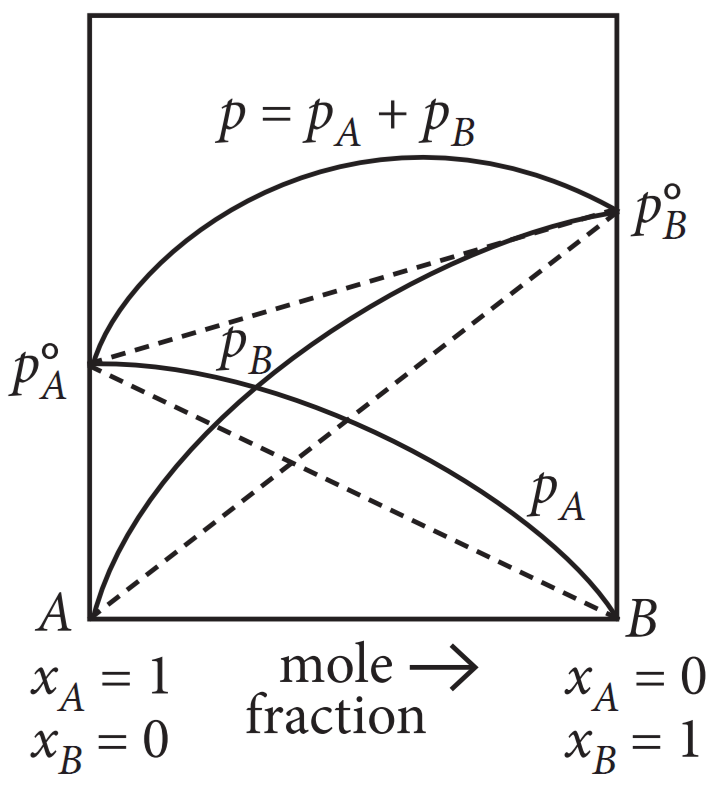
An ideal solution may be defined as the solution which obeys Raoult's law exactly over the entire range of concentration. The solutions for which vapour pressure is either higher or lower than that predicted by Raoult's law are called non-ideal solutions.Non-ideal solutions can show either positive or negative deviations from Raoult's law depending on whether the A-B interactions in solution are stronger or weaker than A - A and B - B interactions.

The following questions are multiple choice questions. Choose the most appropriate answer:

  1. Which of the following solutions is/are ideal solution(s)?
  1. Bromoethane and iodoethane.
  2. Acetone and chloroform
  3. Benzene and acetone
  4. n-heptane and n-hexane
  1. Only I
  2. I and II
  3. II and III
  4. I and Iv
  1. For which of the following solutions $\Delta\text{H}_{\text{mix}}$ and $\Delta\text{V}_{\text{mix}}$ is negative?
  1. Acetone and aniline
  2. Ethyl alcohol and cyclohexane
  3. Acetone and CS2
  4. Benzene and toluene
  1. Which of the following is not true for positive deviations?
  1. The A-B interactions in solution are weaker than the A - A and B - B interactions.
  2. $\text{P}_\text{A}<\text{P}\mathring{\text{A}}\ \text{x}_\text{A}$ and $\text{P}_\text{B}<\text{P}\mathring{\text{B}}\ \text{x}_\text{B}$
  3. Carbon tetrachloride and chloroform mixture is an example of positive deviations.
  4. All of these.
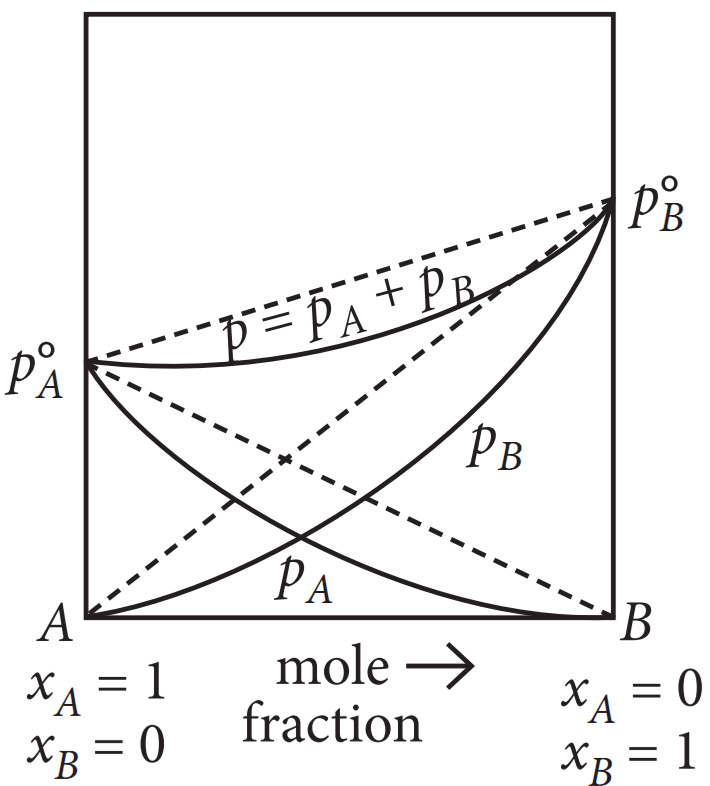
  1. For water and nitric acid mixture, which of the given graph is correct?


  1.  


  1.  

  1. Both of these
  2. None of these
  1. Water-HCI mixture.
  1. Shows positive deviations.
  2. Forms minimum boiling azeotrope.
  3. Shows negative deviations.
  4. Forms maximum boiling azeotrope.
  1. I and II
  2. I and III
  3. I and IV
  4. III and IV
Read the passage given below and answer the following questions:
Iron forms many complexes in its +2 and +3 oxidation states such as [Fe(H2O)6]2+ (A); [Fe(CN)6]4- (B); [Fe(H2O)6]3+ (C); [Fe(CN)6]3- (D), etc., They exhibit, different magnetic properties and undergo different hybridisation of iron.
The following questions are multiple choice questions. Choose the most appropriate answer:
  1. Which of the following statements is correct?
  1. (B) is paramagnetic while (C) is diamagnetic.
  2. Both (B) and (D) are outer orbital complexe.
  3. Both (A) and (C) are paramagnetic.
  4. (A) is outer orbital complex and (C) is inner orbital complex.
  1. The complex having maximum magnetic moment is:
  1. (A)
  2. (B)
  3. (C)
  4. (D)
  1. Which of the following does not represent correct configuration of the d-orbitals in the given complexes?
  1. $\text{(A)}:\text{t}^4_{2\text{g}}\text{e}^2_\text{g}$
  2. $\text{(B)}:\text{t}^6_{2\text{g}}\text{e}^0_\text{g}$
  3. $\text{(C)}:\text{t}^4_{2\text{g}}\text{e}^1_\text{g}$
  4. $\text{(D)}:\text{t}^5_{2\text{g}}\text{e}^0_\text{g}$
  1. The spin only magnetic moment of complexes (A), (B), (C) and (D) are respectively (in BM).
  1. $2\sqrt{6},0,\sqrt{35},\sqrt{3}$
  2. $0,2\sqrt{6},\sqrt{35},\sqrt{3}$
  3. $\sqrt{15,}2\sqrt{6},\sqrt{3},0$
  4. $\sqrt{3},\sqrt{8},0,\sqrt{15}$
  1. Which of the given complexes are outer orbital complexes?
  1. (A) and (B) only
  2. (B) and (C) only
  3. (A) and (C) only
  4. (B) and (D) only
Read the passage given below and answer the following questions:

Carboxylic acids having an $\alpha$-hydrogen atom when treated with chlorine or bromine in the presence of small amount of red phosphorus gives $\alpha$-halocarboxytic acids. The reaction is known as Hell-Volhard-Zelinsky reaction.

$\text{R}-\text{CH}_2-\text{COOH}+\text{X}_2\xrightarrow{\text{red p}}\text{R}-\text{CH}-\text{COOH}\\ \ \ \ \ \ \ \ \ \ \ \ \ \ \ \ \ \ \ \ \ \ \ \ \ \ \ \ \ \ \ \ \ \ \ \ \ \ \ \ \ \ \ \ \ \ \ \ \ \ \ \ \ \ \ \ \ \ \ \ \ \ |\\ \ \ \ \ \ \ \ \ \ \ \ \ \ \ \ \ \ \ \ \ \ \ \ \ \ \ \ \ \ \ \ \ \ \ \ \ \ \ \ \ \ \ \ \ \ \ \ \ \ \ \ \ \ \ \ \ \ \ \ \ \text{X}\\ \ \ \ \ \ \ \ \ \ \ \ \ \ \ \ \ \ \ \ \ \ \ \ \ \ \ \ \ \ \ \ \ \ \ \ \ \ \ \ \ \ \ \ \ \ \ \ \ \ \ \ \ \ \ (\text{X = Cl, Br)}$

When sodium salt of carboxylic acid is heated with soda lime it loses carbon dioxide and gives hydrocarbon with less number of C-atoms.

$\text{R}-\text{COOH}\xrightarrow{\text{NaOH}}\text{R}-\text{COONa}\xrightarrow[\Delta]{\text{NaOH}+\text{CaO}}\text{R}-\text{H}+\text{Na}_2\text{CO}_3\\\text{Carboxylic}\ \ \ \ \ \ \ \ \ \ \ \ \ \ \ \ \ \ \ \ \ \text{Sod.}\ \ \ \ \ \ \ \ \ \ \ \ \ \ \ \ \ \ \ \ \ \ \ \ \ \ \ \ \ \text{Alkane}\\\ \ \ \ \ \text{acid}\ \ \ \ \ \ \ \ \ \ \ \ \ \ \ \ \ \ \ \ \ \ \text{carboxylate}$

In these questions (Q. No. l-iv), a statement of assertion followed by a statement ofreason is given. Choose the correct answer out of the following choices.

  1. Assertion and reason both are correct statements and reason is correct explanation for assertion.
  2. Assertion and reason both are correct statements but reason is not correct explanation for assertion.
  3. Assertion is correct statement but reason is wrong statement.
  4. Assertion is wrong statement but reason is correct statement.
  1. Assertion: (CH3)3CCOOH does not give H.V.Z reaction.

Reason: (CH3)3CCOOH does not have $\alpha$-hydrogen atom.

  1. Assertion: H.V.Z. reaction involves the treatment of carboxylic acids having $\alpha$-hydrogens with Cl2 or Br2 in presence of small amount of red phosphorus.

Reason: Phosphorus reacts with halogens to form phosphorus trihalides.

  1. Assertion: Propionic acid with $\frac{\text{Br}_2}{\text{P}}$ yields CH2Br - CHBr - COOH.

Reason: Propionic acid has two $\alpha$-hydrogen atoms.

  1. Assertion: C6H5COCH2COOH undergoes decarboxylation easily than C6H5COCH2COOH.

Reason: C6H5COCH2COOH is $\beta$-keto acid.

  1. Assertion: On heating 3-methylbutanoic acid with soda lime, isobutane is obtained.

Reason: Soda lime is a mixture of NaOH + CaO in the ratio 3 : 1.

Standard electrode potentials are used for various processes:

  • It is used to measure relative strengths of various oxidants and reductants.
  • It is used to calculate standard cell potential.
  • It is used to predict possible reactions.
A set of half-reactions (in acidic medium) along with their standard reduction potential, Eº (in volt) values are given below:

I2 + 2e- → 2I- ; Eº = 0.54 V

Cl2 + 2e- → 2Cl- ; Eº = 1.36 V

Mn3+ +e- → Mn2+ ; Eº = 1.50 V

Fe3+ + e- → Fe2+ ; Eº = 0.77 V

O2 + 4H+ + 4e- → 2H2O ; Eº = 1.23 V

The following questions are multiple choice questions. Choose the most appropriate answer:

  1. Which of the following statements is correct?
  1. Cl- is oxidised by O2.
  2. Fe2+ is oxidised by iodine.
  3. I- is oxidised by chlorine.
  4. Mn2+ is oxidised by chlorine.
  1. Mn3+ is not stable in acidic medium, while Fe3+ is stable because:
  1. O2 oxidises Mn2+ to Mn3+
  2. O2 oxidises both Mn2+ to Mn3+ and Fe2+ to Fe3+
  3. Fe3+ oxidises H2O to O2
  4. Mn3+ oxidises H2O to O2
  1. The strongest reducing agent in the aqueous solution is:
  1. I-
  2. Cl-
  3. Mn2+
  4. Fe2+
  1. The emf for the following reaction is:

$\text{I}_2+\text{KCl}\rightleftharpoons2\text{KI}+\text{Cl}_2$

  1. -0.82 V
  2. +0.82 V
  3. -0.73 V
  4. +0.73 V
  1. Which of the following statements is correct for the following reaction?

Fe3+ + Mn2+ → Fe2+ + Mn3+

  1. The emf of the cell is positive.
  2. Fe3+ oxidises Mn2+.
  3. The reaction does not occur.
  4. All are correct.
Read the passage given below and answer the following questions:
The properties of the solutions which depend only on the number of solute particles but not on the nature of the solute are called colligative properties. Relative lowering in vapour pressure is also an example of colligative properties. For an experiment, sugar solution is prepared, for which lowering in vapour pressure was found to be 0.061 mm of Hg. (Vapour pressure of water at 20° C is 17.5 mm of Hg)
The following questions are multiple choice questions. Choose the most appropriate answer:
  1. Relative lowering of vapour pressure for the given solution is.
  1. 0.00348
  2. 0.061
  3. 0.122
  4. 1.75
  1. The vapour pressure (mm of Hg) of solution will be.
  1. 17.5
  2. 0.61
  3. 17.439
  4. 0.00348
  1. Mole fraction of sugar in the solution is.
  1. 0.00348
  2. 0.9965
  3. 0.061
  4. 1.75
  1. If weight of sugar taken is 5g in 108g of water, then molar mass of sugar will be.
  1. 358
  2. 120
  3. 240
  4. 400
  1. The vapour pressure (mm of Hg) of water at 293K when 25g of glucose is dissolved in 450g of water is.
  1. 17.2
  2. 17.4
  3. 17.120
  4. 17.02
Read the passage given below and answer the following questions:

Fehling's reagent: Fehling's reagent is a mixture of two solutions. Fehllng's solution A is aqueous copper sulphate solution. Fehling's solution Bis alkaline sodium potassium tartarate (Rochelle salt).

$\ \ \ \ \ \ \ \ \ \ \ \ \ \ \ \ \ \ \ \ \text{CH(OH)COONa}\\\text{CuSo}_{4\text{(aq)}}+|\\\ \ \ \ \ \ \ \ \ \ \ \ \ \ \ \ \ \ \ \ \text{CH(OH)COOK}$

It is a mild oxidising agent. It is weaker than Tollens' reagent. It oxidises only aliphatic aldehydes to carboxylate ions and itself gets reduced to reddish brown precipitate of cuprous oxide. Aromatic aldehydes do not respond to Fehling's test. This reaction is used for the test of aliphatic aldehydes known as Fehling's reagent test.

In these questions (Q. No. l-iv), a statement of assertion followed by a statement ofreason is given. Choose the correct answer out of the following choices.

  1. Assertion and reason both are correct statements and reason is correct explanation for assertion.
  2. Assertion and reason both are correct statements but reason is not correct explanation for assertion.
  3. Assertion is correct statement but reason is wrong statement.
  4. Assertion is wrong statement but reason is correct statement.
  1. Assertion: Fehling's solution can be used to distinguish between acetaldehyde and acetone.

Reason: Fehling's reagent is a mixture of two solutions.

  1. Assertion: Aromatic aldehydes can be distinguished from aliphatic aldehydes by Fehling's solution.

Reason: Aromatic aldehydes reduce Fehling's solution, but aliphatic aldehydes do not.

  1. Assertion: Fehling's solution oxidises acetaldehyde to acetic acid but not benzaldehyde to benzoic acid.

Reason: The C-H bond of -CHO group in benzaldehyde is stronger than in acetaldehyde.

  1. Assertion: CH3CHO and C6H5CH2CHO cannot be distinguished chemically by Fehling's solution.

Reason: CH3CHO and C6H5CH2CHO cannot be distinguished chemically by Fehling's solution.

  1. Assertion: Formaldehyde, when heated with Fehling's reagent produces a reddish brown ppt, of Cu.

Reason: Fehling's reagent oxidises fonnaldehyde to formate ion.

Read the passage given below and answer the following questions:
A chlorocompound (A) on reduction with Zn-Cu and ethanol gives the hydrocarbon (B) with five carbon atoms. When (A) is dissolved in dry ether and treated with sodium metal it gave 2, 2, 5, 5 - tetramethylhexane. The treatment of (A) with alcoholic KCN gives compound ( C).
The following questions are multiple choice questions. Choose the most appropriate answer:
  1. The compound (A) is:
  1. 1-chloro-2, 2-dimethylpropane.
  2. 1-chloro-2, 2-dimethyl butane.
  3. 1-chloro-2-methyl butane.
  4. 2-chloro-2-methyl butane.
  1. The reaction of (C) with Na, C2H5OH gives:
  1. (CH3)3C CH2CONH2
  2. (CH3)3C NH2
  3. (CH3)3C CH2CH2NH2
  4. (CH3)2CHCH2NH2
  1. The reaction of (C) with Na, C2H5OH is called:
  1. Gilman reaction.
  2. Mendius reaction.
  3. Grooves process.
  4. Swart's reaction.
  1. The reaction of (A) with aq. KOH will preferably favour:
  1. SN1 mechanism.
  2. SN2 mechanism.
  3. E1 mechanism.
  4. E2 mechanism.
  1. Compound (B) is:
  1. N-pentane.
  2. 2, 2-dimethylpropane.
  3. 2-methylbutane.
  4. None of these.
Read the passage given below and answer the following questions :
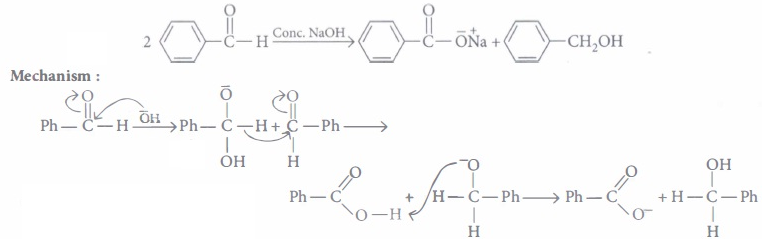
When an aldehyde with no a-hydrogen reacts with concentrated aqueous NaOH, half the aldehyde is converted to carboxylic acid salt and other half is converted to an alcohol. In other words, half of the reactant is oxidized
and other half is reduced. This reaction is known as Cannizzaro reaction

The following questions are multiple choice questions. Choose the most appropriate answer:
  1. A mixture of benzaldehyde and formaldehyde on heating with aqueous NaOH solution gives:
  1. Benzyl alcohol and sodium formate.
  2. Sodium benzoate and methyl alcohol.
  3. Sodium benzoate and sodium formate.
  4. Benzyl alcohol and methyl alcohol.
  1. Which of the following compounds will undergo Cannizzaro reaction?
  1. CH3CHO
  2. CH3COCH3
  3. C6H5CHO
  4. C6H5CH2CHO
  1. Trichloroacetaldehyde is subjected to Cannizzaro's reaction by using NaOH. The mixture of the products contains sodium trichloroacetate ion and another compound. The other compounds is:
  1. 2, 2, 2-trichloroethanol
  2. Trichloromethanol
  3. 2, 2, 2-trichloropropanol
  4. Chloroform
  1. Which of the following reaction will not result in the formation of carbon-carbon bonds?
  1. Cannizzaro reaction
  2. Wurtz reaction
  3. Reimer- Tiemann reaction
  4. Friedel - Crafts acylation

Read the passage given below and answer the following questions:

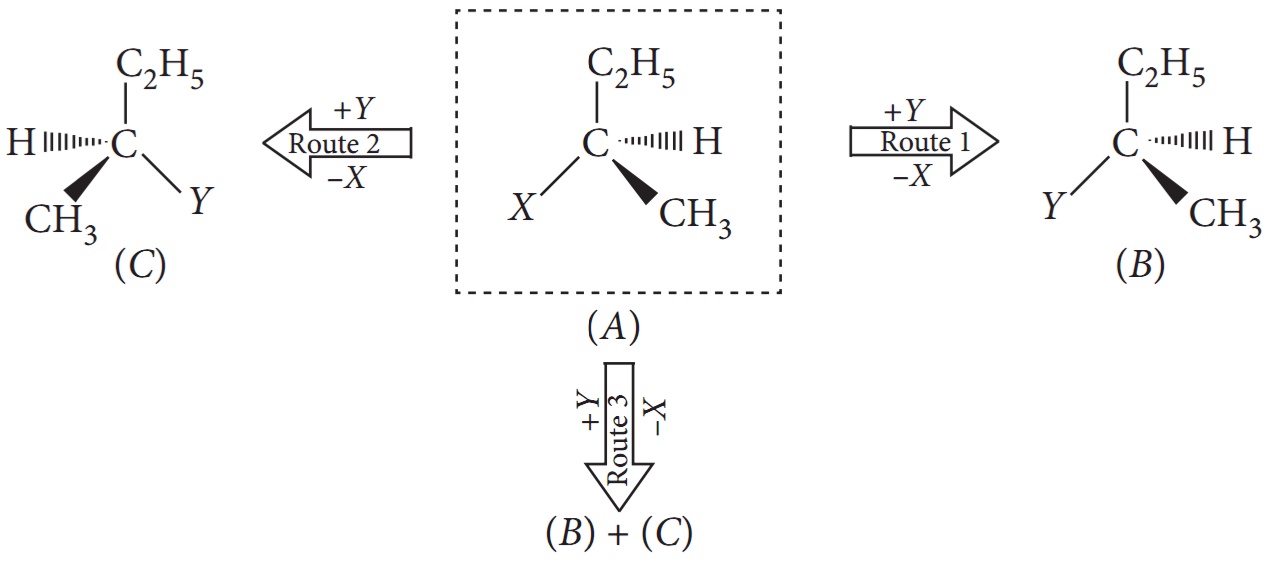
When a chemical reaction involves bond cleavage or bond formation at an asymmetric carbon atom, three different products may be formed. For example, during the substitution of a group X by Y in the following reaction, the three possible products may be shown below:

  1. If Bis the only product, the process is called retention of configuration because B has the same configuration as the starting reactant (A).
  2. If C is the only product, the process is called inversion of configuration because C has the configuration opposite to the starting reactant (A).
  3. If an equimolar mixture of Band C (r.e., a 50 : 50 mixture) is fanned, then the process is called racemisation and the product is optically inactive because one isomer will rotate the light in the direction opposite to another.

In these questions (Q. No. i-iv), a statement of assertion followed by a statement of reason is given. Choose the correct answer out of the following choices.

  1. Assertion and reason both are correct statements and reason is correct explanation for assertion.
  2. Assertion and reason both are correct statements but reason is not correct explanation for assertion.
  3. Assertion is correct statement but reason is wrong statement.
  4. Assertion is wrong statement but reason is correct statement.
  1. Assertion: A reaction is said to be stereospecific if a particular stereoisomer of the reactant produces a specific stereoisomer of the product.

Reason: Bromination of cis-2-butene gives meso-2, 3-dibromobutane which is stereospecific.

  1. Assertion: Addition of Br2 to cis-but-2-ene is stereoselective.

Reason: SN2 reactions are stereospecific as well as stereoselective.

  1. Assertion: Optically active 2-iodobutane on treatment with Nal in acetone undergoes recemization.

Reason: Repeated Walden inversions on the reactant and its product eventually gives a racemic mixture.

  1. Assertion: SN2 reaction of an optically active alkyl halide with an aqueous solution of KOH always gives an alcohol with opposite sign of rotation.

Reason: SN2 reactions always proceed with inversion of configuration.

  1. Assertion: Nudeophilic substitution reaction of an optically active alkyl halide gives a mixture of en an ti om ers.

Reason: The reaction occurs by SN2 mechanism.