Question
Read the passage given below and answer the following questions:

Transition elements are elements that have partially filled d-orbitals. The configuration of these elements corresponds to (n - 1)d1-10ns1-2. It is important to note that the elements mercury, cadmium and zinc are not considered transition elements because of their electronic configurations, which corresponds to (n - 1)d10ns2. Some general properties of transition elements are:

These elements can fonn coloured compounds and ions due to d-d transition;

These elements exhibit many oxidation states;

A large variety of ligands can bind themselves to these elements, due to this, a wide variety of stable complexes formed by these ions. The boiling and melting point of these elements are high. These elements have a large ratio of charge to the radius.

In these questions (Q. No. i-iv), a statement of assertion followed by a statement ofreason is given. Choose the correct answer out of the following choices.

  1. Assertion and reason both are correct statements and reason is correct explanation for assertion.
  2. Assertion and reason both are correct statements but reason is not correct explanation for assertion.
  3. Assertion is correct statement but reason is wrong statement.
  4. Assertion is wrong statement but reason is correct statement.
  1. Assertion: Tungsten has very high melting point.

Reason: Tungsten is a covalent compound.

  1. Assertion: Zn, Cd and Hg are normally not considered transition metals.

Reason: d-Orbitals in Zn, Cd and Hg elements are completely filled, hence these metals do not show the general characteristics properties of the transition elements.

  1. Assertion: Copper metal gets readily corroded in acidic aqueous solution such as HCl and dil. H2SO4.

Reason: Free energy change for this process is positive.

  1. Assertion: Tailing of mercury occurs on passing ozone through it.

Reason: Due to oxidation of mercury.

  1. Assertion: Transition metals are poor reducing agents.

Reason: Transition metals fonn numerous alloys with other metals.
Answer

  1. (c) Assertion is correct statement but reason is wrong statement.

Explanation:

Tungsten is a transition element and is very hard due to high metallic bonding.

  1. (a) Assertion and reason both are correct statements and reason is correct explanation for assertion.
  2. (d) Assertion is wrong statement but reason is correct statement.

Explanation:

Non-oxidising acids (HCl and dil. H2SO4) do not have any effect on copper. However they dissolve the metal in presence of air. As it is a non-spontaneous process so, $\Delta\text{G}$ cannot be-ve.

  1. (a) Assertion and reason both are correct statements and reason is correct explanation for assertion.

Explanation:

When mercury is exposed to ozone it gets superficially oxidised and loses its meniscus and sticks to the glass.

  1. (b) Assertion and reason both are correct statements but reason is not correct explanation for assertion.

Explanation:

In actual practice transition metals react with acid very slowly and act as poor reducing agents. This is due to the protection of metal as a result of formation of thin oxide protective film. Further, their poor tendency as reducing agent is due to high ionisation energy, high heat of vapourisation and low heat of hydration.

Need a full question paper?

Generate a complete, print-ready paper with questions like this in minutes — across 16+ boards, with answer keys.

Start Generating Free

Similar questions

Read the passage given below and answer the following questions:

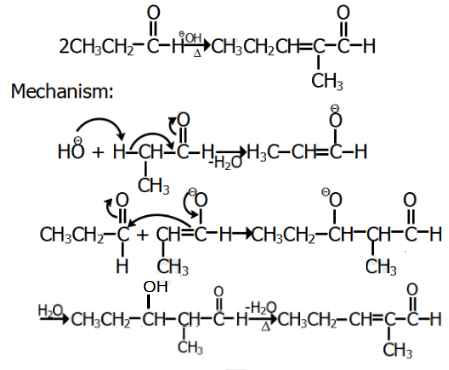
The addition reaction of enol or enolate to the carbonyl functional group of aldehyde or ketone is known as aldol addition. The β-hydroxyaldehyde or ββ-hydroxyketone so obtained undergo dehydration in second step to produce a conjugated enone. The first part of reaction is an addition reaction and the second part is an elimination reaction. Carbonyl compound having αα-hydrogen undergoes aldol condensation reaction.

  1. Condensation reaction is the reverse of which of the following reaction?
  1. Lock and key hypothesis
  2. Oxidation
  3. Hydrolysis
  4. Glycogen formation
  1. Which of the following compounds would be the main product of an aldol condensation of acetaldehyde and acetone?
  1. CH3CH=CHCHO
  2. CH3CH=CHCOCH3
  3. (CH3)2C=CHCHO
  4. (CH3)2C=CHCOCH3
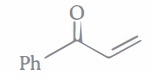
  1. Which combination of carbonyl compounds gives phenyl vinyl ketone by an aldol condensation?

  1.  Acetophenone and Formaldehyde
  2. Acetophenone and acetaldehyde
  3. Benzaldehyde and acetaldehyde
  4. Benzaldehyde and acetone
  5. Which of the following will undergo aldol condensation?
  1. HCHO
  2. CH3CH2OH
  3. C6H5CHO
  4. CH3CH2CHO
Read the passage given below and answer the following questions:
Metal carbonyl is an example of coordination compounds in which carbon monoxide (CO) acts as ligand. These are also called homoleptic carbonyls. These compounds contain both $\sigma$ and $\pi$ character. Some carbonyls have metal-metal bonds. The reactivity of metal carbonyls is due to (i) the metal centre and (ii) the CO ligands. CO is capable of accepting an appreciable amount of electron density from the metal atom into their empty $\pi$ or $\pi-\text{orbital}.$ These types of ligands are called $\pi-\text{accepter}$ or $\pi-\text{acid}$ ligands. These interactions increases the $\Delta_0$ value.
The following questions are multiple choice questions. Choose the most appropriate answer:
  1. What is the oxidation state of metal in [Mn2(CO)10]?
  1. +1
  2. -1
  3. +2
  4. 0
  1. Among the following metal carbonyls, the C-O bond order is lowest in:
  1. [Mn(CO)6]+
  2. [Fe(CO)5]
  3. [Cr(CO)6]
  4. [V(CO)6]-
  1. Which of the following can be reduced easily?
  1. V(CO)6
  2. Mo(CO)6
  3. [Co(CO)4]-
  4. Fe(CO)5
  1. The oxidation state of cobalt in K[Co(CO)4] is:
  1. +1
  2. +3
  3. -1
  4. 0
  1. Structure of decacarbonyl manganese is:
  1. Trigonal bipyramidial
  2. Octahedral
  3. Tetrahedral
  4. Square pyramidal
Read the passage given below and answer the following questions:
The solubility of gases increases with increase of pressure. William Henry made a systematic investigation of the solubility of a gas in a liquid. According to Henry's law "the mass of a gas dissolved per unit volume of the solvent at constant temperature is directly proportional to the pressure of the gas in equilibrium with the solution". Dalton during the same period also concluded independently that the solubility of a gas in a ti quid solution depends upon the partial pressure of the gas. If we use the mole fraction of gas in the solution as a measure of its solubility, then Henry's law can be modified as "the partial pressure of the gas in the vapour phase is directly proportional to the mole fraction of the gas in the solution"
The following questions are multiple choice questions. Choose the most appropriate answer:
  1. Henry's law constant for the solubility of methane in benzene at 298K is 4.27 x 105mm Hg. The solubility of methane in benzene at 298K under 760mm Hg is:
  1. 4.27 × 10⁻⁵
  2. 1.78 × 10⁻³
  3. 4.27 × 10⁻³
  4. 1.78 × 10⁻⁵
  1. The partial pressure of ethane over a saturated solution containing 6.56 × 10-2g of ethane is I bar. If the solution contains 5.00 × 10⁻²g of ethane then what will be the partial pressure (in bar) of the gas?
  1. 0.762
  2. 1.312
  3. 3.81
  4. 5.0
  1. KH (K bar) values for Ar(g), CO2(g), HCHO(g) and CH4(g) are 40.39, 1.67, 1.83 × 10-5 and 0.413 respectively. Arrange these gases in the order of their increasing solubility. Arrange these gases in the order of their increasing solubility.
  1. HCHO < CH4 < CO2 < Ar
  2. HCHO < CO2 < CH4 < Ar
  3. Ar < CO2 < CH4 < HCHO
  4. Ar < CH4 < CO2 < HCHO
  1. When a gas is bubbled through water at 298K, a very dilute solution of the gas is obtained. Henry's law constant for the gas at 298K is 150 kbar. If the gas exerts a partial pressure of 2 bar, the number of millimoles of the gas dissolved in IL of water is:
  1. 0.55
  2. 0.87
  3. 0.37
  4. 0.66
  1. Which of the following statements is correct?
  1. KH increases with increase of temperature.
  2. KH decreases with increase of temperature.
  3. KH remains constant with increase of temperature.
  4. KH first increases then decreases, with increase of temperature.
Read the passage given below and answer the following questions:
Iron forms many complexes in its +2 and +3 oxidation states such as [Fe(H2O)6]2+ (A); [Fe(CN)6]4- (B); [Fe(H2O)6]3+ (C); [Fe(CN)6]3- (D), etc., They exhibit, different magnetic properties and undergo different hybridisation of iron.
The following questions are multiple choice questions. Choose the most appropriate answer:
  1. Which of the following statements is correct?
  1. (B) is paramagnetic while (C) is diamagnetic.
  2. Both (B) and (D) are outer orbital complexe.
  3. Both (A) and (C) are paramagnetic.
  4. (A) is outer orbital complex and (C) is inner orbital complex.
  1. The complex having maximum magnetic moment is:
  1. (A)
  2. (B)
  3. (C)
  4. (D)
  1. Which of the following does not represent correct configuration of the d-orbitals in the given complexes?
  1. $\text{(A)}:\text{t}^4_{2\text{g}}\text{e}^2_\text{g}$
  2. $\text{(B)}:\text{t}^6_{2\text{g}}\text{e}^0_\text{g}$
  3. $\text{(C)}:\text{t}^4_{2\text{g}}\text{e}^1_\text{g}$
  4. $\text{(D)}:\text{t}^5_{2\text{g}}\text{e}^0_\text{g}$
  1. The spin only magnetic moment of complexes (A), (B), (C) and (D) are respectively (in BM).
  1. $2\sqrt{6},0,\sqrt{35},\sqrt{3}$
  2. $0,2\sqrt{6},\sqrt{35},\sqrt{3}$
  3. $\sqrt{15,}2\sqrt{6},\sqrt{3},0$
  4. $\sqrt{3},\sqrt{8},0,\sqrt{15}$
  1. Which of the given complexes are outer orbital complexes?
  1. (A) and (B) only
  2. (B) and (C) only
  3. (A) and (C) only
  4. (B) and (D) only
Read the passage given below and answer the following questions:
When haloalkanes with $\beta-$hydrogen atom are boiled with alcoholic solution of KOH, they undergo elimination of hydrogen halide resulting in the formation of alkenes. These reactions are called $\beta-$elimination reactions or dehydrohalogenation reactions. These reactions follow Saytzeff's rule. Substitution and elimination reactions often compete with each other. Mostly bases behave as nucleophiles and therefore can engage in substitution or elimination reactions depending upon the alkyl halide and the reaction conditions.
The following questions are multiple choice questions. Choose the most appropriate answer:
  1. Among the following the most reactive towards alcoholic KOH is:
  1. CH2 = CHBr
  2. CH3COCH2CH2Br
  3. CH3CH2Br
  4. CH3CH2CH2Br
  1. The general reaction, $\text{R}-\text{X}\xrightarrow{\text{aq.OH}^-}\text{ROH}+\text{X}^-,$ is expected to follow decreasing order of reactivity as in:
  1. t-BuI> t-BuBr > t-BuCI > t-BuF
  2. t-BuF > t-BuCI > t-BuBr > t-BuI
  3. t-BuBr > t-BuCI >t-BuI> t-BuF
  4. t-BuF > t-BuCI > t-BuI > t-BuBr
  1. Reaction of t-butyl bromide with sodium methoxide produces:
  1. Sodium t-butoxide.
  2. t-butyl methyl ether.
  3. Iso-butane.
  4. Iso-butylene.
  1. In the elimination reactions, the reactivity of alkyl halides follows the sequence:
  1. R - F > R - CI > R - Br > R - I
  2. R - I > R - Br > R - Cl > R - F
  3. R - I > R - F > R - Br > R - CI
  4. R - F > R - I > R - Br > R - CI
  1. The ease of dehydrohalogenation of alkyl halide with alcoholic KOH is:
  1. 3º < 2º < 1º
  2. 3º > 2º > 1º
  3. 3º < 2º > 1º
  4. 3º > 2º < 1º

Read the passage given below and answer the following questions:

A primary alkyl halide (A) C4H9Br reacted with akoholic KOH to give compound (B). Compound (B) is reacted with HBr to give compound (C) which is an isomer of (A). When (A) reacted with sodium metal, it gave a compound (D) C8H18 that is different than the compound obtained when n-butyl bromide reacted with sodium metal.

The following questions are multiple choice questions. Choose the most appropriate answer:

  1. Compound (A) is:
  1. CH3CH2CH2CH2Br

  2. $\text{CH}_3\text{CH}-\text{CH}_2\text{Br}\\\ \ \ \ \ \ \ \ \ |\\\ \ \ \ \ \ \ \ \text{CH}_3$

  3. $\ \ \ \ \ \ \ \ \ \ \ \ \ \ \text{CH}_3\\\ \ \ \ \ \ \ \ \ \ \ \ \ \ \ |\\\text{CH}_3-\text{C}-\text{Br} \\\ \ \ \ \ \ \ \ \ \ \ \ \ \ \ \ |\\\ \ \ \ \ \ \ \ \ \ \ \ \ \ \ \text{CH}_3$

  4. CH3CH2CH2Br

  1. Which type of isomerism is present in compound (A) and (C)?
  1. Positional
  2. Functional
  3. Chain
  4. Both (a) and (c)
  1. Identify compound (B).
  1. $\text{CH}_3-\text{C}=\text{CH}_2 \ \ \\ \ \ \ \ \ \ \ \ \ \ \ \ \ \mid \\ \ \ \ \ \ \ \ \ \ \ \ \text{CH}_3$
  2. CH3 – CH = CH – CH3
  3. CH3 – CH2 – CH = CH2
  4. None of these.
  1. IUPAC name of compound (D) is:
  1. N - octane
  2. 2, 5 - dimethylhexane
  3. 2 - methylheptane
  4. 3, 4 - dimethyl hexane.
  1. When compoound (C) is treated with ale. KOH and then treated with presence of peroxide, the compound obtained is:
  1. $\ \ \ \ \ \ \ \ \ \ \ \ \ \ \text{CH}_3\\\ \ \ \ \ \ \ \ \ \ \ \ \ \ \ |\\\text{CH}_3-\text{C}-\text{Br} \\\ \ \ \ \ \ \ \ \ \ \ \ \ \ \ \ |\\\ \ \ \ \ \ \ \ \ \ \ \ \ \ \ \text{CH}_3$

  2. $\ \ \ \ \ \ \ \ \ \ \ \ \ \ \text{CH}_3\\\ \ \ \ \ \ \ \ \ \ \ \ \ \ \ |\\\text{CH}_3-\text{CH}-\text{CH}_2-\text{Br}$

  3. $\text{CH}_3\text{CH}_2\text{CH}_2\text{CH}_2\text{Br}$

  4. $$$\text{CH}_3\text{CH}_2\text{CH}_2\text{CH}-\text{Br}\\\ \ \ \ \ \ \ \ \ \ \ \ \ \ \ \ \ \ \ \ \ \ \ \ \ |\\\ \ \ \ \ \ \ \ \ \ \ \ \ \ \ \ \ \ \ \ \ \ \ \ \text{CH}_3$

The electrochemical cell shown below is concentration cell.

M|M2+ (saturated solution of a sparingly soluble salt, MX2) || M2+ (0.001 mol dm-3) |M The emfof the cell depends on the difference in concentrations of M2+ ions at the two electrodes. The emf of the cell at 298 K is 0.059V.

The following questions are multiple choice questions. Choose the most appropriate answer:

  1. The solubility product (Ksp' mol3 dm-9) of MX2 at 298 K based on the information available for the given concentration cell is $(\text{take }2.303 \times \text{R}\times \frac{298}{\text{F}} = 0.059)$
  1. 2 × 10-15
  2. 4 × 10-15
  3. 3 × 10-12
  4. 1 × 10-12
  1. The value of $\triangle\text{G}$ (in kJ mol-1) for the given cell is (take 1 F = 96500 C mol-1)

  1. 3.7
  2. -3.7
  3. 10.5
  4. -11.4
  1. The equilibrium constant for the foUowing reaction is:

$\text{Fe}^{2+}+\text{Ce}^{4+}\rightleftharpoons\text{Ce}^{3+}+\text{Fe}^{3+}$

(Given, $\text{E}^\circ_\frac{\text{Ce}^{4+}}{\text{Ce}^{3+}}=1.44\text{V}$ and $\text{E}^\circ_\frac{\text{Fe}^{3+}}{\text{Fe}^{2+}}=0.68\text{V}$)

  1. 7.6 × 10¹²
  2. 6.5 × 1010
  3. 5.2 × 109
  4. 3.4 × 1012
  1. The solubility product of a saturated solution of Ag2CrO4 in water at 298 K if the emf of the cell

Ag|Ag+ (satd. Ag2CrO4 soln) || Ag+ (0.1 M) | Ag

is 0.164V at 298 K, is:

  1. 3.359 × 10⁻¹² mol3 L-3
  2. 2.287 × 10⁻¹² mol3 L-3
  3. 1.158 × 10⁻¹² mol3 L-3
  4. 4.135 × 10⁻¹² mol3 L-3
  1. To calculate the emf of the cell, which of the foUowing options is correct?
  1. emf = Ecathode - Eanode
  2. emf = Eanode - Ecathode
  3. emf = Eanode + Ecathode
  4. None of these.
Read the passage given below and answer the following questions:

If some solute is added to a solvent, the boiling point of solution increases. This is known as elevation in baiting point.

$\Delta\text{T}_\text{b}=\text{K}_\text{b}\text{m}$ where, Kb = Molal elevation constant,

$\Delta\text{T}_\text{b}\propto\text{m}$

Hence, it is a colligative property,

Also, $\text{K}_\text{b}=\frac{\text{MRT}^2_\text{b}}{\Delta\text{Vap}\text{H}\times1000}$

where, M = Molar mass of solvent,

$\Delta\text{vap}$ H = Enthalpy of vaporisation,

Molar mass can also be calculated using elevation in boiling point.

$\text{M}_\text{B}=\frac{\text{K}_\text{B}\times\text{W}_\text{B}\times1000}{\Delta\text{T}_\text{b}\times\text{W}_\text{A}}$

A statement of assertion followed by a statement of reason is given. Choose the correct answer out of the following choices.

  1. Assertion and reason both are correct statements and reason is correct explanation for assertion.
  2. Assertion and reason both are correct statements but reason is not correct explanation for assertion.
  3. Assertion is correct statement but reason is wrong statement.
  4. Assertion is wrong statement but reason is correct statement.
  1. Assertion: In a pressure cooker, the water is brought to boil. The cooker is then removed from the stove. Now on removing the lid of pressure cooker, the water starts boiling again.

Reason: The impurities in water bring down its boiling point.

  1. Assertion: On dissolving 3.24g of sulphur in 40g of benzene, boiling point of solution get higher than that of benzene by 0.081K, then the formula of sulphur is S8. (Kb for benzene = 2.53K kg mol-1)

Reason: Molecular mass of sulphur comes out to be 253.

  1. Assertion: When sugar is added to water, boiling point of water increases.

Reason: When a non-volatile solute is added to a solvent, elevation in boiling point is observed.

  1. Assertion: Cooking time in pressure cookers is reduced.

Reason: Boiling point inside the pressure cooker in raised.

  1. Assertion: Elevation in boiling point of two isotonic solutions is same.

Reason: Boiling point depends upon the concentration of the solute.