Question
Need a full question paper?
Generate a complete, print-ready paper with questions like this in minutes — across 16+ boards, with answer keys.
Explore more
Similar questions
Electrical work done in unit time is equal to electrical potential multiplied by total charge passed. ln order to obtain maximum work from a cell, the charge has to be passed reversibly. The reversible work done by a cell is equal to decrease in its Gibb's energy. Hence, Gibb's energy of reaction is given by $\Delta\text{G}=\text{nFE}_\text{cell}$ Hence, Eis the emfof the cell and nFis the amount of energy. In these questions (Q. No. i-Iv), a statement of assertion followed by a statement ofreason is given. Choose the correct answer out of the following choices.
→- Assertion and reason both are correct statements and reason is correct explanation for assertion.
- Assertion and reason both are correct statements but reason is not correct explanation for assertion.
- Assertion is correct statement but reason is wrong statement.
- Assertion is wrong statement but reason is correct statement.
- Assertion: $\Delta\text{G}^\circ=-\text{nFE}^\circ$
Reason: Eº should be positive for a spontaneous reaction.
- Assertion: An electrochemical cell can be set up only if the red ox reaction is spontaneous.
Reason: A reaction is spontaneous if free energy change is negative.
- Assertion: For an electrochemical cell, $\Delta\text{G}<0$ and $\text{E}_\text{cell}>0.$
Reason: The given cell is non-spontaneous.
- Assertion: Current stops flowing when Ecell = 0.
Reason: Equilibrium of the cell reaction is attained.
- Assertion: Ecell should have a positive value for the cell to function.
Reason: Ecell = Ecathode - Eanode
Read the passage given below and answer the following questions: According to Raoult's law, the partial pressure of two components of the solution maybe given as: $\text{P}_\text{A}=\stackrel{{0}}{\hbox{PA }}\text{x}_\text{A}$ and $\text{P}_\text{B}=\stackrel{{0}}{\hbox{PB }}\text{x}_\text{B}$ For an ideal solution (obeys Raoult's law always) $\Delta\text{H}_\text{mix}=0,\Delta\text{mix}=0$ All solutions do not obey Raoults law over entire range of concentration. These are known as non-ideal solutions. For non-ideal solutions, $\text{P}_\text{A}\not=\stackrel{{0}}{\hbox{PA }}\text{x}_\text{A}$ or $\text{P}_\text{B}\not=\stackrel{{0}}{\hbox{PB }}\text{x}_\text{B}$ Positive deviation $\Rightarrow\text{P}_\text{A}>\stackrel{{0}}{\hbox{PA }}\text{x}_\text{A}$ and $\text{P}_\text{B}>\stackrel{{0}}{\hbox{PB }}\text{x}_\text{B}$ Negative deviation $\text{P}_\text{A}<\stackrel{{0}}{\hbox{PA }}\text{x}_\text{A}$ and $\text{P}_\text{B}\stackrel{{0}}{\hbox{PB }}\text{x}_\text{B}$ A statement of assertion followed by a statement ofreason is given. Choose the correct answer out of the following choices.
→- Assertion and reason both are correct statements and reason is correct explanation for assertion.
- Assertion and reason both are correct statements but reason is not correct explanation for assertion.
- Assertion is correct statement but reason is wrong statement.
- Assertion is wrong statement but reason is correct statement.
- Assertion: An ideal solution obeys Raoult's law.
Reason: In an ideal solution, solute-solute as well as solvent-solvent interactions are similar to solute-solvent interactions.
- Assertion: Acetone and aniline show negative deviations.
Reason: H-bonding between acetone and aniline is stronger than that between acetone-acetone and aniline-aniline.
- Assertion: Azeotropic mixtures are formed only by non-ideal solutions and they may have boiling points either greater than both the components or lesser than both the components.
Reason: The composition of the vapour phase is same as that of the liquid phase of an azeotropic mixture.
- Assertion: The solutions which show negative deviations from Raoult's law are called maximum boiling azeotropes.
Reason: 68% nitric acid and 32% water by mass fonn maximum boiling azeotrope.
- Assertion: $\Delta\text{H}_{\text{mix}}$ mix and $\Delta\text{V}_{\text{mix}}$ are positive for an ideal solution.
Reason: The interactions between the particles of the components of an ideal solution are almost identical as between particles in the liquids.
Read the passage given below and answer the following questions: Proteins are high molecular mass complex biomolecules of amino acids. The important proteins required for our body are enzymes, hormones, antibodies, transport proteins, structural proteins, contractile proteins etc. Except for glycine, all $\alpha$-amino acids have chiral carbon atom and most of them have L-configuration. The amino acids exists as dipolar ion called zwitter ion, in which a proton goes from the carboxyl group to the amino group. A large number of $\alpha$-amino acids are joined by peptide bonds forming polypeptides. The peptides having very large molecular mass (more than 10,000) are called proteins. The structure of proteins is described as primary structure giving sequence of linking of amino acids; secondary structure giving manner in which polypeptide chains are arranged and folded; tertiary structure giving folding, coiling or bonding polypeptide chains producing three dimensional structures and quaternary structure giving arrangement of sub-units in an aggregate protein molecule. A statement of assertion followed by a statement of reason is given. Choose the correct answer out of the following choices.
→- Assertion and reason both are correct statements and reason is correct explanation for assertion.
- Assertion and reason both are correct statements but reason is not correct explanation for assertion.
- Assertion is correct statement but reason is wrong statement.
- Assertion is wrong statement but reason is correct statement.
- Assertion: Except glycine, all naturally occurring CL-amino acids are optically active.
Reason: All naturally occurring CL-amino acids, except glycine, has at least one asymmetric carbon.
- Assertion: All amino acids are optically active.
Reason: Amino acids contain asymmetric carbon atoms.
- Assertion: In $\alpha$-helix structure, intramolecular H-bonding takes place whereas in $\beta$-pleated structure, intermolecular H-bonding takes place.
Reason: An egg contains a soluble globular protein called albumin which is present in the white part.
- Assertion: Secondary structure of protein refers to regular folding patterns of continuos portions of the polypeptide chain.
Reason: Out of 20 amino acids, only 12 amino acids can be synthesised by human body.
- Assertion: The helical structure of protein is stabilised by intramolecular hydrogen bond between -NH and carbonyl oxygen.
Reason: Sanger's reagent is used for the identification of N-tenninal amino acid of peptide chain.
Read the passage given below and answer the following questions:
At 298 K, the vapour pressure of pure benzene, C6, H6 is 0.256 bar and the vapour pressure of pure toluene C6 H5 CH3 is 0.0925 bar. Two mixtures were prepared as follows:
At 298 K, the vapour pressure of pure benzene, C6, H6 is 0.256 bar and the vapour pressure of pure toluene C6 H5 CH3 is 0.0925 bar. Two mixtures were prepared as follows:
- 7.8g of C6 H6 + 9.2g of toluene
- 3.9g of C6 H6 + 13.8g of toluene
- The total vapour pressure (bar) of solution I is.
- 0.128
- 0.174
- 0.198
- 0.258
- Which of the given solutions have higher vapour pressure?
- I
- II
- Both have equal vapour pressure
- Cannot be predicted
- Mole fraction of benzene in vapour phase in solution I is.
- 0.128
- 0.174
- 0.734
- 0.266
- Which of the following statements is/are correct?
- Mole fraction of toluene in vapour phase is more in solution I.
- Mole fraction of toluene in vapour phase is less in solution I.
- Mole fraction of benzene in vapour phase is less in solution I.
- Only II
- Only I
- I and III
- II and III
- Solution I is an example of a/an.
- Ideal solution.
- Non-ideal solution with positive deviation.
- Non-ideal solution with negative deviation.
- Can't be predicted.
Read the passage given below and answer the following questions:
When a protein in its native form, is subjected to physical changes like change in temperature or chemical changes like change in pH, the hydrogen bonds are disturbed. Due to this, globules unfold and helix get uncoiled and protein loses its biological activity. This is called denaturation of protein.
The denaturation causes change in secondary and tertiary structures but primary structures remains intact. Examples of denaturation of protein are coagulation of egg white on boiling, curdling of milk, formation of cheese when an acid is added to milk.
The following questions are multiple choice questions. Choose the most appropriate answer:
→When a protein in its native form, is subjected to physical changes like change in temperature or chemical changes like change in pH, the hydrogen bonds are disturbed. Due to this, globules unfold and helix get uncoiled and protein loses its biological activity. This is called denaturation of protein.
The denaturation causes change in secondary and tertiary structures but primary structures remains intact. Examples of denaturation of protein are coagulation of egg white on boiling, curdling of milk, formation of cheese when an acid is added to milk.
The following questions are multiple choice questions. Choose the most appropriate answer:
- Mark the wrong statement about denaturation of proteins.
- The primary structure of the protein does not change.
- Globular proteins are converted into fibrous proteins.
- Fibrous proteins are converted into globular proteins.
- The biological activity of the protein is destroyed.
- Which structure(s) of proteins remains(s) intact during denaturation process?
- Both secondary and tertiary structures.
- Primary structure only.
- Secondary structure only.
- Tertiary structure only.
- $\alpha$-helix and $\beta$-pleated structures of proteins are classified as:
- Primary structure.
- Secondary structure.
- Tertiary structure.
- Quaternary structure.
- Cheese is a:
- Globular protein.
- Conjugated protein.
- Denatured protein.
- Derived protein.
- Secondary structure of protein refers to:
- Mainly denatured proteins and structure of prosthetic groups.
- Three-dimensional structure, especially the bond between amino acid residues that are distant from each other in the polypeptide chain.
- Linear sequence of amino acid residues in the polypeptide chain.
- Regular folding patterns of continuous portions of the polypeptide chain.
Read the passage given below and answer the following questions:
In haloalkanes, when a nucleophile stronger than the halide ion approaches the positively charged carbon atom of an alkyl halide, the halogen atom along with its bonding electron pair gets displaced and a new bond with the carbon and the nucleophile is formed. These reactions are called nucleophilic substitution reactions.
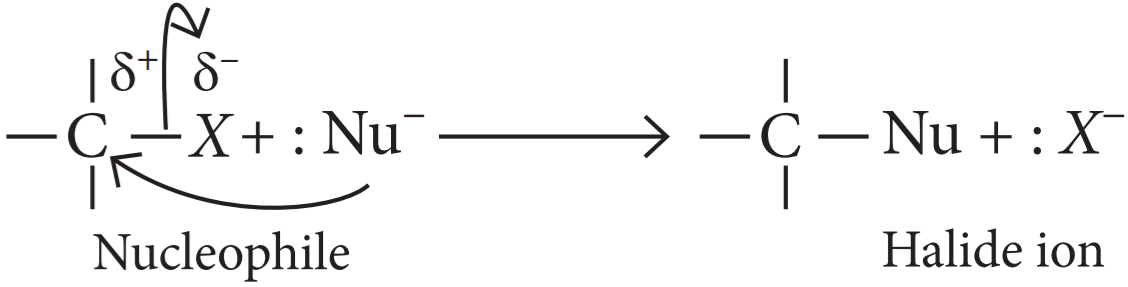
In these reactions the atom or group of atoms which loses its bond from carbon and takes on an additional pair of electrons is called leaving group. Halide ions are good leaving groups. Some important nucleophilic substitution reactions ofhaloalkanes with common nucleophiles are given in the table below.
Reagent | Nucleophile (Nu-) | Substitution product R-Nu | Class of main product | |
1. | NaOH or KOH or moist Ag2O | -OH | ROH | Alcohol |
2. | H2O | H2O | ROH | Alcohol |
3. | Nal | I- | R – I | Alkyl iodide |
4. | R'NH2 | $\text{R'}\ddot{\text{N}}\text{H}_2$ | RNHR' | Sec. amine |
5. | KCN | $\overline{\text{C}}\equiv\text{N}:$ | RCN | Nitrile (cyanide) |
6. | KNO2 | O = N – O- | R – O – N = O | Alkvl nitrite |
In these questions (Q. No. i-iv), a statement of assertion followed by a statement ofreason is given. Choose the correct answer out of the following choices.
- Assertion and reason both are correct statements and reason is correct explanation for assertion.
- Assertion and reason both are correct statements but reason is not correct explanation for assertion.
- Assertion is correct statement but reason is wrong statement.
- Assertion is wrong statement but reason is correct statement.
- Assertion: Alkyl halides are hydrolysed to alcohols by moist silver oxide.
Reason: RCI is hydrolysed to ROH easily but reactions slow down on addition of KI.
- Assertion: Alkyl halides fonn alkenes when heated above 300ºC.
Reason: CH3CH21 reacts slowly with strong base as compared to CD3CH2I.
- Assertion: RBr reacts with AgNO2 to give nitroalkane.
Reason: Silver nitrite (AgNO2) is an ionic compound, therefore the negative charge on nitrogen is the attacking site.
- Assertion: The nucleophilic substitution of vinyl chloride is difficult than ethyl chloride.
Reason: Vinyl group is electron donating group.
- Assertion: 2-Bromobutane on reaction with sodium ethoxide in ethanol gives 1-butene as the major product.
Reason: 1-Butene is less stable than 2-butene.
Read the passage given below and answer the following questions: Aldehydes and ketones undergo nucleophilic addition reactions. 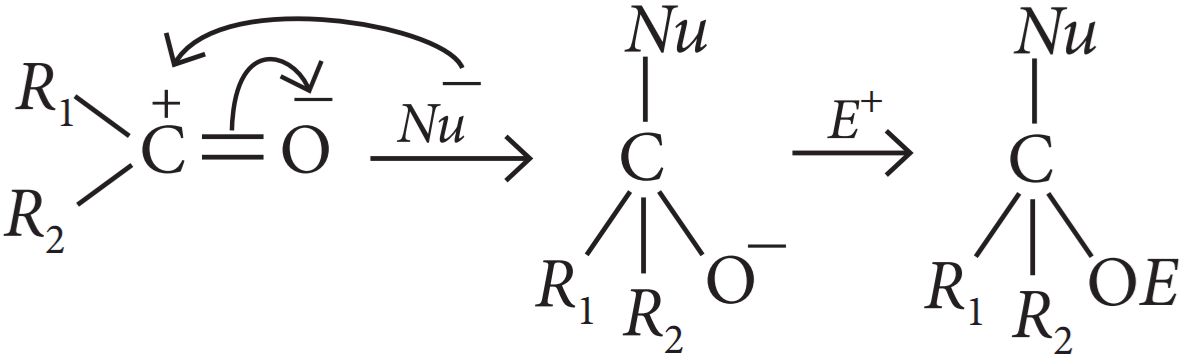 Carbonyl carbon is electron deficient hence acts as an electrophi le. Nucleophile attacks on the electrophili c carbon atom of the carbonyl group from a direction perpendicular to the plane of the molecule.
 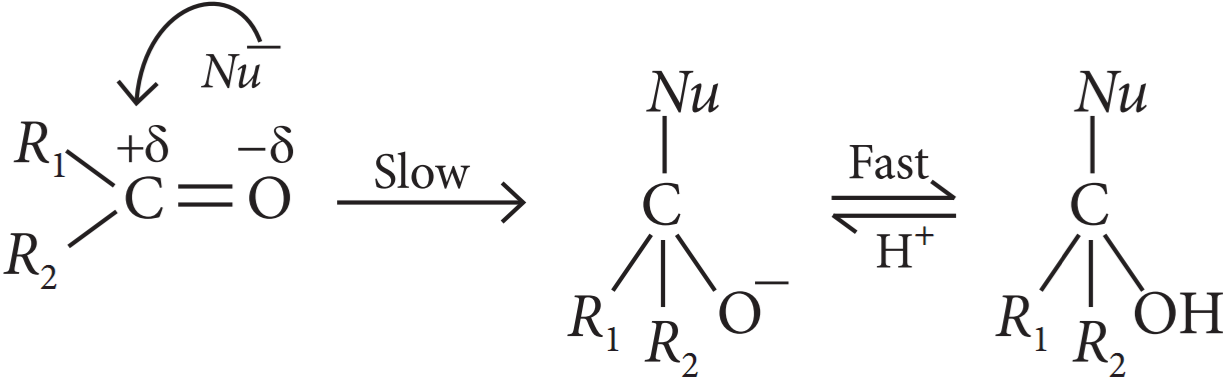 ln this process, hybridisation of carbon atom changes from sp2 to sp3 and a tetrahedral alkoxide ion is formed as intermediate. This intermediate captures proton from the reaction medium to give the neutral product. Aldehydes are generally more reactive than ketones in nucleophilic addition reactions. In these questions (Q. No. l-iv), a statement of assertion followed by a statement ofreason is given. Choose the correct answer out of the following choices.
Carbonyl carbon is electron deficient hence acts as an electrophi le. Nucleophile attacks on the electrophili c carbon atom of the carbonyl group from a direction perpendicular to the plane of the molecule. ln this process, hybridisation of carbon atom changes from sp2 to sp3 and a tetrahedral alkoxide ion is formed as intermediate. This intermediate captures proton from the reaction medium to give the neutral product. Aldehydes are generally more reactive than ketones in nucleophilic addition reactions. In these questions (Q. No. l-iv), a statement of assertion followed by a statement ofreason is given. Choose the correct answer out of the following choices. - Assertion and reason both are correct statements and reason is correct explanation for assertion.
- Assertion and reason both are correct statements but reason is not correct explanation for assertion.
- Assertion is correct statement but reason is wrong statement.
- Assertion is wrong statement but reason is correct statement.
- Assertion: Benzaldehyde is more reactive than ethanal towards nucleophitic attack.
Reason: The overall effect of -I and +R effect of phenyl group decreases the electron density on the carbon atom of >c=o group in benzaldehyde.
- Assertion: (CH3)3CCOC(CH3)3 and acetone can be distinguished by the reaction with NaHSO3.
Reason: HSO3 is the nucleophile in bisulphite addition.
- Assertion: Ease of nucleophilic addition of the compounds
 (I). CH3CHO(II) and CH3COCH3(III) is I > II > III.
Reason: Aldehydes and ketones undergo nucleophilic addition reactions.
- Assertion: The formation of cyanohydrin from an aldehyde or ketone occurs very slowly with pure HCN. The is reaction is catalysed by a base.
Reason: Base generates CN- ion which is a stronger nucleophile.
- Assertion:
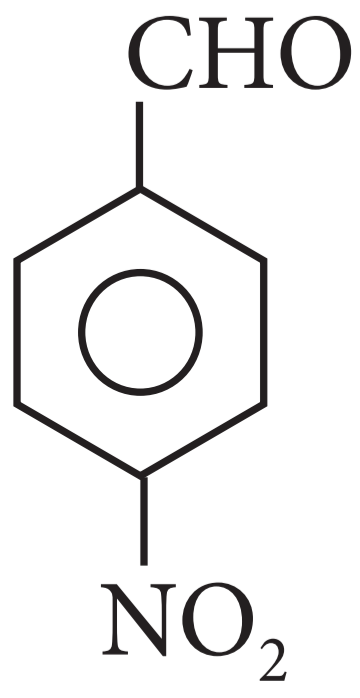 is more reactive towards nucleophilic addition reaction than
 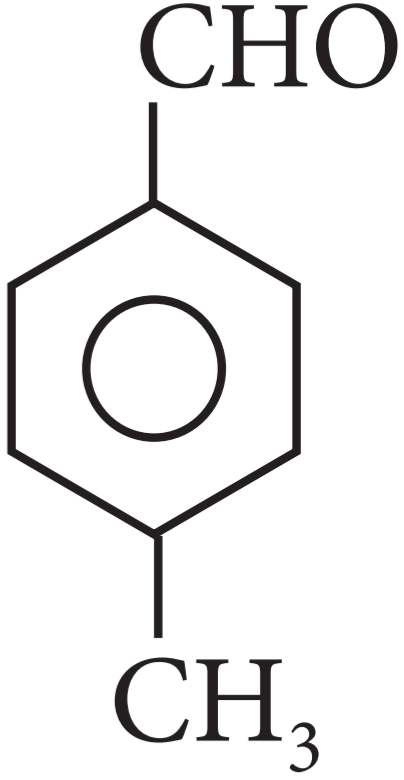 .
.
Reason: Reactivity of carbonyl group is due to electrophilic nature of carbonyl carbon.
Two types of conductors are generally used, metallic and electrolytic. Free electrons are the current carrier in metallic and in electrolytic conductors, free ions. Specific conductance or conductivity of an electrolytic solution is given by $\text{K}=\text{C}\times\frac{\text{l}}{\text{A}}$ where, $\text{C}\times\frac{1}{\text{R}}$ and $\frac{\text{l}}{\text{A}}=\text{G}^\star$ (cell constant) Molar conductance $(\wedge_\text{m})$ and equivalent conductance $(\wedge_\text{e})$ of an electrolyte solution are calculated as $\wedge_\text{m}=\frac{\text{K}\times1000}{\text{M}}$ or $\wedge_\text{e}=\frac{\text{K}\times1000}{\text{N}}$ where, M = molarity of solution and N is normality of solution. Molar conductance of strong electrolyte depends on the concentration. $\wedge_\text{m}=\wedge^\circ_{\text{m}^-}\text{b}\sqrt{\text{C}}$ $\wedge^\circ_\text{m}=$ molar conductance at infinite dilution, b = constant, C = cone.of solution In these questions (Q. No. i-iv), a statement of assertion followed by a statement of reason is given. Choose the correct answer out of the following choices.
→- Assertion and reason both are correct statements and reason is correct explanation for assertion.
- Assertion and reason both are correct statements but reason is not correct explanation for assertion.
- Assertion is correct statement but reason is wrong statement.
- Assertion is wrong statement but reason is correct statement.
- Assertion: The molar conductivity of strong electrolyte decreases with increase in concentration.
Reason: At high concentration, migration ofions is slow.
- Assertion: The molar conductance of weak electrolyte at infinite dilution is equal to the sum of molar conductance of cations and anions.
Reason: Kohlrausch's law is applicable for strong electrolytes.
- Assertion: Equivalent conductance of all electrolytes increases with increasing concentration.
Reason: More number ofions are available per gram equivalent at higher concentration.
- Assertion: Specific conductance decreases with dilution whereas equivalent conductance increases.
Reason: On dilution, number of ions per millilitre decreases but total number ofions increases considerably.
- Assertion: The ratio of specific conductivity to the observed conductance does not depend upon the concentration of the solution taken in the conductivity cell.
Reason: Specific conductivity decreases with dilution whereas observed conductance increases with dilution.
Explain the D and L notation method of spatial arrangement with respect to glucose.
For a first order reaction, A → Products, $\text{k}=\frac{2.303}{\text{t}}\log\frac{\text{a}}{\text{a}-\text{x}},$ where a is the initial concentration of A and (a - x) is the concentration of A after time t. k is rate constant. Its value is constant at constant temperature for a reaction. The time in which half of the reactant is consumed is called half-life period. Half-life period of a first order reaction is constant. Its value is independent of initial concentration or any other external conditions.
→In these questions (Q. No. i-iv), a statement of assertion followed by a statement ofreason is given. Choose the correct answer out of the following choices.
- Assertion and reason both are correct statements and reason is correct explanation for assertion.
- Assertion and reason both are correct statements but reason is not correct explanation for assertion.
- Assertion is correct statement but reason is wrong statement.
- Assertion is wrong statement but reason is correct statement.
- Assertion: Rate of reaction doubles when concentration of reactant is doubled if it is a first order reaction.
Reason: Rate constant also doubles.
-
Assertion: For the first order reaction, half-life period is expressed as
Reason: The half-life time of a first order reaction is not always constant and it depends upon the initial concentration of reactants.
- Reason: The half-life time of a first order reaction is not always constant and it depends upon the initial concentration of reactants.
Reason: Acid only acts as a catalyst whereas alkali acts as one of the reactants.
- Assertion: For a first order reaction, the concentration of the reactant decreases exponentially with time.
Reason: Rate of reaction at any time depends upon the concentration of the reactant at that time.
- Assertion: Half-life period for a first order reaction is independent of initial concentration of the reactant.
Reason: For a first order reaction,
$\text{t}_\frac{1}{2}=\frac{0.693}{\text{k}},$ where k is rate constant.