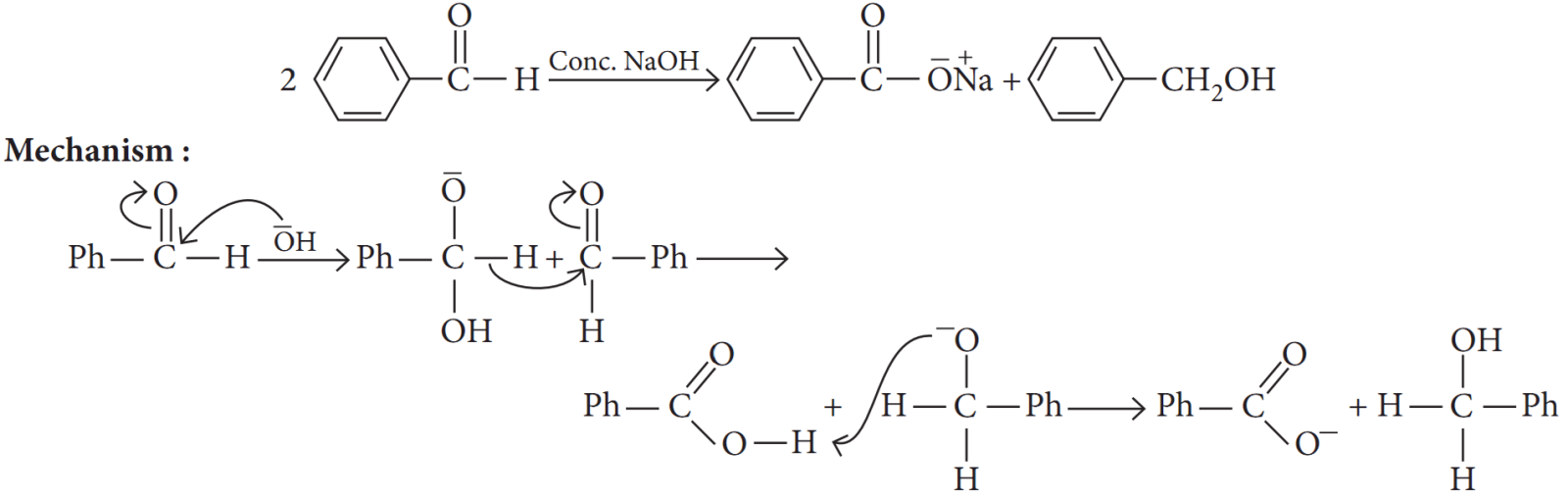
Question
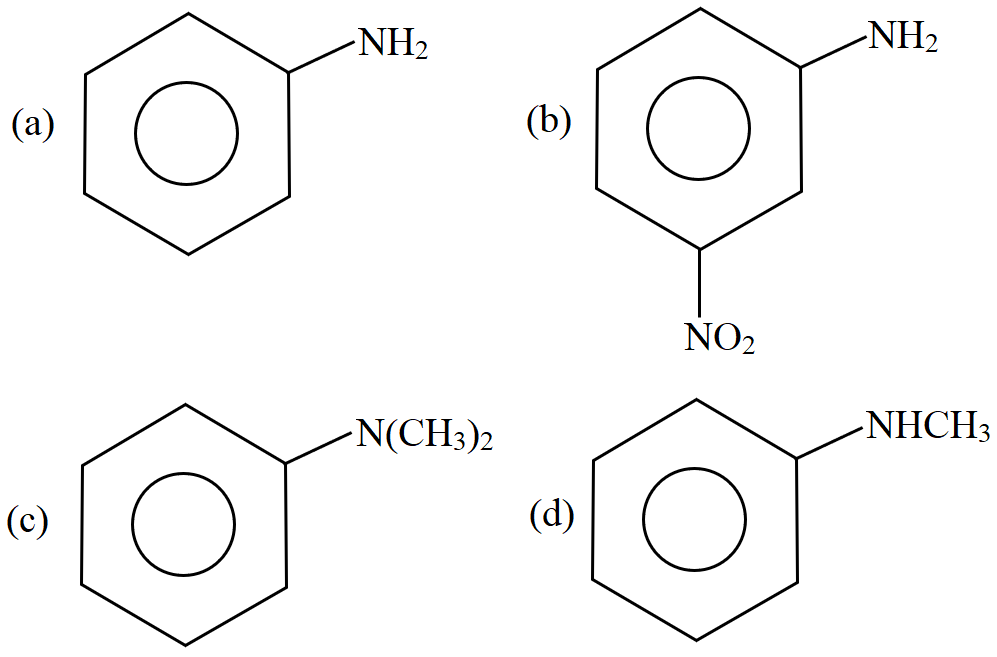

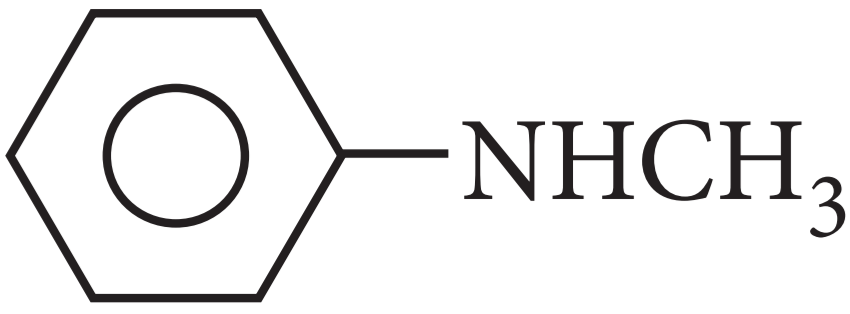
✓
Answer
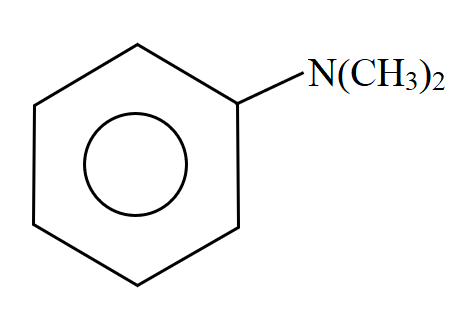

Need a full question paper?
Generate a complete, print-ready paper with questions like this in minutes — across 16+ boards, with answer keys.
Explore more
Similar questions
Read the passage given below and answer the following questions:
When haloalkanes with $\beta-$hydrogen atom are boiled with alcoholic solution of KOH, they undergo elimination of hydrogen halide resulting in the formation of alkenes. These reactions are called $\beta-$elimination reactions or dehydrohalogenation reactions. These reactions follow Saytzeff's rule. Substitution and elimination reactions often compete with each other. Mostly bases behave as nucleophiles and therefore can engage in substitution or elimination reactions depending upon the alkyl halide and the reaction conditions.
The following questions are multiple choice questions. Choose the most appropriate answer:
→When haloalkanes with $\beta-$hydrogen atom are boiled with alcoholic solution of KOH, they undergo elimination of hydrogen halide resulting in the formation of alkenes. These reactions are called $\beta-$elimination reactions or dehydrohalogenation reactions. These reactions follow Saytzeff's rule. Substitution and elimination reactions often compete with each other. Mostly bases behave as nucleophiles and therefore can engage in substitution or elimination reactions depending upon the alkyl halide and the reaction conditions.
The following questions are multiple choice questions. Choose the most appropriate answer:
- Among the following the most reactive towards alcoholic KOH is:
- CH2 = CHBr
- CH3COCH2CH2Br
- CH3CH2Br
- CH3CH2CH2Br
- The general reaction, $\text{R}-\text{X}\xrightarrow{\text{aq.OH}^-}\text{ROH}+\text{X}^-,$ is expected to follow decreasing order of reactivity as in:
- t-BuI> t-BuBr > t-BuCI > t-BuF
- t-BuF > t-BuCI > t-BuBr > t-BuI
- t-BuBr > t-BuCI >t-BuI> t-BuF
- t-BuF > t-BuCI > t-BuI > t-BuBr
- Reaction of t-butyl bromide with sodium methoxide produces:
- Sodium t-butoxide.
- t-butyl methyl ether.
- Iso-butane.
- Iso-butylene.
- In the elimination reactions, the reactivity of alkyl halides follows the sequence:
- R - F > R - CI > R - Br > R - I
- R - I > R - Br > R - Cl > R - F
- R - I > R - F > R - Br > R - CI
- R - F > R - I > R - Br > R - CI
- The ease of dehydrohalogenation of alkyl halide with alcoholic KOH is:
- 3º < 2º < 1º
- 3º > 2º > 1º
- 3º < 2º > 1º
- 3º > 2º < 1º
Read the passage given below and answer the following questions:
When a protein in its native form, is subjected to physical changes like change in temperature or chemical changes like change in pH, the hydrogen bonds are disturbed. Due to this, globules unfold and helix get uncoiled and protein loses its biological activity. This is called denaturation of protein.
The denaturation causes change in secondary and tertiary structures but primary structures remains intact. Examples of denaturation of protein are coagulation of egg white on boiling, curdling of milk, formation of cheese when an acid is added to milk.
The following questions are multiple choice questions. Choose the most appropriate answer:
→→When a protein in its native form, is subjected to physical changes like change in temperature or chemical changes like change in pH, the hydrogen bonds are disturbed. Due to this, globules unfold and helix get uncoiled and protein loses its biological activity. This is called denaturation of protein.
The denaturation causes change in secondary and tertiary structures but primary structures remains intact. Examples of denaturation of protein are coagulation of egg white on boiling, curdling of milk, formation of cheese when an acid is added to milk.
The following questions are multiple choice questions. Choose the most appropriate answer:
- Mark the wrong statement about denaturation of proteins.
- The primary structure of the protein does not change.
- Globular proteins are converted into fibrous proteins.
- Fibrous proteins are converted into globular proteins.
- The biological activity of the protein is destroyed.
- Which structure(s) of proteins remains(s) intact during denaturation process?
- Both secondary and tertiary structures.
- Primary structure only.
- Secondary structure only.
- Tertiary structure only.
- $\alpha$-helix and $\beta$-pleated structures of proteins are classified as:
- Primary structure.
- Secondary structure.
- Tertiary structure.
- Quaternary structure.
- Cheese is a:
- Globular protein.
- Conjugated protein.
- Denatured protein.
- Derived protein.
- Secondary structure of protein refers to:
- Mainly denatured proteins and structure of prosthetic groups.
- Three-dimensional structure, especially the bond between amino acid residues that are distant from each other in the polypeptide chain.
- Linear sequence of amino acid residues in the polypeptide chain.
- Regular folding patterns of continuous portions of the polypeptide chain.
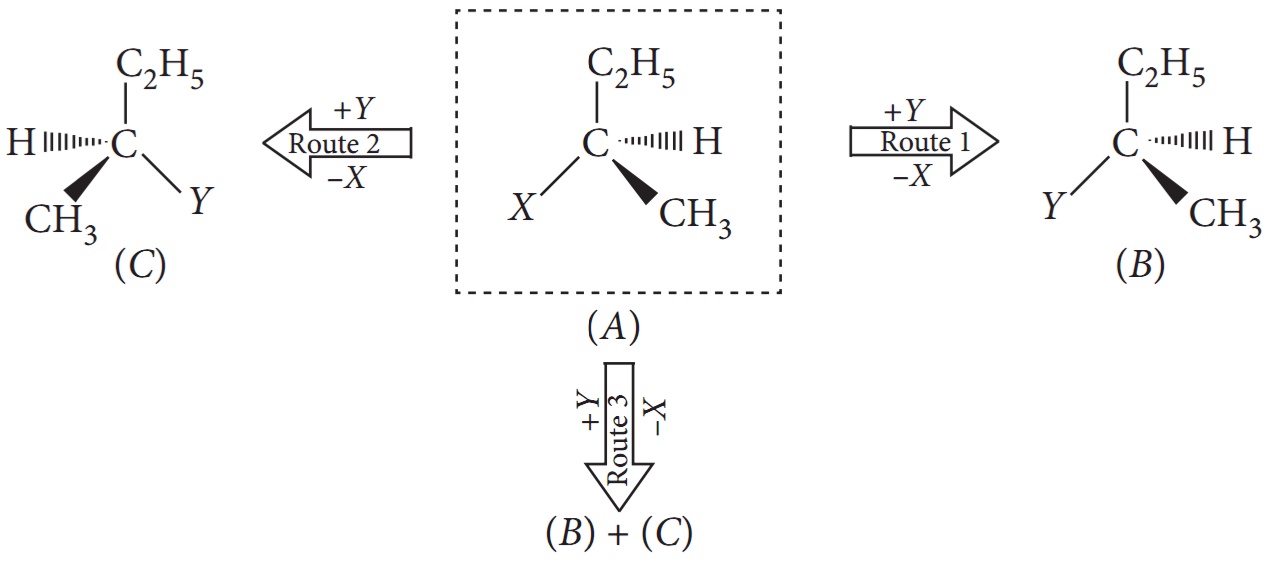
Read the passage given below and answer the following questions: For understanding the structure and bonding in transition metal complexes, the magnetic properties are very helpful. Low spin complexes are generally diamagnetic because of pairing of electrons, whereas high spin complexes are usually paramagnetic because of presence of unpaired electrons. Larger the number of unpaired electrons, stronger will be the paramagnetism. However magnetic behaviour of a complex can be confirmed from magnetic moment measurement. Magnetic moment $\mu=\sqrt{\text{n(n+2)}}\text{B.M.}$ where n = number of unpaired electrons. Greater the number of unpaired electrons, more will be the magnetic moment. In these questions (Q. No. i-iv), a statement of assertion followed by a statement ofreason is given. Choose the correct answer out of the following choices.
→- Assertion and reason both are correct statements and reason is correct explanation for assertion.
- Assertion and reason both are correct statements but reason is not correct explanation for assertion.
- Assertion is correct statement but reason is wrong statement.
- Assertion is wrong statement but reason is correct statement.
- Assertion: Both [Cr(H2O)6]2+ and [Fe(H2O)6]2+ have same magnetic moment.
Reason: Number of unpaired electrons in Cr2+ and Fe2+ are same.
- Assertion: [Fe(H2O)5NO]SO4 is paramagnetic.
Reason: The Fe in [Fe(H2O)5NO]SO4 has three unpaired electrons.
- Assertion: [Co(en)3]3+ is paramagnetic.
Reason: It is an inner orbital complex.
- Assertion: [Ni(CO)4] is diamagnetic and tetrahedral in shape.
Reason: [Ni(CO)4] contains no unpaired electrons and involves dsp2 hybridisation.
- Assertion: [Ni(CN)4]2- is diamagnetic complex.
Reason: It involves dsp2 hybridisation and there is no unpaired electron.
Read the passage given below and answer the following questions: If some solute is added to a solvent, the boiling point of solution increases. This is known as elevation in baiting point. $\Delta\text{T}_\text{b}=\text{K}_\text{b}\text{m}$ where, Kb = Molal elevation constant, $\Delta\text{T}_\text{b}\propto\text{m}$ Hence, it is a colligative property, Also, $\text{K}_\text{b}=\frac{\text{MRT}^2_\text{b}}{\Delta\text{Vap}\text{H}\times1000}$ where, M = Molar mass of solvent, $\Delta\text{vap}$ H = Enthalpy of vaporisation, Molar mass can also be calculated using elevation in boiling point. $\text{M}_\text{B}=\frac{\text{K}_\text{B}\times\text{W}_\text{B}\times1000}{\Delta\text{T}_\text{b}\times\text{W}_\text{A}}$ A statement of assertion followed by a statement of reason is given. Choose the correct answer out of the following choices.
→→- Assertion and reason both are correct statements and reason is correct explanation for assertion.
- Assertion and reason both are correct statements but reason is not correct explanation for assertion.
- Assertion is correct statement but reason is wrong statement.
- Assertion is wrong statement but reason is correct statement.
- Assertion: In a pressure cooker, the water is brought to boil. The cooker is then removed from the stove. Now on removing the lid of pressure cooker, the water starts boiling again.
Reason: The impurities in water bring down its boiling point.
- Assertion: On dissolving 3.24g of sulphur in 40g of benzene, boiling point of solution get higher than that of benzene by 0.081K, then the formula of sulphur is S8. (Kb for benzene = 2.53K kg mol-1)
Reason: Molecular mass of sulphur comes out to be 253.
- Assertion: When sugar is added to water, boiling point of water increases.
Reason: When a non-volatile solute is added to a solvent, elevation in boiling point is observed.
- Assertion: Cooking time in pressure cookers is reduced.
Reason: Boiling point inside the pressure cooker in raised.
- Assertion: Elevation in boiling point of two isotonic solutions is same.
Reason: Boiling point depends upon the concentration of the solute.
Read the passage given below and answer the following questions: At the freezing point of a solvent, the solid and the liquid are in equilibrium. Therefore, a solution will freeze when its vapour pressure becomes equal to the vapour pressure of the pure solid solvent. It has been observed that when a non-volatile solute is added to a solvent, the freezing point of the solution is always lower than that of the pure solvent. Depression in freezing point can be given as, $\Delta\text{T}_\text{f}=\text{K}_\text{f}\text{m}$ Where, Kf = Molal freezing point depression constant or we can write, $\Delta\text{T}_\text{f}=\frac{\text{K}_\text{f}\times\text{W}_\text{B}\times1000}{\text{W}_A\times\text{M}_\text{B}}$ a statement of assertion followed by a statement of reason is given. Choose the correct answer out of the following choices.
→- Assertion and reason both are correct statements and reason is correct explanation for assertion.
- Assertion and reason both are correct statements but reason is not correct explanation for assertion.
- Assertion is correct statement but reason is wrong statement.
- Assertion is wrong statement but reason is correct statement.
- Assertion: 0.1M solution of glucose has same depression in the freezing point as 0.1M solution of urea.
Reason: Kf for both has same value.
- Assertion: Increasing pressure on pure water decreases its freezing point.
Reason: Density of water is maximum at 273K.
- Assertion: Larger the value of cryoscopic constant of the solvent, lesser will be the freezing point of the solution.
Reason: Extent of depression in the freezing point depends on the nature of the solvent.
- Assertion: The water pouch of instant cold pack for treating athletic injuries breaks when squeezed and NH4N03 dissolves thus lowering the temperature.
Reason: Addition of non-volatile solute into solvent results into depression of freezing point of solvent.
- Assertion: If a non-volatile solute is mixed in a solution then elevation in boiling point and depression in freezing point both wiII be same.
Reason: Elevation in boiling point and depression in freezing point both depend on number of particles of solute.
Read the passage given below and answer the following questions: Ligands are atoms or ions which can donate electrons to the central atoms. Ligands can be monodentate, bidentate or polydentate as well. Few ligands can coordinate with the central atom through more than one site, these are called ambidentate ligands. When a di- or polydentate ligand uses its two or more donor atoms to bind a single metal ion, it is said to be a chelating ligand. In these questions (Q. No. i-iv), a statement of assertion followed by a statement ofreason is given. Choose the correct answer out of the following choices.
- Assertion and reason both are correct statements and reason is correct explanation for assertion.
- Assertion and reason both are correct statements but reason is not correct explanation for assertion.
- Assertion is correct statement but reason is wrong statement.
- Assertion is wrong statement but reason is correct statement.
- Assertion: Glycinate ion is an example of monodentate ligand.
Reason: Glycinate contains N and O as donor atoms.
- Assertion: EDTA forms complex with divalent metals of 3d-series in the ratio of 1 : 1.
Reason: EDTA has 4 - COOH groups.
- Assertion: Oxalate ion is a bidentate ligan.
Reason: Oxalate ion has two donor atoms.
- Assertion: A chelating ligand must possess two or more lone pairs at such a distance that it may form suitable strain free 5 and 6 membered rings with the metal ion.
Reason: H2N - NH2 is a chelating ligand.
- Assertion: In Zeise's salt coordination number of Pt is five.
Reason: Ethene is a monodentate ligand.
Read the passage given below and answer the following questions:
The f-block elements are those in which the differentiating electron enters the (n -2)f orbital. There are two series of F-block elements corresponding to filling of 4f and 5f-orbitals. The series of 4f-orbitals is called lanthanides. Lanthanides show different oxidation states depending upon stability of f0, f7 and F14 configurations, though the most conunon oxidation states is +3. There is a regular decrease in size oflanthanides ions with increase in atomic number which is known as lanthanide contraction.
The following questions are multiple choice questions. Choose the most appropriate answer:
The f-block elements are those in which the differentiating electron enters the (n -2)f orbital. There are two series of F-block elements corresponding to filling of 4f and 5f-orbitals. The series of 4f-orbitals is called lanthanides. Lanthanides show different oxidation states depending upon stability of f0, f7 and F14 configurations, though the most conunon oxidation states is +3. There is a regular decrease in size oflanthanides ions with increase in atomic number which is known as lanthanide contraction.
The following questions are multiple choice questions. Choose the most appropriate answer:
- The atomic numbers of three lanthanide elements X, Y and Z are 65, 68 and 70 respectively, their Ln3+ electronic configuration is:
- 4f8, 4f11, 4f13
- 4f11, 4f8, 4f13
- 4f0, 4f2, 4f11
- 4f3, 4f7, 4f9
- Lanthanide contraction is observed in:
- Gd
- At
- Xe
- Te
- Which of the following is not the configuration oflanthanoid?
- [Xe]4f106s2
- [Xe]4f15d16s2
- [Xe]4d145d106s2
- [Xe]4f75d16s2
- Name a member of the lanthanoid series which is well known to exhibit +4 oxidation state.
- Cerium (Z = 58)
- Europium (Z = 63)
- Lanthanum (Z = 57)
- Gadolinium (Z = 64
- Identify the incorrect statement among the following.
- Lanthanoid contraction is the accumulation of successive shrinkages.
- The different radii of Zr and Hf due to consequence of the lanthanoid contraction.
- Shielding power of 4f electrons is quite weak.
- There is a decrease in the radii of the atoms or ions as one proceeds from La to Lu.