Question
Read the passage given below and answer the following questions:

For understanding the structure and bonding in transition metal complexes, the magnetic properties are very helpful. Low spin complexes are generally diamagnetic because of pairing of electrons, whereas high spin complexes are usually paramagnetic because of presence of unpaired electrons. Larger the number of unpaired electrons, stronger will be the paramagnetism. However magnetic behaviour of a complex can be confirmed from magnetic moment measurement. Magnetic moment $\mu=\sqrt{\text{n(n+2)}}\text{B.M.}$ where n = number of unpaired electrons. Greater the number of unpaired electrons, more will be the magnetic moment.

In these questions (Q. No. i-iv), a statement of assertion followed by a statement ofreason is given. Choose the correct answer out of the following choices.

  1. Assertion and reason both are correct statements and reason is correct explanation for assertion.
  2. Assertion and reason both are correct statements but reason is not correct explanation for assertion.
  3. Assertion is correct statement but reason is wrong statement.
  4. Assertion is wrong statement but reason is correct statement.
The following questions are multiple choice questions. Choose the most appropriate answer:

  1. Assertion: Both [Cr(H2O)6]2+ and [Fe(H2O)6]2+ have same magnetic moment.

Reason: Number of unpaired electrons in Cr2+ and Fe2+ are same.

  1. Assertion: [Fe(H2O)5NO]SO4 is paramagnetic.

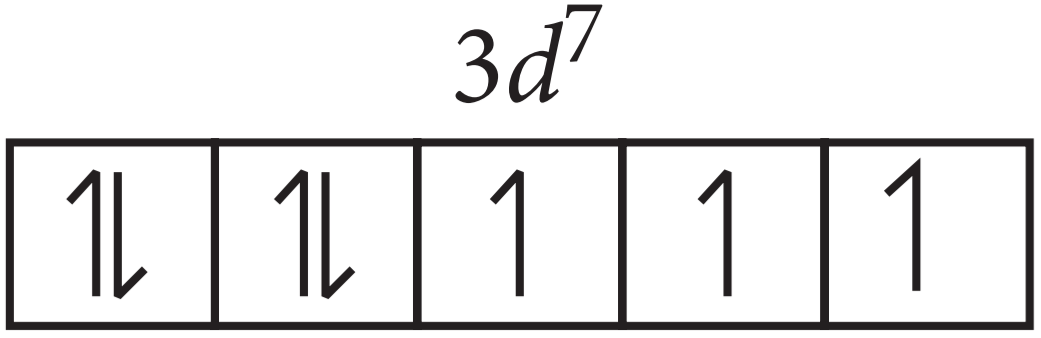
Reason: The Fe in [Fe(H2O)5NO]SO4 has three unpaired electrons.

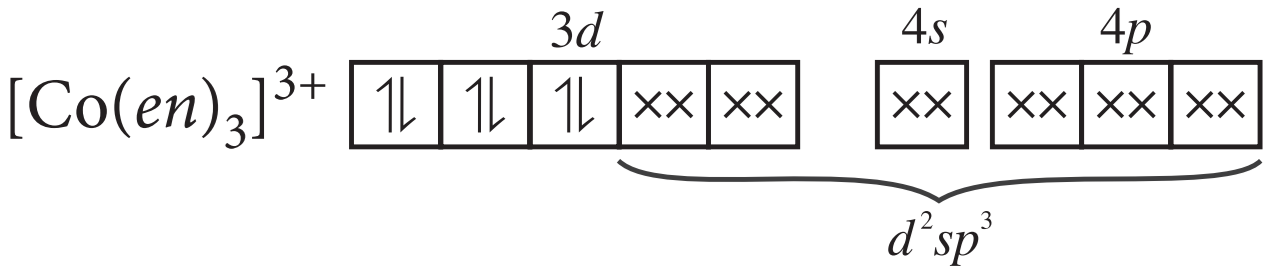
  1. Assertion: [Co(en)3]3+ is paramagnetic.

Reason: It is an inner orbital complex.

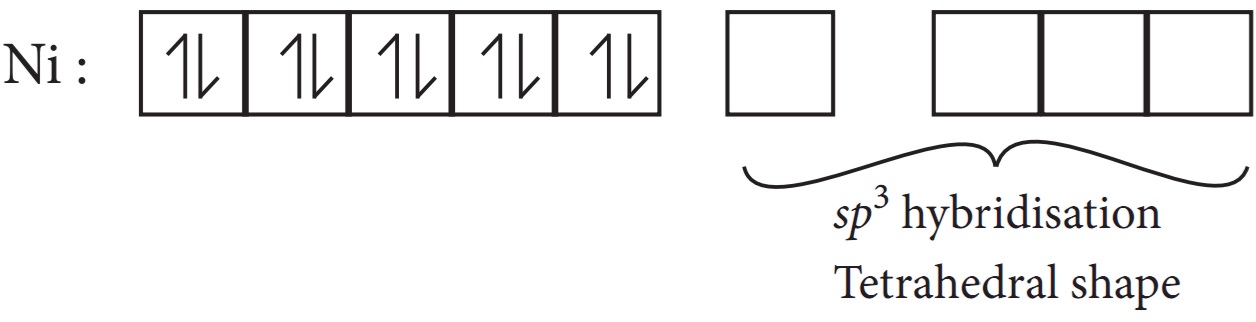
  1. Assertion: [Ni(CO)4] is diamagnetic and tetrahedral in shape.

Reason: [Ni(CO)4] contains no unpaired electrons and involves dsp2 hybridisation.

  1. Assertion: [Ni(CN)4]2- is diamagnetic complex.

Reason: It involves dsp2 hybridisation and there is no unpaired electron.
Need a full question paper?

Generate a complete, print-ready paper with questions like this in minutes — across 16+ boards, with answer keys.

Start Generating Free

Similar questions

Read the passage given below and answer the following questions:

The aryl halides are relatively less reactive towards nucleophilic substitution reactions as compared to alkyl halides. This low reactivity can be attributed to the following factors:

  • The C - X bond in halobenzene has a partial double bond character due to involvement of halogen electrons in resonance with benzene ring.
  • The C - X bond in aryl halides is less polar as compared to that in alkyl halides as sp2 hyridised carbon is more electronegative than sp3 hybridised carbon.

In these questions (Q. No. i-Iv), a statement of assertion followed by a statement of reason is given. Choose the correct answer out of the following choices.

  1. Assertion and reason both are correct statements and reason is correct explanation for assertion.
  2. Assertion and reason both are correct statements but reason is not correct explanation for assertion.
  3. Assertion is correct statement but reason is wrong statement.
  4. Assertion is wrong statement but reason is correct statement.
  1. Assertion: Primary benzylic halides are more reactive than primary alkyl halides towards SN1 reactions.

Reason: Reactivity depends upon the nature of the nucleophile and the solvent.

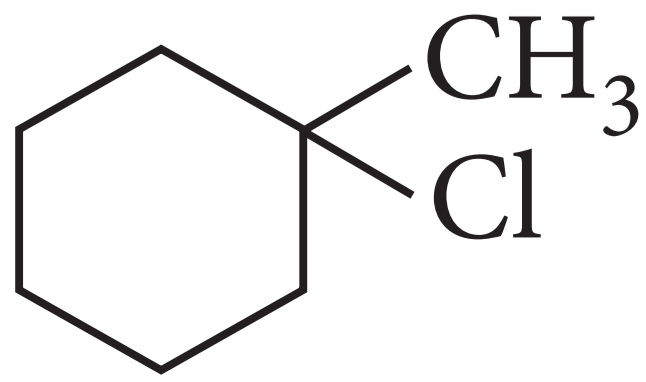
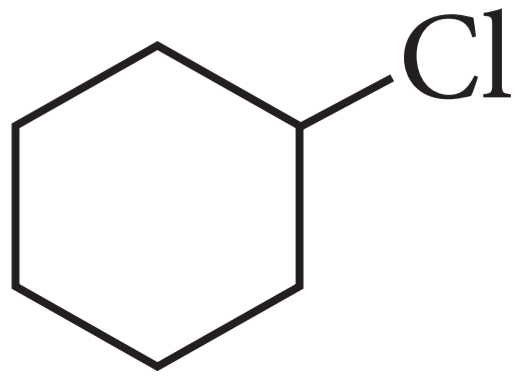
  1. Assertion: is more reactive than towards nucleophilic substitution reactions.
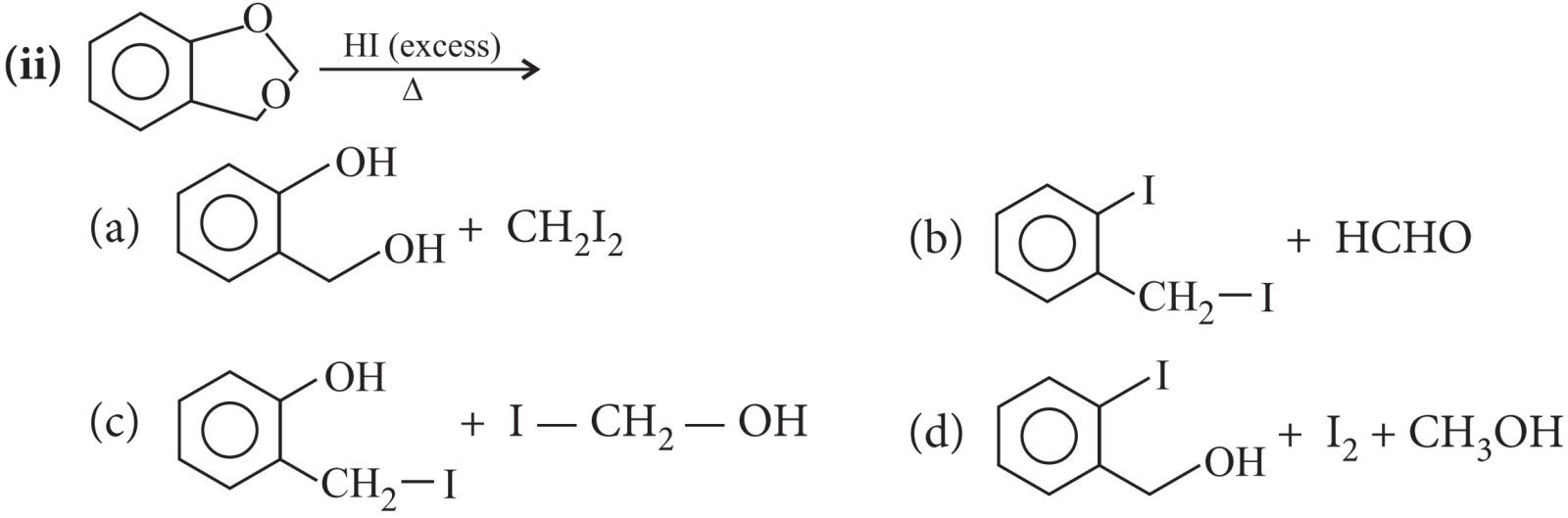
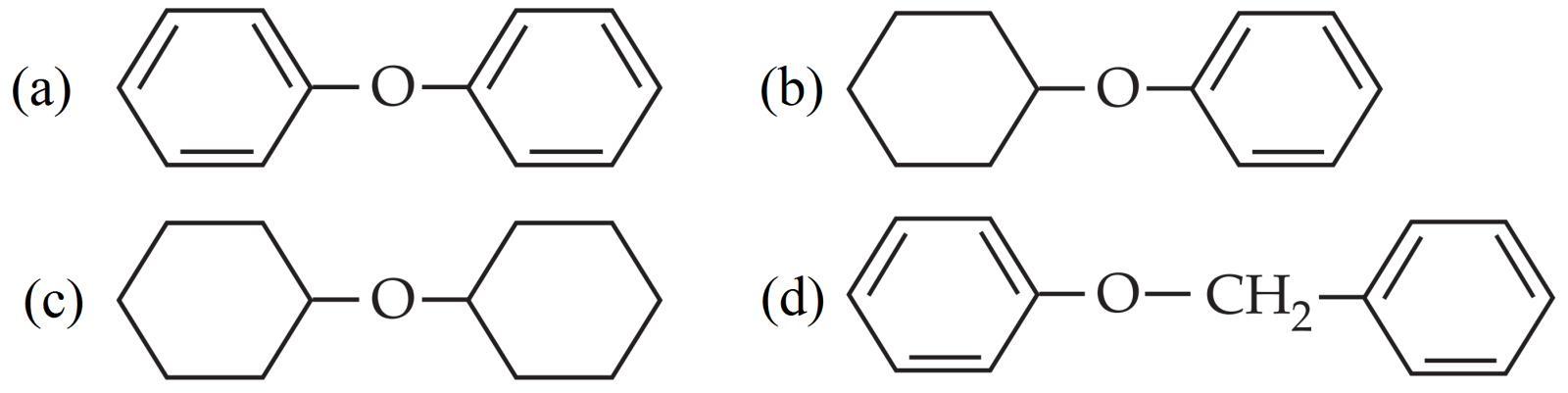
Reason: Tertiary alkyl halides react predominantly by SN1 mechanism.

  1. Assertion: Chlorobenzene is more reactive than p-chloroanisole to nucleophilic substitution reactions.

Reason: Greater the stability of carbanion, greater is its ease of formation and hence, more reactive is the aryl halide.

  1. Assertion: 4-Nitrochlorobenzene undergoes nucleophilic substitution more readily than chlorobenzene.

Reason: Chlorobenzene undergoes nucleophilic substitution by elimination-addition mechanism while 4-nitrochlorobenzene undergoes nucleophilic substitution by addition-elimination mechanism.

  1. Assertion: Chlorobenzene is less reactive than benzene towards the electrophilic substitution reaction.

Reason: Resonance destabilises the carbocation.

Read the passage given below and answer the following questions:

Ethers are readily cleaved by HI or HBr at 373K to form an alcohol and an alkyl halide.

$\text{R}-\text{O}-\text{R}+\text{HX}\xrightarrow{373\text{K}}\text{R}-\text{X}+\text{R}-\text{OH}$

$\text{R}-\text{OH}+\text{HX}\xrightarrow{373\text{K}}\text{R}-\text{X}+\text{H}_2\text{O}$

Mixed ether, containing primary or secondary alkyl group, when heated with hydrogen halide, the lower alkyl group forms halide and higher will form an alcohol. Tertiary alkyl ether when heated with hydrogen halide gives tertiary alkyl halide.

The following questions are multiple choice questions. Choose the most appropriate answer:

  1. Among the following ethers, which one will produce methyl alcohol on treatment with hot concentrated HI?
  1. $\ \ \ \ \ \ \ \ \ \ \ \ \text{CH}_3\\\ \ \ \ \ \ \ \ \ \ \ \ \ \ |\\\text{CH}_3-\text{C}-\text{O}- \text{CH}_3\\\ \ \ \ \ \ \ \ \ \ \ \ \ \ |\\\ \ \ \ \ \ \ \ \ \ \ \ \ \text{CH}_3 $

  2. $\text{CH}_3-\text{CH}-\text{CH}_2-\text{O}-\text{CH}_3\\\ \ \ \ \ \ \ \ \ \ \ \ \ |\\\ \ \ \ \ \ \ \ \ \ \ \text{CH}_3$

  3. $\text{CH}_3-\text{CH}_2-\text{CH}_2-\text{CH}_2-\text{O}-\text{CH}_3$

  4. $\text{CH}_3-\text{CH}_2-\text{CH}-\text{O}-\text{CH}_3\\\ \ \ \ \ \ \ \ \ \ \ \ \ \ \ \ \ \ \ \ \ \ \ \ \ \ |\\\ \ \ \ \ \ \ \ \ \ \ \ \ \ \ \ \ \ \ \ \ \ \ \ \ \text{CH}_3$

  1. When CH2 = CH - O - CH2 - CH3 reacts with one mole of HI, one of the products formed is:
  1. Ethane.
  2. Ethanol.
  3. Iodoethene.
  4. Ethanal.
  1. (CH3)3COCH3 and CH3OC2H5 are treated with hydroiodic acid. The fragments obtained after reactions are respectively:
  1. (CH3)3CI + CH3OH; CH3I + C2H5OH

  2. (CH3)3CI + CH3OH; CH3OH + C2H5I

  3. (CH3)3COH + CH3I; CH3OH + C2H5I

  4. CH3I + (CH3)3COH; CH3I + C2H5OH

  1. Which of the following ether is unlikely to be cleaved by hot cone. HBr?

The electrochemical cell shown below is concentration cell.

M|M2+ (saturated solution of a sparingly soluble salt, MX2) || M2+ (0.001 mol dm-3) |M The emfof the cell depends on the difference in concentrations of M2+ ions at the two electrodes. The emf of the cell at 298 K is 0.059V.

The following questions are multiple choice questions. Choose the most appropriate answer:

  1. The solubility product (Ksp' mol3 dm-9) of MX2 at 298 K based on the information available for the given concentration cell is $(\text{take }2.303 \times \text{R}\times \frac{298}{\text{F}} = 0.059)$
  1. 2 × 10-15
  2. 4 × 10-15
  3. 3 × 10-12
  4. 1 × 10-12
  1. The value of $\triangle\text{G}$ (in kJ mol-1) for the given cell is (take 1 F = 96500 C mol-1)

  1. 3.7
  2. -3.7
  3. 10.5
  4. -11.4
  1. The equilibrium constant for the foUowing reaction is:

$\text{Fe}^{2+}+\text{Ce}^{4+}\rightleftharpoons\text{Ce}^{3+}+\text{Fe}^{3+}$

(Given, $\text{E}^\circ_\frac{\text{Ce}^{4+}}{\text{Ce}^{3+}}=1.44\text{V}$ and $\text{E}^\circ_\frac{\text{Fe}^{3+}}{\text{Fe}^{2+}}=0.68\text{V}$)

  1. 7.6 × 10¹²
  2. 6.5 × 1010
  3. 5.2 × 109
  4. 3.4 × 1012
  1. The solubility product of a saturated solution of Ag2CrO4 in water at 298 K if the emf of the cell

Ag|Ag+ (satd. Ag2CrO4 soln) || Ag+ (0.1 M) | Ag

is 0.164V at 298 K, is:

  1. 3.359 × 10⁻¹² mol3 L-3
  2. 2.287 × 10⁻¹² mol3 L-3
  3. 1.158 × 10⁻¹² mol3 L-3
  4. 4.135 × 10⁻¹² mol3 L-3
  1. To calculate the emf of the cell, which of the foUowing options is correct?
  1. emf = Ecathode - Eanode
  2. emf = Eanode - Ecathode
  3. emf = Eanode + Ecathode
  4. None of these.
Read the passage given below and answer the following questions:

Williamson's synthesis is used for the preparation of symmetrical as well as unsymmerical ether. It is SN2 reaction mechanism. In Williamson's synthesis, 1º alkyl halide are used for preparation of ethers because 2º and 3º alkyl halide give alkene. Ethers are cleaved by hydrogen halides to alcohol and alkyl halide where alkyl halide is corresponding to that alkyl which has less number of carbon atom (it is because of less steric hindrance). In polar media unsymmetrical ether like tertiary butyl ethyl ether gives ethyl alcohol and tertiary butyl halide as reaction proceeds via carbocation.

In these questions (Q. No. i-iv), a statement of assertion followed by a statement of reason is given. Choose the correct answer out of the following choices.

  1. Assertion and reason both are correct statements and reason is correct explanation for assertion.
  2. Assertion and reason both are correct statements but reason is not correct explanation for assertion.
  3. Assertion is correct statement but reason is wrong statement.
  4. Assertion is wrong statement but reason is correct statement.
  1. Assertion: Rate of reaction of alkyl halide in Williamson's synthesis reaction is 1ºRX > 2ºRX > 3ºRX.

Reason: It is a type of bimolecular substitution reaction (SN2).

  1. Assertion: T-Butyl methyl ether is not prepared by the reaction of t-butyl bromide with sodium methoxide.

Reason: Sodium methoxide is a weak nucleophile.

  1. Assertion: Williamson's synthesis method cannot be used for preparing diphenyl ether.

Reason: Aryl halides do not undergo nucleophilic substitution easily.

  1. Assertion: When isopropyl bromide is treated with sodium isopropoxide, di-isopropyl ether is obtained as a major product.

Reason: With secondary alkyl halides, both substitution and elimination occur.

  1. Assertion: Both symmetrical and unsymmetrical ethers can be prepared by Williamson's synthesis.

Reason: Williamson's synthesis is an example of nucleophilic substitution reaction.

Read the passage given below and answer the following questions
Few colligative properties are:
  1. Relative lowering of vapour pressure: depends only on molar concentration of solute (mole fraction) and independent of its nature.
  2. Depression in freezing point: it is proportional to the molal concentration of solution.
  3. Elevation of boiling point: it is proportional to the molal concentration of solute.
  4. Osmotic pressure: it is proportional to the molar concentration of solute
A solution of glucose is prepared with 0.052 g at glucose in 80.2 g of water.(KJ = 1.86K kg mol-1 and Kb = 5.2K kg mol-1)
The following questions are multiple choice questions. Choose the most appropriate answer:
  1. Molality of the given solution is.
  1. 0.0052m
  2. 0.0036m
  3. 0.0006m
  4. 1.29m
  1. Boiling point for the solution will be.
  1. 373.05K
  2. 373.15K
  3. 373.02K
  4. 373.02K
  1. The depression in freezing point of solution will be.
  1. 0.0187K
  2. 0.035K
  3. 0.082K
  4. 0.067K
  1. Mole fraction of glucose in the given solution is.
  1. 6.28 × 10⁻⁵
  2. 6.28 × 10⁻⁴
  3. 0.00625
  4. 0.00028
  1. If same amount of sucrose (C12 H22 O11) is taken instead of glucose, then.
  1. Elevation in boiling point will be higher.
  2. Depression in freezing point will be higher.
  3. Depression in freezing point will be lower.
  4. Both (a) and (b).
Read the passage given below and answer the following questions:

Transition metal oxides are compounds fanned by the reaction of metals with oxygen at high temperature. The highest oxidation number in the oxides coincides with the group number. In vanadium, there is a gradual change from the basic V2O3 to less basic V2O4 and to amphoteric V2O5· V2O4 dissolves in acids to give VO2+ salts. Transition metal oxides are commonly utilized for their catalytic activity and semi conductive properties. Transition metal oxides are also frequently used as pigments in paints and plastic. Most notably titatnium dioxide. One of the earliest application of transition metal oxides to chemical industry involved the use of vanadium oxide for catalytic oxidation of sulfur dioxide to sulphuric acid. Since then, many other applications have emerged, which include benzene oxidation to maleic anhydride on vandium oxides; cyclohexane oxidation to adipic acid on cobalt oxides. An important property of the catalyst material used in these processes is the ability of transition metals to change their oxidation state under a given chemical potential of reductants and oxidants.

The following questions are multiple choice questions. Choose the most appropriate answer:

  1. Which oxide of vanadium is most likely to be basic and ionic?
  1. VO
  2. V2O3
  3. VO2
  4. V2O5
  1. Vanadyl ion is:
  1. $\text{VO}^{2+}$
  2. $\text{VO}^{+}_2$
  3. $\text{V}_{2}\text{O}^+$
  4. $\text{VO}^{3-}_4$
  1. Which of the following statements is false?
  1. With fluorine vanadium can form VF5.
  2. With chlorine vanadium can form VCl5.
  3. Vanadium exhibits highest oxidation state in oxohalides VOCl3, VOBr3 and fluoride VF5.
  4. With iodine vanadium cannot form Vl5 due to oxidising power of V5+ and reducing nature of I-.
  1. The oxidation state of vanadium in V2O5 is:
  1. $\frac{+5}{2}$

  2. +7
  3. +5
  4. +6
  1. Identify the oxidising agent in the following reaction.

V2O+ 5Ca → 2V + 5CaO

  1. V2O5
  2. Ca
  3. V
  4. None of these.
Read the passage given below and answer the following questions:
Coordination compounds are formulated and named according to the IUPAC system.
Few rules for naming coordination compounds are:
  1. In ionic complex, the cation is named first and then the anion.
  2. In the coordination entity, the ligands are named first and then the central metal ion.
  3. When more than one type of ligands are present, they are named in alphabetical order of preference without any consideration of charge.
The following questions are multiple choice questions. Choose the most appropriate answer:
  1. The IUPAC name of the complex [Pt(NH3)3Br(NO2)Cl]Cl is:
  1. Triamminechlorobromonitroplatinum (IV) chloride.
  2. Triamminebromonitrochloroplatinum (IV) chloride.
  3. Triamminebromidochloridonitroplatinum (IV) chloride.
  4. Triamminenitrochlorobromoplatinum (IV) chloride.
  1. The IUPAC name of [Ni(CO)4] is:
  1. Tetracarbonylnickel (II).
  2. Tetracarbonylnickel (0).
  3. Tetracarbonylnickelate (II).
  4. Tetracarbonylnickelate (0).
  1. As per IUPAC nomenclature, the name of the complex [Co(H2O)4(NH3)2]Cl3 is:
  1. Tetraaquadiamminecobalt (II) chloride.
  2. Tetraaquadiamminecobalt (III) chloride.
  3. Diamminetetraaquacobalt (II) chloride.
  4. Diamminetetraaquacobalt (III) chloride.
  1. Which of the following represents correct formula of dichloridobis(ethane -1, 2-diamine)cobalt (III) ion?
  1. [CoCl2(en)]2+
  2. [CoCl2(en)2]2+
  3. [CoCl2(en)]+
  4. [CoCl2(en)2]+
  1. Correct formula of pentaamminenitro-O-cobalt (III) sulphate is:
  1. [Co(NO2)(NH3)5]SO4
  2. [Co(ONO)(NH3)5]SO4
  3. [Co(NO2)(NH3)4](SO4)2
  4. [Co(ONO)(NH3)4](SO4)2
Molar conductivity of ions are given as product of charge on ions to their ionic mobilities and Faradays constant.
$\lambda_\text{A}\text{n}+=\text{n}\mu_\text{A}\text{n}+\text{F}$ (here $\mu$ is the ionic mobility of An+)
For electrolytes say AxBy, molar conductivity is given by
$\lambda_{\text{m}(\text{A}_\text{x}\text{B}_\text{y})}=\text{x}_\text{n}\mu_{\text{A}^\text{n}}+\text{F}+\text{y}_\text{m}\lambda_{\text{A}^\text{m}}-\text{F}$
Ions
Ionic mobility
K+
7.616 × 10⁻⁴
Ca2+
12.33 × 10-4
Br-
8.09 × 10-4
$\text{SO}_{4}^{2-}$
16.58 × 10-4
The following questions are multiple choice questions. Choose the most appropriate answer:
  1. At infinite dilution, the equivalent conductance of CaSO4 is:
  1. 256 × 10-4
  2. 279
  3. 23.7
  4. 2.0 × 10-8
  1. If the degree of dissociation of CaSO4 solution is 10% then equivalent conductance of CaSO4 is:
  1. 3.59
  2. 36.9
  3. 27.9
  4. 30.6
  1. The correct order of equivalent conductance at infinite dilution of LiCl, NaCl, KCl is:
  1. LiCl = NaCl = KCl
  2. LiCl > NaCl > KCl
  3. KCl > LiCl > NaCl
  4. KCl > NaCl > LiCl
  1. What is the unit of equivalent conductivity?
  1. ohm-1 cm2 eq-1
  2. ohm cm2 eq-1
  3. ohm-1 cm eq-1
  4. ohm cm-2eq-2
  1. If the molar conductance value of Ca2+ and Cl- at infinite dilution are 118.88 × 10-4m2 mho mol-1 and 77.33 × 10-4m2 mho mol-1 respectively then the molar conductance of CaCl2 (in m2 mho mol-1) will be:
  1. 120.18 × 10⁻⁴
  2. 135 × 10-4
  3. 273.54 × 10⁻⁴
  4. 192.1 × 10⁻⁴
Read the passage given below and answer the following questions:
A compound (X) containing C, H and O is unreactive towards sodium. It also does not react with Schiff s reagent. On refluxing with an excess of hydroiodic acid, (X) yields only one organic product ( Y). On hydrolysis, (Y) yields a new compound (Z) which can be converted into (Y) by reaction with red phosphorus and iodine. The compound (Z) on oxidation with potassium permanganate gives a carboxylic acid. The equivalent weight of this acid is 60.
The following questions are multiple choice questions. Choose the most appropriate answer:
  1. The compound (X) is an:
  1. Acid.
  2. Aldehyde.
  3. Alcohol.
  4. Ether.
  1. The IUPAC name of the acid formed is:
  1. Methanoic acid.
  2. Ethanoic acid.
  3. Propanoic acid.
  4. Butanoic acid.
  1. Compound (Y) is:
  1. Ethyl iodide.
  2. Methyl iodide.
  3. Propyl iodide.
  4. Mixture of (a) and (b).
  1. Compound (Z) is:
  1. Methanol.
  2. Ethanol.
  3. Propanol.
  4. Butanol.
  1. Compound (X) on treatment with excess of Cl2 in presence of tight gives:
  1. $\propto-$ Chlorodiethyl ether.
  2. $\propto,\propto'-$ Dichlorodiethyl ether.
  3. Perchlorodiethyl ether.
  4. None of these.