Question
Read the passage given below and answer the following questions:
Both alcohols and phenols are acidic in nature, but phenols are more acidic than alcohols. Acidic strength of alcohols mainly depends upon the inductive effect. Acidic strength of phenols depends upon a combination of both inductive effect and resonance effects of the substituent and its position on the benzene ring. Electron withdrawing groups increases the acidic strength of phenols whereas electron donating groups decreases the acidic strength of phenols. Phenol is a weaker acid than carboxylic acid.
The following questions are multiple choice questions. Choose the most appropriate answer:
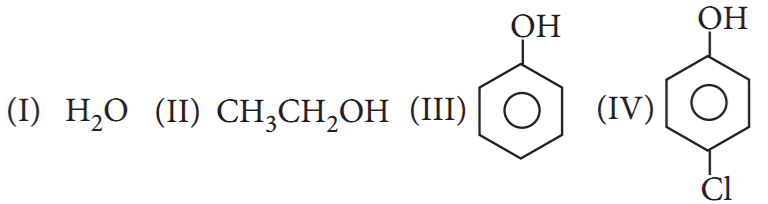
  1. Phenols are highly acidic as compare to alcohols due to:
  1. The higher molecular mass of phenols.
  2. The stronger hydrogen bonds in phenols.
  3. Alkoxide ion is a strong conjugate base.
  4. Phenoxide ion is resonance stabilised.
  1. The correct order of acidic strength among the following is:
  1. (III) > (IV) > (II) > (I)
  2. (IV) > (III) > (I) > (II)
  3. (IV) > (III) > (II) > (I)
  4. (I) > (II) > (IV) > (III)
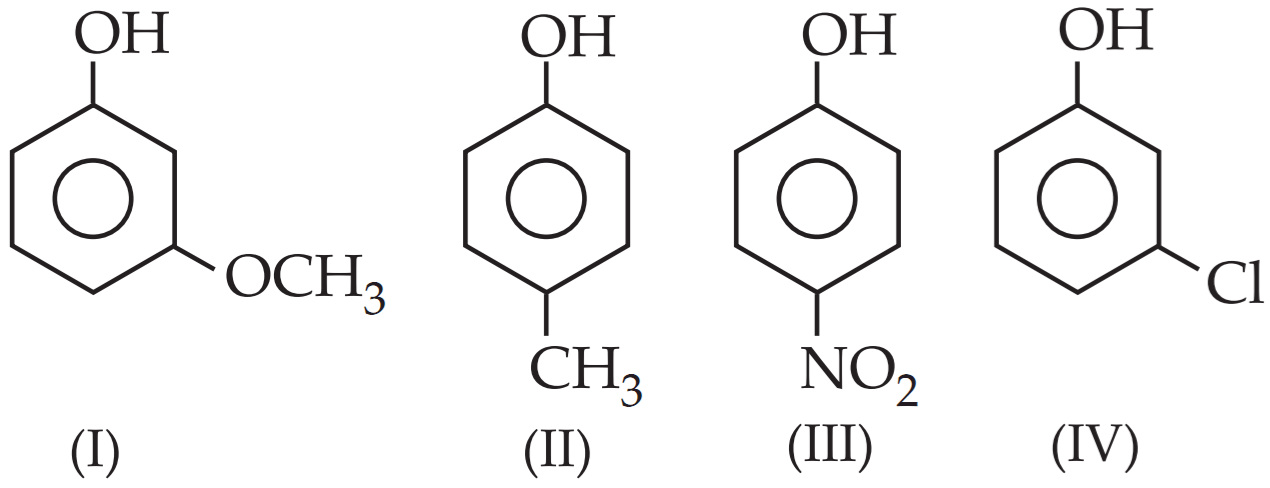
  1. The correct decreasing order of $pK_a$ value is:
  1. II > IV > I > III
  2. IV > II > III > I
  3. II I> II > IV > I
  4. IV > I > II > III
  1. The compound that does not liberate $CO_2$, on treatment with aqueous sodium bicarbonate solution is:
  1. Benzoic acid.
  2. Benzenesulphonic acid.
  3. Salicylic acid.
  4. Carbolic acid.
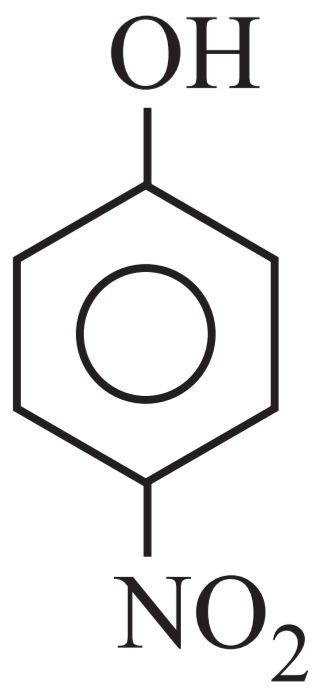
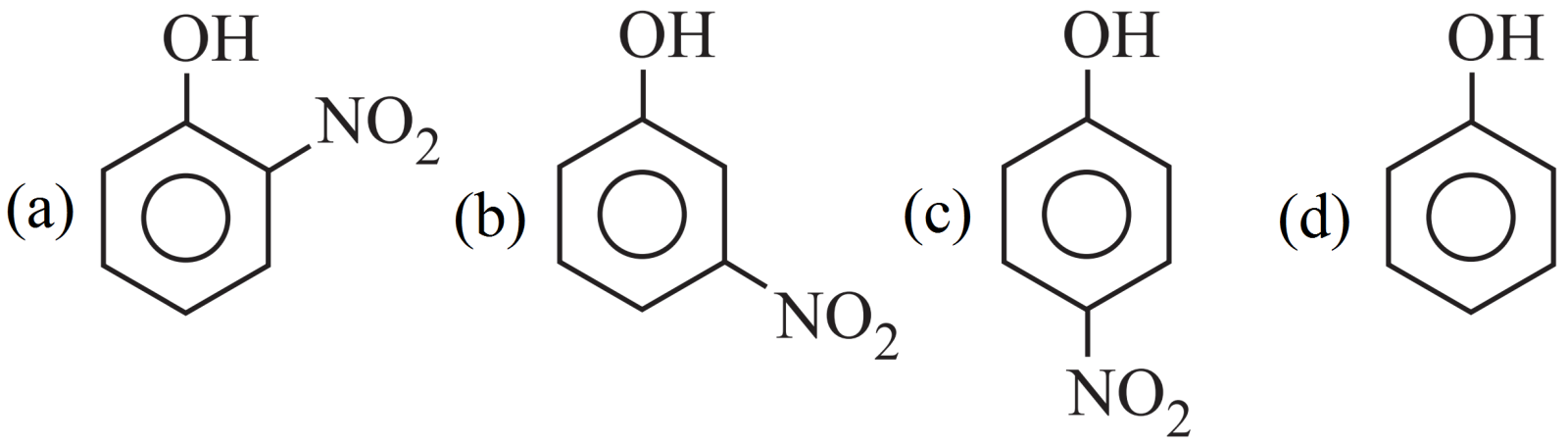
  1. Most acidic amongst the following is:

Answer

  1. (d) Phenoxide ion is resonance stabilised.
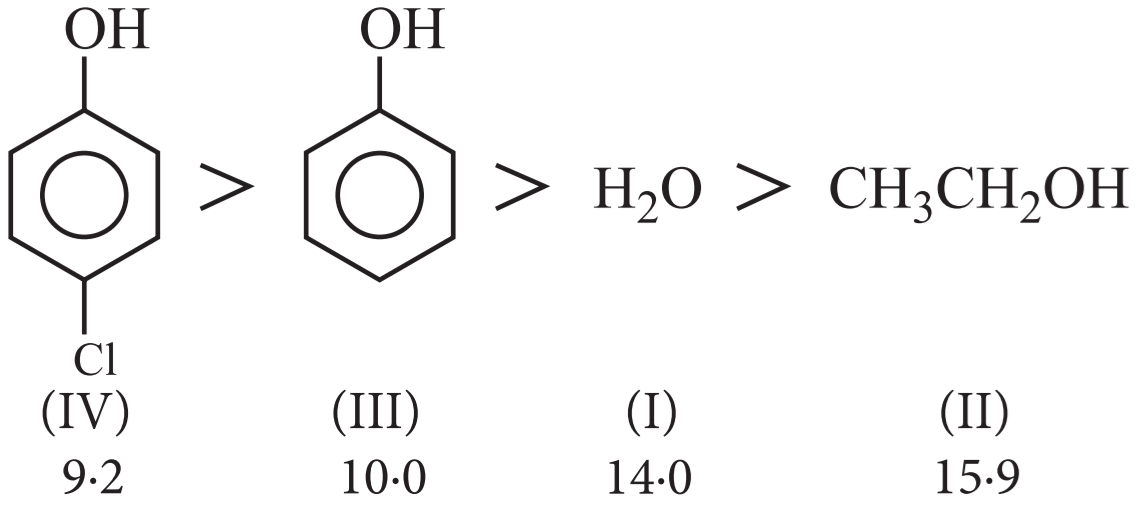
  2. (b) (IV) > (III) > (I) > (II)
Explanation:
The order of acidic strength is,
  1. (a) II > IV > I > III
Explanation:
Weaker acids have higher $pK_a. - OCH_3$ at meta-position exerts only - I effect, hence increases the acidity.
- I effect order: - $NO_2 > - OCH_3 > - Cl$.
- $CH_3$ has + I effect. So, order is (a).
  1. (d) Carbolic acid.
Explanation:
Phenol (Carbolic acid) is a weaker acid than carbonic acid $(H_2CO_3)$ and does not liberate $CO_2​​​​​​​$​​​​​​​ on treatment with aqueous sodium bicarbonate solution.
  1. (c)

​​​​​​​​​​​​​​Explanation:
- $NO_2$ exhibits both - I and - R influence to stabilise the corresponding phenoxide. ln ortho derivative, intermolecular H - bonding lowers the acidity.

Need a full question paper?

Generate a complete, print-ready paper with questions like this in minutes — across 16+ boards, with answer keys.

Start Generating Free

Similar questions

Read the passage given below and answer the following questions :
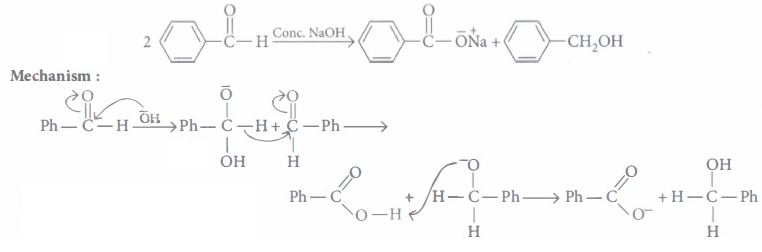
When an aldehyde with no a-hydrogen reacts with concentrated aqueous $NaOH$, half the aldehyde is converted to carboxylic acid salt and other half is converted to an alcohol. In other words, half of the reactant is oxidized
and other half is reduced. This reaction is known as Cannizzaro reaction

The following questions are multiple choice questions. Choose the most appropriate answer:
  1. A mixture of benzaldehyde and formaldehyde on heating with aqueous $NaOH$ solution gives:
  1. Benzyl alcohol and sodium formate.
  2. Sodium benzoate and methyl alcohol.
  3. Sodium benzoate and sodium formate.
  4. Benzyl alcohol and methyl alcohol.
  1. Which of the following compounds will undergo Cannizzaro reaction?
  1. $CH_3CHO$
  2. $CH_3COCH_3$
  3. $C_6H_5CHO$
  4. $C_6H_5CH_2CHO$
  1. Trichloroacetaldehyde is subjected to Cannizzaro's reaction by using $NaOH$. The mixture of the products contains sodium trichloroacetate ion and another compound. The other compounds is:
  1. 2, 2, 2-trichloroethanol
  2. Trichloromethanol
  3. 2, 2, 2-trichloropropanol
  4. Chloroform
  1. Which of the following reaction will not result in the formation of carbon-carbon bonds?
  1. Cannizzaro reaction
  2. Wurtz reaction
  3. Reimer- Tiemann reaction
  4. Friedel - Crafts acylation
Read the passage given below and answer the following questions:
Nucleophilic substitution reactions are of two types; substitution nucleophilic bimolecular $(S_N2)$ and substitution nucleophilic unimolecular $(S_N1)$ depending on molecules taking part in determining the rate of reaction. Reactivity of alkyl halide towards $S_N1$ and $S_N2$ reactions depends on various factors such as steric hindrance, stability of intermediate or transition state, and polarity of solvent. $S_N2$ reaction mechanism is favoured mostly by primary alkyl halide then secondary and then tertiary. This order is reversed in case of $S_N1$ reactions.
The following questions are multiple choice questions. Choose the most appropriate answer:
  1. Which of the following is most reactive towards nucleophilic substitution reaction?
  1. $C_6H_5Cl$
  2. $CH_2 = CHCl$
  3. $ClCH_2CH = CH_2$
  4. $CH_3CH = CHCl$
  1. Isopropyl chloride undergoes hydrolysis by:
  1. $S_N1$ mechanism.
  2. $S_N2$ mechanism.
  3. $S_N1$ and $S_N2$ mechanism.
  4. Neither $S_N1$ nor $S_N2$ mechanism.
  1. The most reactive nucleophile among the following is:
  1. $CH_3O^-$
  2. $C_6H_5O^-$
  3. $(CH_3)_2CHO^-$
  4. $(CH_3)_3CO^-$
  1. Tertiary alkyl halides are practically inert to substitution by $S_N2$ mechanism because of:
  1. Insolubility.
  2. Instability.
  3. Inductive effect.
  4. Stearic hindrance.
  1. Which of the following is the correct order of decreasing $S_N2$ reactivity?
  1. $RCH_2X > R_2CHX > R_3CX$
  2. $R_3CX > R_2CHX > RCH_2X$
  3. $R_2CHX > R_3CX > RCH_2X$
  4. $RCH_2X > R_3CX > R_2CHX$
ln a reaction, the rates of disappearance of different reactants or rates of formation of different products may not be equal but rate of reaction at any instant of time has the same value expressed in terms of any reactant or product. Further, the rate of reaction may not depend upon the stoichiometric coefficients of the balanced chemical equation. The exact powers of molar concentrations of reactants on which rate depends are found experimentally and expressed in terms of 'order of reaction'. Each reaction has a characteristic rate constant depends upon temperature. The units of the rate constant depend upon the order of reaction.
The following questions are multiple choice questions. Choose the most appropriate answer:
  1. The rate constant of a reaction is found to be $3 \times 10^{-3} mol^{-2}\ L^2 sec^{-1}$. The order of the reaction is:
  1. $0.5$
  2. $2$
  3. $3$
  4. $1$
  1. ln the reaction, $A + 3B \rightarrow 2C$, the rate of formation of $C$ is:
  1. The same as rate of consumption of A.
  2. The same as the rate of consumption of B.
  3. Twice the rate of consumption of A.
  4. $\frac{3}{2}$ times the rate of consumption of B.
  1. Rate of a reaction can be expressed by following rate expression, Rate $= k[A]^2 [B]$, if concentration of A is increased by $3$ times and concentration of B is increased by $2$ times, how many times rate of reaction increases?
  1. $9$ times
  2. $27$ times
  3. $18$ times
  4. $8$ times
  1. The rate of a certain reaction is given by, rate $= k[H^+]^n$.The rate increases $100$ times when the pH changes from $3$ to $1$. The order $(n)$ of the reaction is:
  1. $2$
  2. $0$
  3. $1$
  4. $1.5$
  1. ln a chemical reaction $A + 2B \rightarrow $ products, when concentration of $A$ is doubled, rate of the reaction increases $4$ times and when concentration of $B$ alone is doubled rate continues to be the same. The order of the reaction is:
  1. $1$
  2. $2$
  3. $3$
  4. $4$
In these questions, a statement of assertion followed by a statement of reason is given. Choose the correct answer out of the following choices.
Assertion: A colloidal sol of $\ce{As_2S_3}$ is coagulated faster by $\ce{0.1M\ BaCl_2}$ than by $\ce{0.1M NaCl.}$
Reason: $BaCl_2$ gives double the number of $Cl^-$ ions than $\ce{NaCl.}$
Read the passage given below and answer the following questions: Boiling point or freezing point of liquid solution would be affected by the dissolved solids in the liquid phase. A soluble solid in solution has the effect of raising its boiling point and depressing its freezing point. The addition of non-volatile substances to a solvent decreases the vapor pressure and the added solute particles affect the formation of pure solvent crystals. According to many researches the decrease in freezing point directly correlated to the concentration of solutes dissolved in the solvent. This phenomenon is expressed as freezing point depression and it is useful for several applications such as freeze concentration of liquid food and to find the molar mass of an unknown solute in the solution. Freeze concentration is a high quality liquid food concentration method where water is removed by forming ice crystals. This is done by cooling the liquid food below the freezing point of the solution. The freezing point depression is referred as a colligative property and it is proportional to the molar concentration of the solution (m), along with vapor pressure lowering, boiling point elevation, and osmotic pressure. These are physical characteristics of solutions that depend only on the identity of the solvent and the concentration of the solute. The characters are not depending on the solute’s identity.
  1. When a non volatile solid is added to pure water it will:
  1. boil above 100°C and freeze above 0°C
  2. boil below 100°C and freeze above 0°C
  3. boil above 100°C and freeze below 0°C
  4. boil below 100°C and freeze below 0°C
  1. Colligative properties are:
  1. dependent only on the concentration of the solute and independent of the solvent’s and solute’s identity.
  2. dependent only on the identity of the solute and the concentration of the solute and independent of the solvent's identity.
  3. dependent on the identity of the solvent and solute and thus on the concentration of the solute.
  4. dependent only on the identity of the solvent and the concentration of the solute and independent of the solute’s identity.
  1. Assume three samples of juices A, B and C have glucose as the only sugar present in them. The concentration of sample A, B and C are 0.1M, 5M and 0.2 M respectively. Freezing point will be highest for the fruit juice:
  1. A
  2. B
  3. C
  4. All have same freezing point
  1. Identify which of the following is a colligative property:
  1. freezing point
  2. boiling point
  3. osmotic pressure
  4. all of the above
In these questions, a statement of assertion followed by a statement of reason is given. Choose the correct answer out of the following choices.
Assertion: Porous or finely divided fonns of adsorbents adsorb larger quantities of adsorbate.
Reason: The greater the specific area of the solid, the greater would be its adsorbing capacity.
Read the passage given below and answer the following questions:
The properties of the solutions which depend only on the number of solute particles but not on the nature of the solute are called colligative properties. Relative lowering in vapour pressure is also an example of colligative properties. For an experiment, sugar solution is prepared, for which lowering in vapour pressure was found to be 0.061 mm of Hg. (Vapour pressure of water at 20° C is 17.5 mm of Hg)
The following questions are multiple choice questions. Choose the most appropriate answer:
  1. Relative lowering of vapour pressure for the given solution is.
  1. 0.00348
  2. 0.061
  3. 0.122
  4. 1.75
  1. The vapour pressure (mm of Hg) of solution will be.
  1. 17.5
  2. 0.61
  3. 17.439
  4. 0.00348
  1. Mole fraction of sugar in the solution is.
  1. 0.00348
  2. 0.9965
  3. 0.061
  4. 1.75
  1. If weight of sugar taken is 5g in 108g of water, then molar mass of sugar will be.
  1. 358
  2. 120
  3. 240
  4. 400
  1. The vapour pressure (mm of Hg) of water at 293K when 25g of glucose is dissolved in 450g of water is.
  1. 17.2
  2. 17.4
  3. 17.120
  4. 17.02
In these questions, a statement of assertion followed by a statement of reason is given. Choose the correct answer out of the following choices.
Assertion: Lyophilic sols are prepared by directly mixing the substance with the dispersion medium.
Reason: Lyophobic sols can not be prepared by simply mixing the substance with the dispersion medium.
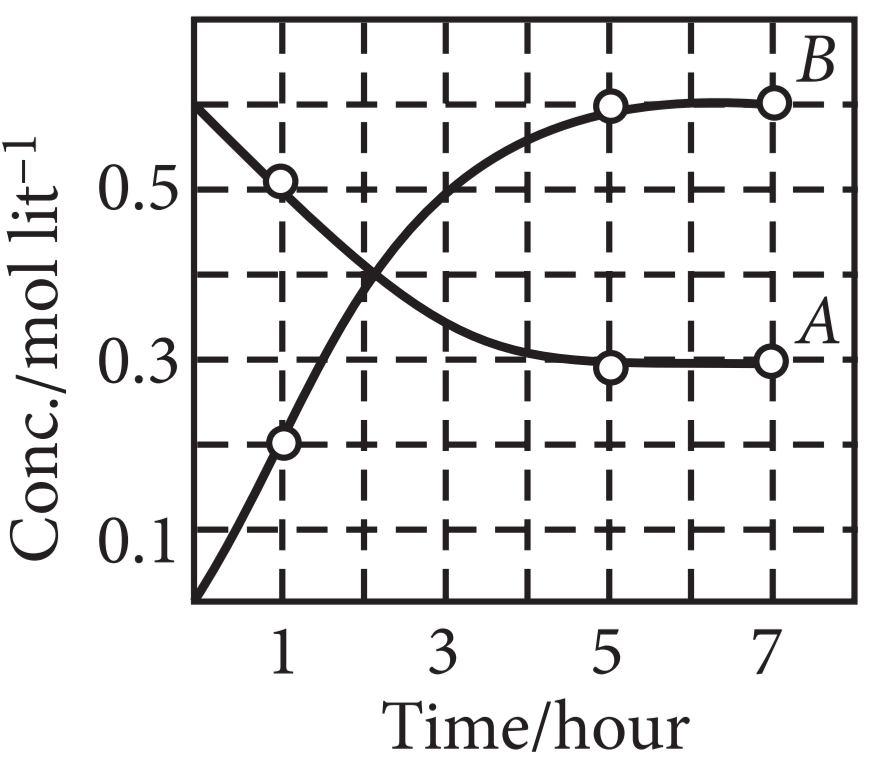
The progress of the reaction, $\text{A}\rightleftharpoons\text{nB}$ with time is represented in the following figure:

The following questions are multiple choice questions. Choose the most appropriate answer:
  1. What is the value of n?
  1. 1
  2. 2
  3. 3
  4. 4
  1. Find the value of the equilibrium constant.
  1. 0.6M
  2. 1.2M
  3. 0.3M
  4. 2.4M
  1. The initial rate of conversion of A will be:
  1. $0.1 mol ~L^{-1}hr^{-1}$
  2. $0.2 mol ~L^{-1}hr^{-1}$
  3. $0.4 mol ~L^{-1}hr^{-1}$
  4. $0.8 mol ~L^{-1}hr^{-1}$
  1. For the reaction, if $\frac{\text{d}[\text{B}]}{\text{dt}}=2\times10^{-4},$ value of $-\frac{\text{d}[\text{A}]}{\text{dt}}$ will be:
  1. $2 \times 10^{-4}$
  2. $10^{-4}$
  3. $4 \times 10^{-4}$
  4. $0.5 \times 10^{-4}$
  1. Which factor has no effect on rate of reaction?
  1. Temperature.
  2. Nature of reactant.
  3. Concentration of reactant.
  4. Molecularity.
Read the passage given below and answer the following questions:
Chlorine is a greenish yellow gas with pungent and suffocating odour. With dry slaked lime, it gives bleaching powder. Bleaching powder is a mixture of calcium hypochlorite and basic calcium chloride:
$[Ca(OCl)_2· CaCl_2· Ca(OH)_2· 2H_2O].$
The amount of chlorine obtained from a sample of bleaching powder by the treatment with excess of dilute acids or $CO_2$ is called available chlorine. Chlorine is a powerful bleaching agent. Bleaching effect of chlorine is permanent.
The following questions are multiple choice questions. Choose the most appropriate answer:
  1. Chlorine gas reacts with _____ to form bleaching powder.
  1. $Ca(OH)_2$
  2. $CaCl_2$
  3. $CaSO_4$
  4. dry $CaO$
  1. Chlorine reacts with cold and dilute alkali to form:
  1. Chloride
  2. Hypochlorite
  3. Chlorate
  4. Both $(a)$ and $(b)$
  1. Which of the following is produced on the reaction of bleaching powder with a few drops of cone. $HCl?$
  1. Hypochlorous acid
  2. Oxygen
  3. Chlorine
  4. Calcium oxide
  1. Chlorine is used as a bleaching agent. The bleaching action is due to.
  1. Oxidation
  2. Chlorination
  3. Hydrogenation
  4. Reduction
  1. Bleaching powder contains a salt of an oxoacid as one of its components. The anhydride of that oxoacid is:
  1. $Cl_2O$
  2. $Cl_2O_7$
  3. $ClO_2$
  4. $Cl_2O_6$