Question
Read the passage given below and answer the following questions :
When an aldehyde with no a-hydrogen reacts with concentrated aqueous $NaOH$, half the aldehyde is converted to carboxylic acid salt and other half is converted to an alcohol. In other words, half of the reactant is oxidized
and other half is reduced. This reaction is known as Cannizzaro reaction
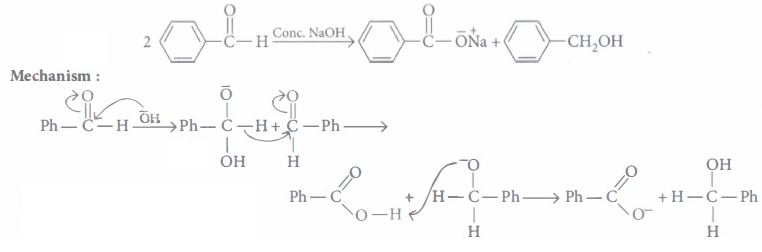
The following questions are multiple choice questions. Choose the most appropriate answer:
  1. A mixture of benzaldehyde and formaldehyde on heating with aqueous $NaOH$ solution gives:
  1. Benzyl alcohol and sodium formate.
  2. Sodium benzoate and methyl alcohol.
  3. Sodium benzoate and sodium formate.
  4. Benzyl alcohol and methyl alcohol.
  1. Which of the following compounds will undergo Cannizzaro reaction?
  1. $CH_3CHO$
  2. $CH_3COCH_3$
  3. $C_6H_5CHO$
  4. $C_6H_5CH_2CHO$
  1. Trichloroacetaldehyde is subjected to Cannizzaro's reaction by using $NaOH$. The mixture of the products contains sodium trichloroacetate ion and another compound. The other compounds is:
  1. 2, 2, 2-trichloroethanol
  2. Trichloromethanol
  3. 2, 2, 2-trichloropropanol
  4. Chloroform
  1. Which of the following reaction will not result in the formation of carbon-carbon bonds?
  1. Cannizzaro reaction
  2. Wurtz reaction
  3. Reimer- Tiemann reaction
  4. Friedel - Crafts acylation

Answer

  1. (a) Benzyl alcohol and sodium formate.
Explanation:

It is an example of cross Cannizzaro reaction where aromatic aldehyde gets reduced to alcohol and aliphatic aldehyde gets oxidised to its sodium salt (both aldehydes must not contain any αα-hydrogen).
CBSE 12th Chemistry Aldehydes , Ketones and Carboxylic Acids Case Study Questions With Solution 2021
  1. (c) $C_6H_5CHO$
  1. (a) 2, 2, 2-trichloroethanol
Explanation:

The Cannizzaro product of given reaction yields 2, 2, 2-trichloroethanol.
CBSE 12th Chemistry Aldehydes , Ketones and Carboxylic Acids Case Study Questions With Solution 2021
  1. (a) Cannizzaro reaction
Explanation:
C - C bond is not formed in Cannizzaro reaction while other reactions result in the formation of C - C bond.

Need a full question paper?

Generate a complete, print-ready paper with questions like this in minutes — across 16+ boards, with answer keys.

Start Generating Free

Similar questions

Read the passage given below and answer the following questions:
The halogen elements show great resemblances to one another in their chemical behaviour and properties of their compounds with other elements. There is, however, a progressive change in properties from F through $Cl, Br,$ and I to At. F is most reactive among the halogens and in fact, from all other elements and it has certain other properties that set it apart from the other halogens.
In these questions (Q.No. i - iv), a statement of assertion followed by a statement of reason is given. Choose the correct answer out of the following choices.
  1. Assertion and reason both are correct statements and reason is correct explanation for assertion.
  2. Assertion and reason both are correct statements but reason is not correct explanation for assertion.
  3. Assertion is correct statement but reason is wrong statement.
  4. Assertion is wrong statement but reason is correct statement.
  1. Assertion: $F_2 $ has high reactivity.
Reason: $F_2$ has low bond dissociation enthalpy.
  1. Assertion: The bond between $F - F$ is weaker than between $Cl - Cl.$
Reason: Atomic size of $F$ is smaller than that of $Cl.$
  1. Assertion: Fluoride does not show oxidation number greater than zero.
Reason: The halogens chlorine, bromine and iodine can show positive oxidation state of $+1, +3$ and $+7.$
  1. Assertion: F atom has less negative electron affinity than Cl atom.
Reason: Additional electrons are repelled more effectively by $3p-$electrons in $Cl$ than by $2p-$electrons in Fatom.
  1. Assertion: Fluorine is strongest oxidising agent in halogens.
Reason: It displaces other halogens from its aqueous solution.
Read the passage given below and answer the following questions:
The transition elements have incompletely filled d-subshells in their ground state or in any of their oxidation states. The transition elements occupy position in betweens- and p-blocks in groups $3-12$ of the Periodic table. Starting from fourth period, transition elements consists of four complete series : Sc to $Zn, Y$ to Cd and La, $Hf$ to $Hg$ and $Ac, Rf$ to $Cn$. In general, the electronic configuration of outer orbitals of these elements is $(n - 1)d^{1-10} n^{1-2}$. The electronic configurations of outer orbitals of $Zn, Cd, Hg$ and $Cn$ are represented by the general formula $(n - 1)d^{10}ns^2$. All the transition elements have typical metallic properties such as high tensile strength, ductility, malleability. Except mercury, which is liquid at room temperature, other transition elements have typical metallic structures. The transition metals and their compounds also exhibit catalytic property and paramagnetic behaviour. Transition metal also forms alloys. An alloy is a blend of metals prepared by mixing the components. Alloys may be homogeneous solid solutions in which the atoms of one metal are distributed randomly among the atoms of the other.
The following questions are multiple choice questions. Choose the most appropriate answer:
  1. Which of the following characteristics of transition metals is associated with higher catalytic activity?
  1. High enthalpy of atomisation.
  2. Variable oxidation states.
  3. Paramagnetic behaviour.
  4. Colour of hydrated ions.
  1. Transition elements form alloys easily because they have.
  1. Same atomic number.
  2. Same electronic configuration.
  3. Nearly same atomic size.
  4. Same oxidation states.
  1. The electronic configuration of tantalum $(Ta)$ is:
  1. $[Xe]4f^05d^16s^2$
  2. $[Xe]4f^{14}5d^26s^2$
  3. $[Xe]4f^{14}5d^36s^2$
  4. $[Xe]4f^{14}5d^46s^2$
  1. Which one of the following outer orbital configurations may exhibit the largest number of oxidation states?
  1. $3d^54s^1$
  2. $3d^54s^2$
  3. $3d^24s^2$
  4. $3d^34s^2$
  1. The correct statement(s) among the following is/ are:
  1. All d and f-block elements are metals.
  2. All d and f-block elements form coloured ions.
  3. All d and f-block elements are paramagnetic.
  1. $(I)$ only
  2. $(I)$ and $(II)$ only
  3. $(II)$ and $(III)$ only
  4. $(I), (II)$ and $(III)$
Number of molecules which must collide simultaneously to give product is called molecularity. It is equal to sum of coefficients of reactants present in stoichiometric chemical equation.
For reaction, $m_1A + m_2B \rightarrow$ Product
Molecularity $= [m_1 + m_2]$
ln complex reaction each step has its own molecularity which is equal to the sum of coefficients of reactants present in a particular step. Molecularity is a theoretical property. Its value is any whole number. Number of concentration terms on which rate of reaction depends is called order of reaction or sum of powers of concentration terms present in the rate equation is called order of reaction.
If rate equation ofreaction is: Rate $=\text{k}\cdot\text{C}^{\text{m}_1}_\text{A}\cdot\text{C}^{\text{m}_2}_\text{B}$
Then order of reaction $= m_1 + m_2.$
ln simple reaction, order and molecularity are same.
ln complex reaction, order of slowest step is the order ofover all reaction. This step is known as rate determining step. Order is an experimental property. Its value may be zero, fractional or negative.
The following questions are multiple choice questions. Choose the most appropriate answer:
  1. Higher order$(> 3)$ reactions are rare due to:
  1. Shifting of equilibrium towards reactants due to elastic collisions.
  2. Loss of active species on collision.
  3. Low probability of simultaneous collision of all the reacting species.
  4. Increase in entropy and activation energy as more molecules are involved.
  1. The molecularity of the reaction:
$6\text{FeSO}_4+3\text{H}_2\text{SO}_4+\text{KClO}_3\rightarrow\text{KCl}+3\text{Fe}_2(\text{SO}_4)_3+3\text{H}_2\text{O}$ is:
  1. $6$
  2. $10$
  3. $3$
  4. $7$
  1. Which of the following statements is false in the following?
  1. Order of a reaction may be even zero.
  2. Molecularity of a reaction is always a whole number.
  3. Molecularity and order always have same values for a reaction.
  4. Order of a reaction depends upon the mechanism of the reaction.
  1. The rate of reaction, $A + 2B →$ products, is given by the following equation:
$-\frac{\text{d}[\text{A}]}{\text{dt}}=\text{k}[\text{A}][\text{B}]^2$

If $B$ is present in large excess, the order of the reaction is:
  1. Zero
  2. First
  3. Second
  4. Third
  1. The rate of the reaction, $A + B + C →$ products, is given by $\text{r}=\frac{\text{d}[\text{A}]}{\text{dt}}=\text{k}[\text{A}]^\frac{1}{2}[\text{B}]^\frac{1}{3}[\text{C}]^\frac{1}{4}.$ The order of the reaction is:
  1. $\frac{1}{3}$
  2. $\frac{1}{4}$
  3. $\frac{1}{2}$
  4. $\frac{13}{12}$
The following reaction, $\text{A}_{(\text{g})}\xrightarrow{\ \ \triangle\ \ \ }\text{P}_{(\text{g})}+\text{Q}_{(\text{g})}+\text{R}_{(\text{g})},$ follows first order kinetics. The half-life period of this reaction is $69.3s$ at $500^\circ C$. The gas A is enclosed in a container at $500^\circ C$ and at a pressure of $0.4$ atm.
The following questions are multiple choice questions. Choose the most appropriate answer:
  1. The rate constant for the reaction is:
  1. $0.4s^{-1}$
  2. $0.02s^{-1}$
  3. $0.01s^{-1}$
  4. $0.3s^{-1}$
  1. The pressure of the gas $A$ after $230$ s will be:
  1. $0.04$ atm
  2. $0.36$ atm
  3. $0.4$ atm
  4. $0.036$ atm
  1. The total pressure of the system after $230$ swill be:
  1. $2.15$ atm
  2. $1.12$ atm
  3. $0.4$ atm
  4. $3.08$ atm
  1. The plot ofln[A] vs twill be:
  1. Linear with slope $= k$
  2. Linear with intercept $= In[A]_0$
  3. Linear with slope $= In[A]_0$
  4. Linear with intercept $= [A]_0$
  1. Which of the following is not an example of first order reaction?
  1. $\text{C}_2\text{H}_{4(\text{g})}+\text{H}_{2(\text{g})}\rightarrow\text{C}_2\text{H}_{6(\text{g})}$
  2. $2\text{N}_2\text{O}_{5(\text{g})}\rightarrow4\text{NO}_{2(\text{g})}+\text{O}_{2(\text{g})}$
  3. $2\text{N}\text{H}_{3(\text{g})}\xrightarrow[\triangle]{\text{pt}}\text{N}_{2(\text{g})}+3\text{H}_{2(\text{g})}$
  4. $2\text{N}_2\text{O}_{(\text{g})}\xrightarrow{\ \ \triangle\ \ }2\text{N}_{2(\text{g})}+\text{O}_{2(\text{g})}$
Decrease in concentration of reactant or increase in concentration of product per unit time is called rate of reaction. lt is of two types:
  1. Instantaneous rate of reaction: Rate of change of concentration of reactant or product at a particular time is called instantaneous rate of reaction.
$\text{r}_\text{inst.}=\frac{\text{dC}}{\text{dt}}$
where, dC = infinitely small change in concentration
dt = infinitely small change in time.
  1. Average rate of reaction: Ratio of change in concentration and time required for the change is average rate of reaction.
$\text{r}_\text{av}=\frac{\triangle\text{x}}{\triangle\text{t}}=\frac{\text{Change in concentration}}{\text{Time required for the change}}$
For a reaction of the type, $m_1A + m_2B → n_1C + n_2D$
Rate of reaction is given as
$\frac{1}{\text{m}_1}\frac{\text{d[A]}}{\text{dt}}=-\frac{1}{\text{m}_2}\frac{\text{d[B]}}{\text{dt}}=+\frac{1}{\text{n}_1}\frac{\text{d[C]}}{\text{dt}}=+\frac{1}{\text{n}_2}\frac{\text{d[D]}}{\text{dt}}$
In these questions (Q. No. i-iv), a statement of assertion followed by a statement ofreason is given. Choose the correct answer out of the following choices.
  1. Assertion and reason both are correct statements and reason is correct explanation for assertion.
  2. Assertion and reason both are correct statements but reason is not correct explanation for assertion.
  3. Assertion is correct statement but reason is wrong statement.
  4. Assertion is wrong statement but reason is correct statement.
  1. Assertion: The kinetics of the reaction, $\text{mA}+\text{nB}+\text{pC}\rightarrow\text{m}'\text{ X}+\text{n}'\text{ Y}+\text{p}'\text{ Z}$ obey the rate expression as $\frac{\text{dx}}{\text{dt}}=\text{k}[\text{A}]^\text{m}[\text{B}]^\text{n}.$
Reason: The rate of the reaction does not depend upon the concentration of C.
  1. Assertion: Instantaneous rate of reaction is equal to $\frac{\text{dx}}{\text{dt}}.$
Reason: lt is the rate of reaction at any particular instant of time.
  1. Assertion: For the reaction, $\text{RCl}+\text{NaOH}\rightarrow\text{ROH}+\text{NaCl},$ the rate of reaction is reduced to half on reducing the concentration of RCl to half.
Reason: The rate of reaction is represented by k[RCl].
  1. Assertion: ln rate law, unlike in the expression for equilibrium constants, the exponents for concentrations do not necessarily match the stoichiometric coefficients.
Reason: It is the mechanism and not the balanced chemical equation for the overall change that governs the reaction rate.
  1. Assertion: ln a reaction, $2A + B → A_2B$, the reactant B will disappear at twice the rate as A will decrease.
Reason: The rate of disappearance of reactant will be $-\frac{1}{2}\frac{\text{d[A]}}{\text{dt}}=-\frac{\text{d[B]}}{\text{dt}}$
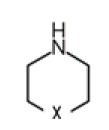
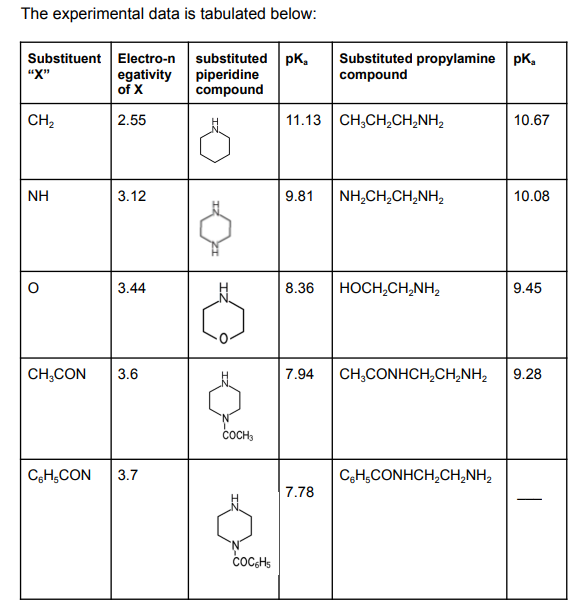
Amines are basic in nature. The $pK_b$ value is a measure of the basic strength of an amine. Lower the value of $pK_b$ more basic is the amine. The effect of substituent on the basic strength of amines in aqueous solution was determined using titrations. The substituent $"X"$ replaced $"-CH_2"$ group in piperidine $($ compound $1)$ and propylamine $CH_3CH_2CH_2NH_2, ($compound $2).$
Compound $1:$
Image
Compound $2: HXCH_2CH_2NH_2$
Image
(source: Hall Jr, $H. K. (1956).$ Field and inductive effects on the base strengths of amines. Journal of the American Chemical Society, $78(11), 2570-2572.) $
Study the above data and answer the following questions:
$a.$ Plot a graph between the electronegativity of the substituent vs $pK_b$ value of the corresponding substituted propyl amine $($ given that $pK_a + pK_b =14).$ Is there any relation between the electronegativity of the substituent and its basic strength?
$b.$ The electronegativity of the substituent $"C6H5CON\ "$ is $3.7,$ what is the expected pKa value of compound $C_6H_5CONHCH_2CH_2NH_2?$
$(i) \ 9.9 \ (ii) \ 9.5 \ (iii) \ 9.3 \ (iv) \ 9.1$
$c.$ The pKa value of the substituted piperidine formed with substituent $"X\ "$ is found to be $8.28.$ What is the expected electronegativity of $"X\ "$
$(i)\ 3.5 \ (ii)\ 3.4 \ (iii)\ 3.8\ (iv) \ 3.1$
Read the passage given below and answer the following questions:
All the elements of group $16$ have $ns^2np^4$ configuration in their outermost shell. Therefore, the atoms of these elements try to gain or share two electrons to achieve noble gas configuration. Sulphur and other elements of group $16$ are less electronegative than oxygen, so, they cannot accept electrons easily. By sharing of two electrons with other elements, these elements acquire $ns^2np^6$ configuration and exhibit $+2$ oxidation state. Except oxygen, group $16$ elements have vacant d-orbitals in their valence shell to which electrons Call be promoted from P- and s-orbitals of the same shell As a result, they Call show $+4$ and $+6$ oxidation states also.
The following questions are multiple choice questions. Choose the most appropriate answer:
  1. Oxygen shows $+2$ oxidation state in.
  1. $OF_2$​​​​​​​
  2. $H_2O$
  3. $CI_2O$
  4. $H_2O_2$
  1. Like sulphur, oxygen is not able to show $+4$ and $+6$ oxidation states because?
  1. Oxygen is a gas while sulphur is a solid.
  2. Sulphur has high ionisation enthalpy as compared to oxygen.
  3. Oxygen has nod-orbitals in its valence shell.
  4. Oxygen has high electron affmity as compared to sulphur.
  1. Compounds of sulphur with $+4$ oxidation state acts as a/ an.
  1. Oxidising agent.
  2. Reducing agent.
  3. Both oxidising as well as reducing agen.
  4. Cannot be predicted.
  1. Oxidation state of sulphur in $Na_2S_4O_6$​​​​​​​ is:
  1. $\frac{7}{2}$
  2. $\frac{5}{2}$
  3. $\frac{1}{2}$
  4. $\frac{3}{2}$
  1. The oxidation states of sulphur in $S_8, SO_3​​​​​​​$​​​​​​​ and $H_2S$ are respectively.
  1. $0, +6$ and $-2$
  2. $+6, 0$ and $-2$
  3. $-2, 0$ and $+6$
  4. $+2, +6$ and $-2$
ln a reaction, the rates of disappearance of different reactants or rates of formation of different products may not be equal but rate of reaction at any instant of time has the same value expressed in terms of any reactant or product. Further, the rate of reaction may not depend upon the stoichiometric coefficients of the balanced chemical equation. The exact powers of molar concentrations of reactants on which rate depends are found experimentally and expressed in terms of 'order of reaction'. Each reaction has a characteristic rate constant depends upon temperature. The units of the rate constant depend upon the order of reaction.
The following questions are multiple choice questions. Choose the most appropriate answer:
  1. The rate constant of a reaction is found to be $3 \times 10^{-3} mol^{-2}\ L^2 sec^{-1}$. The order of the reaction is:
  1. $0.5$
  2. $2$
  3. $3$
  4. $1$
  1. ln the reaction, $A + 3B \rightarrow 2C$, the rate of formation of $C$ is:
  1. The same as rate of consumption of A.
  2. The same as the rate of consumption of B.
  3. Twice the rate of consumption of A.
  4. $\frac{3}{2}$ times the rate of consumption of B.
  1. Rate of a reaction can be expressed by following rate expression, Rate $= k[A]^2 [B]$, if concentration of A is increased by $3$ times and concentration of B is increased by $2$ times, how many times rate of reaction increases?
  1. $9$ times
  2. $27$ times
  3. $18$ times
  4. $8$ times
  1. The rate of a certain reaction is given by, rate $= k[H^+]^n$.The rate increases $100$ times when the pH changes from $3$ to $1$. The order $(n)$ of the reaction is:
  1. $2$
  2. $0$
  3. $1$
  4. $1.5$
  1. ln a chemical reaction $A + 2B \rightarrow $ products, when concentration of $A$ is doubled, rate of the reaction increases $4$ times and when concentration of $B$ alone is doubled rate continues to be the same. The order of the reaction is:
  1. $1$
  2. $2$
  3. $3$
  4. $4$
Read the passage given below and answer the following questions:
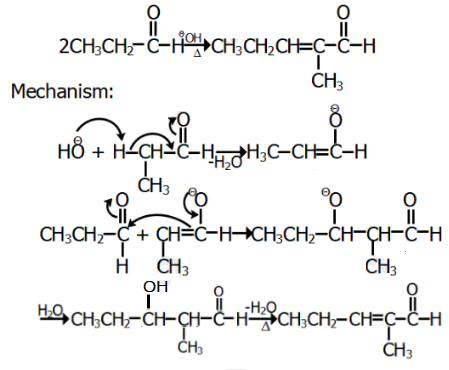
The addition reaction of enol or enolate to the carbonyl functional group of aldehyde or ketone is known as aldol addition. The β-hydroxyaldehyde or ββ-hydroxyketone so obtained undergo dehydration in second step to produce a conjugated enone. The first part of reaction is an addition reaction and the second part is an elimination reaction. Carbonyl compound having αα-hydrogen undergoes aldol condensation reaction.
  1. Condensation reaction is the reverse of which of the following reaction?
  1. Lock and key hypothesis
  2. Oxidation
  3. Hydrolysis
  4. Glycogen formation
  1. Which of the following compounds would be the main product of an aldol condensation of acetaldehyde and acetone?
  1. $CH_3CH=CHCHO$
  2. $CH_3CH=CHCOCH_3$
  3. $(CH_3)_2C=CHCHO$
  4. $(CH_3)_2C=CHCOCH_3$
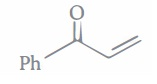
  1. Which combination of carbonyl compounds gives phenyl vinyl ketone by an aldol condensation?
  1. Acetophenone and Formaldehyde
  2. Acetophenone and acetaldehyde
  3. Benzaldehyde and acetaldehyde
  4. Benzaldehyde and acetone
  5. Which of the following will undergo aldol condensation?
  1. $HCHO$
  2. $CH_3CH_2OH$
  3. $C_6H_5CHO$
  4. $CH_3CH_2CHO$
In these questions, a statement of assertion followed by a statement of reason is given. Choose the correct answer out of the following choices.
Assertion: Porous or finely divided fonns of adsorbents adsorb larger quantities of adsorbate.
Reason: The greater the specific area of the solid, the greater would be its adsorbing capacity.