Question
✓
Answer
- (d) Anomers.
Explanation:
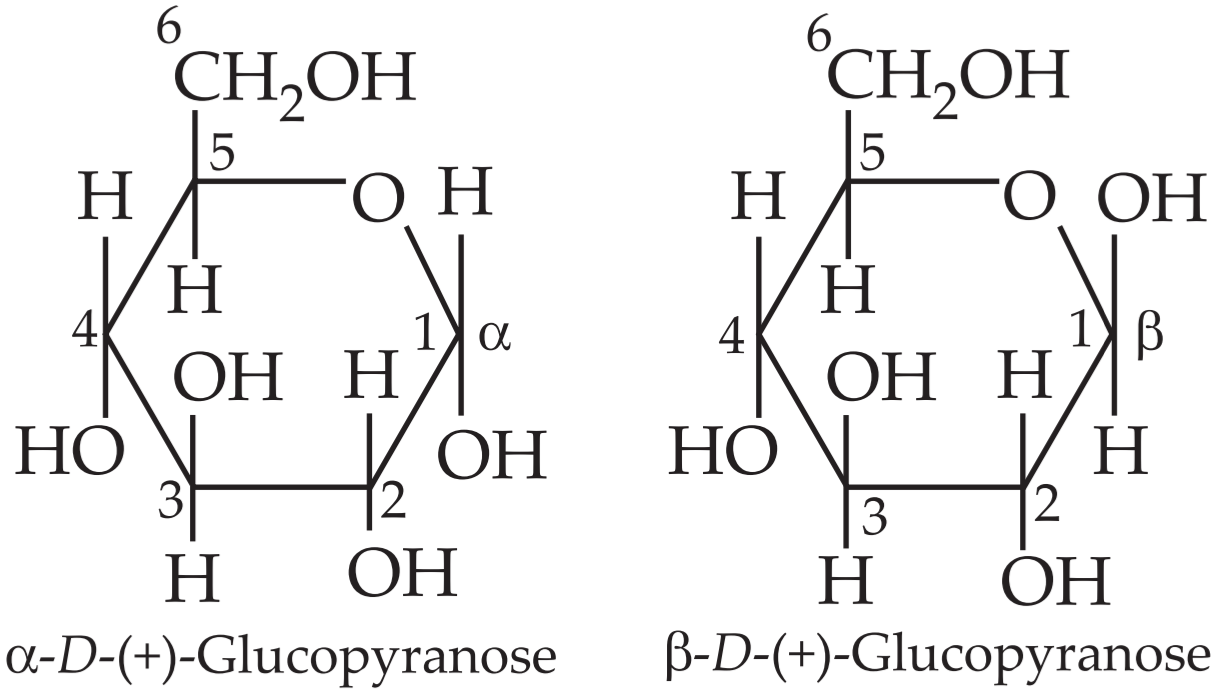
$\alpha$-D-( + )-glucose and $\beta$-D-( + )-glucose differ in configuration at C1 (i.e., anomeric or glycosidic carbon) and hence are called anomers.
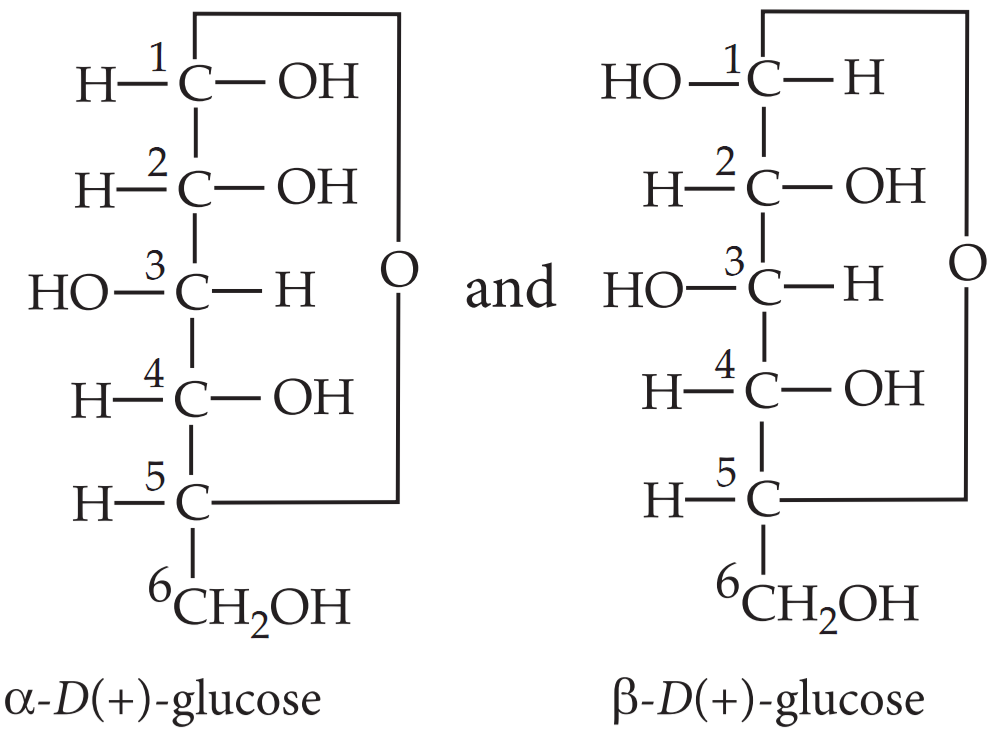
- (b) An aldohexose.
Explanation:
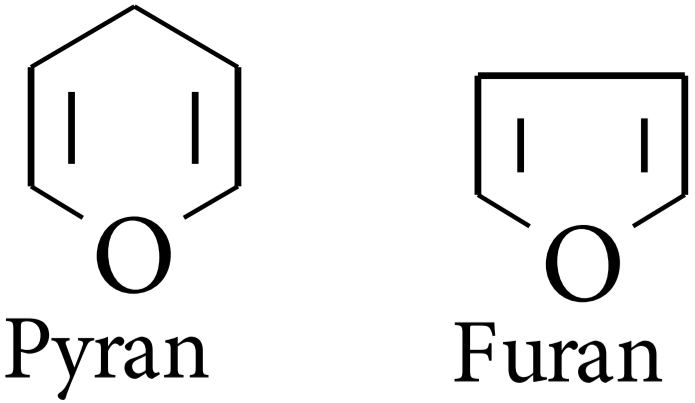
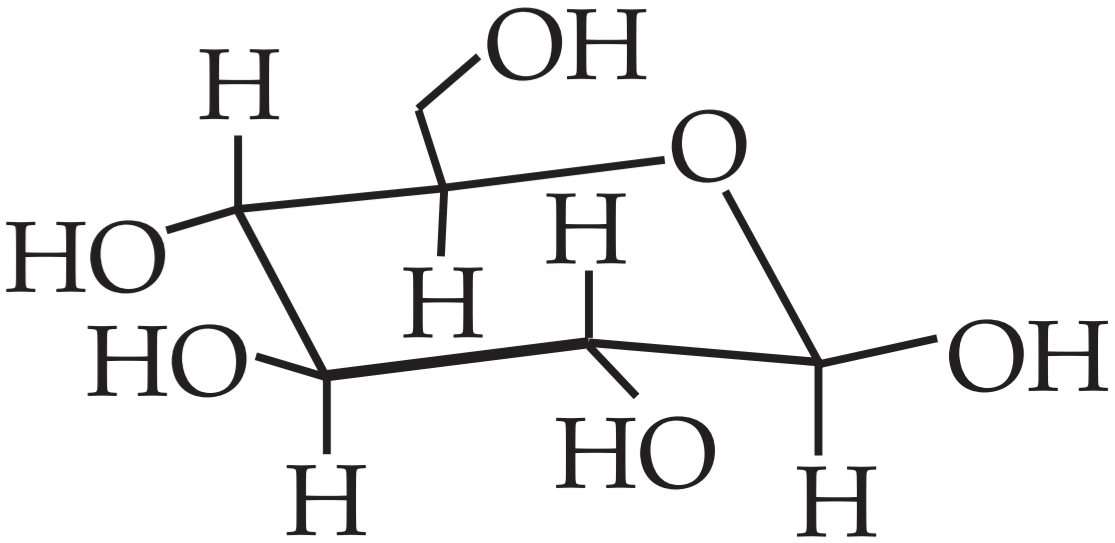
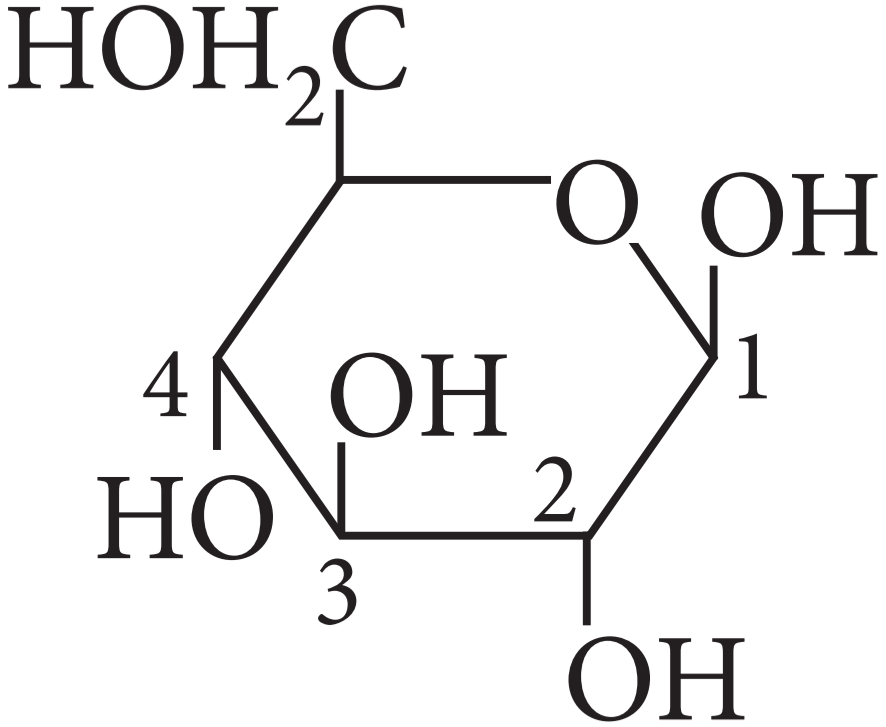
This structure is an example of pyranose and aldohexose. Here, the carbohydrate's structure is of the $\beta$-pyranose fonn.
- (a) C-1
Explanation:
C-1 is the anomeric carbon.
- (d) Isomers of glucose that differ in configuration at carbon one (C-1).
Explanation:
Anomers are cyclic monosaccharides or glycosides that are epimers, differing from each other in the configuration at C-1, if they are aldoses or in the configuration at C-2 if they are ketoses.
- (d) 64%
Explanation:
Ordinary glucose is CL-glucose, with a fresh aqueous solution having specific rotation, $[\alpha]_\text{D}=+111^\circ.$ On keeping the solution for sometime, $\alpha$-glucose slowly changes into an equilibrium mixture of $\alpha$-glucose (36%) and $\beta$-glucose(64%) and the mixture has specific rotation + 52.5°
Need a full question paper?
Generate a complete, print-ready paper with questions like this in minutes — across 16+ boards, with answer keys.
Explore more
Similar questions
Read the passage given below and answer the following questions: Carboxylic acids having an $\alpha$-hydrogen atom when treated with chlorine or bromine in the presence of small amount of red phosphorus gives $\alpha$-halocarboxytic acids. The reaction is known as Hell-Volhard-Zelinsky reaction. $\text{R}-\text{CH}_2-\text{COOH}+\text{X}_2\xrightarrow{\text{red p}}\text{R}-\text{CH}-\text{COOH}\\ \ \ \ \ \ \ \ \ \ \ \ \ \ \ \ \ \ \ \ \ \ \ \ \ \ \ \ \ \ \ \ \ \ \ \ \ \ \ \ \ \ \ \ \ \ \ \ \ \ \ \ \ \ \ \ \ \ \ \ \ \ |\\ \ \ \ \ \ \ \ \ \ \ \ \ \ \ \ \ \ \ \ \ \ \ \ \ \ \ \ \ \ \ \ \ \ \ \ \ \ \ \ \ \ \ \ \ \ \ \ \ \ \ \ \ \ \ \ \ \ \ \ \ \text{X}\\ \ \ \ \ \ \ \ \ \ \ \ \ \ \ \ \ \ \ \ \ \ \ \ \ \ \ \ \ \ \ \ \ \ \ \ \ \ \ \ \ \ \ \ \ \ \ \ \ \ \ \ \ \ \ (\text{X = Cl, Br)}$ When sodium salt of carboxylic acid is heated with soda lime it loses carbon dioxide and gives hydrocarbon with less number of C-atoms. $\text{R}-\text{COOH}\xrightarrow{\text{NaOH}}\text{R}-\text{COONa}\xrightarrow[\Delta]{\text{NaOH}+\text{CaO}}\text{R}-\text{H}+\text{Na}_2\text{CO}_3\\\text{Carboxylic}\ \ \ \ \ \ \ \ \ \ \ \ \ \ \ \ \ \ \ \ \ \text{Sod.}\ \ \ \ \ \ \ \ \ \ \ \ \ \ \ \ \ \ \ \ \ \ \ \ \ \ \ \ \ \text{Alkane}\\\ \ \ \ \ \text{acid}\ \ \ \ \ \ \ \ \ \ \ \ \ \ \ \ \ \ \ \ \ \ \text{carboxylate}$ In these questions (Q. No. l-iv), a statement of assertion followed by a statement ofreason is given. Choose the correct answer out of the following choices.
→- Assertion and reason both are correct statements and reason is correct explanation for assertion.
- Assertion and reason both are correct statements but reason is not correct explanation for assertion.
- Assertion is correct statement but reason is wrong statement.
- Assertion is wrong statement but reason is correct statement.
- Assertion: (CH3)3CCOOH does not give H.V.Z reaction.
Reason: (CH3)3CCOOH does not have $\alpha$-hydrogen atom.
- Assertion: H.V.Z. reaction involves the treatment of carboxylic acids having $\alpha$-hydrogens with Cl2 or Br2 in presence of small amount of red phosphorus.
Reason: Phosphorus reacts with halogens to form phosphorus trihalides.
- Assertion: Propionic acid with $\frac{\text{Br}_2}{\text{P}}$ yields CH2Br - CHBr - COOH.
Reason: Propionic acid has two $\alpha$-hydrogen atoms.
- Assertion: C6H5COCH2COOH undergoes decarboxylation easily than C6H5COCH2COOH.
Reason: C6H5COCH2COOH is $\beta$-keto acid.
- Assertion: On heating 3-methylbutanoic acid with soda lime, isobutane is obtained.
Reason: Soda lime is a mixture of NaOH + CaO in the ratio 3 : 1.
Nemst equation relates the reduction potential of an electrochemical reaction to the standard potential and activities of the chemical species undergoing oxidation and reduction. Let us consider the reaction, $\text{M}^{\text{n+}}_{(\text{aq})}\xrightarrow{\ \ \ \ \ \ \ \ }\text{nM}_\text{(s)}$ For this reaction, the electrode potential measured with respect to standard hydrogen electrode can be given as $\text{E}_{\Big(\frac{\text{M}^{\text{n+}}}{\text{M}}\Big)}=\text{E}^\circ_{\Big(\frac{\text{M}^\text{n+}}{\text{M}}\Big)}-\frac{\text{RT}}{\text{nF}}\text{ln}\frac{[\text{M}]}{[\text{M}^{\text{n}+}]}$ In these questions (Q. No. i-iv), a statement of assertion followed by a statement ofreason is given. Choose the correct answer out of the following choices.
→→- Assertion and reason both are correct statements and reason is correct explanation for assertion.
- Assertion and reason both are correct statements but reason is not correct explanation for assertion.
- Assertion is correct statement but reason is wrong statement.
- Assertion is wrong statement but reason is correct statement.
- Assertion: For concentration cell, $\text{Zn}_{(\text{s})}|\text{ Zn}^{2+}_{\text{(aq)}}||\text{ Zn}^{2+}_{(\text{aq})}|\text{ Zn}\\\ \ \ \ \ \ \ \ \ \ \ \ \text{C}_1\ \ \ \ \ \ \ \ \text{C}_2$
For spontaneous cell reaction, C1 < C2
Reason: For concentration cell, $\text{E}_\text{cell}=\frac{\text{RT}}{\text{nF}}\log\frac{\text{C}_2}{\text{C}_1}$
For spontaneous reaction, $\text{E}_\text{cell}=+\text{ve}\Rightarrow\text{C}_2>\text{C}_1$
- Assertion: For the cell reaction, $\text{Zn}_{(\text{s})}+\text{Cu}^{2+}_{(\text{aq})}\xrightarrow{\ \ \ \ \ }\text{Zn}^{2+}_{(\text{aq})}+\text{Cu}_{(\text{s})}$ voltmeter gives zero reading at equilibrium.
Reason: At the equilibrium, there is no change in concentration of Cu2+ and Zn2+ ions.
- Assertion: The Nernst equation gives the concentration dependence of emf of the cell.
Reason: In a cell, current flows from cathode to anode.
- Assertion: Increase in the concentration of copper half cell in a cell, increases the emfofthe cell.
Reason: $\text{E}_\text{cell}=\text{E}^\circ_\text{cell}+\frac{0.059}{2}\log\frac{[\text{Cu}^{2+}]}{[\text{Zn}^{2+}]}$
- Assertion: Electrode potential for the electrode $\frac{\text{Mn}^+}{\text{Mn}}$ with concentration is given by the expression under STP conditions.
$\text{E}=\text{E}^\circ+\frac{0.059}{\text{n}}\log[\text{Mn}^{+}]$
Reason: STP conditions require the temperature to be 273K.
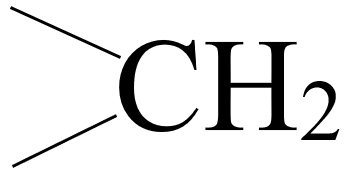 group on treatment with Zn-Hg and cone. HCl (Clemmensen reduction) or with hydrazine followed by NaOH or KOH in highly boiling solvent such as ethylene glycol (Wolff-Kishner reduction).Aldehydes differ from ketones in their oxidation reactions. Aldehydes are easily oxidised to carboxylic acids on treatment with HNO3, KMnO4, K2Cr2O7 etc. Even mild oxidising agents mainlyTollens' reagent and Fehling's solution also oxidise aldehydes. Ketones are generally oxidised under vigorous conditions i.e., strong oxidising agents and at elevated temperatures, to give mixture of carboxylic acids having lesser number of C-atoms than the parent ketone.
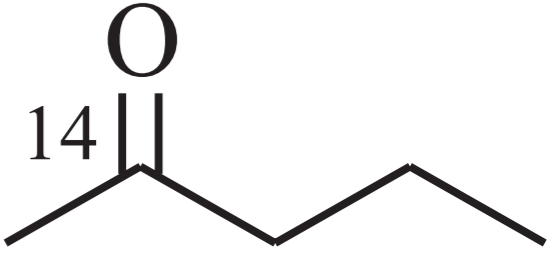 by acidified K2Cr2O7, the products are: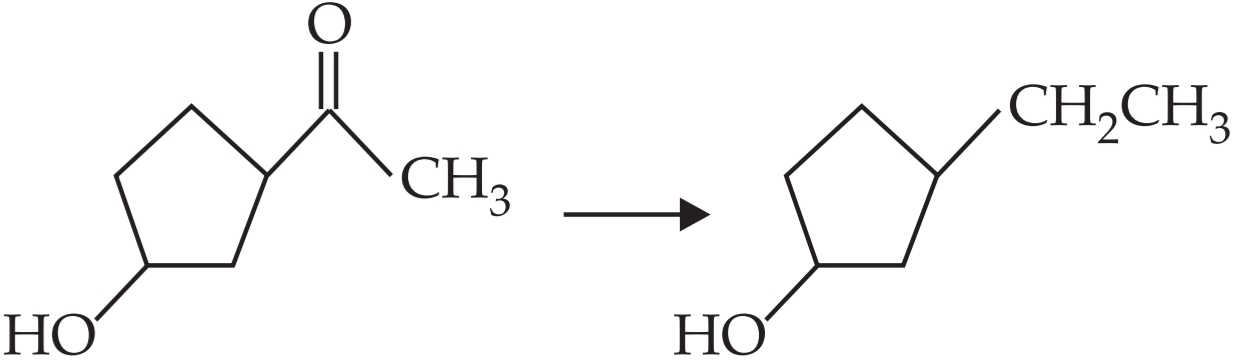
Read the passage given below and answer the following questions: Transition metal oxides are compounds fanned by the reaction of metals with oxygen at high temperature. The highest oxidation number in the oxides coincides with the group number. In vanadium, there is a gradual change from the basic V2O3 to less basic V2O4 and to amphoteric V2O5· V2O4 dissolves in acids to give VO2+ salts. Transition metal oxides are commonly utilized for their catalytic activity and semi conductive properties. Transition metal oxides are also frequently used as pigments in paints and plastic. Most notably titatnium dioxide. One of the earliest application of transition metal oxides to chemical industry involved the use of vanadium oxide for catalytic oxidation of sulfur dioxide to sulphuric acid. Since then, many other applications have emerged, which include benzene oxidation to maleic anhydride on vandium oxides; cyclohexane oxidation to adipic acid on cobalt oxides. An important property of the catalyst material used in these processes is the ability of transition metals to change their oxidation state under a given chemical potential of reductants and oxidants. The following questions are multiple choice questions. Choose the most appropriate answer:
→- Which oxide of vanadium is most likely to be basic and ionic?
- VO
- V2O3
- VO2
- V2O5
- Vanadyl ion is:
- $\text{VO}^{2+}$
- $\text{VO}^{+}_2$
- $\text{V}_{2}\text{O}^+$
- $\text{VO}^{3-}_4$
- Which of the following statements is false?
- With fluorine vanadium can form VF5.
- With chlorine vanadium can form VCl5.
- Vanadium exhibits highest oxidation state in oxohalides VOCl3, VOBr3 and fluoride VF5.
- With iodine vanadium cannot form Vl5 due to oxidising power of V5+ and reducing nature of I-.
- The oxidation state of vanadium in V2O5 is:
- $\frac{+5}{2}$
- +7
- +5
- +6
- Identify the oxidising agent in the following reaction.
V2O5 + 5Ca → 2V + 5CaO
- V2O5
- Ca
- V
- None of these.
Read the passage given below and answer the following questions:
The amines are basic in nature due to the presence of a lone pair of electron on N-atom of the -NH2 group, which it can donate to electron deficient compounds. Aliphatic amines are stronger bases than NH3 because of the +I effect of the alkyl groups. Greater the number of alkyl groups attached to N-atom, higher is the electron density on it and more will be the basicity. Thus, the order of basic nature of amines is expected to be 3º > 2º > 1º, however the observed order is 2º > 1º > 3º. This is explained on the basis of crowding on N-atom of the amine by alkyl groups which hinders the approach and bonding by a proton, consequently, the electron pair which is present on N is unavailable for donation and hence 3º amines are the weakest bases.
Aromatic amines are weaker bases than ammonia and aliphatic amines. Electron-donating groups such as -CH3, -OCH3, etc. increase the basicity while electron-withdrawing substitutes such as -NO2, -CN, halogens, etc. decrease the basicity of amines. The effect of these substituents is more at p than at m-positions.
The following questions are multiple choice questions. Choose the most appropriate answer:
The amines are basic in nature due to the presence of a lone pair of electron on N-atom of the -NH2 group, which it can donate to electron deficient compounds. Aliphatic amines are stronger bases than NH3 because of the +I effect of the alkyl groups. Greater the number of alkyl groups attached to N-atom, higher is the electron density on it and more will be the basicity. Thus, the order of basic nature of amines is expected to be 3º > 2º > 1º, however the observed order is 2º > 1º > 3º. This is explained on the basis of crowding on N-atom of the amine by alkyl groups which hinders the approach and bonding by a proton, consequently, the electron pair which is present on N is unavailable for donation and hence 3º amines are the weakest bases.
Aromatic amines are weaker bases than ammonia and aliphatic amines. Electron-donating groups such as -CH3, -OCH3, etc. increase the basicity while electron-withdrawing substitutes such as -NO2, -CN, halogens, etc. decrease the basicity of amines. The effect of these substituents is more at p than at m-positions.
The following questions are multiple choice questions. Choose the most appropriate answer:
- Which one of the following is the strongest base in aqueous solution?
- Methyl amine.
- Tri methyl amine.
- Aniline.
- Dimethyl amine.
- Which order ofbasicity is correct?
- Aniline > m-toluidine > o-toluidine
- Aniline> o-toluidine > m-toluidine
- o-toluidine > aniline> m-toluidine
- o-toluidine < aniline < m-toluidine
- What is the decreasing order of basicity of primary, secondary and tertiary ethylamines and NH3?
- NH3 > C2H5NH2 > (C2H5)2NH > (C2H5)3N
- (C2H5)3N > (C2H5)2NH > C2H5NH2 > NH3
- (C2H5)2NH > C2H5NH2> (C2H5)3N > NH3
- (C2H5)2NH > (C2H5)3N > C2H5NH2 > NH3
- The order of basic strength among the following amines in benzene solution is:
- CH3NH2 > (CH3)3N > (CH3)2NH
- (CH3)3N > (CH3)2NH > CH3NH2
- CH3NH2 > (CH3)2NH > (CH3)3N
- (CH3)3N > CH3NH2 > (CH3)2NH
- Choose the correct statement.
- Methylamine is slightly acidic.
- Methylamine is less basic than ammonia.
- Methylamine is a stronger base than ammonia.
- Methylamine forms salts with alkalies.
Read the passage given below and answer the following questions:
Nucleophilic substitution reactions are of two types; substitution nucleophilic bimolecular (SN2) and substitution nucleophilic unimolecular (SN1) depending on molecules taking part in determining the rate of reaction. Reactivity of alkyl halide towards SN1 and SN2 reactions depends on various factors such as steric hindrance, stability of intermediate or transition state, and polarity of solvent. SN2 reaction mechanism is favoured mostly by primary alkyl halide then secondary and then tertiary. This order is reversed in case of SN1 reactions.
The following questions are multiple choice questions. Choose the most appropriate answer:
Nucleophilic substitution reactions are of two types; substitution nucleophilic bimolecular (SN2) and substitution nucleophilic unimolecular (SN1) depending on molecules taking part in determining the rate of reaction. Reactivity of alkyl halide towards SN1 and SN2 reactions depends on various factors such as steric hindrance, stability of intermediate or transition state, and polarity of solvent. SN2 reaction mechanism is favoured mostly by primary alkyl halide then secondary and then tertiary. This order is reversed in case of SN1 reactions.
The following questions are multiple choice questions. Choose the most appropriate answer:
- Which of the following is most reactive towards nucleophilic substitution reaction?
- C6H5Cl
- CH2 = CHCl
- ClCH2CH = CH2
- CH3CH = CHCl
- Isopropyl chloride undergoes hydrolysis by:
- SN1 mechanism.
- SN2 mechanism.
- SN1 and SN2 mechanism.
- Neither SN1 nor SN2 mechanism.
- The most reactive nucleophile among the following is:
- CH3O-
- C6H5O-
- (CH3)2CHO-
- (CH3)3CO-
- Tertiary alkyl halides are practically inert to substitution by SN2 mechanism because of:
- Insolubility.
- Instability.
- Inductive effect.
- Stearic hindrance.
- Which of the following is the correct order of decreasing SN2 reactivity?
- RCH2X > R2CHX > R3CX
- R3CX > R2CHX > RCH2X
- R2CHX > R3CX > RCH2X
- RCH2X > R3CX > R2CHX
Read the passage given below and answer the following questions:
Metal carbonyl is an example of coordination compounds in which carbon monoxide (CO) acts as ligand. These are also called homoleptic carbonyls. These compounds contain both $\sigma$ and $\pi$ character. Some carbonyls have metal-metal bonds. The reactivity of metal carbonyls is due to (i) the metal centre and (ii) the CO ligands. CO is capable of accepting an appreciable amount of electron density from the metal atom into their empty $\pi$ or $\pi-\text{orbital}.$ These types of ligands are called $\pi-\text{accepter}$ or $\pi-\text{acid}$ ligands. These interactions increases the $\Delta_0$ value.
The following questions are multiple choice questions. Choose the most appropriate answer:
→Metal carbonyl is an example of coordination compounds in which carbon monoxide (CO) acts as ligand. These are also called homoleptic carbonyls. These compounds contain both $\sigma$ and $\pi$ character. Some carbonyls have metal-metal bonds. The reactivity of metal carbonyls is due to (i) the metal centre and (ii) the CO ligands. CO is capable of accepting an appreciable amount of electron density from the metal atom into their empty $\pi$ or $\pi-\text{orbital}.$ These types of ligands are called $\pi-\text{accepter}$ or $\pi-\text{acid}$ ligands. These interactions increases the $\Delta_0$ value.
The following questions are multiple choice questions. Choose the most appropriate answer:
- What is the oxidation state of metal in [Mn2(CO)10]?
- +1
- -1
- +2
- 0
- Among the following metal carbonyls, the C-O bond order is lowest in:
- [Mn(CO)6]+
- [Fe(CO)5]
- [Cr(CO)6]
- [V(CO)6]-
- Which of the following can be reduced easily?
- V(CO)6
- Mo(CO)6
- [Co(CO)4]-
- Fe(CO)5
- The oxidation state of cobalt in K[Co(CO)4] is:
- +1
- +3
- -1
- 0
- Structure of decacarbonyl manganese is:
- Trigonal bipyramidial
- Octahedral
- Tetrahedral
- Square pyramidal
Read the passage given below and answer the following questions: If some solute is added to a solvent, the boiling point of solution increases. This is known as elevation in baiting point. $\Delta\text{T}_\text{b}=\text{K}_\text{b}\text{m}$ where, Kb = Molal elevation constant, $\Delta\text{T}_\text{b}\propto\text{m}$ Hence, it is a colligative property, Also, $\text{K}_\text{b}=\frac{\text{MRT}^2_\text{b}}{\Delta\text{Vap}\text{H}\times1000}$ where, M = Molar mass of solvent, $\Delta\text{vap}$ H = Enthalpy of vaporisation, Molar mass can also be calculated using elevation in boiling point. $\text{M}_\text{B}=\frac{\text{K}_\text{B}\times\text{W}_\text{B}\times1000}{\Delta\text{T}_\text{b}\times\text{W}_\text{A}}$ A statement of assertion followed by a statement of reason is given. Choose the correct answer out of the following choices.
→- Assertion and reason both are correct statements and reason is correct explanation for assertion.
- Assertion and reason both are correct statements but reason is not correct explanation for assertion.
- Assertion is correct statement but reason is wrong statement.
- Assertion is wrong statement but reason is correct statement.
- Assertion: In a pressure cooker, the water is brought to boil. The cooker is then removed from the stove. Now on removing the lid of pressure cooker, the water starts boiling again.
Reason: The impurities in water bring down its boiling point.
- Assertion: On dissolving 3.24g of sulphur in 40g of benzene, boiling point of solution get higher than that of benzene by 0.081K, then the formula of sulphur is S8. (Kb for benzene = 2.53K kg mol-1)
Reason: Molecular mass of sulphur comes out to be 253.
- Assertion: When sugar is added to water, boiling point of water increases.
Reason: When a non-volatile solute is added to a solvent, elevation in boiling point is observed.
- Assertion: Cooking time in pressure cookers is reduced.
Reason: Boiling point inside the pressure cooker in raised.
- Assertion: Elevation in boiling point of two isotonic solutions is same.
Reason: Boiling point depends upon the concentration of the solute.
Read the passage given below and answer the following questions :
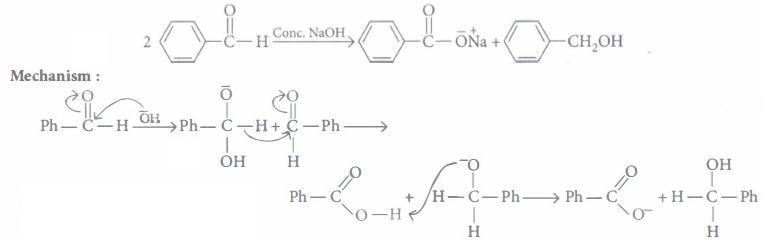
When an aldehyde with no a-hydrogen reacts with concentrated aqueous NaOH, half the aldehyde is converted to carboxylic acid salt and other half is converted to an alcohol. In other words, half of the reactant is oxidized
and other half is reduced. This reaction is known as Cannizzaro reaction
The following questions are multiple choice questions. Choose the most appropriate answer:
When an aldehyde with no a-hydrogen reacts with concentrated aqueous NaOH, half the aldehyde is converted to carboxylic acid salt and other half is converted to an alcohol. In other words, half of the reactant is oxidized
and other half is reduced. This reaction is known as Cannizzaro reaction
The following questions are multiple choice questions. Choose the most appropriate answer:
- A mixture of benzaldehyde and formaldehyde on heating with aqueous NaOH solution gives:
- Benzyl alcohol and sodium formate.
- Sodium benzoate and methyl alcohol.
- Sodium benzoate and sodium formate.
- Benzyl alcohol and methyl alcohol.
- Which of the following compounds will undergo Cannizzaro reaction?
- CH3CHO
- CH3COCH3
- C6H5CHO
- C6H5CH2CHO
- Trichloroacetaldehyde is subjected to Cannizzaro's reaction by using NaOH. The mixture of the products contains sodium trichloroacetate ion and another compound. The other compounds is:
- 2, 2, 2-trichloroethanol
- Trichloromethanol
- 2, 2, 2-trichloropropanol
- Chloroform
- Which of the following reaction will not result in the formation of carbon-carbon bonds?
- Cannizzaro reaction
- Wurtz reaction
- Reimer- Tiemann reaction
- Friedel - Crafts acylation
Electrical work done in unit time is equal to electrical potential multiplied by total charge passed. ln order to obtain maximum work from a cell, the charge has to be passed reversibly. The reversible work done by a cell is equal to decrease in its Gibb's energy. Hence, Gibb's energy of reaction is given by $\Delta\text{G}=\text{nFE}_\text{cell}$ Hence, Eis the emfof the cell and nFis the amount of energy. In these questions (Q. No. i-Iv), a statement of assertion followed by a statement ofreason is given. Choose the correct answer out of the following choices.
→- Assertion and reason both are correct statements and reason is correct explanation for assertion.
- Assertion and reason both are correct statements but reason is not correct explanation for assertion.
- Assertion is correct statement but reason is wrong statement.
- Assertion is wrong statement but reason is correct statement.
- Assertion: $\Delta\text{G}^\circ=-\text{nFE}^\circ$
Reason: Eº should be positive for a spontaneous reaction.
- Assertion: An electrochemical cell can be set up only if the red ox reaction is spontaneous.
Reason: A reaction is spontaneous if free energy change is negative.
- Assertion: For an electrochemical cell, $\Delta\text{G}<0$ and $\text{E}_\text{cell}>0.$
Reason: The given cell is non-spontaneous.
- Assertion: Current stops flowing when Ecell = 0.
Reason: Equilibrium of the cell reaction is attained.
- Assertion: Ecell should have a positive value for the cell to function.
Reason: Ecell = Ecathode - Eanode