Question
For a first order reaction, A → Products, $\text{k}=\frac{2.303}{\text{t}}\log\frac{\text{a}}{\text{a}-\text{x}},$ where a is the initial concentration of A and (a - x) is the concentration of A after time t. k is rate constant. Its value is constant at constant temperature for a reaction. The time in which half of the reactant is consumed is called half-life period. Half-life period of a first order reaction is constant. Its value is independent of initial concentration or any other external conditions.

In these questions (Q. No. i-iv), a statement of assertion followed by a statement ofreason is given. Choose the correct answer out of the following choices.

  1. Assertion and reason both are correct statements and reason is correct explanation for assertion.
  2. Assertion and reason both are correct statements but reason is not correct explanation for assertion.
  3. Assertion is correct statement but reason is wrong statement.
  4. Assertion is wrong statement but reason is correct statement.
  1. Assertion: Rate of reaction doubles when concentration of reactant is doubled if it is a first order reaction.

Reason: Rate constant also doubles.

  1. Assertion: For the first order reaction, half-life period is expressed as $\text{t}_\frac{1}{2}=\frac{2.303}{\text{k}}\log2.$

Reason: The half-life time of a first order reaction is not always constant and it depends upon the initial concentration of reactants.

  1. Reason: The half-life time of a first order reaction is not always constant and it depends upon the initial concentration of reactants.

Reason: Acid only acts as a catalyst whereas alkali acts as one of the reactants.

  1. Assertion: For a first order reaction, the concentration of the reactant decreases exponentially with time.

Reason: Rate of reaction at any time depends upon the concentration of the reactant at that time.

  1. Assertion: Half-life period for a first order reaction is independent of initial concentration of the reactant.

Reason: For a first order reaction, $\text{t}_\frac{1}{2}=\frac{0.693}{\text{k}},$ where k is rate constant.
Answer

  1. (c) Assertion is correct statement but reason is wrong statement.

Explanation:

For first order reaction, Rate, = k[A1] According to question,

[A2] = [2A1]

$\therefore$ Rate2 = k[2A1]

⇒ Rate2 = 2 Rate1

For a given reaction, rate constant is constant and independent of the concentration of reactant.

  1. (c) Assertion is correct statement but reason is wrong statement.

Explanation:

For first order reaction $\text{k}=\frac{2.303}{\text{t}}\log\frac{\text{a}}{\text{a}-\text{x}}$

$\text{k}=\frac{2.303}{\text{t}_\frac{1}{2}}\log\frac{\text{a}}{\text{a}-\frac{\text{a}}{2}}=\frac{2.303}{\text{t}_\frac{1}{2}}\log\frac{\text{a}}{\frac{\text{a}}{2}}=\frac{2.303}{\text{t}_\frac{1}{2}}\log2$

Therefore half-life period $\text{t}_\frac{1}{2}=\frac{2.303}{\text{k}}\log2.$

Thus $\text{t}_\frac{1}{2}$ is independent of initial concentration of reactant for first order reaction.

  1. (a) Assertion and reason both are correct statements and reason is correct explanation for assertion.

Explanation:

$\text{CH}_3\text{COOC}_2\text{H}_5+\text{H}_2\text{O}\xrightarrow{\ \ \text{H}^+\ \ }\text{CH}_3\text{COOH}+\text{C}_2\text{H}_5\text{OH}$

Rate $\propto[\text{CH}_3\text{COOC}_2\text{H}_5]$

$\text{CH}_3\text{COOC}_2\text{H}_5+\text{NaOH}\rightarrow\text{CH}_3\text{COONa}+\text{C}_2\text{H}_5\text{OH}$

Rate $\propto[\text{CH}_3\text{COOC}_2\text{H}_5][\text{NaOH}]$

  1. (a) Assertion and reason both are correct statements and reason is correct explanation for assertion.

Explanation:

For a first order reaction, $[\text{A}]=[\text{A}]_0\text{e}^{-\text{kt}}$

or $\log[\text{A}]=-\frac{\text{kt}}{2.303}+\log[\text{A}]_0$

  1. (a) Assertion and reason both are correct statements and reason is correct explanation for assertion.

Explanation:

For a first order reaction, $\text{t}_\frac{1}{2}$ is inversely proportional to k, it does not depend on the initial concentration of the reactant.

Need a full question paper?

Generate a complete, print-ready paper with questions like this in minutes — across 16+ boards, with answer keys.

Start Generating Free

Similar questions

Read the passage given below and answer the following questions:

At the freezing point of a solvent, the solid and the liquid are in equilibrium. Therefore, a solution will freeze when its vapour pressure becomes equal to the vapour pressure of the pure solid solvent. It has been observed that when a non-volatile solute is added to a solvent, the freezing point of the solution is always lower than that of the pure solvent. Depression in freezing point can be given as, $\Delta\text{T}_\text{f}=\text{K}_\text{f}\text{m}$ Where, Kf = Molal freezing point depression constant or we can write, $\Delta\text{T}_\text{f}=\frac{\text{K}_\text{f}\times\text{W}_\text{B}\times1000}{\text{W}_A\times\text{M}_\text{B}}$

a statement of assertion followed by a statement of reason is given. Choose the correct answer out of the following choices.

  1. Assertion and reason both are correct statements and reason is correct explanation for assertion.
  2. Assertion and reason both are correct statements but reason is not correct explanation for assertion.
  3. Assertion is correct statement but reason is wrong statement.
  4. Assertion is wrong statement but reason is correct statement.
  1. Assertion: 0.1M solution of glucose has same depression in the freezing point as 0.1M solution of urea.

Reason: Kf for both has same value.

  1. Assertion: Increasing pressure on pure water decreases its freezing point.

Reason: Density of water is maximum at 273K.

  1. Assertion: Larger the value of cryoscopic constant of the solvent, lesser will be the freezing point of the solution.

Reason: Extent of depression in the freezing point depends on the nature of the solvent.

  1. Assertion: The water pouch of instant cold pack for treating athletic injuries breaks when squeezed and NH4N03 dissolves thus lowering the temperature.

Reason: Addition of non-volatile solute into solvent results into depression of freezing point of solvent.

  1. Assertion: If a non-volatile solute is mixed in a solution then elevation in boiling point and depression in freezing point both wiII be same.

Reason: Elevation in boiling point and depression in freezing point both depend on number of particles of solute.

Write detailed note on: Starch
For the reaction : $2\text{NO}_\text{(g)}+\text{Cl}_{2\text{(g)}}\rightarrow2\text{NOCl}_\text{(g)},$ the following data were collected. All the measurements were taken at 263K.
Experiment No.
Initial [NO] (M)
Initial [Cl2] (M)
Initial rate of disapp. of Cl2 (M/ min)
1.
0.15
0.15
0.60
2.
0.15
0.30
1.20
3.
0.30
0.15
2.40
4.
0.25
0.25
?
The following questions are multiple choice questions. Choose the most appropriate answer:
  1. The molecularity of the reaction is:
  1. 1
  2. 2
  3. 3
  4. 4
  1. The expression for rate law is:
  1. $\text{r}=\text{k}[\text{NO}][\text{Cl}_2]$
  2. $\text{r}=\text{k}[\text{NO}]^2[\text{Cl}_2]$
  3. $\text{r}=\text{k}[\text{NO}][\text{Cl}_2]^2$
  4. $\text{r}=\text{k}[\text{NO}]^2[\text{Cl}_2]^2$
  1. The overall order of the reaction is:
  1. 2
  2. 0
  3. 1
  4. 3
  1. The value of rate constant is:
  1. 150.32 M-2 min-1
  2. 200.08 M-1 min-1
  3. 177.77 M-2 min-1
  4. 155.75 M-1 min-1
  1. The initial rate of disappearance of Cl2 in experiment 4 is:
  1. 1.75M min-1
  2. 3.23M min-1
  3. 2.25M min-1
  4. 2.77M min-1
Read the passage given below and answer the following questions:

If some solute is added to a solvent, the boiling point of solution increases. This is known as elevation in baiting point.

$\Delta\text{T}_\text{b}=\text{K}_\text{b}\text{m}$ where, Kb = Molal elevation constant,

$\Delta\text{T}_\text{b}\propto\text{m}$

Hence, it is a colligative property,

Also, $\text{K}_\text{b}=\frac{\text{MRT}^2_\text{b}}{\Delta\text{Vap}\text{H}\times1000}$

where, M = Molar mass of solvent,

$\Delta\text{vap}$ H = Enthalpy of vaporisation,

Molar mass can also be calculated using elevation in boiling point.

$\text{M}_\text{B}=\frac{\text{K}_\text{B}\times\text{W}_\text{B}\times1000}{\Delta\text{T}_\text{b}\times\text{W}_\text{A}}$

A statement of assertion followed by a statement of reason is given. Choose the correct answer out of the following choices.

  1. Assertion and reason both are correct statements and reason is correct explanation for assertion.
  2. Assertion and reason both are correct statements but reason is not correct explanation for assertion.
  3. Assertion is correct statement but reason is wrong statement.
  4. Assertion is wrong statement but reason is correct statement.
  1. Assertion: In a pressure cooker, the water is brought to boil. The cooker is then removed from the stove. Now on removing the lid of pressure cooker, the water starts boiling again.

Reason: The impurities in water bring down its boiling point.

  1. Assertion: On dissolving 3.24g of sulphur in 40g of benzene, boiling point of solution get higher than that of benzene by 0.081K, then the formula of sulphur is S8. (Kb for benzene = 2.53K kg mol-1)

Reason: Molecular mass of sulphur comes out to be 253.

  1. Assertion: When sugar is added to water, boiling point of water increases.

Reason: When a non-volatile solute is added to a solvent, elevation in boiling point is observed.

  1. Assertion: Cooking time in pressure cookers is reduced.

Reason: Boiling point inside the pressure cooker in raised.

  1. Assertion: Elevation in boiling point of two isotonic solutions is same.

Reason: Boiling point depends upon the concentration of the solute.

Read the passage given below and answer the following questions:

An ideal solution may be defined as the solution which obeys Raoult's law exactly over the entire range of concentration. The solutions for which vapour pressure is either higher or lower than that predicted by Raoult's law are called non-ideal solutions.Non-ideal solutions can show either positive or negative deviations from Raoult's law depending on whether the A-B interactions in solution are stronger or weaker than A - A and B - B interactions.

The following questions are multiple choice questions. Choose the most appropriate answer:

  1. Which of the following solutions is/are ideal solution(s)?
  1. Bromoethane and iodoethane.
  2. Acetone and chloroform
  3. Benzene and acetone
  4. n-heptane and n-hexane
  1. Only I
  2. I and II
  3. II and III
  4. I and Iv
  1. For which of the following solutions $\Delta\text{H}_{\text{mix}}$ and $\Delta\text{V}_{\text{mix}}$ is negative?
  1. Acetone and aniline
  2. Ethyl alcohol and cyclohexane
  3. Acetone and CS2
  4. Benzene and toluene
  1. Which of the following is not true for positive deviations?
  1. The A-B interactions in solution are weaker than the A - A and B - B interactions.
  2. $\text{P}_\text{A}<\text{P}\mathring{\text{A}}\ \text{x}_\text{A}$ and $\text{P}_\text{B}<\text{P}\mathring{\text{B}}\ \text{x}_\text{B}$
  3. Carbon tetrachloride and chloroform mixture is an example of positive deviations.
  4. All of these.
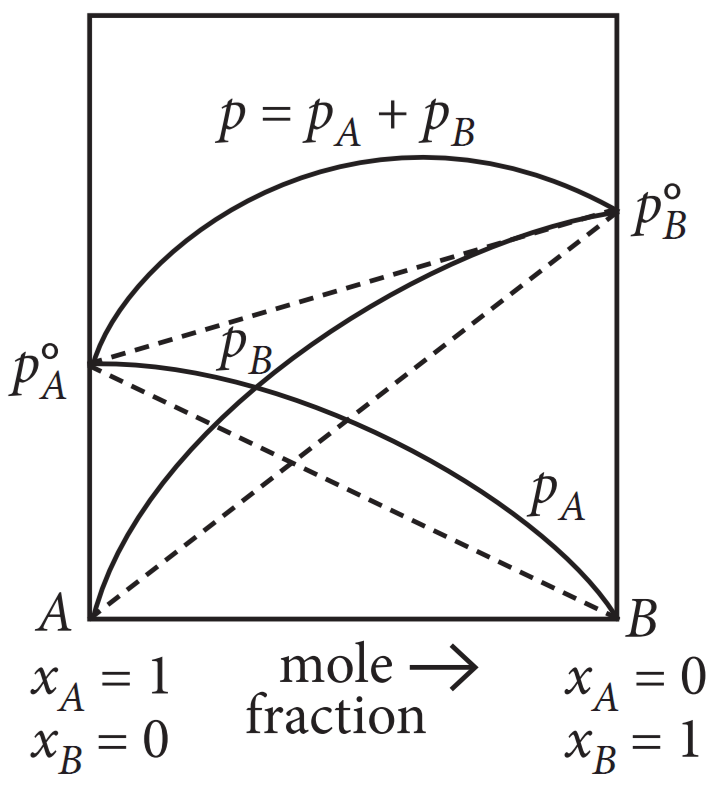
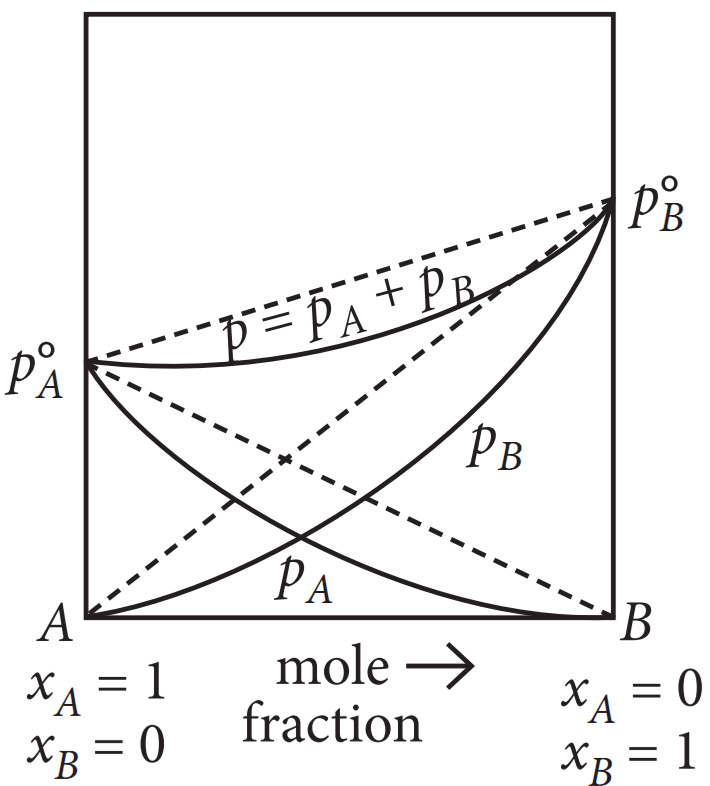
  1. For water and nitric acid mixture, which of the given graph is correct?


  1.  


  1.  

  1. Both of these
  2. None of these
  1. Water-HCI mixture.
  1. Shows positive deviations.
  2. Forms minimum boiling azeotrope.
  3. Shows negative deviations.
  4. Forms maximum boiling azeotrope.
  1. I and II
  2. I and III
  3. I and IV
  4. III and IV
Read the passage given below and answer the following questions:
The f-block elements are those in which the differentiating electron enters the (n -2)f orbital. There are two series of F-block elements corresponding to filling of 4f and 5f-orbitals. The series of 4f-orbitals is called lanthanides. Lanthanides show different oxidation states depending upon stability of f0, f7 and F14 configurations, though the most conunon oxidation states is +3. There is a regular decrease in size oflanthanides ions with increase in atomic number which is known as lanthanide contraction.
The following questions are multiple choice questions. Choose the most appropriate answer:
  1. The atomic numbers of three lanthanide elements X, Y and Z are 65, 68 and 70 respectively, their Ln3+ electronic configuration is:
  1. 4f8, 4f11, 4f13
  2. 4f11, 4f8, 4f13
  3. 4f0, 4f2, 4f11
  4. 4f3, 4f7, 4f9
  1. Lanthanide contraction is observed in:
  1. Gd
  2. At
  3. Xe
  4. Te
  1. Which of the following is not the configuration oflanthanoid?
  1. [Xe]4f106s2
  2. [Xe]4f15d16s2
  3. [Xe]4d145d106s2
  4. [Xe]4f75d16s2
  1. Name a member of the lanthanoid series which is well known to exhibit +4 oxidation state.
  1. Cerium (Z = 58)
  2. Europium (Z = 63)
  3. Lanthanum (Z = 57)
  4. Gadolinium (Z = 64
  1. Identify the incorrect statement among the following.
  1. Lanthanoid contraction is the accumulation of successive shrinkages.
  2. The different radii of Zr and Hf due to consequence of the lanthanoid contraction.
  3. Shielding power of 4f electrons is quite weak.
  4. There is a decrease in the radii of the atoms or ions as one proceeds from La to Lu.
Read the passage given below and answer the following questions:
Nucleophilic substitution reactions are of two types; substitution nucleophilic bimolecular (SN2) and substitution nucleophilic unimolecular (SN1) depending on molecules taking part in determining the rate of reaction. Reactivity of alkyl halide towards SN1 and SN2 reactions depends on various factors such as steric hindrance, stability of intermediate or transition state, and polarity of solvent. SN2 reaction mechanism is favoured mostly by primary alkyl halide then secondary and then tertiary. This order is reversed in case of SN1 reactions.
The following questions are multiple choice questions. Choose the most appropriate answer:
  1. Which of the following is most reactive towards nucleophilic substitution reaction?
  1. C6H5Cl
  2. CH2 = CHCl
  3. ClCH2CH = CH2
  4. CH3CH = CHCl
  1. Isopropyl chloride undergoes hydrolysis by:
  1. SN1 mechanism.
  2. SN2 mechanism.
  3. SN1 and SN2 mechanism.
  4. Neither SN1 nor SN2 mechanism.
  1. The most reactive nucleophile among the following is:
  1. CH3O-
  2. C6H5O-
  3. (CH3)2CHO-
  4. (CH3)3CO-
  1. Tertiary alkyl halides are practically inert to substitution by SN2 mechanism because of:
  1. Insolubility.
  2. Instability.
  3. Inductive effect.
  4. Stearic hindrance.
  1. Which of the following is the correct order of decreasing SN2 reactivity?
  1. RCH2X > R2CHX > R3CX
  2. R3CX > R2CHX > RCH2X
  3. R2CHX > R3CX > RCH2X
  4. RCH2X > R3CX > R2CHX
Read the passage given below and answer the following questions:

The sequence of bases along the DNA and RNA chain establishes its primary structure which controls the specific properties of the nucleic acid. An RNA molecule is usually a single chain ofribose-containing nucleotide. On the basis of X-ray analysis of DNA, J.D., Watson and EH.C. crick (shared noble prize in 1962) proposed a three dimensional secondary structure for DNA. DNA molecule is a long and highly complex, spirally twisted, double helix, ladder like structure. The two polynucleotide chains or strands are linked up by hydrogen bonding between the nitrogeneous base molecules of their nucleotide monomers. Adenine (purine) always links with thymine (pyrimidine) with the help of two hydrogen bonds and guanine (purine) with cytosine (pyrimidine) with the help of three hydrogen bonds. Hence, the two strands extend in opposite directions, i.e., are antiparallel and complimentary.

  1. Assertion and reason both are correct statements and reason is correct explanation for assertion.
  2. Assertion and reason both are correct statements but reason is not correct explanation for assertion.
  3. Assertion is correct statement but reason is wrong statement.
  4. Assertion is wrong statement but reason is correct statement.
  1. Assertion: DNA molecules and RNA molecules are found in the nucleus of a cell.

Reason: There are two types of nitrogenous bases, purines and pyrimidines. Adenine (A) and guanine (G) are substituted purines; cytosine (C), thymine (T) and uracil (U) are substituted pyrimidines.

  1. Assertion: In both DNA and RNA, heterocyclic base and phosphate ester linkages are at C-1' and C-5' respectively of the sugar molecule.

Reason: Nucleotides and nucleosides mainly differ from each other in presence of phosphate units.

  1. Assertion: The backbone of RNA molecule is a linear chain consisting of an alternating units of a heterocylic base, D-ribose and a phosphate.

Reason: The segment of DNA which acts as the instruction manual for the synthesis of protein is ribose.

  1. Assertion: The double helical structure of DNA was proposed by Emil Fischer.

Reason: A nucleoside is an N-glycoside of heterocyclic base.

  1. Assertion: In DNA, the complementary bases are, adenine and guanine; thymine and cytosine.

Reason: The phenomenon of mutation is chemical change in DNA molecule.

Read the passage given below and answer the following questions:

Fehling's reagent: Fehling's reagent is a mixture of two solutions. Fehllng's solution A is aqueous copper sulphate solution. Fehling's solution Bis alkaline sodium potassium tartarate (Rochelle salt).

$\ \ \ \ \ \ \ \ \ \ \ \ \ \ \ \ \ \ \ \ \text{CH(OH)COONa}\\\text{CuSo}_{4\text{(aq)}}+|\\\ \ \ \ \ \ \ \ \ \ \ \ \ \ \ \ \ \ \ \ \text{CH(OH)COOK}$

It is a mild oxidising agent. It is weaker than Tollens' reagent. It oxidises only aliphatic aldehydes to carboxylate ions and itself gets reduced to reddish brown precipitate of cuprous oxide. Aromatic aldehydes do not respond to Fehling's test. This reaction is used for the test of aliphatic aldehydes known as Fehling's reagent test.

In these questions (Q. No. l-iv), a statement of assertion followed by a statement ofreason is given. Choose the correct answer out of the following choices.

  1. Assertion and reason both are correct statements and reason is correct explanation for assertion.
  2. Assertion and reason both are correct statements but reason is not correct explanation for assertion.
  3. Assertion is correct statement but reason is wrong statement.
  4. Assertion is wrong statement but reason is correct statement.
  1. Assertion: Fehling's solution can be used to distinguish between acetaldehyde and acetone.

Reason: Fehling's reagent is a mixture of two solutions.

  1. Assertion: Aromatic aldehydes can be distinguished from aliphatic aldehydes by Fehling's solution.

Reason: Aromatic aldehydes reduce Fehling's solution, but aliphatic aldehydes do not.

  1. Assertion: Fehling's solution oxidises acetaldehyde to acetic acid but not benzaldehyde to benzoic acid.

Reason: The C-H bond of -CHO group in benzaldehyde is stronger than in acetaldehyde.

  1. Assertion: CH3CHO and C6H5CH2CHO cannot be distinguished chemically by Fehling's solution.

Reason: CH3CHO and C6H5CH2CHO cannot be distinguished chemically by Fehling's solution.

  1. Assertion: Formaldehyde, when heated with Fehling's reagent produces a reddish brown ppt, of Cu.

Reason: Fehling's reagent oxidises fonnaldehyde to formate ion.