Question
Read the Source/ Text given below and answer any four questions: During Maths Lab Activity each student was given four broomsticks of lengths $8\ cm, 8\ cm, 5\ cm, 5\ cm$ to make different types of quadrilaterals.
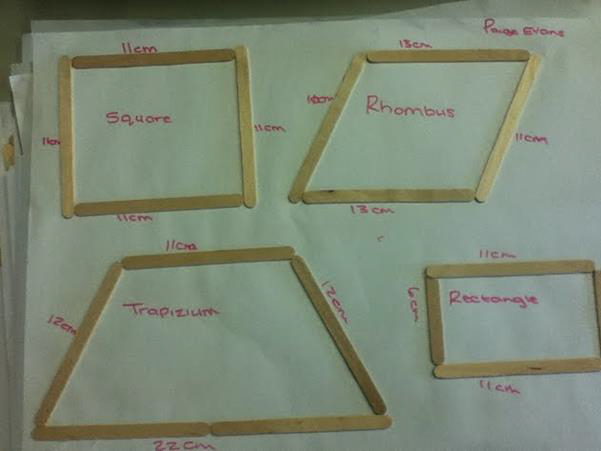
Using the above information answer the following questions:
$i.$ How many quadrilaterals can be formed using these sticks?
$a.$ Only One type of quadrilaterals can be formed.
$b.$ Two types of quadrilaterals can be formed.
$c.$ Three types of quadrilaterals can be formed.
$d.$ Four types of quadrilaterals can be formed.
$ii.$ Name the types of quadrilaterals formed:
$a.$Rectangle, parallelogram, kite.
$b.$ Rectangle, parallelogram, Trapizum.
$c.$, parallelogram, Square.
$d.$Rectangle, Square, kite.
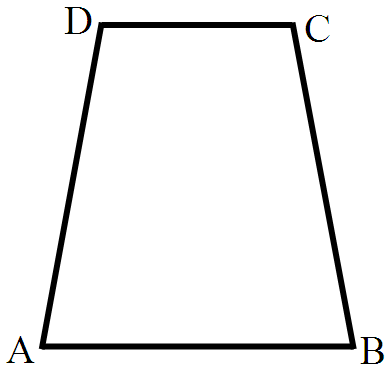
$iii.$ In a trapezium $\text{ABCD}, DC \| AB$ and $\angle\text{A}=\angle\text{B}=45^\circ,$ the teacher asked the student to find $\angle\text{D}.$ Naresh answered it is $...........$
$a. 105^\circ $
$b.108^\circ $
$c.135^\circ $
$d. 125^\circ $
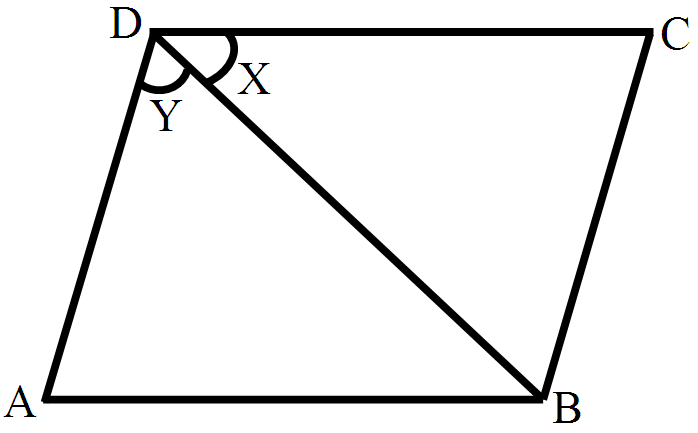
While discussing the properties of a parallelogram teacher asked about the relation between two angles x and y of a parallelogram as shown in fig. The teacher gave them $4$ options as $($if $BC < CD):$
$a.x > y$
$b. x < y$
$c.x = y$
$d.$None of these.
$P, Q, R,$ and $S$ are respectively the mid-points of sides $AB, BC, CD,$ and $DA$ of quadrilateral $ABCD$ in which $AC = BD$ and $\text{AC}\bot\text{BD}, \text{PQRS},$ is a:
$a.$ Square.
$b.$ Rhombus.
$c.$Kite.
$d.$Parallelogram.
Answer

$(i)$ $(c)$ Three types of quadrilaterals can be formed.
$(ii)$ $(a)$ Rectangle, parallelogram, kite.
$(iii)$ $(c)$ $135^\circ $
$(iv)$ $(b)$ $x < y$
$(v)$ $(a)$ Square.

Need a full question paper?

Generate a complete, print-ready paper with questions like this in minutes — across 16+ boards, with answer keys.

Start Generating Free

Similar questions

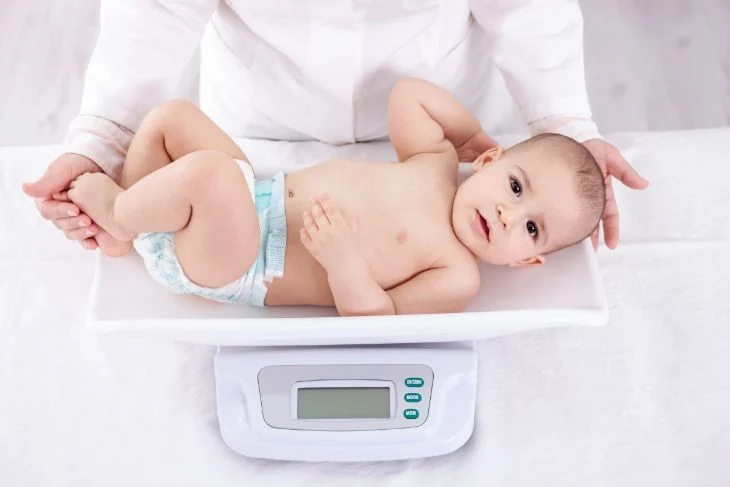
Read the Source/ Text given below and answer any four questions: The weights of newborn babies $($in $kg.)$ are recorded to maintain the health report cards in Apollo hospital on regular basis. On a particular day the weights of newborn recorded are are as follows$: \ 3.1, 3.0, 2.9, 2.9, 2.8, 2.8, 2.7, 2.7, 2.6, 2.5, 2.5, 2.4, 2.3, 2.2, 2.1.$

$i.$ Determine the range:
$a. 1.0\ Kg$
$b. 2.1\ Kg$
$c. 2.7\ Kg$
$d. 2.0\ kg$
$ii.$ How many babies were born on that day$?$
$a.11$
$b.15$
$c.12$
$d.16$
$iii.$ How many babies weight below $2.5\ kg?$
$a.3$
$b.4$
$c.5$
$d.6$
$iv.$ How many babies weigh more than $2.8\ kg?$
$a.1$
$b.2$
$c.3$
$d.4$
$v.$ How many babies weight $2.8\ kg?$
$a.1$
$b.2$
$c.3$
$d.4$
Five friends Anchal, Amisha, Mahi, Vaishu and Sahar are living in a hostel.
At the end of every month, they calculate the expenses on food and shopping.
The table given below shows their monthly expenses for the month of November.
Name Anchal Amisha Mahi Vishu Sahar
Expenditure (in Rs) $3000$ $5000$ $6000$ $4500$ $7000$
$1.$ Which graphical representation method would best represent the data given$?$
$2.$ What is the average expense of the friends for the month of November$?$
$3.$ Anchal says, “The difference between the median expenditures for October and November amounts to $0\%$ of the November expense, and we have been able to reduce our median expense for November.”
What was their median expense for the month of October$?$
$A. 12π$
$B. 15π$
$C. 19π$
$D. 20π$
Read the Source/ Text given below and answer these questions:
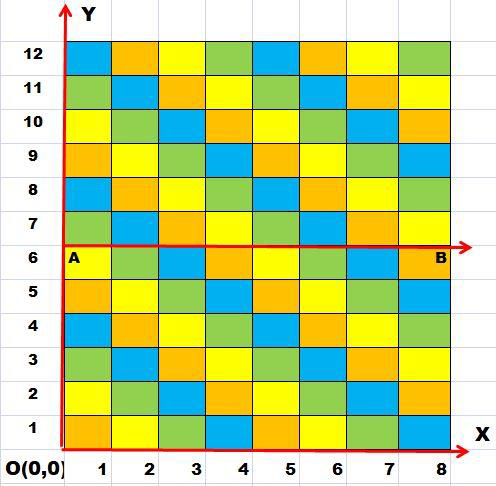
Roshan decorated one of his bathroom wall with tiles as shown in the picture. He was having tiles of four colours orange, yellow, green and blue. He fitted the tiles in $8$ columns and $12$ rows. The size of one tile was $1$ foot $\times \ 1$ foot and the area of each tile is $1$ foot$^2$. He arranged the tile in such a way that colour of tiles in each row and column were in the pattern: Orange $\rightarrow $ Yellow $\rightarrow $ green $\rightarrow $ Blue $\rightarrow $ Orange $\rightarrow .....$ and so on. Now answer the following questions:
$i.$ Which colour tile was fitted at the point with coordinates $(5, 3)?$
$a.$ Orange.
$b.$ Yellow.
$c.$ Green.
$d.$ Blue.
$ii.$ Which colour tile was fitted at the point with coordinates $(7, 7)$?
$a.$ Orange.
$b.$ Yellow.
$c.$ Green.
$d.$ Blue.
$iii.$ Which colour tile was fitted at the point with coordinate $(2, 5)$?
$a.$ Orange.
$b.$ Yellow.
$c.$ Green.
$d.$ Blue.
$iv.$ What is the area of the tiles fitted in the rectangular part $\text{OABX}$?
$a. 50$ foot$^2$
$b. 24$ foot$^2$
$c. 12$ foot$^2$
$d. 48$ foot$^2$
$v.$ What is the ordinate of top row tiles?
$a. 8$
$b. 12$
$c. 16$
$d. 6$
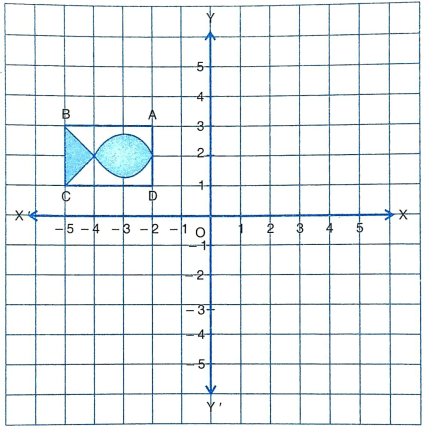
For Maths integrated project, Sonia created a symmetrical design on Cartesian plain. She drew a fish in a rectangle ABCD in the 2nd quadrant as shown in figure.
Image
Based on the above information, answer the following questions:
(i) Find the sum of abscissa of points A and B.
(ii) Find the area of rectangle ABCD.
(iii) What will be the new coordinates of A, B, C and D to draw the reflection of fish in the $3^{\text {rd }}$ quadrant across $x$-axis.
(iv) What will be the new coordinates of A, B, C and D to draw the fish by shifting each vertex of the rectangle 5 units to the right.
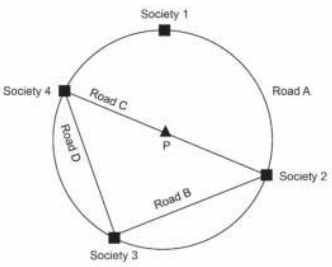
Given below is the map giving the position of four housing societies in a township connected by a circular road $A.$Image

Society $2$ and $3$ are connected by straight road $B,$ society $4$ and $2$ are connected by straight road $C$ and society $ 4$ and 3 are connected by road $D.$ Point $P$ denotes the position of a park. The park is equidistant to all four societies.
Rubina claims that it is not possible to construct another circular road connecting all four societies.
$1.$ Which of the following options justiies Rubina’s claim?
$A.$ Equal chords of congruent circles subtend equal angles at the centre.
$B.$ The perpendicular from the centre of a circle to a chord bisects the chord.
$C.$ There is a unique circle passing through three non-collinear points.
$D.$ Points equidistant from a given point will lie on a circle.
$2$ What is the position of the park P with respect to road $A?$
$A.$ Chord
$B.$ Centre
$C.$ Sector
$D.$ Segment
$3.$ The length of Road $B$ is equal to the length of Road $D.$
Which of the following options can be true for the roads in the township$?$
$A.$ Road $B$ bisects Road $D.$
$B.$ Road $B$ and Road make an acute angle.
$C.$ Road $B,$ Road $C$ and Road $D$ are of equal length.
$D. $ Road $B$ and Road $D$ subtend equal angles at society $1.$
$4.$ Alex says, “The angle made by road $B$ on road $D$ is a right angle.”
Jai and Angad give different justiications to support Alex’s claim.
Jai says, “Angles in the same segment of a circle are equal.”
Angad says, “The angle in a semicircle is a right angle.”
Who has given the correct justiication$?$
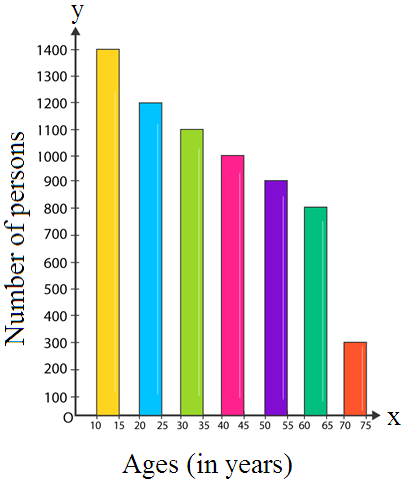
Read the Source Text given below and answer answer these questions: A healthcare survey was done by the state health and family welfare care board of the state of Punjab. The data is collected by forming age groups; i.e; $10-15, 20-25 ....$ and so on. The overall data from a town is given below in the form of a bar graph. Read the data carefully and answer the questions that follow.

$i.$ What is the percentage of the youngest age-group persons over those in the oldest age group$?$
$a. 400.56\%$
$b. 466.67\%$
$c. 500\%$
$d. 500.67\%$
$ii.$ What is the total population of the town$?$
$a. 6800$
$b. 7000$
$c. 6700$
$d. 6600$
$iii.$ How many persons are more in the age-group $10-15$ than in the age group $30-35?$
$a. 100$
$b. 200$
$c. 250$
$d. 300$
$iv.$ What is the age-group of exactly $1200$ persons living in the town$?$
$a. 20-25$
$b. 10-15$
$c. 15-20$
$d. 25-30$
$v.$ What is the total number of persons living in the town in the age$-$groups $10-15$ and $60-65?$
$a. 2100$
$b. 2000$
$c. 2200$
$d. 2400$