Question
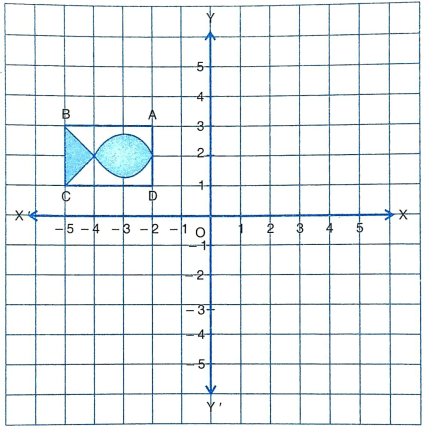
For Maths integrated project, Sonia created a symmetrical design on Cartesian plain. She drew a fish in a rectangle ABCD in the 2nd quadrant as shown in figure.
Image
Based on the above information, answer the following questions:
(i) Find the sum of abscissa of points A and B.
(ii) Find the area of rectangle ABCD.
(iii) What will be the new coordinates of A, B, C and D to draw the reflection of fish in the $3^{\text {rd }}$ quadrant across $x$-axis.
(iv) What will be the new coordinates of A, B, C and D to draw the fish by shifting each vertex of the rectangle 5 units to the right.
Answer

(i) -7
(ii) 6 sq. units
(iii) $A(-2,-3), B(-5,-3), C(-5,-1), D(-2,-1)$
(iv) $A(3,3), B(0,3), C(0,1), D(3,1)$

Need a full question paper?

Generate a complete, print-ready paper with questions like this in minutes — across 16+ boards, with answer keys.

Start Generating Free

Similar questions

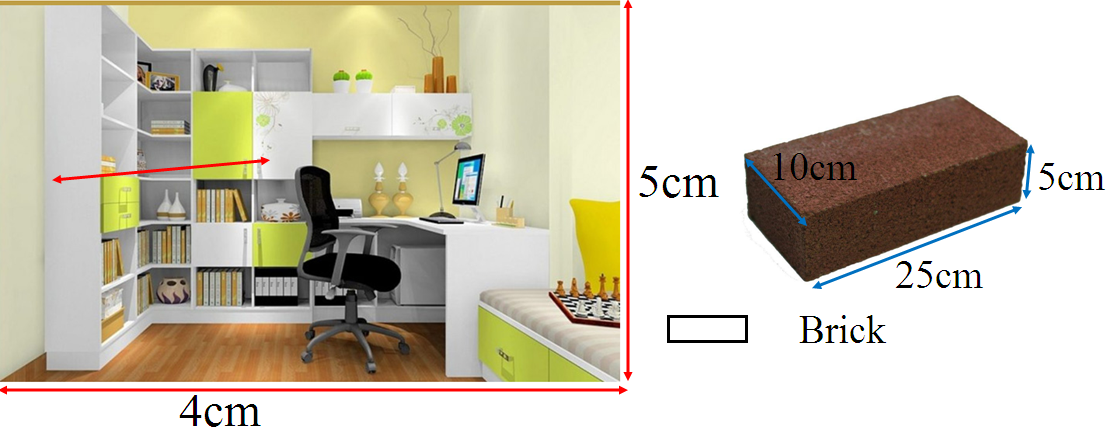
Read the passage given below and answer any four questions: Sohan's house has one bedroom hall with kitchen. His son needed a separate room for study. Thus Sohan planned to construct a new room with length $4\ m,$ width $2\ m$ and the height $3\ m$ as shown in the following figure. The room was separate at the roof of the house. The dimensions of the bricks used are: $25cm \times 10\ cm \times 5\ cm$
.
$i.$ Total how many bricks will be required? $(1\ m^3 =1000000\ cm^3):$
$a. 30000$
$b. 40000$
$c. 28800$
$d. 27000$
$ii.$ How many bricks will be used on both walls along the length $($length $= 4\ m)$?
$a. 19200$
$b. 20200$
$c. 18800$
$d. 17000$
$iii.$ How many bricks will be used on both walls along the width $($width $= 3\ m)$?
$a. 19200$
$b. 9600$
$c. 10000$
$d. 15000$
$iv.$ What is the volume of the room?
$a. 24\ m^3$
$b. 1\ m^3$
$c. 20\ m^3$
$d. 15\ m^3$
What is the area of the floor?
$a. 10\ m^2$
$b. 12\ m^2$
$c. 8\ m^2$
$d. 8\ m^3$
Which of the following statements is true$?$
In a school camp, $40$ students were divided into two groups to play a game.
The table given below shows the scores of team $A$ and team $B.$
Time(s) in minutes Cumulative Score of Team $A$ Cumulative Score of Team $A$
$0-5$ $14$ $20$
$5-10$ $35$ $27$
$10-15$ $30$ $31$
$15-20$ $35$ $31$
$20-25$ $44$ $37$
$25-30$ $52$ $50$
$7.$ How many score points did team A get between $10-15$ minutes$?$
$A. 6$
$B. 24$
$C. 30$
$D. 68$
$8.$ Which team scored more points during last $5$ minutes$?$ Justify your answer.
$9.$ What is the mean number of score points obtained by team $A$ in a $5-$minute interval rounded to the nearest whole number$?$
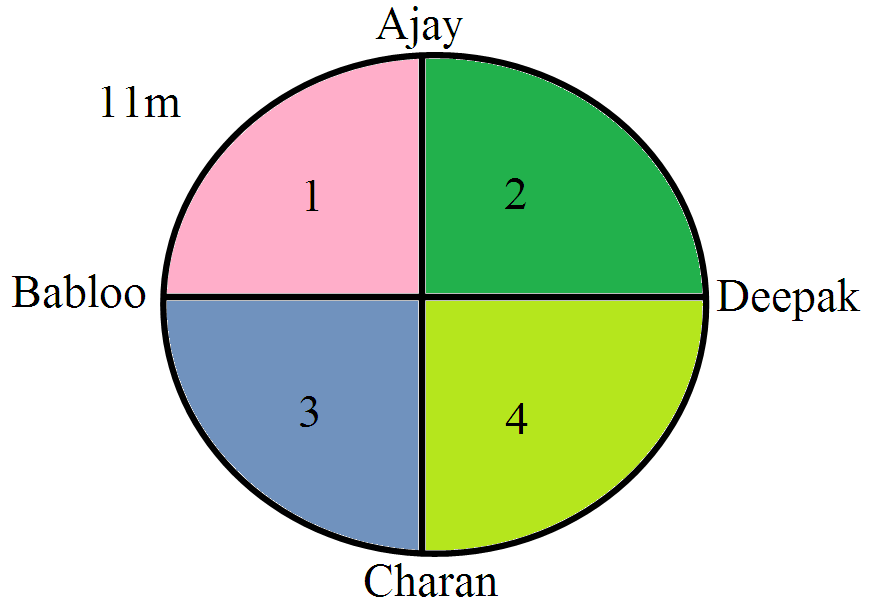
Read the Source/ Text given below and answer any four questions: Four students of class$ IX B$ with names Ajay, Babloo, Charan and Deepak are playing a game in a circular playground. All four students are holding radios with speaker and mic. These radios are connected by a wire of equal length that is $11\ m$ $($for each radio$)$. Ajay Asks a question to Babloo. If Babloo gives the correct answer he gets $10$ points and asks a new question to Charan, If he can not answer then he passes the same question to Charan and gets no points. These conditions apply to all four players. After $10$ rounds who gets maximum points, he becomes the winner.

$i.$ What is the radius of the field?
$a. 7\ m$
$b. 14\ m$
$c. 11\ m$
$d. 22\ m$
$ii.$ What is the area of the field?
$a. 70\ m^2$
$b. 154\ m^2$
$c. 110\ m^2$
$d. 220\ m^2$
$iii.$ What is the area of the part \ marked with 1 on the field?
$a. 50\ m^2$
$b. 154\ m^2$
$c. 76\ m^2$
$d. 38.5\ m^2$
$iv.$ What is the circu\ mference of the field?
$a. 22\ m$
$b. 14\ m$
$c. 44\ m$
$d. 28\ m$
4 What is the direct distance fro\ m Ajay to Charan?
$a. 7\ m$
$b. 28\ m$
$c. 15\ m$
$d. 14\ m$
Read the Source/ Text given below and answer these questions:
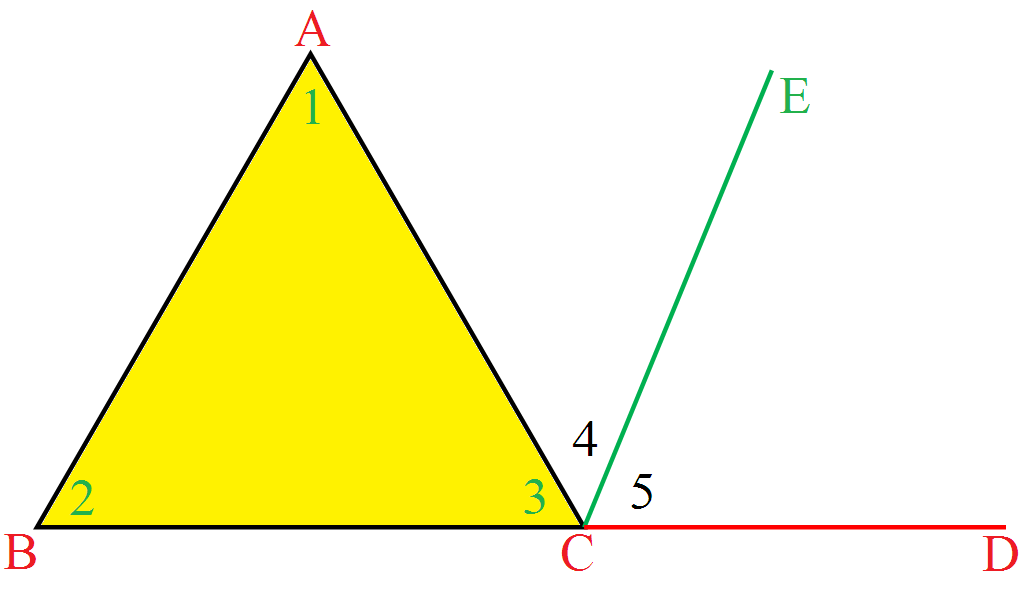
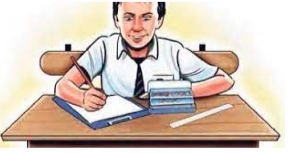
Once the Maths teacher of class $IX\ D$ told students that today we will prove that the sum of all three angles is $180^\circ .$ As shown in the figure, he told to draw any $\triangle ABC$ in the notebook.
Further side $BC$ was extended to $D.$

Now the teacher said to draw $CE \| BA.$ Further angles were named $1$ to $5$ as shown in the figure.
Now answer the following questions:
$i. BA \| CE$ and $AC$ is the transverse line, So $\angle1$ is equal to which angle$?$
$a. \angle2$
$b. \angle3$
$c. \angle4$
$d. \angle5$
$ii. \angle2$ is equal to which angle$?$
$a.\angle2$
$b.\angle3$
$c.\angle4$
$d. \angle5$
$iii.$ What is value of $\angle3+\angle4+\angle5?$
$a.180^\circ $
$b.120^\circ $
$c. 200^\circ $
$d. 360^\circ $
$iv.$ What is value of $\angle\text{ECD}=\angle4+\angle5?$
$a.\angle3+\angle5$
$b.\angle1+\angle2$
$c. \angle2+\angle3$
$d. \angle3+\angle4$
$v.$ What is value of $\angle1+\angle2+\angle3?$
$a.\angle3+\angle4+\angle5=180^\circ$
$b.360^\circ$
$c. \angle3+\angle4=100^\circ$
$d. 280^\circ$
Read the following text carefully and answer the questions that follow:
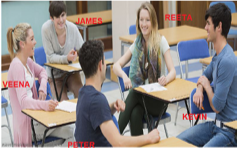
Peter, Kevin James, Reeta and Veena were students of Class $9^{th}\ B$ at Govt Sr Sec School, Sector $5,$ Gurgaon.
Once the teacher told Peter to think a number $x$ and to Kevin to think another number $y$ so that the difference of the numbers is $10 (x > y).$
Now the teacher asked James to add double of Peter's number and that three times of Kevin's number, the total was found $120.$
Reeta just entered in the class, she did not know any number.
The teacher said Reeta to form the $1^{st}$ equation with two variables $x$ and $y.$
Now Veena just entered the class so the teacher told her to form $2^{nd}$ equation with two variables $x$ and $y.$
Now teacher Told Reeta to find the values of $x$ and $y.$ Peter and kelvin were told to verify the numbers $x$ and $y.$
Image

$i.$ What are the equation formed by Reeta and Veena?
$ii.$ What was the equation formed by Veena?
$iii.$ Which number did Peter think?
OR
Which number did Kelvin think?
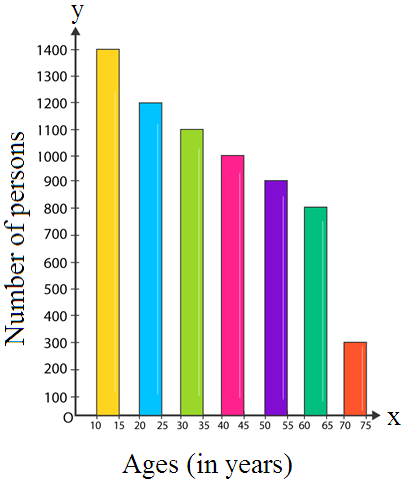
Read the Source Text given below and answer answer these questions: A healthcare survey was done by the state health and family welfare care board of the state of Punjab. The data is collected by forming age groups; i.e; $10-15, 20-25 ....$ and so on. The overall data from a town is given below in the form of a bar graph. Read the data carefully and answer the questions that follow.

$i.$ What is the percentage of the youngest age-group persons over those in the oldest age group$?$
$a. 400.56\%$
$b. 466.67\%$
$c. 500\%$
$d. 500.67\%$
$ii.$ What is the total population of the town$?$
$a. 6800$
$b. 7000$
$c. 6700$
$d. 6600$
$iii.$ How many persons are more in the age-group $10-15$ than in the age group $30-35?$
$a. 100$
$b. 200$
$c. 250$
$d. 300$
$iv.$ What is the age-group of exactly $1200$ persons living in the town$?$
$a. 20-25$
$b. 10-15$
$c. 15-20$
$d. 25-30$
$v.$ What is the total number of persons living in the town in the age$-$groups $10-15$ and $60-65?$
$a. 2100$
$b. 2000$
$c. 2200$
$d. 2400$
Read the following text carefully and answer the questions that follow:
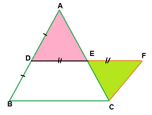
Haresh and Deep were trying to prove a theorem. For this they did the following
Image
$i.$ Draw a triangle $ABC$
$ii. \ D$ and E are found as the mid points of $AB$ and $AC$
$iii.\ DE$ was joined and $DE$ was extended to $F$ so $DE = EF$
$iv. \ FC$ was joined.
Questions :
$i. \triangle ADE$ and $\triangle EFC$ are congruent by which criteria?
$ii.$ Show that $C F \| A B$.
$iii.$ Show that $C F=B D$.
OR
Show that $D F=B C$ and $D F \| B C$.
Read the Source/ Text given below and answer any four questions:

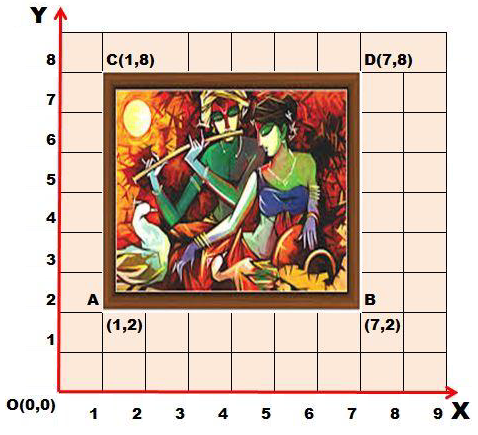
Rohit was putting up one of his paintings in his living room. Before this Rohit had put a grid on the wall where each unit measured equal to a foot. The upper$-$left corner of the frame is at point $C(1, 8)$ and the upper$-$right corner at $D(7, 8).$ The bottom$-$left corner is at $A(1, 2)$ and the bottom$-$right corner at $B(7, 2).$ Please answer the following questions:
$i.$ What is the width of the painting plus frame$?$
$a. 5$ feet
$b. 8$ feet
$c. 9$ feet
$d. 6$ feet
$ii.$ What is the length of the painting plus frame$?$
$a. 9$ feet
$b. 8$ feet
$c. 6$ feet
$d. 5$ feet
$iii.$ Which sides of the painting are parallel to $x-$axis$?$
$a. AB$ and $CD$
$c. AC$ and $BD$
$c.$ Diagonals $AD$ and $BC$
$d.$ No one
$iv.$ Which sides of the painting are parallel to $y-$axis$?$
$a. AB$ and $CD$
$b.AC$ and $BD$
$c.$ Diagonals $AC$ and $BD$
$d.$ No one
$v.$ Point $A, B, C$ and $D$ lie in which quadrant$?$
$a. I$
$b. II$
$c. III$
$d. IV$