Question
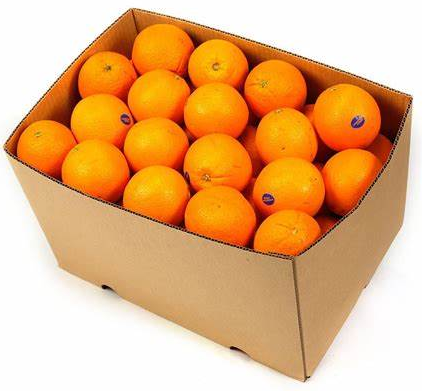
Read the Source/ Text given below and answer these questions: The following data given the weight (in grams) of $30$ oranges picked from a basket$:\ 106, 107, 76, 109, 187, 95, 125, 92, 70, 139, 128, 100, 88, 84, 99, 113, 204, 141, 136, 123, 90, 115, 110, 97, 90, 107, 75, 80,$ Frequency distribution table:
Class Interval
Tally marks
Frequency
$60 - 80$
$|||$
$3$
$80 - 100$
 
$||||\ ||||$
$10$
$100 - 120$
$||||\ ||||$
$9$
$120 - 140$
$||||$
$5$
$140 - 160$
$|$
$1$
$160 - 180$
$-$
$0$
$180 - 200$
$|$
$1$
$200 - 220$
$|$
$1$
Total
$30$
$30$

$i. $Class Size of given class data:
$a. 20$
$b. 10$
$c. 30$
$d. 15$
$ii.$ Classmark of forth class:
$a.70$
$b.130$
$c.20$
$d.15$
$iii.$ The number of oranges, whose weight is more than $180g:$
$a.1$
$b.3$
$c.2$
$d.4$
$iv.$ The number of oranges, whose weight is less than $100g:$
$a.10$
$b.3$
$c.5$
$d.13$
$v.$ The range of data is:
$a.70$
$204$
$c.134$
$d.274$
Answer

$(i)$ $(a)$ $20$
$(ii)$ $(b)$ $130$
$(iii)$ $(c)$ $2$
$(iv)$ $(d)$ $13$
$(v)$ $(c)$ $134$

Need a full question paper?

Generate a complete, print-ready paper with questions like this in minutes — across 16+ boards, with answer keys.

Start Generating Free

Similar questions

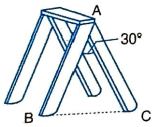
A ladder manufacturing company manufactures foldable step ladders of aluminum as shown in Fig. The lengths of two legs AB and AC are both equal to 110 cm and the angle between the two legs is $30^{\circ}$. On the basis of the above information answer the following questions:
Image
(i) $\angle A B C$ is equal to
(a) $70^{\circ}$ $\quad$(b) $75^{\circ}$(c) $85^{\circ}$ $\quad$(d) $60^{\circ}$
(ii) If $\angle B A C=60^{\circ}$, then $B C=$
(a) 120 cm $\quad$(b) 55 cm $\quad$(c) 110 cm $\quad$(d) 100 cm
(iii) $\triangle A B C$ is
(a) isosceles acute angled $\quad$ (b) right angled isosceles
(c) isosceles obtuse angled$\quad$(d) equilateral
(iv) In two triangles ABC and DEF, if $\angle A=\angle D, A B=D E$ and $A C=D F$, then the criterion by which two triangles are congruent is
(a) SSS $\quad$(b) ASA $\quad$(c) AAS $\quad$(d) SAS
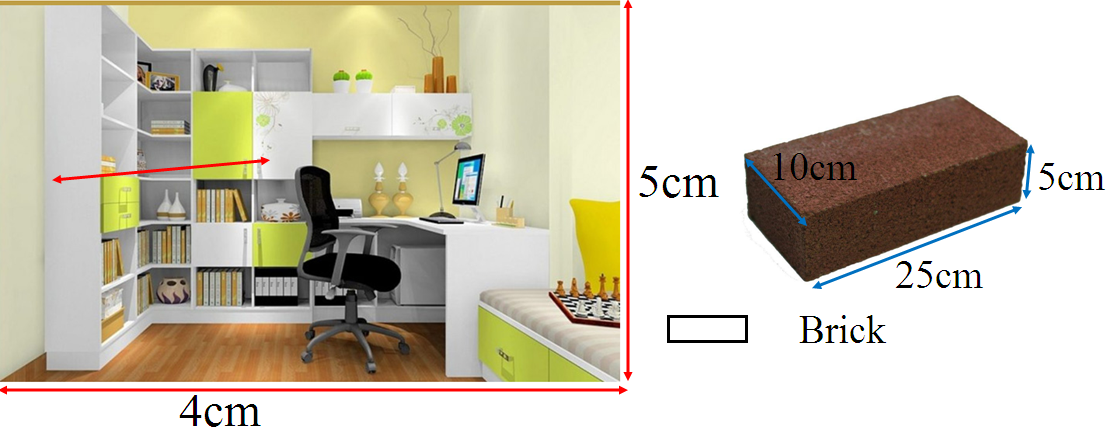
Read the passage given below and answer any four questions: Sohan's house has one bedroom hall with kitchen. His son needed a separate room for study. Thus Sohan planned to construct a new room with length $4\ m,$ width $2\ m$ and the height $3\ m$ as shown in the following figure. The room was separate at the roof of the house. The dimensions of the bricks used are: $25cm \times 10\ cm \times 5\ cm$
.
$i.$ Total how many bricks will be required? $(1\ m^3 =1000000\ cm^3):$
$a. 30000$
$b. 40000$
$c. 28800$
$d. 27000$
$ii.$ How many bricks will be used on both walls along the length $($length $= 4\ m)$?
$a. 19200$
$b. 20200$
$c. 18800$
$d. 17000$
$iii.$ How many bricks will be used on both walls along the width $($width $= 3\ m)$?
$a. 19200$
$b. 9600$
$c. 10000$
$d. 15000$
$iv.$ What is the volume of the room?
$a. 24\ m^3$
$b. 1\ m^3$
$c. 20\ m^3$
$d. 15\ m^3$
What is the area of the floor?
$a. 10\ m^2$
$b. 12\ m^2$
$c. 8\ m^2$
$d. 8\ m^3$
In a school camp, $40$ students were divided into two groups to play a game.
The table given below shows the scores of team $A$ and team $B.$
Time(s) in minutes Cumulative Score of Team $A$ Cumulative Score of Team $A$
$0-5$ $14$ $20$
$5-10$ $35$ $27$
$10-15$ $30$ $31$
$15-20$ $35$ $31$
$20-25$ $44$ $37$
$25-30$ $52$ $50$
$7.$ How many score points did team A get between $10-15$ minutes$?$
$A. 6$
$B. 24$
$C. 30$
$D. 68$
$8.$ Which team scored more points during last $5$ minutes$?$ Justify your answer.
$9.$ What is the mean number of score points obtained by team $A$ in a $5-$minute interval rounded to the nearest whole number$?$
Read the Source/ Text given below and answer these questions:
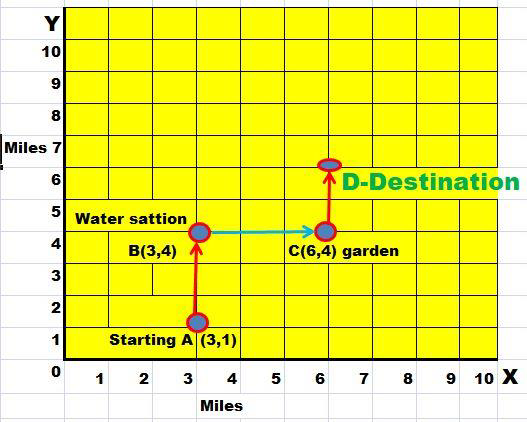
Arun is participating in an $8$ miles walk. The organizers used a square coordinate grid to plot the course. The starting point is at $A (3, 1).$ At $B (3, 4),$ there's a water station to make sure the walkers stay hydrated. From water station, the walkway turns right and at $C (6,4)$ a garden is situated to keep walkers fresh. From the garden, the walkway turns left and finally, Arun reaches at destination $D$ to complete $8$ miles.
$i.$ How far is the water station $B$ from the starting point $A?$
$a. 4$ miles
$b. 3$ miles
$c. 1$ mile
$d. 5$ miles
$ii.$ How far is the water station $B$ from garden $C?$
$a. 3$ miles
$b. 4$ miles
$c. 1$ mile
$d. 5$ miles
$iii.$ What is the abscissa of destination point $D:$
$a. 3$
$b. 5$
$c. 3$
$d. 6$
$iv$. What is the ordinate of destination point $D?$
$a. 3$
$b. 2$
$c. 6$
$d. 5$
$v.$ What are the coordinates of destination point $D?$
$a. (5, 6)$
$b. (6, 5)$
$c. (3, 9)$
$d. (6, 6)$
Mr. Roy, a Mathematics teacher explained some key points of unit 1 of class IX to his students. Some are given here.
• There are infinite rational numbers between any two rational numbers.
• Rationalisation of a denominator means to change the irrational denominator to rational form.
• A number is irrational if its decimal form is non-terminating and non-recurring. On the basis of these key points, choose the correct option in the following questions:
(i) What is the reciprocal of $2+\sqrt{3}$ ?
(a) $\sqrt{3}+2$ $\quad$(b) $\frac{1}{\sqrt{3}-2}$$\quad$ (c) $2-\sqrt{3}$ $\quad$(d) $\frac{1}{2}+\frac{1}{\sqrt{3}}$
(ii) Which of the following is irrational?
(a) $\frac{\sqrt{4}}{\sqrt{9}}$$\quad$ (b) $\frac{\sqrt{12}}{\sqrt{3}}$ $\quad$(c) $\sqrt{7}$ $\quad$(d) $\sqrt{81}$
(iii) Which of the following is irrational?
(a) 0.14 $\quad$(b) $0.14 \overline{16}$ $\quad$(c) $0.1 \overline{416}$ $\quad$(d) 0.401400140001......
(iv) Which of the following is value of $(\sqrt{11}+\sqrt{7})(\sqrt{11}-\sqrt{7})$ ?
(a) $\sqrt{11}$$\quad$ (b) 4 $\quad$(c) -4 $\quad$(d) $\sqrt{7}$
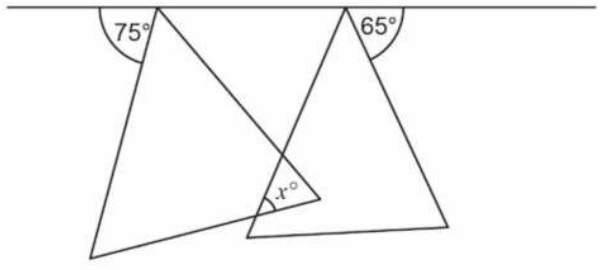
Two equilateral triangles on a straight line are shown below.What is the measure of $ 'x\ ’?$​​​​​​​
Image
 
Raghav bought this planter.
Image
The radius of the rim is $14\ cm.$ The curved surface area of the planter is $1848\ cm^2$
$5.$ What is the height of the planter$?$
$6.$ What is the volume of the planter$?$
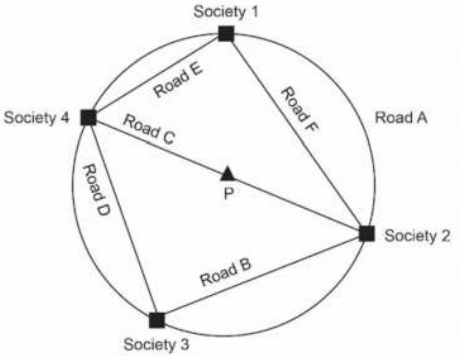
Two new roads, Road $E$ and Road $F$ were constructed between society $4$ and $1$ and society $1$ and $2.$Image
$5.$ What would be the measure of the sum of angles formed by the straight roads at society $1$ and society $3?$
$A. 60^\circ $
$B. 90^\circ $
$C. 180^\circ $
$D. 360^\circ $
$6.$ Krish says, “The distance to go from society $4$ to society $2$ using Road $D$ will be longer that the distance using Road $E”$
Is Krish correct$?$ Justify your answer with examples.
$7.$ Road $G,$ perpendicular to Road $F$ was constructed to connect the park and Road $F.$
Which of the following is true for Road $G$ and Road $F?$
$A.$ Road $G$ and road $F$ are of same length.
$B$. Road $F$ divides Road $G$ into two equal parts.
$C.$ Road $G$ divides Road $F$ into two equal parts.
$D.$ The length of road $G$ is one-fourth of the length of Road $F.$
$8.$ Priya said, “Minor arc corresponding to Road $B$ is congruent to minor arc corresponding to Road $D.”$ 
Do you agree with Priya$?$ Give reason to support your answer.
Read the Source/ Text given below and answer any four questions:
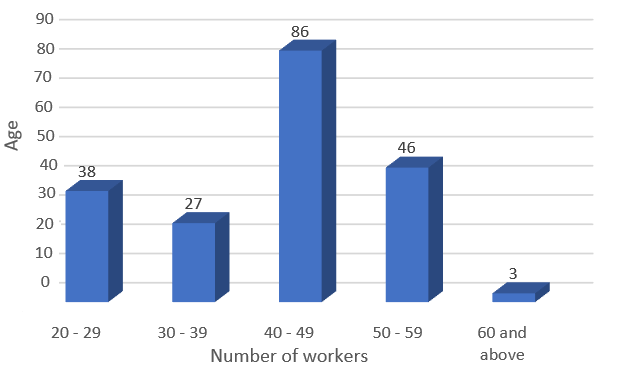
A recent survey by a labour organization of the state government of Odisha found that the wages of workers in a factory for different age groups are distributed as given in the bar graph. Read the bar graph carefully and answer the questions that follow.


If a person is selected at random, find the probability that the person is.
$i. 40$ years or more:
$a. 0.675$
$b. 0.576$
$c. 0.86$
$d. 0.10$
$ii.$ Under $40$ years:
$a.0$
$b.0.325$
$c.0.531$
$d.0.27$
$iii.$ Having age from $30$ to $39$ years:
$a.0.553$
$b.0.513$
$c.0.135$
$d.0.125$
$iv.$ Under $60$ but above $39$ years:
$a.0.62$
$b.0.66$
$c.0.55$
$d.0.02$
$v.$ Not less than $20$ years:
$a.0$
$b.1.03$
$c.0.01$
$d.1$