MCQ
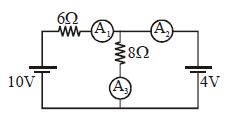
Reading of ammeter $A_1, A_2$ and $A_3$ will be respectively
  • A
    $1\,A, 0\,A, 1\,A$
  • B
    $2\,A, 1\,A, 1\,A$
  • $1\,A, 0.5\,A, 0.5\,A$
  • D
    None of these

Answer

Correct option: C.
$1\,A, 0.5\,A, 0.5\,A$
c
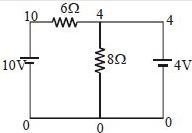
Reading of ammeter $A_{1}=\frac{10-4}{6}=1 \mathrm{\,A}$

Reading of ammeter $\mathrm{A}_{2}=1-0.5=0.5 \mathrm{\,A}$

Reading of ammeter $A_{3}=\frac{4-0}{8}=0.5 \mathrm{\,A}$
Need a full question paper?

Generate a complete, print-ready paper with questions like this in minutes — across 16+ boards, with answer keys.
Start Generating Free

Similar questions

A car moves along a circular track of radius $R$ banked at an angle of $30^o$ to the horizontal. The coefficient of static friction between the wheels and the track is $\mu$ . The maximum speed with which the car can move without skidding out is
Sound travels in a mixture of two moles of helium and n moles of hydrogen. If rms speed of gas molecules in the mixture is $\sqrt{2}$ times the speed of sound, then the value of $n$ will be
Which of the following particle will experience maximum acceleration when projected with same speed in transverse magnetic field
A glass tube $1.5 m$ long and open at both ends, is immersed vertically in a water tank completely. A tuning fork of $660 Hz$ is vibrated and kept at the upper end of the tube and the tube is gradually raised out of water. The total number of resonances heard before the tube comes out of water, taking velocity of sound air $330 m/sec$ is
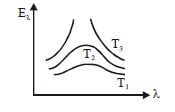
Variation of radiant energy emitted by sun, filament of tungsten lamp and welding arc as a function of its wavelength is shown in figure. Which of the following option is the correct match?
When a $_4B{e^9}$ atom is bombarded with $\alpha - $ particles, one of the product of nuclear transmutation is $_6{C^{12}}$. The other is
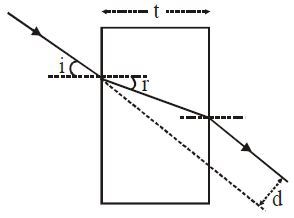
A ray of light is incident on a thick slab of glass of thickness $t$ as shown in the figure.  The  emergent ray is parallel to the incident ray but displaced sideways by a distance $d$. If  the angles are small then $d$ is
A concave and convex lens have the same focal length of $20 cm$ and are put into contact to form a lens combination. The combination is used to view an object of $5 cm$ length kept at $20 cm $ from the lens combination. As compared to the object, the image will be
Four identical charges $ + \,50\,\mu C$ each are placed, one at each corner of a square of side $2\,m$. How much external energy is required to bring another charge of $ + \,50\,\mu C$ from infinity to the centre of the square......$J$ $\left( {{\rm{Given}}\frac{{\rm{1}}}{{{\rm{4}}\pi {\varepsilon _{\rm{0}}}}} = 9 \times {{10}^9}\,\frac{{N{m^2}}}{{{C^2}}}} \right)$
Absolute zero $(0\, K)$ is that temperature at which