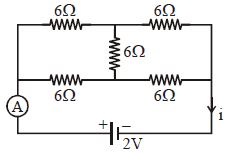
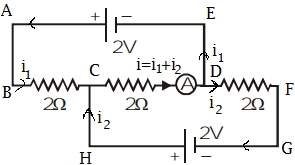
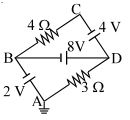
Reading of ammeter in ampere for the following circuit is
Medium


Download our appand get started for free
Experience the future of education. Simply download our apps or reach out to us for more information. Let's shape the future of learning together!No signup needed.*
Similar Questions
- 1View SolutionWhich of the adjoining graphs represents ohmic resistance
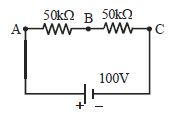
- 2In the adjacent shown circuit, a voltmeter of internal resistance $R$, when connected across $B$ and $C$ reads $\frac{{100}}{3}\,V$. Neglecting the internal resistance of the battery, the value of $R$ is ................. $k \Omega$View Solution
- 3View SolutionThe internal resistance of a cell is the resistance of
- 4The given figure shows $a$ network of resistances and $a$ battery. Which of the two batteries is getting charged?View Solution
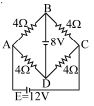
- 5The figure shows a network of resistances in which the point $A$ is earthed. The point which has the least potential isView Solution
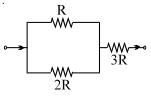
- 6The ratio of powers dissipatted respectively in $R$ and $3R$, as shown is:View Solution
- 7In a meter bridge experiment the balance point in obtained if the gaps are closed by $2\,\Omega$ and $3\,\Omega$. A shunt of $x\,\Omega$ is added to $3\,\Omega$ resistor to shift the balancing point by $22.5\,cm$. The value of $X$ is $................$View Solution
- 8A wire of length $100\, cm$ is connected to a cell of emf $2\,V$ and negligible internal resistance. The resistance of the wire is $3\,\Omega $. The additional resistance required to produce a potential difference of $1\, mV/cm$ is ............. $\Omega$View Solution
- 9An electric wire of length ‘$I$’ and area of cross-section $a$ has a resistance $R\, ohms$. Another wire of the same material having same length and area of cross-section $4a$ has a resistance ofView Solution
- 10A wire of length $L$ and $3$ identical cells of negligible internal resistances are connected in series. Due to current, the temperature of the wire is raised by $\Delta T$ in a time $t$. A number $N$ of similar cells is now connected in series with a wire of the same material and cross-section but of length $2\, L$. The temperature of the wire is raised by the same amount $\Delta T$ in the same time $t$. the value of $N$ isView Solution