MCQ
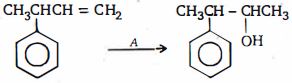
Reagent $A$ may be
  • A
    $H_2O/H^+$
  • B
    $BH_3 . THF/H_2O_2 -OH^-$
  • $Hg(OCOCH_3)_2.H_2O/NaBH_4 .NaOH$
  • D
    All are possible

Answer

Correct option: C.
$Hg(OCOCH_3)_2.H_2O/NaBH_4 .NaOH$
c
$(c)$ Oxymercuration - Demercuration reaction addition of $H_2O$ molecule is  according to Markovnikoff's rule

Need a full question paper?

Generate a complete, print-ready paper with questions like this in minutes — across 16+ boards, with answer keys.

Start Generating Free

Similar questions

Which of the following represents outermost shell electronic configuration of halogens
Which of the following has longest $C-O$ bond length ? (Free $C-O$ bond length in $CO$ is $1.128\,\mathop A\limits^o .$)
Which of the following is maximum stable free radical
$CO$ has same electrons as or the ion that is isoelectronic with $CO$ is
The number of $\pi - {\rm{bonds}}$ in the product formed by passing acetylene through dilute sulphuric acid containing mercuric sulphate is
How many secondary amine are possible with molecular formula $C_4H_{11}NH_2$
Given below are two statements:

Statement $I$: IUPAC name of $\mathrm{HO}-\mathrm{CH}_2-\left(\mathrm{CH}_2\right)_3-$ $\mathrm{CH}_2-\mathrm{COCH}_3$ is $7$-hydroxyheptan-2-one.

Statement $II$: $2$-oxoheptan-$7$-ol is the correct IUPAC name for above compound.In the light of the above statements. choose the most appropriate answer from the options given below:

Bottles containing $C_6H_5I$ and $C_6H_5-CH_2I$ lost their original labels. They were labelled $A$ and $B$ for testing. $A$ and $B$ were separately taken in a test tube and boiled with $NaOH$ solution. The end solution in each tube was made acidic with dilute $HNO_3$ and then some $AgNO_3$ solution was added. Substance $B$ gave a yellow precipitate. Which one of the following statements is true for this experiment
$100\  gm$ each solution, one containing $20\%$  by mass of $NaOH$ and other $40\%$ by mass of $NaOH$ are mixed and the density of the resulting solution is $1.25\  gm/ ml$ . Find the new $\%$ $w/v$ of $NaOH$ in the final solution ....... $\%$.
Product $(C)$ is

(figure) $\xrightarrow[CC{{l}_{4}}]{B{{r}_{2}}}(A)\xrightarrow[(ii)\,NaN{{H}_{2}}]{(i)\,alc.\,KOH}(B)\xrightarrow[(ii)\,C{{H}_{3}}-Cl]{(i)\,NaN{{H}_{2}}}(C)$