MCQ
Red light is generally used to observe diffraction pattern from single slit. If blue light is used instead of red light, then diffraction pattern
  • A
    Will be more clear
  • Will contract
  • C
    Will expanded
  • D
    Will not be visualized

Answer

Correct option: B.
Will contract
b
(b) ${\lambda _{{\rm{Blue}}}} < {\lambda _{{\rm{Red}}}}$. Therefore fringe pattern will contract because fringe width $ \propto \lambda $

Need a full question paper?

Generate a complete, print-ready paper with questions like this in minutes — across 16+ boards, with answer keys.

Start Generating Free

Similar questions

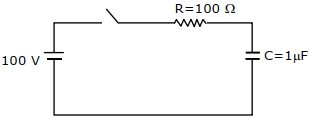
A capacitor of capacitance $C=1\, \mu \,{F}$ is suddenly connected to a battery of $100\, volt$ through a resistance ${R}=100\, \Omega$. The time taken for the capacitor to be charged to get $50 \,{V}$ is $....\,\times \,10^{-4}\,s.$

[Take $\ln 2=0.69]$

In terms of Bohr radius $a_0$, the radius of the second Bohr orbit of a hydrogen atom is given by
A proton with a kinetic energy of $2.0\,eV$ moves into a region of uniform magnetic field of magnitude $\frac{\pi}{2} \times 10^{-3}\,T$. The angle between the direction of magnetic field and velocity of proton is $60^{\circ}$. The pitch of the helical path taken by the proton is $..........cm$ (Take, mass of proton $=1.6 \times 10^{-27}\,kg$ and Charge on proton $=1.6 \times 10^{-19}\,kg)$
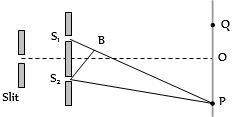
In the figure is shown Young’s double slit experiment.$ Q$ is the position of the first bright fringe on the right side of $O. P$ is the $11^{th}$ fringe on the other side, as measured from $Q$. If the wavelength of the light used is $6000 \times {10^{ - 10}}m$, then ${S_1}B$ will be equal to
A proton enters a magnetic field of flux density 1.5 weber/m$^2$  with a velocity of $2\times 10^7$ m/sec  at an angle of 30° with the field. The force on the proton will be
The Bohr model for the spectra of a H-atom:
A $10 \;eV$ electron is circulating in a plane at right angles to a uniform field at magnetic induction $10^{-4} \;W b / m^{2}(=1.0$ gauss), the orbital radius of electron is ........ $cm$
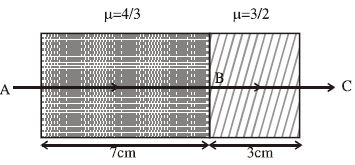
The given figure shows a ray of light passing through two media having refractive indices $4/3$ and $3/2$ respectively. The ratio of times taken by the ray in traversing the distances $AB$ and $BC$ is
$1$ micro coulomb $=$
The stopping potential ($v_0$)