Question
Reduce the following fractions into its simplest form: $\frac{72}{90}$

Answer

Here, numerator $= 72$ and denominator $= 90$
Factors of $72$ are $1, 2, 3, 4, 6, 8, 9, 12, 18, 24, 36$ and $72$
Factors of $90$ are $1, 2, 3, 5, 6, 9, 10, 15, 18, 30, 45$ and $90$
Common factors of $72$ and $90$ are $1, 2, 3, 6, 9$ and $18 H.C.F.$ of $72$ and $90$ is $18$
$\therefore\frac{72}{90}=\frac{72\div18}{90\div18}=\frac{4}{5}$
Hence, the simplest form of $\frac{72}{90}$ is $\frac{4}{5}$.

Need a full question paper?

Generate a complete, print-ready paper with questions like this in minutes — across 16+ boards, with answer keys.
Start Generating Free

Similar questions

The quarterly school fee in Kendriya Vidyalaya for Class $VI$ is $Rs. 540$. What will be the fee for seven months?
If $AB = 7.5\ cm$ and $CD = 2.5\ cm,$ construct a segment whose length is equal to: $AB + CD$
Find the $LCM$ of the numbers given below:$48, 64, 72, 96, 108$
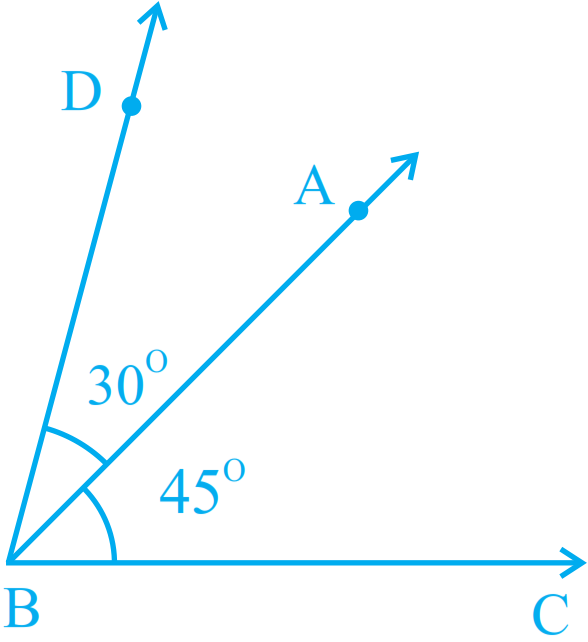
Draw an angle $ABC$ of measure $45^\circ$, using ruler and compasses. Now draw an angle $DBA$ of measure $30^\circ$, using ruler and compasses as shown in Figure. What is the measure of $\angle\text{DBC}?$
Reduce the following fractions to its lowest term (simplest form): $\frac{42}{28}$
Mark two points, $A$ and $B$ on a piece of paper and join them. Measure this length. Draw a line segment $CD$ that is: Collinear with $AB$ and is equal to it.
Find the fraction that represents the number of natural numbers to total numbers in the collection $0, 1, 2, 3, 4, 5$. What fraction will it be for whole numbers?
$\frac{2}{3}$ and $\frac{6}{7}$
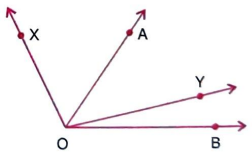
Which angle is greater: $\angle XOY$ or $\angle A O B$ ? Give reasons.
Image
$\begin{array}{l}\text {[HINT: } \angle XOY =\angle XOA +\angle A O Y \\ \angle A O B=\angle B O Y+\angle A O Y \\ \therefore \angle XOY -\angle A O B=[\angle X O A+\angle A O Y]-[\angle B O Y+\angle A O Y]\\ =\angle X O A-\angle B O Y\end{array}$
We observe that $\angle X O A>\angle B O Y$
$
\therefore \angle X O A-\angle B O Y>0 \Rightarrow \angle X O Y-\angle A O B>0 \Rightarrow \angle X O Y>\angle A O B]
$
To stitch a shirt $2m$ $15cm$ cloth is needed. Out of $40m$ cloth, how many shirts can be stitched and how much cloth will remain?