Question
Reduce the fraction to simplest from: $\frac7{28}$

Answer

Factors of $7$ are $1$ and $7$
Factors of $28$ are $1, 2, 4, 7, 14$ and $28$
$\therefore$ Common factors of $7$ and $28$ are $1$ and $7$
Highest of these common factors is $7$
$\therefore H.C.F.$ of $7$ and $28$ is $7$
Now, $\frac7{28}=\frac{7\div7}{28\div7}=\frac14$
Hence, the simplest form of $\frac7{28}$ is $\frac14$

Need a full question paper?

Generate a complete, print-ready paper with questions like this in minutes — across 16+ boards, with answer keys.
Start Generating Free

Similar questions

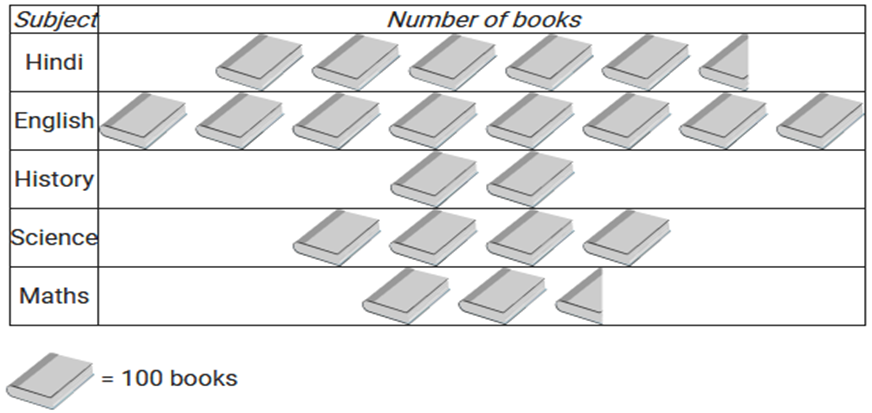
The pictograph shown different subject books which are kept in a library.

$i.\ $How many English books are there in the library?
$ii.\ $How many maths books are there?
$iii.\ $Which books are maxmimum in number?
$iv.\ $Which books are minimum in number?
Solve the following equation and verify the answer: $3(2 - 5x) - 2(1 - 6x) = 1$
Total number of students of a school in different years is shown in the following table:
Year
Number of students
$1996$
$400$
$1998$
$550$
$2000$
$450$
$2002$
$600$
$2006$
$650$
Represent the above data by a pictograph. Prepare a pictograph of students using one symbol an icon of a student to represent students and answer the following questions:
$i.\ $How many symbols represent total number of students in the year $2002$?
$ii.\ $How many symbols represent total number of students for the year $1998$?
The sides of a triangle are in the ratio $2 : 3 : 5.$ If its perimeter is $100\ cm,$ the length of its smallest side is:
Solve the following equation and verify the answer: $6(1 - 4x) + 7(2 + 5x) = 53$
Give your examples of each rule.
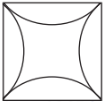
This is a square with 8 cm sidelengths.
Image
Construct a “Square with Curves ”, taking a square of side 8 cm as shown in the figure.
Hint: Think where the tip of the compass can be placed to get all 4 arcs to bulge uniformly from each of the sides. Try it out!
Let $A, B$ be the centres of two circles of equal radii; draw them so that each one of them passes through the centre of the other. Let them intersect at $C$ and $D.$ Examine whether $\overline{\text{AB}}\text{ and}\ \overline{\text{CD}}$ are at right angles.
Using a protractor, draw an angle of measure $72^\circ .$ With this angle as given, draw angles of measure $36^\circ $ and $54^\circ .$