MCQ
Reduction of an aldehyde produces
  • Primary alcohol
  • B
    Monocarboxylic acid
  • C
    Secondary alcohol
  • D
    Tertiary alcohol

Answer

Correct option: A.
Primary alcohol
a
(a)$\mathop {R - CHO}\limits_{{\text{Aldehyde}}} \xrightarrow{{{\text{Reduction}}}}\mathop {R - C{H_2} - OH}\limits_{{1^o}\,\,{\text{alcohol}}} $

Need a full question paper?

Generate a complete, print-ready paper with questions like this in minutes — across 16+ boards, with answer keys.

Start Generating Free

Similar questions

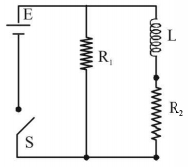
An inductor of inductance $L=400\,mH$ and resistors of resistance $R_1=2 \,\Omega$ and $R _2=2\,\Omega$ are connected to a battery of emf $12\,V$ as shown in the figure. The internal resistance of the battery is negligible. The switch $S$ is closed at $t=0$. The potential drop across $L$ as a function of time is
A positively charged pendulum is oscillating in a uniform electric field pointing upwards. Its time period as compared to that when it oscillates without electric field
Initial pressure and volume of a gas are $ P$ and $V$ respectively. First it is expanded isothermally to volume $4V$ and then compressed adiabatically to volume $ V$. The final pressure of gas will be
The angle of incidence for a ray of light at a refracting surface of a prism is $45^o  $. The angle of prism is $60^o $ . If the ray suffers minimum deviation through the prism, the angle of minimum deviation and refractive index of the material of the prism respectively, are 
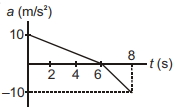
The acceleration-time graph for a particle moving along $x$-axis is shown in figure. If the initial velocity of particle is $-5 \,m / s$, the velocity at $t=8 \,s$ is ....... $m / s$
A stone tide to a string of length $L$ is whirled in a vertical circle with the other end of the string at the centre. At a certain instant of time, the stone is at its lowest position and has a speed $u$. The magnitude of change in its velocity, as it reaches a position where the string is horizontal, is $\sqrt{ x \left( u ^{2}- gL \right)}$. The value of $x$ is .............
A block of mass $m$ is pulled along a horizontal surface by applying a force at an angle $\theta $ with the horizontal. The friction coefficient between the block and surface is $\mu$. If the block travels at a uniform velocity , then work-done during its displacement $d$ is
The magnetic field vector of an electromagnetic wave is given by ${B}={B}_{o} \frac{\hat{{i}}+\hat{{j}}}{\sqrt{2}} \cos ({kz}-\omega {t})$; where $\hat{i}, \hat{j}$ represents unit vector along ${x}$ and ${y}$-axis respectively. At $t=0\, {s}$, two electric charges $q_{1}$ of $4\, \pi$ coulomb and ${q}_{2}$ of $2 \,\pi$ coulomb located at $\left(0,0, \frac{\pi}{{k}}\right)$ and $\left(0,0, \frac{3 \pi}{{k}}\right)$, respectively, have the same velocity of $0.5 \,{c} \hat{{i}}$, (where ${c}$ is the velocity of light). The ratio of the force acting on charge ${q}_{1}$ to ${q}_{2}$ is :-
The internal and external radii of a hollow cylinder are measured with the help of a vernier callipers.Their values are $(4.23 \pm 0.01)\,\,cm$ and $(3.87 \pm 0.01)\,\,cm,$ respectively. The thickness of the wall of the cylinder is
Two particles are in $SHM$ on same straight line with amplitude $A$ and $2A$ and with same angular frequency $\omega .$ It is observed that when first particle is at a distance $A/\sqrt{2}$ from origin and going toward mean position, other particle is at extreme position on other side of mean position. Find phase difference between the two particles