MCQ
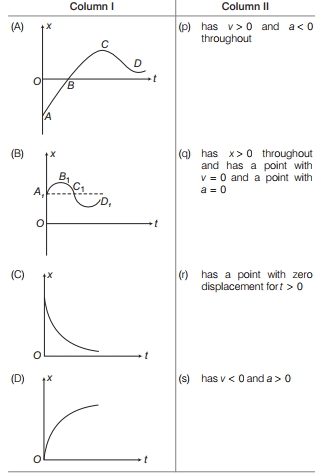
Refer to the graph in figure. Match the following
  • $(A \rightarrow r, B \rightarrow q, C \rightarrow s, D \rightarrow p)$
  • B
    $(A \rightarrow q, B \rightarrow r, C \rightarrow s, D \rightarrow p)$
  • C
    $(A \rightarrow r, B \rightarrow s, C \rightarrow q, D \rightarrow p)$
  • D
    $(A \rightarrow r, B \rightarrow q, C \rightarrow p, D \rightarrow s)$
Answer

Correct option: A.
$(A \rightarrow r, B \rightarrow q, C \rightarrow s, D \rightarrow p)$
a
(a)

We have to analyse slope of each curve i.e. $\frac{d x}{d t}$. For peak points $\frac{d x}{d t}$ will be zero as $x$ is maximum at peak points.

For graph $(A)$, there is a point $(B)$ for which displacement is zero. So, a matches with $(r)$.

In graph $(B)$, $x$ is positive $\diamond 0$ ) throughout and at point $B_1, V=\frac{d x}{d t}=0$

since, at point of curvature changes $a=0$, So $b$ matches with $(q)$

Need a full question paper?

Generate a complete, print-ready paper with questions like this in minutes — across 16+ boards, with answer keys.

Start Generating Free

Similar questions

The magnitude of displacement of a particle moving in a circle of radius $a$ with constant angular speed $\omega$ varies with time $t$ as
A monoatomic gas molecule has
In the above question, if another body is at rest, then velocity of the compound body after collision is
A bullet is fired from a gun at the speed of $280\,ms ^{-1}$ in the direction $30^{\circ}$ above the horizontal. The maximum height attained by the bullet is $........\,m$ $\left(g=9.8\,ms ^{-2}, \sin 30^{\circ}=0.5\right):-$
A nucleus moving with a velocity $\vec{\text{v}}$ emits an $\alpha -$particle. Let the velocities of the $\alpha -$particle and the remaining nucleus be $\vec{\text{v}}_1$ and $\vec{\text{v}}_2$ and their masses be $m_1$ and $m_2$.
If $C_P, C_V$ are molar specific heats of a solid and $R$ is universal gas constant, then:
The temperature of hot and cold end of a $20cm$ long rod in thermal steady state are at ${100^o}C$ and ${20^o}C$ respectively. Temperature at the centre of the rod is...... $^oC$
Two small, equal masses are attached by a light weight rod. This object orbits a planet ; the length of the rod is smaller than the radius of the orbit, but not negligible. The rod rotates about its axis in such a way that it remains vertical with respect to the planet. (Assume in each case perturbation maintains the rate of rotation, so that in the co-rotating frame the rod is  still stationary but at an angle to the vertical.)
Moment of a force of magnitude $20 \,N$ acting along positive $x$ direction at point $(3 \,m , 0,0)$ about the point $(0,2,0)$ (in $Nm$ ) is ...........
Assume that a block of very low shear modulus is fixed on an inclined plane as shown. Due to elastic forces it will deform. What will be the shape of the block ?