MCQ
A monoatomic gas molecule has
  • Three degrees of freedom
  • B
    Four degrees of freedom
  • C
    Five degrees of freedom
  • D
    Six degrees of freedom

Answer

Correct option: A.
Three degrees of freedom
a
An atomic gas molecule has only three transferable degrees of freedom.

Need a full question paper?

Generate a complete, print-ready paper with questions like this in minutes — across 16+ boards, with answer keys.

Start Generating Free

Similar questions

A body will have uniform acceleration if its:
The decimal equivalent of $\frac {1}{20} $ upto three significant figures is
Moment of inertia $(M.I.)$ of four bodies, having same mass and radius, are reported as;

$I _{1}= M$. of thin circular ring about its diameter.

$I _{2}=$ $M.I.$ of circular disc about an axis perpendicular to the disc and going through the centre,

$I _{3}=$ $M.I.$ of solid cylinder about its axis and

$I _{4}= M . I.$ of solid sphere about its diameter. Then
The magnetic field energy in an inductor changes from maximum value to minimum value in 5.0ms when connected to an AC source. The frequency of the source:
In a playground there is a merry-go-round of mass $120\ kg$ and radius $4\ m$. The radius of gyration is $3\ m$. A child of mass $30\ kg$ runs at a speed of $5\ m/sec$ tangent to the rim of the merry-go-round when it is at rest and then jumps on it. Neglect friction and find the angular velocity of the merry-go-round and child ......... $ rad/sec$.
A ball is thrown up at an angle with the horizontal. Then, the total change of momentum by the instant it returns to the ground is
A boy of mass M is applying a horizontal force to slide a box of mass M' on a rough horizontal surface. The coefficient of friction between the shoes of the box and the floor is $\mu.$ In which of the following cases it is certainly not possible to slide the box?
What is the torque of the force $\mathop F\limits^ \to   = (2\hat i - 3\hat j + 4\hat k)N$ acting at the pt. $\mathop r\limits^ \to   = (3\hat i + 2\hat j + 3\hat k)\,m$ about the origin
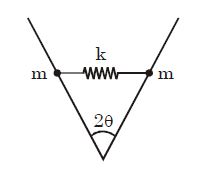
Two particles of mass $m$ are constrained to move along two horizontal frictionless rails that make an angle $2\theta $ with respect to each other. They are connected by a spring with spring constant $k$ . The angular frequency of small oscillations for the motion where the two masses always stay parallel to each other (that is the distance between the meeting point of the rails and each particle is equal) is 
Two identical mass $M$ moving with velocity $\mu_1$ and $\mu_2$ collide perfectly inelastically. The loss in energy is