Question
Regarding a semiconductor which one of the following is wrong

Answer

(a)At room temperature, few bonds breaks and electron hole pair generates inside the semiconductor.

Need a full question paper?

Generate a complete, print-ready paper with questions like this in minutes — across 16+ boards, with answer keys.
Start Generating Free

Similar questions

$5 \%$ of the power of $100\, W$ bulb is converted to visible radiation. Average intensity of visible radiation at a distance of $10 \,m$ from the bulb is .......... $watt / m ^2$
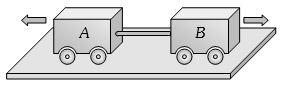
Two carts of masses $200\, kg$ and $300 \,kg$ on horizontal rails are pushed apart. Suppose the coefficient of friction between the carts and the rails are same. If the $200 \,kg$ cart travels a distance of $36 \,m$ and stops, then the distance travelled by the cart weighing $300 \,kg$ is ........ $m$
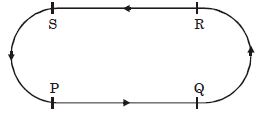
A dancer moves counterclockwise at constant speed around the path shown below. The path is such that the lengths of its segments, $PQ, QR, RS$, and $SP$, are equal. Arcs $QR$ and $SP$ are semicircles. Which of the following best represents the magnitude of the dancer’s acceleration as a function of time $t$ during one trip around the path, beginning at point $P$ ?
A disk of radius $R$ with uniform positive charge density $\sigma$ is placed on the $x y$ plane with its center at the origin. The Coulomb potential along the $z$-axis is

$V(z)=\frac{\sigma}{2 \epsilon_0}\left(\sqrt{R^2+z^2}-z\right)$

A particle of positive charge $q$ is placed initially at rest at a point on the $z$ axis with $z=z_0$ and $z_0>0$. In addition to the Coulomb force, the particle experiences a vertical force $\vec{F}=-c \hat{k}$ with $c>0$. Let $\beta=\frac{2 c \epsilon_0}{q \sigma}$. Which of the following statement($s$) is(are) correct?

$(A)$ For $\beta=\frac{1}{4}$ and $z_0=\frac{25}{7} R$, the particle reaches the origin.

$(B)$ For $\beta=\frac{1}{4}$ and $z_0=\frac{3}{7} R$, the particle reaches the origin.

$(C)$ For $\beta=\frac{1}{4}$ and $z_0=\frac{R}{\sqrt{3}}$, the particle returns back to $z=z_0$.

$(D)$ For $\beta>1$ and $z_0>0$, the particle always reaches the origin.
Two discs of moments of inertia $I_1$ and $I_2$ about their respective axes (normal to  the disc and passing through the centre), and rotating with angular speed $\omega _1$ and $\omega _2$ are  brought into contact face to face with their axes of rotation coincident. What is the  loss in kinetic energy of the system in the process ?
A circuit to verify $Ohm's$ law uses ammeter and voltmeter in series or parallel connected correctly to the resistor. In the circuit
The extension in a string obeying Hooke's law is $x.$ The speed of sound in the stretched string is $v.$ If the extension in the string is increased to $1.5x$, the speed of sound will be
Which of the following graphs best represents the motion of a raindrop?
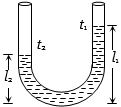
In a vertical $U-$tube containing a liquid, the two arms are maintained at different temperatures ${t_1}$ and ${t_2}$. The liquid columns in the two arms have heights ${l_1}$ and ${l_2}$ respectively. The coefficient of volume expansion of the liquid is equal to
A radioactive sample disintegrates via two independent decay processes having half lives $T _{1 / 2}^{(1)}$ and $T _{1 / 2}^{(2)}$ respectively. The effective half- life $T _{1 / 2}$ of the nuclei is