MCQ
Relation between current (i) and drift velocity $\left(v_d\right)$ is :
- ✓$i=n e A v_d$
- B$i=\frac{n e A}{v_d}$
- C$i=\frac{n e v_d}{A}$
- D$i=\frac{n e}{A v_d}$
Generate a complete, print-ready paper with questions like this in minutes — across 16+ boards, with answer keys.
Assertion : X-ray travel with the speed of light.
Reason : X-rays are electromagnetic rays.
|
(a) If both assertion and reason are true and the reason is the correct explanation of the assertion. |
|
(b) If both assertion and reason are true but reason is not the correct explanation of the assertion. |
|
(c) If assertion is true but reason is false. |
|
(d) If the assertion and reason both are false. |
A beam of plane polarized light falls normally on a polarizer of cross sectional area 3  . Flux of energy of incident ray in 10–3 W. The polarizer rotates with an angular frequency of 31.4 rad/sec. The energy of light passing through the polarizer per revolution will be
|
(a) 10–4 Joule |
(b) 10–3 Joule |
(c) 10–2 Joule |
(d) 10–1 Joule |
The kinetic energy of electron in the first Bohr orbit of the hydrogen atom is
| (a) – 6.5 eV | (b) – 27.2 eV | (c) 13.6 eV | (d) – 13.6 eV |
If the following input signal is sent through a PN-junction diode, then the output signal across RL will be
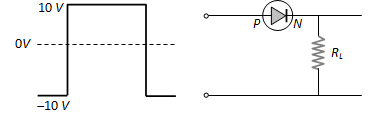
(a)
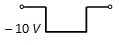
|
(b)
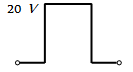
|
(c)
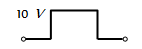
|
(d)
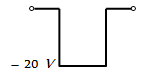
|
Kirchhoff's first law i.e.  at a junction is based on the law of conservation of
|
(a) Charge |
(b) Energy |
(c) Momentum |
(d) Angular momentum |
If the ammeter in the given circuit reads 2 A, the resistance R is

|
(a) 1 ohm |
(b) 2 ohm |
(c) 3 ohm |
(d) 4 ohm |
The particles emitted by radioactive decay are deflected by magnetic field. The particles will be
|
(a) Protons and α - particles |
(b) Electrons, protons and α -particles |
|
(c) Electrons, protons and neutrons |
(d) Electrons and α -particles |
Assertion : Only microwaves are used in radar.
Reason : Because microwaves have very small wavelength.
|
(a) If both assertion and reason are true and the reason is the correct explanation of the assertion. |
|
(b) If both assertion and reason are true but reason is not the correct explanation of the assertion. |
|
(c) If assertion is true but reason is false. |
|
(d) If the assertion and reason both are false. |