MCQ
Relative stability of the contributing structures is :
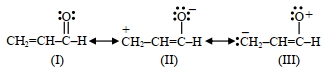
- A$(I) $>$ (III) $>$ (II)$
- ✓$(I) $>$ (II) $>$ (III)$
- C$(II) $>$ (I) $>$ (III)$
- D$(III) $>$ (II) $>$ (I)$
$(2)$ +ve charge on less electronegative atom is more stable i.e., $\mathrm{C}^{\oplus}$ is more stable than $\mathrm{O}^{\oplus}$
$\therefore \quad$ Order is $\mathrm{I}>$ II $>$ $III$
Generate a complete, print-ready paper with questions like this in minutes — across 16+ boards, with answer keys.
| $I.E.\, (kJ \,mol^{-1})$ | $I.E.\, (kJ\, mol^{-1})$ |
| $A_{(g)} \to A^+_{(g)}+e^-,$ $A_1$ | $B_{(g)} \to B^{+}_{(g)}+e^-,$ $B_1$ |
| $B^+_{(g)} \to B^{2+}_{(g)}+e^-,$ $B_2$ | $C_{(g)} \to C^{+}_{(g)}+e^-,$ $C_1$ |
| $C^+_{(g)} \to C^{2+}_{(g)}+e^-,$ $C_2$ | $C^{2+}_{(g)} \to C^{3+}_{(g)}+e^-,$ $C_3$ |
If monovalent positive ion of $A,$ divalent positive ion of $B$ and trivalent positive ion of $C$ have zero electron. Then incorrect order of corresponding $I.E.$ is
A for precipitate formation reaction.
B for precipitate dissolution reaction.
C for precipitate exchange reaction.
D for no reaction.
${P_4} + NaOH \longrightarrow P{H_3} \uparrow + Na{H_2}P{O_2}$

$(A)$ Kinetic energy of electron is $\propto \frac{ Z ^{2}}{ n ^{2}}$.
$(B)$ The product of velocity (v) of electron and principal quantum number (n), 'vn' $\propto Z ^{2}$.
$(C)$ Frequency of revolution of electron in an orbit is $\propto \frac{ Z ^{3}}{ n ^{3}}$.
$(D)$ Coulombic force of attraction on the electron is $\propto \frac{ Z ^{3}}{ n ^{4}}$.
Choose the most appropriate answer from the options given below :