- A$2 \times 10^3$
- B$10^6$
- ✓$10^{12}$
- D$4 \times 10^{12}$
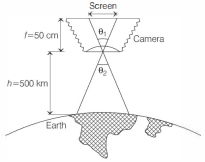
Consider the given diagram,
Assuming area observed and screen both circular, we have
$\theta_1=\theta_2 \Rightarrow \frac{d_1}{f}=\frac{d_2}{h} \Rightarrow \frac{d_2}{d_1}=\frac{h}{f}$
where, $d_1=$ diameter of camera screen and $d_2=$ diameter of area on earth.
Now, $\frac{area \,observed \,on \,earth}{area \,of \,screen}=\frac{A_0}{A}$
$=\frac{\left(\frac{\pi \cdot d_2^2}{4}\right)}{\left(\frac{\pi \cdot d_1^2}{4}\right)}=\frac{d_2^2}{d_1^2}$
$\Rightarrow \quad \frac{A_0}{A}=\left(\frac{h}{f_1}\right)^2=\left(\frac{500 \times 10^{+3}}{50 \times 10^{-2}}\right)^2$
$=\left(10 \times 10^3 \times 10^2\right)^2=\left(10^6\right)^2=10^{12}$
Generate a complete, print-ready paper with questions like this in minutes — across 16+ boards, with answer keys.
$\theta = 2{t^3} + 0.5,$
where $\theta $ is in radians and $t$ is in second. Then the angular velocity of the particle after two second will be ....... $rad/sec$