Question
Repeat part (a) of problem 6 if the push is applied horizontally and not parallel to the incline.

Answer


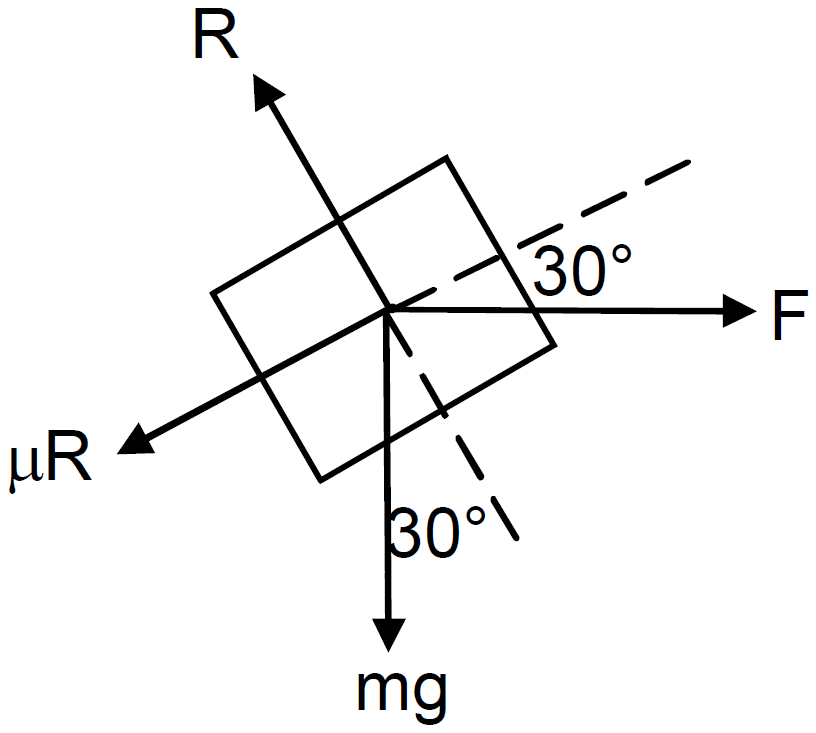
From the free body diagram
$\text{g}=10\text{m/s}^2,\text{m}=2\text{kg},\theta=30^{\circ},\mu=0.2$
$\text{R}-\text{mg}\cos\theta-\text{F}\sin\theta=0$
$\Rightarrow\text{R = mg}\cos\theta+\text{F}\sin\theta \ ...(1)$
And $\text{mg}\sin\theta+\mu\text{R}-\text{F}\cos\theta=0$
$\Rightarrow\text{mg}\sin\theta+\mu(\text{mg}\cos\theta+\text{F}\sin\theta)-\text{F}\cos\theta=0$
$\Rightarrow\text{mg}\sin\theta+\mu\text{ mg}\cos\theta+\mu\text{F}\sin\theta-\text{F}\cos\theta=0$
$\Rightarrow\text{F}=\frac{(\text{mg}\sin\theta+\mu\text{mg}\cos\theta)}{(\mu\sin\theta-\cos\theta)}$
$\Rightarrow\text{F}=\frac{2\times10\times\big(\frac{1}{2}\big)+0.2\times2\times10\times\big(\frac{\sqrt{3}}{2}\big)}{0.2\times\big(\frac{1}{2}\big)-\big(\frac{\sqrt{3}}{2}\big)}$
$=\frac{13.464}{0.76}=17.7\text{N}\approx17.5\text{N}$

Need a full question paper?

Generate a complete, print-ready paper with questions like this in minutes — across 16+ boards, with answer keys.
Start Generating Free

Similar questions

In a plane electromagnetic wave, the electric field oscillates sinusoidally at a frequency of $2.0 \times 10^{10} Hz$ and amplitude $48 V m^{-1}.$
  1. What is the wavelength of the wave?
  2. What is the amplitude of the oscillating magnetic field?
  3. Show that the average energy density of the $E$ field equals the average energy density of the $B$ field. $[c = 3 \times 10^8 m s^{-1}.]$
​​​​​​​
  1. Draw a ray diagram to show refraction of a ray of monochromatic light passing through a glass prism.
  1. Deduce the expression for the refractive index of glass in terms of angle of prism and angle of minimum deviation.
  2. Explain briefly how the phenomenon of total internal reflection is used in fibre optics.
The half$-$life of $^{40}K$ is $1.30 \times 10^9y$. A sample of $1.00g$ of pure $\text{KCI}$ gives $160$ counts/ s. Calculate the relative abundance of $^{40}K\ ($fraction of $^{40}K$ present$)$ in natural potassium.
A capacitor of capacitance C is connected to a battery of emf $\epsilon$ at t = 0 through a resistance R. Find the maximum rate at which energy is stored in the capacitor. When does the rate have this maximum value?
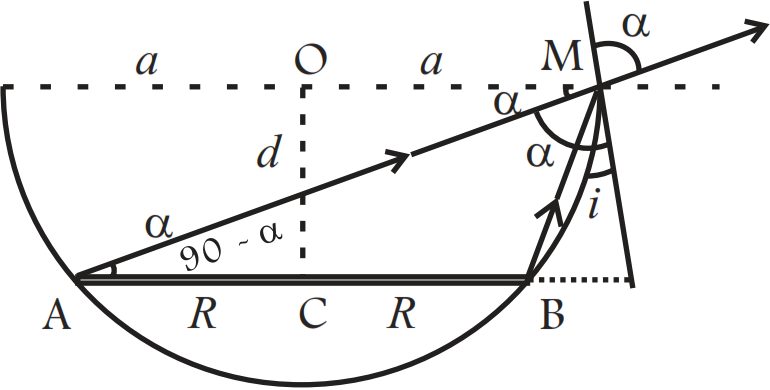
A circular disc of radius 'R' is placed co-axially and horizontally inside an opaque hemispherical bowl of radius 'a' (Fig). The far edge of the disc is just visible when viewed from the edge of the bowl. The bowl is filled with transparent liquid of refractive index μ and the near edge of the disc becomes just visible. How far below the top of the bowl is the disc placed?
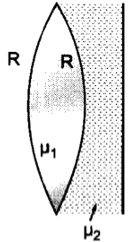
A biconvex lens with its two faces of equal radius of curvature $R$ is made of a transparent medium of refractive index $\mu_1$. It is kept in contact with a medium of refractive index $\mu_2$ as shown in the figure.
Image
$a$. Find the equivalent focal length of the combination.
$b$. Obtain the condition when this combination acts as a diverging lens.
$c$. Draw the ray diagram for the case $\mu_1>\frac{\left(\mu_2+1\right)}{2}$, when the object is kept far away from the lens. Point out the nature of the image formed by the system.
In beta decay, an electron (or a positron) is emitted by a nucleus. Does the remaining atom get oppositely charged?
The current in a conductor and the potential difference across its ends are measured by an ammeter and a voltmeter. The meters draw negligible currents. The ammeter is accurate but the voltmeter has a zero error (that is, it does not read zero when no potential difference is applied). Calculate the zero error if the readings for two different conditions are 1.75A, 14.4V and 2.75A, 22.4V.
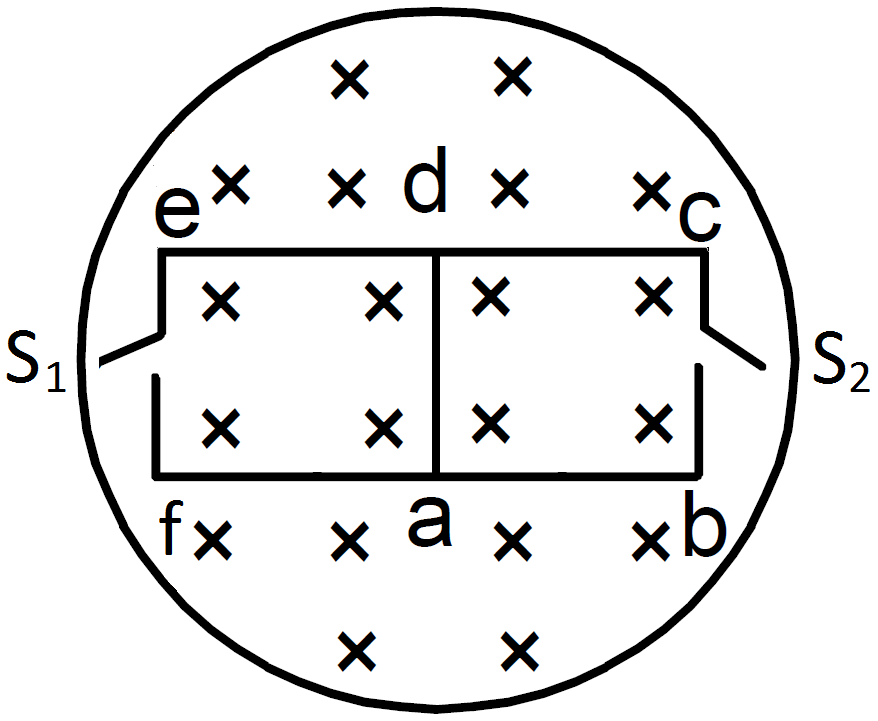
The magnetic field in the cylindrical region shown in figure increases at a constant rate of $20.0mT/s$. Each side of the square loop abcd and defa has a length of $1.00cm$ and a resistance of $4.00\Omega.$ Find the current $($magnitude and sense$)$ in the wire ad if:
A turn of radius 20m is banked for the vehicles going at a speed of 36 km/h. If the coefficient of static friction between the road and the tyre is 0.4, what are the possible speeds of a vehicle so that it neither slips down nor skids up?